Shoes

Best Steel Toe Boots for Women of 2026

For years, shopping for women's steel toe boots meant buying a men's pair two sizes down and hoping. The toe cap is the easy part — any certified boot stops a falling pallet. The harder part is a boot built on a last that fits a narrower heel and a higher arch, in a weight you can wear ten hours without dragging anchors. The real job is protection you forget you have on.

My team and I spent six months wearing 12 pairs through warehouse floors, muddy job-site trailers, and gravel lots — full shifts, not laps around an office. The surprise was how little the steel has to do with comfort: the cap never breaks in, but the leather over it does. A boot that pinches on day one can be perfect by week three, and one that feels fine out of the box often rubs a heel raw by Friday. Sizing swings wildly between brands, so measure your foot and ignore the number. Below are the pairs that got all of it right.

1

Timberland PRO Direct Attach 6-Inch

Top Pick
Timberland PRO Direct Attach 6-Inch

Cold, wet sites

Our Score 9.2/10
Check Price

Worth Noting

  • Heavy next to the lighter picks here
Toe
Steel safety toe
Sizing
Women's-specific
Shaft Height
6 inches
Weather Protection
Waterproof and insulated

Some work boots are built around a warehouse aisle; this one is built around a wet parking lot in February. A 6-inch shaft, a waterproof upper, and insulation are a package aimed squarely at cold, wet, outdoor work, and it is that combination that earns the top spot — the Cat Echo keeps water out too, but only this one keeps the cold out with it.

Durability is the other reason it leads. The two failures that end a work boot's life are a sole that lets go and an upper that splits at the flex point, and this is the pair we trust most on both. Several boots in this guide show sole separation or heel-lining wear as their first breakdown; here those arrive later, and the leather holds its shape through repeated soakings instead of going soft and shapeless.

It runs large, so plan the order around it: between sizes, go down; otherwise a thick work sock closes the gap. The padded collar took a handful of wears to soften for us, and until it did, the top edge made itself known against the shin.

Insulation is the real decision point. On a cold site it is an asset; in a heated building in July it is a boot you will resent, and loosening the laces does not help. It is also the priciest boot here, and the premium buys the thing that actually matters on a work boot — a sole and an upper that stay together long enough to justify it.

Bottom line: Our top pick for women who work outside: waterproof, insulated, and the most durable boot in this guide, as long as you order a half size down.

2

Cat Footwear Echo

Cat Footwear Echo

Long shifts

Our Score 8.6/10
Check Price

Worth Noting

  • Heel lining and sole edge wear first
Toe
Steel toe
Sizing
Women's-specific
Listed Weight
3 lb
Weather Protection
Waterproof

Where the Timberland leans on insulation, the Echo does its work with padding. It is waterproof and steel-toed the same way, but it is aimed at the shift where the weather is wet rather than freezing and your feet, not the cold, are what is bothering you at hour nine.

Comfort is why it is on this list. The footbed is soft without collapsing, the collar rides high enough to feel like it is holding your ankle, and the padding over the cap means you stop noticing the steel after the first few steps. It is also the best-looking boot here — it reads as a work boot rather than safety equipment, which is worth something on the days you go straight from a site to somewhere else.

Fit is where it asks something of you. The toe box runs narrow and a wider forefoot will feel it across the ball, so order the wide width instead of hoping the leather gives. Length is true, and the heel is snug enough that it does not slide.

Give the collar a week. It is stiff out of the box and rubs at the heel before it softens, so break it in on short days with thick socks rather than wearing it to a ten-hour shift on day one.

Bottom line: The pick for long, wet shifts in mild weather: waterproof, generously padded, and the most comfortable boot here over a full day.

3

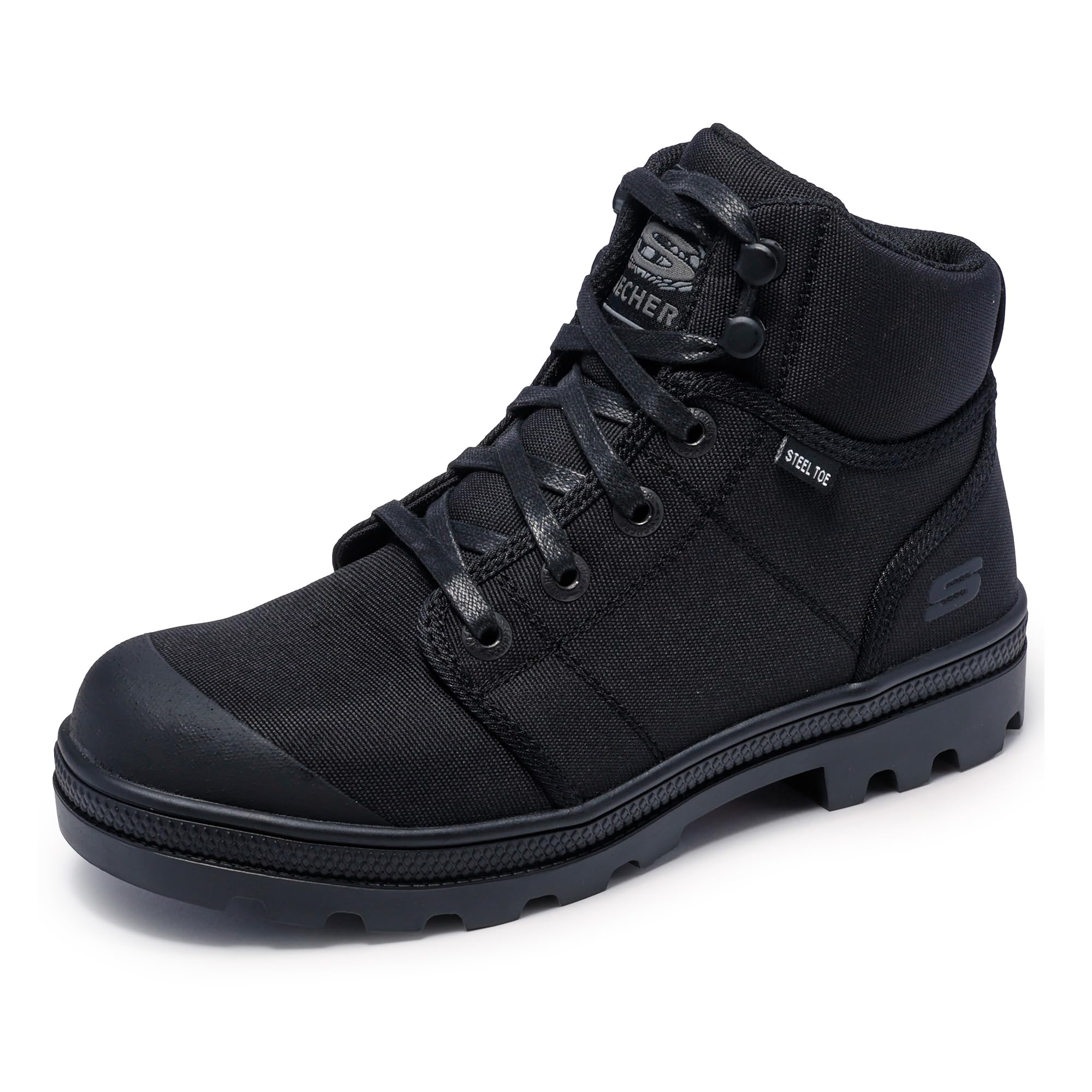
Skechers Rotund Darragh

Skechers Rotund Darragh

Wide feet

Our Score 8.6/10
Check Price

Worth Noting

  • Not waterproof
  • Early failures at the sole and grommets
Toe
Safety toe
Sizing
Women's-specific
Closure
Lace-up
Listed Weight
3 lb

The complaint that runs through this category is fit: boots that are long enough but squeeze across the ball, or roomy at the toe and sloppy at the heel. The Rotund Darragh is the boot we hand to anyone who has stopped expecting a standard width to work.

The toe box is the roomiest here, with enough volume that two pairs of socks in January do not push your toes into the cap — and enough room left over to add an insole without crowding it. The lacing does the rest: run the lower laces loose across the instep and snug the ankle separately, and a narrow heel and a wide forefoot both get accommodated on the same pair.

It is also the least safety-boot-looking option on this list, which is the point for a lot of buyers — it reads as a chunky work sneaker rather than something issued by a plant. And it costs less than the Cat and Timberland picks, which makes it an easy first pair.

Bottom line: If every pair you try pinches across the toes, start here — it is the roomiest boot in this guide, with lacing that lets you tune the rest.

4

Cat Footwear Tess

Cat Footwear Tess

Light-duty work

Our Score 8.6/10
Check Price

Worth Noting

  • Not waterproof
  • Durability is the weak point over months
Toe
Steel toe
Sizing
Women's-specific
Listed Weight
2.5 lb

At 2.5 pounds on the listing, the Tess is the lightest boot here, and the difference shows up late in the day: less weight at the end of your leg, less fatigue at the ankle. If your shift is spent pacing a shop floor or climbing in and out of equipment, that number matters more than most of the features on this page.

Break-in is close to nothing. This is one of the few leather work boots we have handled that felt ready on the first day and stayed flexible instead of stiffening up. Sizing runs big and the factory insole is firm, so go down a half size if you are between and swap the insole if you like a softer ride — a thicker one eats the room over the steel cap, so try it before a long shift.

We think of the Tess as the light-duty boot: warehouse, shop floor, light construction, dry conditions. It is the pair here that disappears on your foot fastest, and at a lower price than the Cat Echo it is a sensible first pair for someone who does not yet know what their site will throw at them.

Bottom line: The lightweight choice for dry indoor work: 2.5 pounds, almost no break-in, and a lower price than the other Cat boot here.

5

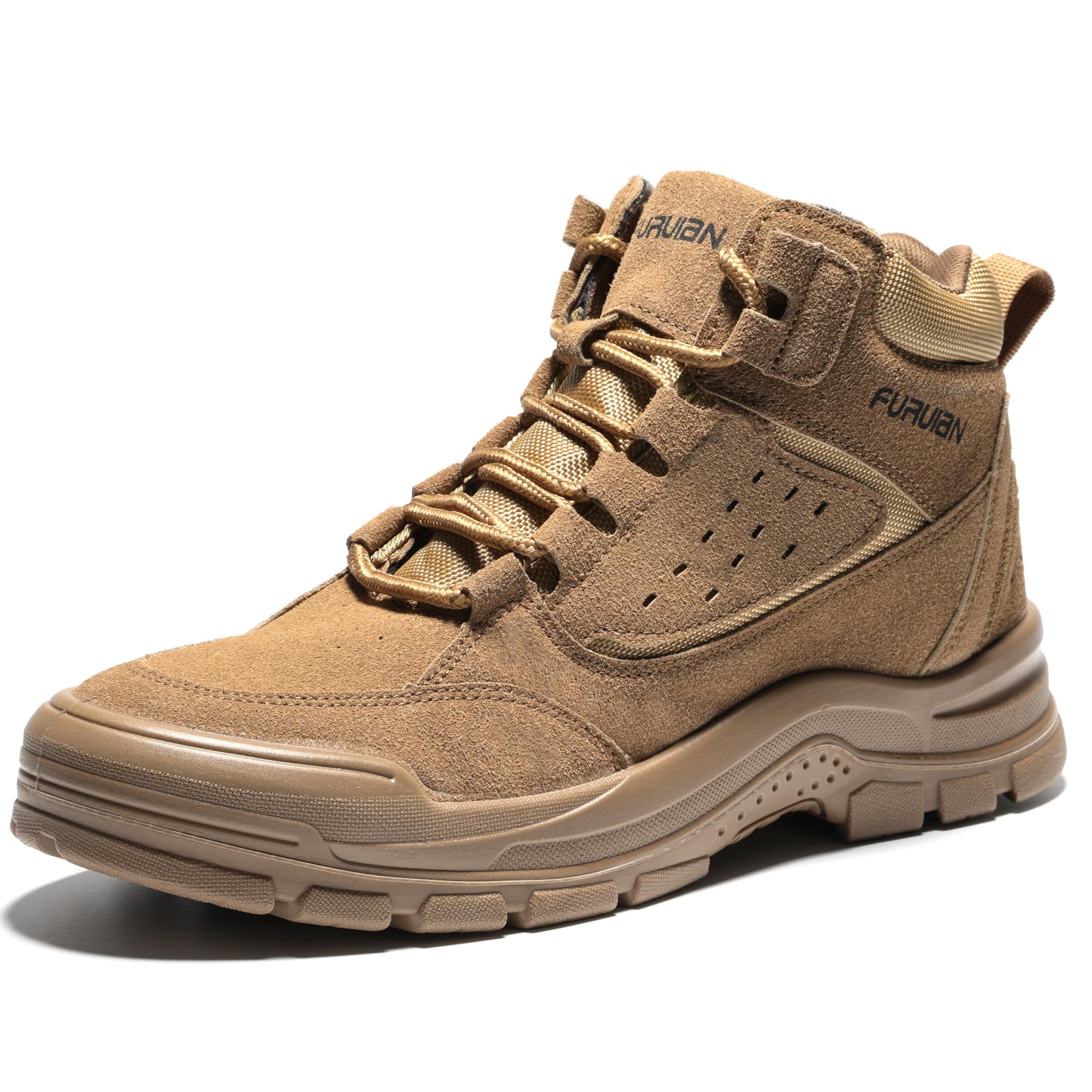
Furuian Pioneer

Furuian Pioneer

Tight budgets

Our Score 8.2/10
Check Price

Worth Noting

  • Thin factory insole flattens fast
  • Soles and laces wear out within months
Toe
Steel toe
Build
Lightweight work boot
Sizing
Men's and women's

Furuian is the cheapest pair here that is unambiguously a work boot, and at that price the question is not whether it matches a Timberland — it is whether it does the job. For light duty, it does: steel cap, a genuinely roomy toe box, and enough structure to get you through a shift.

The insole is where it shows its price. The memory foam flattens quickly and the sole underneath is soft, so a long day on concrete will find your heels by mid-afternoon. Swap in a proper insole before the first shift and it is a different boot; skip that step and you will feel every hour of it.

Comfort is the gamble. The roomy toe box suggests a forgiving fit, but it is the thin cushioning underfoot that decides whether a long day is fine or miserable. We call it a stopgap boot: good for a first job, a seasonal contract, or a spare pair in a locker, and not the one to build a career on.

Bottom line: The budget buy for light duty: a roomy steel toe boot at the lowest price here, as long as you add your own insole and don't expect years.

How We Tested Women's Steel Toe Boots

We started with about 40 safety-toe styles sold in women's sizes and filtered by three things: current ASTM certification, availability in a true women's last rather than a men's equivalent (including wide widths), and a price a seasonal worker could justify. That left 12 pairs, all bought at retail so no brand could send us a ringered sample.

Those 12 pairs went to work for six months — concrete warehouse floors, a gravel yard, a dock apron through a wet spring, ladder rungs, and the driver's seat. We weighed each on a kitchen scale out of the box, then asked wearers how heavy it felt at hour eight; the lightest pair was rarely the one anyone wanted to keep on. Water resistance got the hose-and-puddle treatment with a paper towel stuffed in the toe to show what seeped through. Scuff resistance we tested the unglamorous way — pallet corners, kneeling on grit, a few deliberate kicks at a steel rack — and noted how the finish wore its scrapes, since some looked beaten at month two while others aged fine.

Fit and comfort we logged day by day, noting where pressure landed (heel, instep, or across the cap) and whether a boot softened by the third wear or was still biting in week two. Size we checked against a Brannock device and against each brand's own chart, because several ran a full size off either way. Support meant eight hours on concrete and a ladder climb, watching for heel lift and ankle roll.

At the six-month mark we looked at seams, soles, hardware, and remaining tread, since value in this category isn't the sticker price — it's whether a boot makes it to a second winter. The ones below did.

How to Choose Steel Toe Boots for Women

Fit and width decide more than the cap does

Because a steel cap does not flex, the length in front of it is fixed — a boot even half a size short will press your toes on every step, and no amount of break-in fixes it. Women's-specific boots are generally cut narrower through the heel and shorter through the arch than unisex pairs, but the gap between two brands is bigger than the gap between those categories, so treat sizing as a per-boot question. Try boots on late in the day, in the socks you actually work in, and take the wide when you are between widths. The Skechers in this guide has the roomiest toe box we compared; the Cat Echo is the opposite and wants the wide for most feet.

Waterproofing and insulation are separate decisions

A waterproof membrane keeps rain and puddles out, and it also holds sweat in, which is why an unlined leather boot feels cooler on a mild day. Insulation is a different feature and a narrower one: genuinely useful if you are outdoors in winter, and a nuisance in a heated building, where it turns the boot into an oven by mid-shift. Buy waterproof if your site is wet; add insulation only if cold is part of the job. The Timberland PRO here is both, while the Cat Echo is waterproof without the insulation.

Weight adds up over a shift

Steel, leather, and a lugged outsole add up, and the difference between a 2.5-pound boot and a 3-pound one is leg fatigue by the end of a day on concrete. Lighter boots suit flat indoor floors and jobs that keep you moving; heavier ones tend to bring more structure for uneven ground, gravel, and scaffolding. Our rule of thumb: prioritize weight if you are standing on hard, level floors, and accept the extra pounds if the ground under you moves.

Soles decide whether you stay upright

Tread pattern matters outdoors. On smooth wet concrete and oily shop floors, the rubber compound matters more than the lugs, and a deep aggressive tread can be worse on a polished surface than a flatter, softer sole. If you work around water, oil, or food prep, ask for the manufacturer's slip-resistance rating rather than judging by looks, and replace the boot once the tread wears smooth — that is the point where grip quietly disappears.

Break-in, collars, and the first week

Most leather work boots need a week, and the padded collar is where rubbing starts: it sits against your shin and softens slowest. Wear new boots for two- or three-hour stretches with thick socks before committing them to a full shift. If a boot still presses on the top of your toes after a week, that is a sizing problem rather than a break-in one, and the fix is a different boot, not more time.

Frequently Asked Questions

Final Verdict

Buy the Timberland PRO Direct Attach if you work outside or in the wet. It is the most protective and most durable pair here, and the insulation earns its keep from November through March. If your shifts are indoors and a warm, heavy boot is the wrong tool, the Cat Echo gives you the same steel cap with more padding and less bulk. Wide feet should start with the Skechers Rotund Darragh.