Fashion

Best Rain Jackets for Women of 2026

Keeping rain off your shoulders for ten minutes is easy. The hard part starts when you zip a jacket up and actually walk somewhere in it — the shell that blocks the downpour also traps every bit of heat you're generating, so you end up soaked from the inside by the third block. A jacket worth owning solves both halves of that: it sheds water at the shoulders and hood, then lets the warmth escape before it turns into sweat. It also has to fit over the sweater you're wearing underneath, which is where a lot of otherwise decent raincoats fall apart.

I've been caught in enough surprise downpours to be particular about which jacket I grab on the way out, and over the past eight months my team and I have worn 12 of them through commutes, dog walks, and weekend hikes. The differences show up fast: whether the hood stays put in wind, whether the seams at the shoulders give out, and whether "waterproof" means a taped shell or a light coating that quits after a couple of washes. Style counts for more than people admit — a jacket you don't want to be seen in tends to stay on the hook. And if you're between sizes, size up; almost every one we tried runs snug across the back, and layering room is the entire point.

1

Columbia Arcadia II

Top Pick
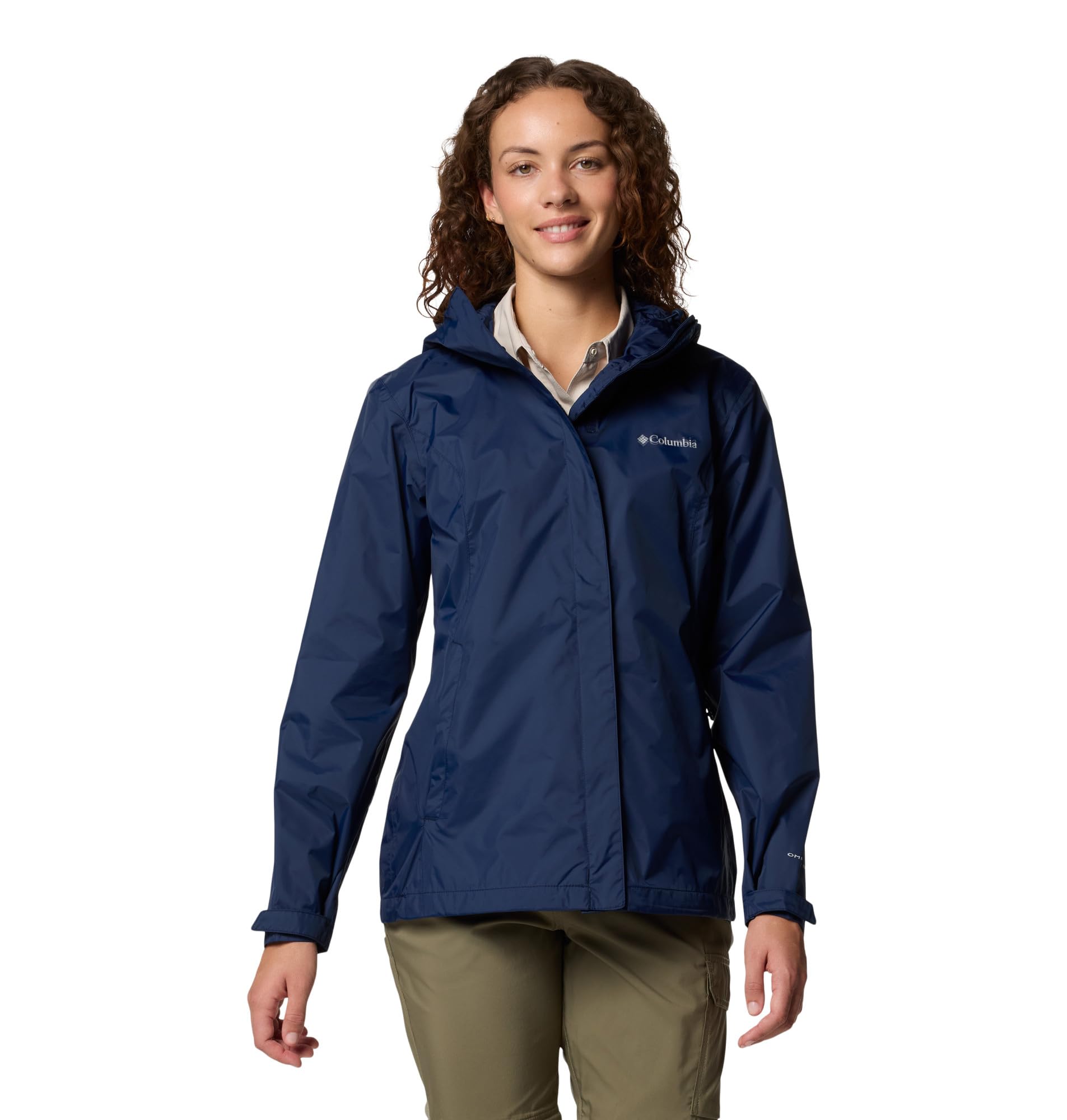
Columbia Arcadia II

Everyday rain

Our Score 9.2/10
Check Price

Worth Noting

  • Runs small; order up if you layer
  • No interior pockets
Hood
Attached, face-covering
Sizing
Runs small
Closure
Full zip with Velcro storm flap
Water Protection
Waterproof, wind-blocking shell

Two things decide a rain jacket for us before anything else: whether the hood covers your face, and whether the zip has something behind it. The Arcadia II gets both right. It's a thin shell rather than a coat, cut close enough that it doesn't look like a poncho on the way to work, with deep hand pockets and a collar that stands up under your chin.

That's why it's our pick for most people. Across this set it has the most consistent record in real rain, and it manages it without weight — the jacket sits in a tote or a backpack and you forget it's there until the sky changes. It blocks wind as well as rain, which matters more than shoppers expect: a shell that stops a gust is the difference between a brisk walk and a miserable one.

Warmth comes from what you wear underneath. There's no lining to trap heat, so it's a sweater in March and a T-shirt in June, and it stays comfortable in humid rain where a fleece-lined coat turns into a sauna. That's a trade we're happy to make, because the alternative is a jacket you can only wear three months of the year.

Where it stops is cold, driving sleet — this is a shell, not insulation — and a raw November commute calls for something with a lining. For everything from spring showers to a wet September, this is the one that earns its place in the bag.

Bottom line: The jacket we tell most people to buy: reliably dry in real rain, light enough to forget, and the most versatile shell in this set.

2

33,000ft Packable Rain Jacket

33,000ft Packable Rain Jacket

Travel and packing

Our Score 9.2/10
Check Price

Worth Noting

  • Repacking the sack takes practice after a wet walk
Hood
Adjustable opening
Packing
Stuff sack included
Pockets
Zippered, plus internal zip pocket
Ventilation
Underarm zips

The sack it ships with is the reason to choose this one. Rolled tight, it takes up less room in a daypack than a paperback, which is the difference between a rain jacket that travels with you and one that stays in the hotel room. The underarm zips are the surprise at this size — on a warm, wet afternoon you can dump heat without taking the jacket off.

The cut is roomy through the shoulders and adjustable at the hem, hood opening and cuffs, so it sits over a fleece without pulling across the back. Zippered hand pockets plus an internal zip pocket cover a phone, keys and a card, and the hood cinches down far enough to stay on in a headwind rather than ballooning behind you.

It is a shell, with no lining, so July rain is comfortable and November rain is not — that's what a midlayer is for. Getting it back into the sack after a wet walk takes a couple of tries, and a damp jacket never rolls as small as a dry one. Neither changes the fact that this is the one we'd pack first for a trip where the forecast is uncertain.

Bottom line: Buy this one if the jacket has to travel: it packs into its own sack, vents under the arms, and keeps you dry in a heavy shower.

3

Outdoor Ventures Fleece-Lined Raincoat

Outdoor Ventures Fleece-Lined Raincoat

Cold, wet days

Our Score 9.0/10
Check Price

Worth Noting

  • Fleece lining limits it to cool weather
Length
Covers the backside
Lining
Fleece
Closure
Two-way zip with snaps
Pockets
Multiple zippered

Cold rain is the harder problem than rain. A thin shell keeps the water out and lets the wind through, and two blocks later you're chilled and damp from the inside. This coat answers that with a fleece lining, a hood roomy enough to go over a beanie, and an exterior that sheds water rather than soaking it up.

The details are more thought-through than most: a two-way zip so you can open the bottom when you sit down or get on a bike, an inner drawstring at the waist to give it some shape, snaps over the zip, and zippered pockets inside and out. The hem runs past your backside, which we appreciated on wet benches and cold bleachers.

This is the jacket for a raw, windy drizzle, the kind that turns up in March and again in October. Once the day turns mild the fleece works against you and you'll end up carrying it, so if your rain arrives warm and sudden, take the Columbia instead. For everything colder, this is the one.

Bottom line: The cold-rain pick: a fleece lining, a hood that fits over a hat, and enough length to keep your seat dry on a raw day.

4

Diamond Candy Lightweight Rain Jacket

Diamond Candy Lightweight Rain Jacket

Tight budgets

Our Score 9.0/10
Check Price

Worth Noting

  • Runs small; size up to layer
Hood
Zip-off, removable
Cuffs
Adjustable
Pockets
Large zippered

The least expensive jacket in this set still manages the thing that matters: water beads on the surface and runs off. It's also thicker than a windbreaker — not insulated, but with enough body that it doesn't cling — and the hood zips off completely, which is handy when you want it to read as a jacket rather than rain gear.

As a knock-around coat it's hard to fault. The pockets are big and zippered, the cuffs adjust, and it rolls up small enough to shove into a seat pocket or the bottom of a tote. That's the role it fills best: the jacket that lives in the car, goes to the ballfield, and doesn't need babying.

Sizing is the catch. It runs small and the shoulders are cut close, so if you're between sizes, or you plan to wear a sweater underneath, take the larger one. It handles steady rain and shakes it off; a long walk in a downpour is more than this jacket is built for, and that's the honest gap between it and the sealed shells here.

Bottom line: The budget jacket we'd hand someone who needs rain cover for a trip without thinking hard about it — just order a size up.

5

baleaf Packable Rain Jacket

baleaf Packable Rain Jacket

Cycling and commutes

Our Score 9.0/10
Check Price

Worth Noting

  • Clammy during hard effort
Hood
Stows in the collar
Pockets
Zippered hand pockets
Visibility
Fluorescent color options

Rain jackets are usually designed to disappear into a crowd, which is exactly wrong at seven in the morning in November on a bike. The baleaf comes in fluorescent and high-visibility colorways that show up in a driver's headlights, and the hood tucks away into the collar when you're moving fast and don't want it flapping behind you.

The rest is sensible commuter kit: zippered hand pockets that stay shut over a bike lane, a hood with a stiffened brim that sends drips past your face, and a build light enough to fold into a pannier or backpack. The fabric isn't the softest here — there's a bit of rustle to it — but it shrugs off a wet ride without weighing you down.

Where it struggles is effort. Zip it up and pedal hard and you'll feel the clamminess build; the venting helps, but this is a jacket for getting somewhere, not for a training ride. As a bright, packable layer for dark, wet mornings, it does a job nothing else in this set does.

Bottom line: The commuter's jacket: bright enough to be seen on a dark, wet ride and light enough to keep in a bag the rest of the week.

6

Little Donkey Andy Rain Jacket

Little Donkey Andy Rain Jacket

Long wet walks

Our Score 8.8/10
Check Price

Worth Noting

  • Runs small; size up to layer
Lining
Mesh
Pockets
4
Venting
Underarm zips
Waterproofing
DWR plus PU membrane, seam sealed

The most explicitly built-for-rain jacket here spells out why: a DWR finish over a PU-coated membrane, critically seam sealed, with a storm flap across the zip and a chin guard at the top. That's the construction to look for when you want to be dry after an hour rather than ten minutes, and it's the one we point to when someone asks what waterproof is supposed to mean.

The details back it up. Four pockets, underarm zips, a hood with a peripheral cord that cinches at the sides as well as the back, hook-and-loop cuffs you can close over a glove, and an elastic drawcord at the hem. The mesh lining holds the shell off your skin and moves sweat, so a climb doesn't leave you stewing in your own jacket.

The hood deserves its own note: it's big enough to go over a cap, which is what you want in weather, but that means it can sag forward when you're bareheaded — cinch the side cords and it sits where it should. Done up properly, it's the most protective hood in this group.

Bottom line: The most weather-ready build here for a long, wet walk, with sealed seams and vents — provided you size up before you order.

7

SaphiRose Long Hooded Rain Jacket

SaphiRose Long Hooded Rain Jacket

Dressier rainy days

Our Score 9.2/10
Check Price

Worth Noting

  • Water resistance falters in sustained rain
Fit
Loose, runs large
Waist
Drawstring
Closure
Zip with snap placket
Water Resistance
Water resistant, light rain

A drawstring at the waist changes how a raincoat looks more than any other detail at this level, and SaphiRose leans into it: cinch it and the jacket nips in; leave it loose and it hangs like a trench. Add a snap placket over the zip, a hood with its own drawcord and a length that clears the hip, and you have a coat that looks deliberate in the rain rather than resigned to it.

It's also warm for a shell, with a soft lining and enough body to take the edge off a cool morning, and the two utility pockets are big enough for a phone and a pair of gloves. The zip runs smoothly, though the pull is large enough to clink against the teeth when you walk.

Water resistance is the part to be clear-eyed about. In drizzle and a short walk to the car it does exactly what you want. In sustained rain, water can work through the fabric and you'll feel it first at the shoulders, which is the real difference between this and the sealed shells above.

So this is the coat for the rainy dinner, the school run, the commute where you're outside eight minutes at a stretch — not the one for a two-hour walk in a downpour. Wear it for what it is and it's the best-looking option in this group by a distance.

Bottom line: Buy it as a good-looking drizzle coat for short trips outdoors — it isn't the jacket to trust in sustained rain.

8

Kikibell Striped Lined Raincoat

Kikibell Striped Lined Raincoat

Office commutes

Our Score 9.0/10
Check Price

Worth Noting

  • Warm when fully zipped on humid days
Fit
Runs large
Lining
Striped full lining
Closure
Zip plus snaps
Water Resistance
Water resistant

You wear a rain jacket to work and then sit in a meeting in it, which is where the Kikibell does better than the technical shells here. The striped lining shows when it's open, the front closes with both a zip and snaps, and the shape is closer to a lightweight trench than a trail jacket.

It keeps your clothes dry in steady rain, and the hood sits forward enough to keep drips off your glasses. The pockets are deep enough for a phone, the stitching is even, and the whole thing rolls up small enough to sit in a tote on a morning that turns out clear. For the money it looks like a more expensive coat than it is.

The fit is generous. If you want the tailored line it has in the photos, size down, because the cut leaves room for a bulky sweater — which is exactly right in February and less so over a blouse in May. The lining doesn't breathe the way a mesh-lined shell does, so it gets warm once you're indoors with the zip closed.

That's the role it plays: the coat for a wet city morning, a lunch out, a walk to the station where you'd rather not look like you're headed up a mountain. Take it off when you reach your desk and it hangs like a coat should.

Bottom line: The dressiest way to stay dry on a rainy workday: buy it if you want a coat rather than a shell, and won't sit in it all afternoon.

How We Tested a Dozen Rain Jackets in Actual Weather

We started by pulling together every women's rain jacket we could find with a real waterproof claim, then filtered the list by construction details and price — taped or seam-sealed seams, an adjustable hood, a size range that went beyond a single straight fit, and a packed weight that made sense for someone carrying it in a tote or a daypack. That cut the field to 12 jackets, which we then rotated through eight months of ordinary wet weather.

Each jacket went on commutes, 40-minute dog walks in steady drizzle, and a few long weekend hikes, and we layered every one over both a t-shirt and a chunky knit sweater to see where the shoulders and back pulled tight. We also stood in the shower for five minutes with the hood up and the zipper closed, then checked the shoulders, cuffs, and center front for any dampness that had crept through.

For portability, we stuffed each jacket into its own pocket or stuff sack, weighed it on a kitchen scale, and timed how long it took to shake back out. Breathability got the hill test — a brisk uphill walk on a 50-degree morning, with a note afterward on whether our base layer came back clammy or dry. Every jacket was washed twice on cool and re-tested under the faucet to see whether the surface still beaded or had started to soak through, and we paid attention to fit after washing too, since a shell that shrinks out of its sleeve length stops being useful.

How to Choose a Women's Rain Jacket

Waterproof, Water-Resistant, and the Label in Between

Every jacket here handles rain, but not the same rain. A water-resistant shell carries a finish that makes drizzle bead and roll off; a waterproof one adds a membrane or coating plus sealed seams, which is what stops water finding the stitching at your shoulders twenty minutes in. For a commute and a dog walk, water-resistant is genuinely enough.

For a long walk or a wet trail, look for seam sealing and a flap over the zip — the Little Donkey Andy is the only jacket here that spells out that construction, and it's the one we'd point to for a soaking. A cheap zipper without a flap is where most shells give up first.

Sizing Is the Wildest Variable in This Category

These brands don't share a size chart, and the same letter size swings from snug to boxy across this set. Measure your chest and check it against that brand's own chart rather than reordering whatever you wear in a sweater, because a rain jacket has to fit over clothes and still let you move.

Decide about layering before you order. The Columbia and the Little Donkey Andy run small, while the SaphiRose and the Kikibell are cut generously, and in practice that gap is a full size. If you're between sizes and plan to wear a fleece underneath, go up.

Match the Lining to the Weather You'll Wear It In

An unlined shell is a three-season travel piece: it keeps rain off, vents heat, and lets you add a midlayer when the temperature drops. A fleece-lined coat like the Outdoor Ventures is a different garment altogether — it's built for cold, windy rain and it turns into a sauna once the day warms up.

If you want one jacket for everything, buy the shell and layer under it. If your wet days are always cold, the lining is worth the bulk and the extra hanging weight.

Packability: Will You Actually Carry It?

A jacket left at home protects nobody. Stuff sacks, stowable hoods and fabric that folds flat rather than springing back are what decide whether it travels with you or stays on the hook. If it lives in a tote or a pannier, favor one that ships with its own bag, like the 33,000ft.

Practice repacking it while it's dry. A wet jacket never rolls as small as it did in the shop, and knowing the fold saves you ten minutes in a hotel room.

Hoods, Length, and the Details You'll Notice Later

A hood is only useful if it stays where you put it, so look for a cord at the back and at the sides, plus a brim that keeps drips off your glasses. Length matters more than most shoppers expect: a hem that covers your seat is the difference between sitting down on a wet bench and not.

A two-way zip earns its keep if you cycle or drive, since it lets the bottom open when you sit. Zippered pockets matter more in the rain than anywhere else — anything unzipped collects water.

Frequently Asked Questions

Final Verdict

For most people, we recommend the Columbia Arcadia II. It's the most consistently dry shell in this set, the hood covers your face without a cap, and it's light enough to live in a bag from April to October. If your wet days are cold and windy rather than mild, the fleece-lined Outdoor Ventures is the better buy, and it's the only jacket here built for that weather.

On a tight budget, the Diamond Candy sheds rain, rolls up small and asks for very little in return — just order a size up. Otherwise, buy for the rain you actually get.