Shoes

Best Rain Boots for Women of 2026

A rainy morning should be a small pleasure — wet pavement, quiet streets, an excuse for a slow coffee. Instead it usually ends with soggy socks, a blister from a boot that rubs at the heel, or a calf wedged into a shaft cut for somebody else's leg. A good pair fixes all three: water stays out for the length of an actual commute, the footbed feels less like a rubber bucket and more like a shoe, and the shape is one you'd wear on purpose.

I've learned the hard way that a pretty pair can still be a bad pair — the glossy ones that cracked at the heel by March, the tall ones that swallowed my knees. Over the past eight months, my team and I have worn 12 pairs through commutes, dog walks, muddy garden beds, and one very ill-advised puddle. Fit and sizing mattered more than anything printed on the box, because a boot that's half a size off will undo a waterproof liner's best work. The ones below earned their spots, and each suits a different leg, budget, and kind of rain.

1

Sperry Saltwater Duck Boot

Top Pick
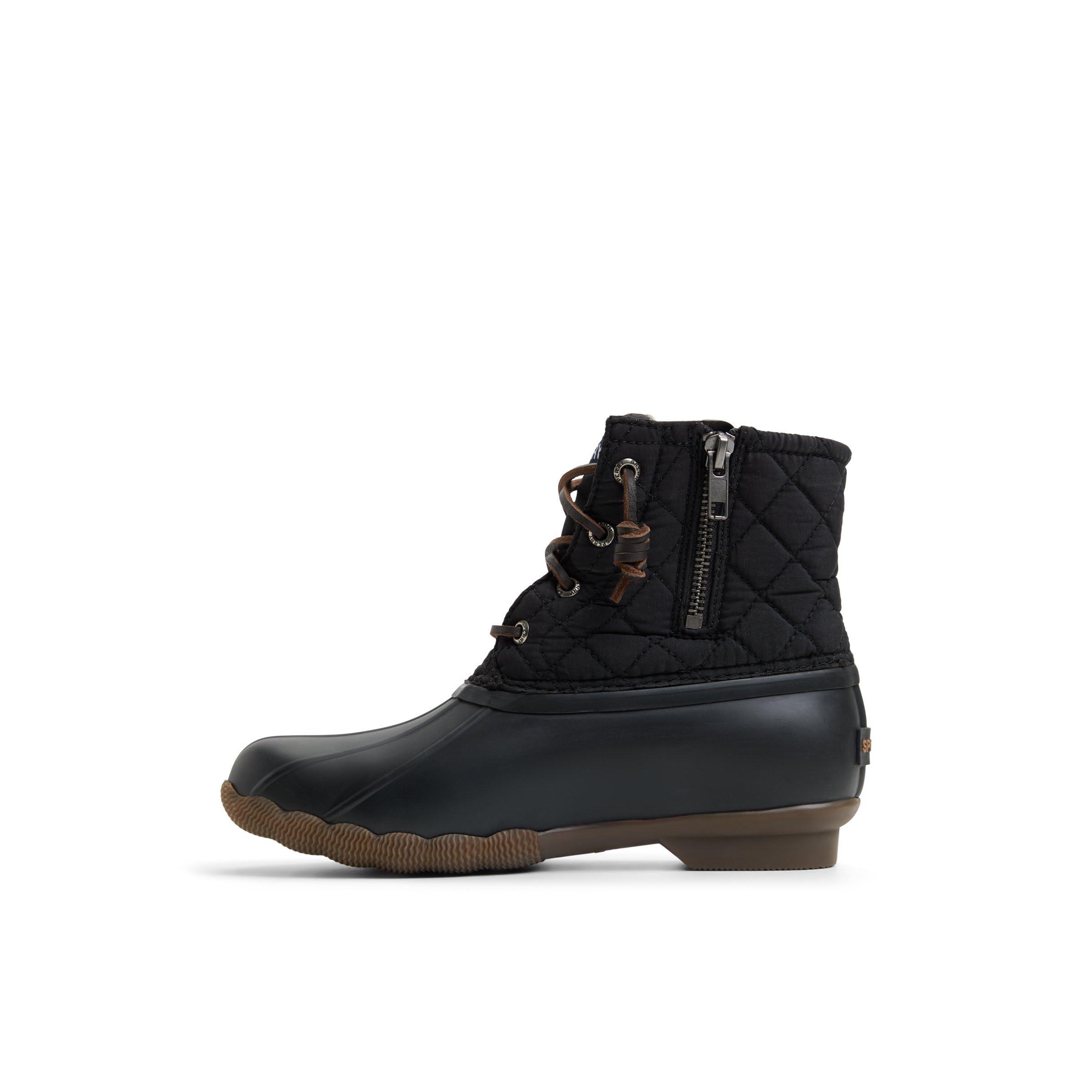
Sperry Saltwater Duck Boot

Everyday wet weather

Our Score 9.2/10
Check Price

Worth Noting

  • Stitched seams are the part that ages first
Style
Duck boot
Weight
4 lb
Waterproofing
Waterproof

Rubber wellies keep you dry and make you look like you are about to muck out a stable. The Saltwater is the exception in this set: a duck boot with a molded rubber lower and a laced upper, so it takes a puddle the way a rain boot should while reading as an ordinary winter boot under jeans. That is why it is our top pick — most people want one pair for the whole wet season, and this is the pair that goes to work, to the grocery store, and across a muddy parking lot without a costume change.

The fit is where it earns the recommendation rather than just the look. It runs true to size with room for a thick sock, and the cushioned insole survived a mile-long walk in the rain without the ache a cheap rubber boot leaves behind. The laces let you snug the ankle, which matters more than it sounds when you are stepping through standing water, and the collar sits high enough that a curb full of it stays out.

Two things we noticed. At four pounds it is a substantial boot, and you feel that at the end of a long walk, though the heft is also why it feels solid underfoot instead of flimsy. And the lining is thin, so this is a rain-and-slush boot rather than a snow boot; on a hard freeze, swap in wool socks. If you will be standing in water above your ankle, the Hunter Original Tall is the better tool, and if the boots live by the back door for yard work, the Sloggers do most of the same job for a good deal less. For the one pair you wear to work in the rain, this is it.

Bottom line: We recommend the Saltwater as the default: it keeps feet dry in rain, mud, and slush, and it is the only boot here you can wear straight to work.

2

Sloggers Mid-Calf Rain Boot

Sloggers Mid-Calf Rain Boot

Yard and garden

Our Score 9.4/10
Check Price

Worth Noting

  • Unlined, so they run cold below freezing
Style
Garden rain boot
Shaft Height
Mid-calf
Waterproofing
Waterproof

The Sloggers cost a good deal less than our top pick, and on a wet day it gives up surprisingly little. It is waterproof — properly so, the kind of waterproof where the water sits on the surface and runs off — it comes off without a fight, and it shrugs off mud that would stain a fabric boot for good.

The height is what we like most. Mid-calf is the practical middle: tall enough that a curb full of water does not reach your sock, short enough to pull on in a doorway without sitting down. The insole is soft enough for an afternoon of yard work, and there is a nub at the back you can catch with your other foot to lever them off, which sounds like a small thing until your hands are full of wet garden waste.

Sizing is the one thing to get right. They run small and come in whole sizes only, so if you are a half size, go up rather than hoping they loosen. And they are unlined, which is right for three seasons out of four and cold in a real freeze — that is when a wool sock or one of the fur-lined Chookas earns its place. For a boot that lives by the back door and gets worn in mud, this is the sensible money.

Bottom line: Our value pick: waterproof, comfortable, easy to kick off, and priced well below the boots it competes with on a wet day.

3

Hunter Original Tall

Hunter Original Tall

Deep puddles

Our Score 8.8/10
Check Price

Worth Noting

  • Takes two hands and a bench to pull off
  • Can crack and peel with age
Style
Pull-on
Shaft Height
Tall
Waterproofing
Waterproof

Knee-high boots solve the problem the others cannot: water deeper than your ankle. If your route includes a flooded underpass, a slushy farm track, or a street where the drains give up every March, the Original Tall is the boot that gets you through it dry, and no other pair here covers that much leg.

It is also the best-looking boot in the set. The matte finish has a depth that the cheaper rubber does not, it reads as a proper piece of kit rather than a costume, and the sole has enough give that pavement does not thump through your heel on a long walk. The calf is the fit question: it is unforgiving if you are not narrow through the leg, and that is the reason some buyers should be looking at the Play Short instead.

What you are paying for is coverage and silhouette, and both hold up season after season. Whether that is worth the money depends entirely on how often you meet deep water — for two flooded walks a year, the Sloggers or the Play Short will do everything you need. For a wet climate and a long daily walk, nothing here covers more ground.

Bottom line: Worth the splurge only if you actually meet deep water; if you do, nothing else here matches its coverage or its silhouette.

4

Chooka Delridge Faux Fur Mid

Chooka Delridge Faux Fur Mid

Cold, wet walks

Our Score 8.8/10
Check Price

Worth Noting

  • Seam at the sole can split
Lining
Faux fur
Shaft Height
Mid-calf
Waterproofing
Waterproof

The lining is the whole argument. A faux fur interior turns a rubber boot into something you do not dread on a 40-degree morning, and on a cold, wet walk that matters more than another inch of shaft height. Slip a bare foot in and it is warm immediately, which is not something we can say about any unlined pair here.

For dog walks, the school run, and errands in nasty weather, this is the boot we reach for. It is comfortable enough to keep on for an hour, the pull-on shaft goes on fast, and it is shaped like a normal boot, so you can wear it into a store without looking like you have been in the yard. At three and a bit pounds it is not a burden on a short walk either.

The limits are water and time. Wet grass is fine; standing in a puddle up to the ankle can let water in, so treat these as cold-weather boots rather than wading boots. The lining also holds damp, so dry them away from direct heat rather than leaving them in a heap by the door — a warm radiator will bake the rubber and shorten their life.

Bottom line: Buy it for cold, wet mornings when warmth matters as much as waterproofing — and keep it out of standing water.

5

Chooka Delridge Faux Fur Chelsea

Chooka Delridge Faux Fur Chelsea

Quick errands

Our Score 8.4/10
Check Price

Worth Noting

  • Snow and deeper water come in over the short shaft
Style
Chelsea slip-on
Lining
Faux fur
Waterproofing
Waterproof

This is the least expensive boot here, and it is the one we would hand to someone whose wet-weather trips are short: the walk to the car, the school gate, the dog around the block. The faux fur lining is the reason to pick it over a plain rubber Chelsea — it turns a cold, damp morning into nothing much at all.

For that job it is hard to beat. The elastic gore means you step into them hands-free, the lining is warm enough that you stop thinking about your feet, and the shaft sits above the ankle so a shallow puddle stays out. It also looks like a boot you would wear anyway, which is more than most of the boots here manage, and the plush collar reads as considered rather than cheap.

Where it stops is depth and width. Snow and deeper water find their way in over the short shaft, so it is not the pair for a slushy commute or a flooded street. And the fit runs narrow — if you are between sizes or plan to wear thick socks, order up rather than hoping they loosen, because rubber does not.

Bottom line: The pair we would hand someone who wants warm, dry feet for the walk to the car without spending much.

6

Asgard Chelsea Ankle Boot

Asgard Chelsea Ankle Boot

City rain

Our Score 8.8/10
Check Price

Worth Noting

  • Wide collar lets rain run down the shaft
  • Lining can bunch up with wear
Style
Chelsea ankle boot
Shaft Height
Ankle
Waterproofing
Waterproof

Most rain boots announce themselves. This one does not. It is a plain ankle Chelsea in matte rubber that reads as an ordinary boot under jeans, which is exactly why it is the pair that ends up by the front door rather than at the back of the closet.

The fit is the pleasant part. It is roomy through the foot with enough stretch to suit wide feet, it slips on and off without a struggle, and it kept our feet dry through a wet walk and a muddy shortcut that would have ruined trainers. When it got filthy, it rinsed clean in the sink and dried overnight, which is more than most of these boots will do.

It is the boot we point to when someone wants waterproofing without a rain-boot look, and the price makes that an easy call. Just know what you are trading: this is ankle coverage, so the water it handles stops around your heel, and rain running off your trousers can find the wide collar. For city rain and wet pavements, neither matters.

Bottom line: A waterproof ankle boot that passes as an ordinary one — our choice for wet city days when a tall boot is overkill.

7

Hunter Play Short

Hunter Play Short

Travel and commuting

Our Score 9.2/10
Check Price

Worth Noting

  • Short shaft limits it to shallow water
Weight
2.88 lb
Shaft Height
Short
Waterproofing
Waterproof

The Play Short is a Hunter for people who find the Original Tall a chore. Short shaft, no buckle wrestling, and a boot you can pull off with one hand at the door while holding a bag in the other. That sounds like a small convenience until you have spent a winter fighting a knee-high boot on a wet doormat.

It is comfortable in a way tall rubber boots rarely are. The shorter shaft means less weight swinging off your foot, the ankle feels more supported than in the knee-high version, and there is no break-in at all. We wore them through wet pavement and a couple of proper puddles without a leak, and they clean up with a rinse.

Sizing is the catch. They run big and there are no half sizes, so if you are a true half size you are choosing between snug and sloppy; a thick sock closes the gap. Wide feet may also find the toe box narrow, which is worth knowing before you commit at this price.

It is still a lot to pay for a rubber boot, and that is the honest case against it: the Chooka Chelsea does the quick-errand job for a fraction of the money, without the finish or the name. What the Play Short buys you is the pair you will actually keep by the door — light enough to grab, smart enough to wear into a shop, and flat enough to throw in a suitcase for a wet weekend away.

Bottom line: The Hunter we would actually wear day to day: easy on, easy off, short enough to pack — if you accept the premium.

8

Fubotao Mid-Calf Rain Boot

Fubotao Mid-Calf Rain Boot

Muddy yard work

Our Score 9.2/10
Check Price

Worth Noting

  • No arch support underfoot
Sole
Anti-slip
Shaft Height
Mid-calf
Waterproofing
Waterproof

The sole is where this one surprises you. It is a chunky, flexible tread that grips wet grass and rutted ground better than the other budget boots here, and the boot bends where your foot bends instead of clomping along like a stiff wellie. On a muddy slope, that difference is the whole reason to own a pair.

Mid-calf is the useful height for a yard boot: high enough for wet grass and a shallow puddle, low enough to pull on without sitting down. Ours wiped clean with a hose in seconds, and the bright colorways are half the point — the yellow and the red are cheerful in a way garden boots usually are not, and there is a small buckle detail on the side that stops them looking like pure utility.

Two things to plan around. There is no arch support worth the name, so if you will be standing in them for hours, drop in an insole before you wear them for a full afternoon. And sizing has gone both ways depending on the pair, so if you are between sizes, order up and let the insole take up the slack.

For a boot that lives by the back door for wet grass, muddy walks, and whatever the dog finds, that is plenty. It does the job for less than nearly everything else here, the sole has held up better than we expected from the price, and nobody will mind when it gets destroyed — which, in a yard boot, is the point.

Bottom line: A cheap, sturdy, genuinely waterproof yard boot; add an insole and do not expect much arch support.

How We Tested 12 Pairs of Rain Boots in Real Weather

We started by gathering every pair we could find with a full size run, a lugged outsole, and a price we could justify. That meant filtering out boots that came only in whole sizes, anything with a heel too tall for a mile-long walk, and anything whose photos didn't match the listed shaft height. From that pool we bought 12 pairs and wore them for eight months.

Water resistance got the harshest treatment. We stood in ankle-deep puddles for ten minutes at a time, crossed wet grass until our socks told us the truth, and ran each seam under a faucet to see where moisture crept in first. Every pair also went back into the closet damp at least once, which is where durability showed itself: we checked heel flex points and the bond between sole and upper at the end of each month, looking for cracks, peeling, and that chalky bloom rubber gets when it's drying out.

Fit decided more matchups than any other factor. We logged our usual size against the size that actually worked, measured shaft height and calf opening against our own legs, and had wide-footed and high-arched testers try the pairs that ran narrow. Comfort was judged by distance, not by squeezing an insole at my desk: two miles of sidewalk, a full grocery run, an hour standing in wet garden soil. We also noted how hard each pair was to haul off at the door with wet hands.

Looks are personal, so we asked a simpler question — would you wear these somewhere other than a downpour? We took the least rubbery pairs to the office and to dinner and counted the second glances. Value came last, judged against how a boot held up in month eight rather than week one, since a modest pair that survives three seasons beats an expensive one that quits in six.

How to Choose Rain Boots for Women

Match the shaft height to your worst puddle

Pick height from the deepest water on your regular route, not from the style you like best. An ankle boot handles wet pavement and splashes; a mid-calf covers curbs, wet grass, and a muddy yard; a knee-high boot is for flooded paths, deep slush, and standing water. Be honest about which one you actually meet.

Tall boots are also the hardest to pull on and the warmest to wear, which is why the Hunter Original Tall suits a rural walk better than a school run. If your worst case is a wet sidewalk, the Asgard Chelsea does everything you need and does it invisibly.

Seams and sole bonds decide how long they stay dry

A molded rubber boot has fewer places to fail than a stitched one, and the bond where the sole meets the upper is the first thing to go on any pair. It flexes at the ball of the foot with every step, and once it cracks, water gets in at exactly puddle height.

Run your thumb along that seam when the boots arrive: an even, soft bond is what you want. Once a boot starts leaking there, glue fixes rarely hold. Our advice is to spend on the seam and save on the color.

Fit for the sock you will really wear

Rubber does not give. Very few of these boots come in half sizes, and most run either large or small rather than true. Try them on with the thickest sock you own, at the end of the day, and check that you can still wiggle your toes and slide a finger behind your heel. If you are between sizes, go up and add an insole.

Calf width matters as much as foot length on a tall boot. A pair that fits your foot but grips your calf will stay in the closet, and no amount of wearing will change that.

Lined or unlined

A faux fur lining turns a wet 40-degree morning into a non-event, and it is the difference between the Chooka Delridge and an unlined boot on a cold walk. The trade-offs are real: lined boots are warmer, slower to dry, and more likely to drag your socks down as you pull them off.

Unlined rubber, like the Sloggers, is fine for most of the year, rinses clean in seconds, and takes a wool sock when the temperature drops. If you run hot, go unlined. If you hate being cold, go lined.

Weight and grip for the walking you actually do

A four-pound pair is fine for the commute and tiring two miles in. If you are on your feet all day, look at the lighter boots here, like the Fubotao and the Hunter Play Short, and check the tread. Lugged soles grip wet grass and mud; smooth ones slide on wet metal stairs and polished floors.

You want a tread deep enough to shed water and flexible enough to bend where your foot bends. If the sole feels like a plank when you try it on, it will feel like one on the walk.

Frequently Asked Questions

Final Verdict

The Sperry Saltwater is the pair we point most people to. It keeps feet dry in rain, mud, and slush, it is comfortable enough for a real walk, and it looks like a boot rather than a piece of farm equipment — which is why it gets worn on dry days too.

If your boots never leave the garden, the Sloggers do the job for a good deal less. If you regularly step into water above your ankle, the Hunter Original Tall is the one with the coverage, and no other boot here comes close to its height.