Shoes

Best Gardening Shoes for Women of 2026

Every gardener I know has a pair of shoes they've ruined. Mine was a white sneaker that met a bag of wet compost one April and never came back. Gardening shoes exist to end that trade-off: something you can step into with muddy hands, hose off at the back door, and still wear to the nursery without wincing. The right pair keeps your socks dry through a wet morning of watering and won't turn into a slipping hazard on a damp deck.

Fit is where most people get burned. Garden clogs and rain shoes run differently from sneakers, so the size you wear in a running shoe isn't automatically the size you order here. Over the past five months, my team and I have put 14 pairs through mud, mulch, and wet grass, and the ones that held up shared a roomy toe box, a sole with real tread, and a shape you can kick off at the door with muddy hands. A few even look good enough for the garden center. The picks below are built for dirty work first, everything else second.

1

Sloggers Original Garden Shoe

Top Pick
Sloggers Original Garden Shoe

Wet garden tasks

Our Score 9.2/10
Check Price

Worth Noting

  • No half sizes; sizing can run small
Style
Garden clog
Weight
13.8 oz
Closure
Slip-on
Waterproof
Yes

At the back door, a garden shoe has one job: get you across wet grass and back without a change of socks. The Sloggers Original is the pair that makes that feel easy. It is a closed, waterproof clog with a slip-on shape, and the upper wipes down after a muddy morning. We like that it does not ask for careful handling; you step in, work, and hose it off.

What puts it at the top of this group is how purpose-built it feels. The waterproof upper keeps feet dry in dew and wet soil, and the shoe has enough substance underfoot for beds, borders, and gravel paths. The shiny finish looks tidier than a lot of garden footwear, which matters if the pair lives by the door. The one oddity we noticed is a soft suction noise when walking in thicker socks; it's a small quirk, not a reason to pass.

The sole is happiest on soil and grass. On smooth, wet concrete we take our time, and that is the trade-off for a tread that clears mud well. For most gardeners, the Sloggers is the pair to buy first: it covers the wet jobs, cleans up fast, and has the durable build we want in a shoe that stays outside.

Bottom line: For most gardeners, the Sloggers is the waterproof clog to buy first: easy to slip on, easy to hose off, and built for wet beds and muddy paths.
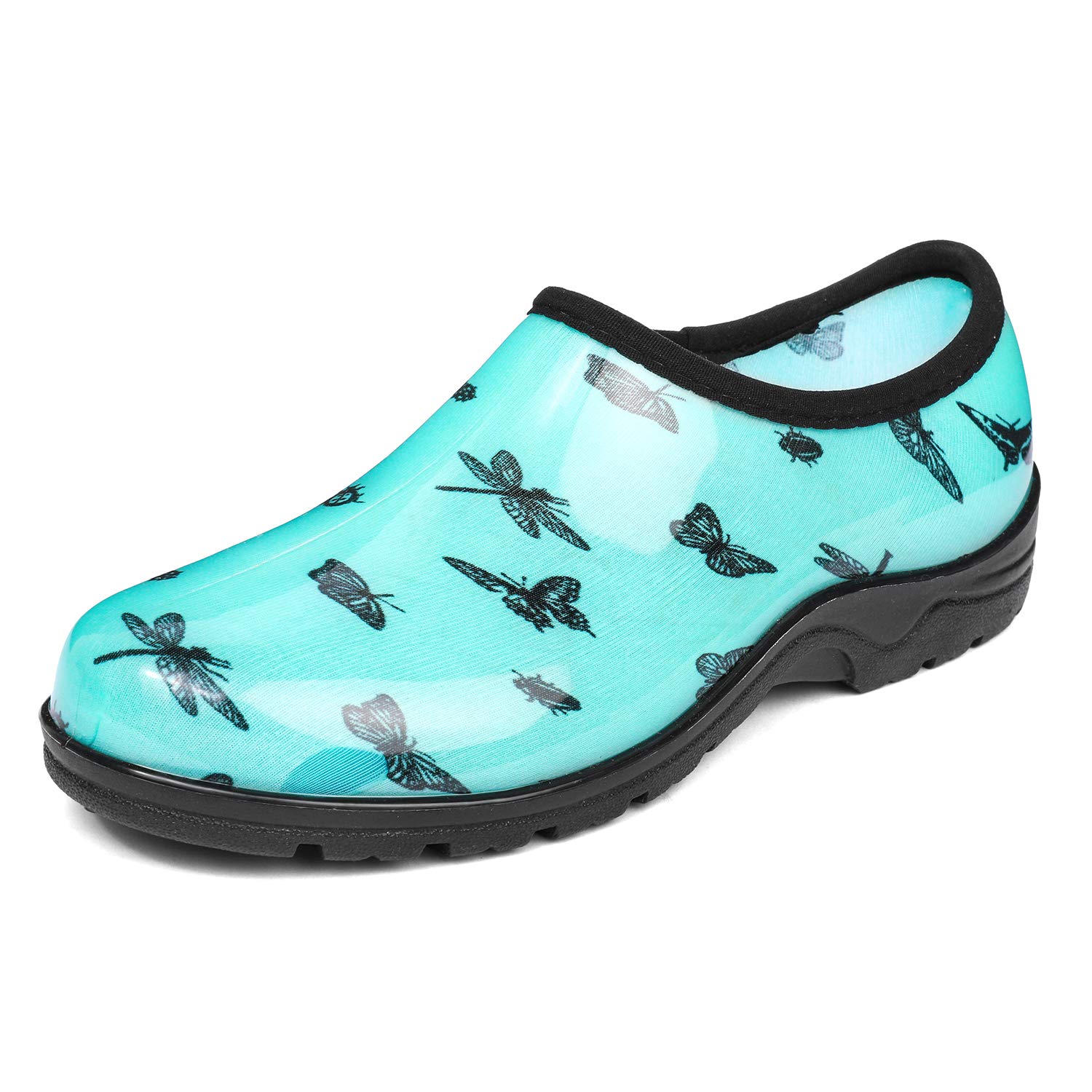
2

DKSUKO Waterproof Garden Shoe

DKSUKO Waterproof Garden Shoe

Wide feet

Our Score 9.0/10
Check Price

Worth Noting

  • Narrow heels may lift; the fit is not universal
Style
Low garden shoe
Closure
Slip-on
Department
Women's
Waterproof
Yes

Some garden clogs pinch across the toes, and the DKSUKO is shaped with more room in the forefoot. It is a low, waterproof slip-on with an easy, unstructured feel, the kind of shoe you can step into with one hand against the doorframe. In wet grass and slushy paths, it kept feet dry and wiped clean without a fuss.

What earns it a runner-up place is how that roominess works for a wider foot. There is enough volume for the upper to sit away from the toes, which is not a given in a waterproof shoe. We also found it less structured than the Sloggers underfoot, so it suits errands, raised beds, and quick dog walks better than a long digging session. The low profile rinses clean and does not clamp the ankle.

For a gardener who wants a light, waterproof pair that does not fight a wide forefoot, this is the one we choose. It is happiest as the shoe by the back door for wet grass, quick errands, and garden work that does not demand a boot. The low profile is the detail we keep coming back to: it rinses clean and leaves the ankle free.

Bottom line: If a standard garden clog pinches your forefoot, the DKSUKO is the waterproof pair we recommend for a roomier fit and easy wet-yard errands.

3

Kprm Waterproof Garden Clog

Kprm Waterproof Garden Clog

Budget waterproof pair

Our Score 8.6/10
Check Price

Worth Noting

  • Runs small; can be tight over a high instep
Style
Garden clog
Closure
Slip-on
Department
Women's
Waterproof
Yes

The Kprm is a rubbery, closed-toe garden clog with a waterproof upper and a simple slip-on shape. It handles the messy basics: feet stay dry, mud wipes off, and the toe box keeps stones away from your socks. At the budget end of this group, that combination is the point. It is not trying to be a technical boot, and that is fine for most yard work.

The detail that surprised us is the sock lining. It makes the shoe feel less like a bare rubber shell, so a quick dash outside without socks is more comfortable than we expected. The upper has a simple wipe-clean finish, and the sole has enough tread for soil and grass. We also like the patterned options, which make it pleasant to leave by the door.

It is not the most refined pick here, but it is a sensible waterproof pair at the budget end of this group. For muddy beds, rainy dog walks, and jobs where you want to hose the shoe off afterward, it earns its place. The low clog shape is easier to step out of than a tall boot, which matters when you are going in and out of the house.

Bottom line: The Kprm is the waterproof garden clog we point to when the yard is wet and the budget is tight, as long as you check the fit.

4

HISEA Garden Shoe

HISEA Garden Shoe

Deep wet grass

Our Score 8.8/10
Check Price

Worth Noting

  • Durability is uneven; soles can split
Style
Garden rain boot
Closure
Slip-on
Department
Unisex
Waterproof
Yes

When the wet grass is tall enough to reach your ankles, the HISEA is the pair here with the most coverage. It is a unisex slip-on garden shoe with a rain-boot shape, a closed upper, and a pull tab at the back. We like it for mowing, muddy paths, and the kind of morning when a low clog would let water over the collar.

The coverage is the reason it earns a place. The upper keeps water and mud out, and the pull tab makes it easy to pull on and gives a snug seal around the ankle. The shoe has a soft, flexible feel rather than a stiff boot, which makes it comfortable for yard work and short walks. We also appreciate the unisex shape, which can work for a man or a woman who wants a roomier fit.

The shape is more boot than clog, so it is not the pair we reach for on a dry, warm afternoon. It is the one we choose when the grass is long and wet and we do not want to think about splashes. For deep wet grass and mowing, the extra coverage is worth it.

Bottom line: The HISEA is the pick for deep wet grass and mowing, with more coverage than a low clog, but its durability is uneven enough to keep it off the top tier.

5

WHITIN Cushioned Garden Clog

WHITIN Cushioned Garden Clog

Dry garden days

Our Score 8.8/10
Check Price

Worth Noting

  • No waterproof claim; best for dry garden days
Sole
Thick cushioned
Style
Garden clog
Closure
Slip-on
Department
Women's

The thick sole is the first thing you notice on the WHITIN. It is soft, springy, and gives a little height, which makes standing at a potting bench or walking a gravel path feel easier on the feet than a flat rubber clog. We also like that it looks more like a sneaker-adjacent clog than a utilitarian garden shoe, so it does not feel out of place on a quick errand.

The cushioning is the reason to choose it. The footbed is soft underfoot and the slip-on shape is easy to kick on when your hands are full. The fit is generous, so a narrow foot may slide around; that is the trade-off for the cushioned feel. It is also the least expensive pair here, which makes it an easy one to try for potting, weeding, and dry-path garden work.

For comfort on dry jobs, this is the pair we choose. The thick sole is the detail that keeps us coming back: it makes a gravel path feel softer and puts a little height between your feet and the cold ground. It is the pair we leave by the door for potting, weeding, and quick dry-day chores.

Bottom line: The WHITIN is the cushioned, budget-friendly pair we choose for dry garden days, not for wet grass or muddy jobs.

How We Tested 14 Pairs of Gardening Shoes

We started by gathering the waterproof clogs and slip-on garden shoes that turn up again and again in reviews, then cut anything with a fabric upper, a heel that would sink into soft beds, or a sole with no discernible tread. That left 14 pairs, ranging from stiff rubber clogs to cushioned EVA styles, which we wore for five months, from first spring planting straight through the summer.

Each pair got a full week of real garden work: morning watering with the hose running over our feet, weeding in damp beds, hauling mulch across wet grass, the muddy walk to the compost bin, and the errands that follow — garden center, farmers market, a run to the mailbox. Nobody wore them only in the garden, because nobody actually does that.

Fit came first, since that's where these shoes go wrong: we noted whether the toe box crowded our toes, whether a heel slipped out on the first step, and whether the sizing ran true or needed a half size up. For water resistance, we stood in an inch of water, held a hose over the toe for a minute, and checked our socks afterward. Traction got judged on wet decking, a sloped mulch pile, and a gravel drive. We stepped into each pair with muddy hands to see if they went on without fingers, then kicked them off at the back door. Five months in, we checked tread wear, cracking at the flex point, and whether the uppers still held their shape — plus whether we'd still wear them in public.

How to Choose Gardening Shoes for Women

Waterproofing and Coverage

A waterproof upper is the baseline for wet grass and mud, but the height of the shoe decides how far that protection goes. A low clog keeps splashes and damp soil off your socks; a rain-boot shape keeps water from coming over the collar in long, wet grass. If your garden is mostly raised beds and dry paths, a water-resistant clog is enough. If you cross a soggy lawn or mow in morning dew, choose a closed waterproof upper and check where the opening sits.

The trap is assuming every garden clog is equally waterproof. A vented or casual clog can let water and grit straight through, and a low shoe will still ship water over the top in a deep puddle. We prioritize a closed toe and a waterproof upper for the wettest jobs, then decide whether we need the extra coverage of a boot-like pair. The Sloggers and DKSUKO are the low waterproof options here; the HISEA is the one with more coverage.

Fit, Sizing, and Heel Hold

Fit is the biggest return risk in this category because many garden clogs come in whole sizes only. A shoe that feels roomy at the toe can still lift at the heel, and a pair that fits barefoot may pinch with thick socks. Start with the size you normally wear in a rubber clog, then check the heel: if it lifts when you walk, go down or add a thin sock; if the toe touches, go up.

Wide feet have an easier time in a roomy clog shape, but roomy is not the same as secure. Look for a shaped footbed or a heel cup that holds the foot, not just a wide opening. The DKSUKO is the roomiest waterproof option here for a wide forefoot; the Kprm runs small and can be tight over a high instep. If you're between sizes, sizing up is usually the safer move for garden work.

Traction and Mud Shedding

A garden shoe needs two kinds of grip: bite on wet soil and grass, and a sole that sheds mud instead of packing it into deep lugs. A moderate tread with a wide, flat base is more useful around beds and paths than an aggressive hiking sole that cakes with clay. On smooth, wet concrete, no clog is as sure as a rubber boot with a sharper heel, so take corners slowly.

Cleanup matters as much as grip. A smooth upper rinses off with a hose; a fabric or foam upper holds water and grit. We like a closed rubber or rubber-like upper for muddy jobs, with a sole that doesn't trap soil. The Sloggers clears mud well but is less confident on slick concrete; the Kprm wipes clean easily. If you work in clay, choose the smoother upper over the deeper tread.

Comfort, Support, and Time on Your Feet

Cushioning feels good in the store, but support matters more after an hour of digging. A soft, thick sole is pleasant for potting and dry paths; a firmer clog with a shaped footbed is better for uneven ground and long yard sessions. If you stand at a bench, cushion wins. If you walk the property, choose structure and a secure heel.

We also think about socks. A roomy clog with a smooth lining is fine barefoot for a quick dash, but a wet morning or a long session is more comfortable with a thin wool or synthetic sock. The WHITIN is the cushioned, height-adding choice here for dry work; the Sloggers has more structure for wet beds. Neither replaces a supportive walking shoe for a long hike.

Frequently Asked Questions

Final Verdict

The Sloggers is the pair we recommend first for most gardeners. It has the waterproof upper, closed toe, and easy hose-off finish that wet grass and muddy beds ask for, and a durable build that suits a pair left by the door. The one thing to sort out is fit: there are no half sizes, and it can run small, so size up if you're between sizes.

If the budget is tight, the Kprm is the waterproof alternative we point to; if you have a wide forefoot, start with the DKSUKO.