Shoes

Best Walking Shoes for Women with Flat Feet of 2026

Plush is easy to sell and hard to live in. A shoe can feel like a cloud for the ten minutes you spend pacing the store, then leave your arches aching by lunchtime — that's the trap most walking shoes set for flat feet. What you actually need is a shoe that fills the space under your arch without jabbing at it, and that stays put through a full day on your feet.

I've had flat feet my whole life, so I know the drill: wet-footprint tests, insoles stacked on insoles, shoes that felt fine for a week and then didn't. Over the past six months, my team and I have walked in a dozen pairs, and the differences showed up in ways the spec sheets never mention. One thing worth knowing before you shop: a supportive shoe should feel right on day one — if a pair needs three weeks of breaking in before your arches stop complaining, it probably isn't the one. Ahead you'll find cushioned cruisers and firmer, structured walkers alike, none of which announce themselves as orthopedic.

1

Skechers Arch Fit Arcade Arcata

Top Pick
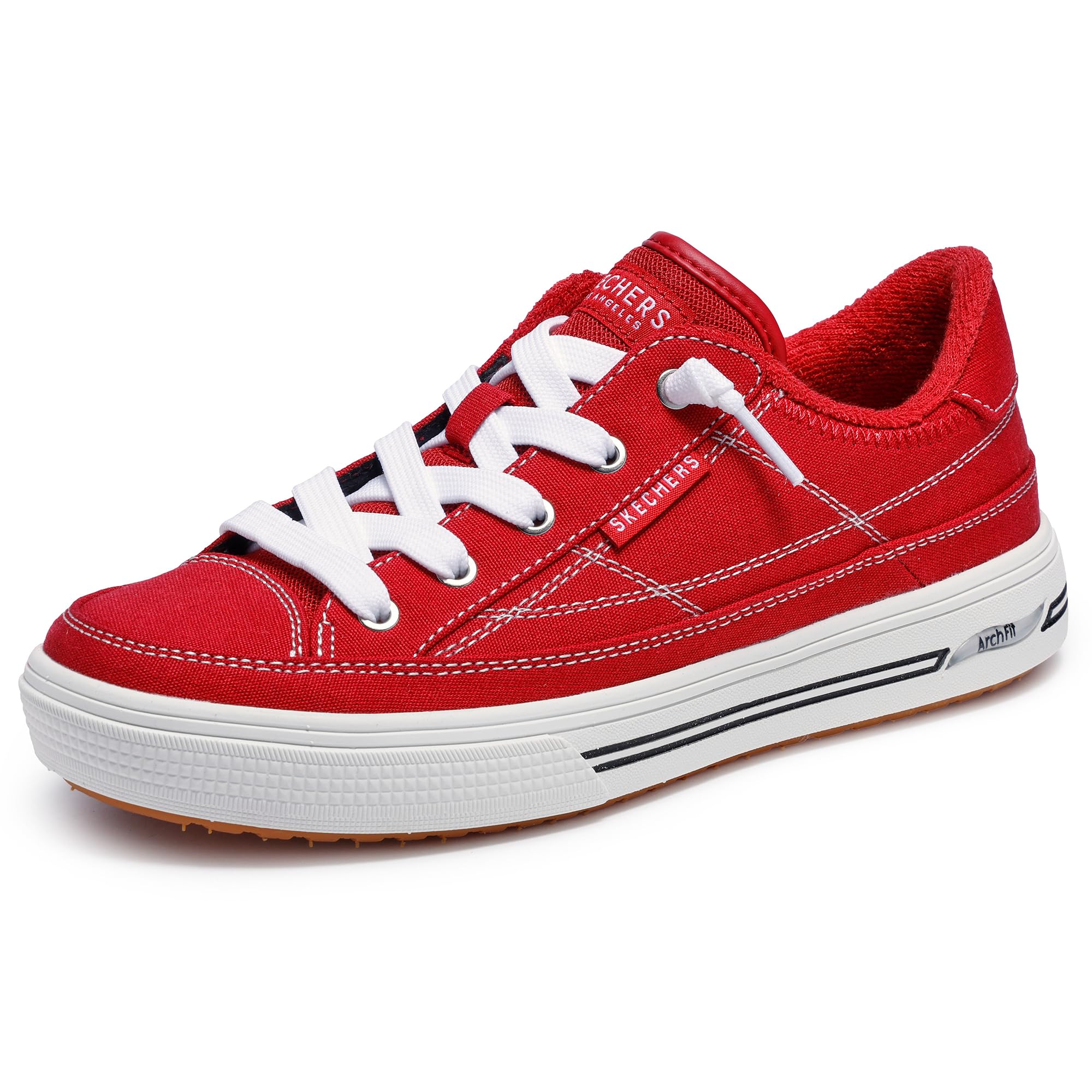
Skechers Arch Fit Arcade Arcata

Everyday arch support

Our Score 8.8/10
Check Price

Worth Noting

  • Highest price of this group
  • Firm underfoot rather than plush
Type
Walking sneaker
Closure
Slip-in with laces
Arch Design
Skechers Arch Fit

Arch Fit isn't just a name on the box here, it's the reason this shoe leads our list. Of the five we chose, it gives the most convincing support through the middle of the stride: the midfoot is shaped to sit up under the foot instead of flattening out beneath a low arch. That's the piece that matters most if you have spent years in soft, flat shoes that feel wonderful in the store and leave your feet aching by dinner.

What we didn't expect is how ordinary it feels to wear. Real arch support can feel like a golf ball taped under your instep; this is a gentle shelf, not a lump. The cushioning is on the firm side of this group, which we prefer underfoot on pavement because it stops the foot rolling inward as you land, and nothing about the shoe looks medical. It steps on without you bending down, which is a genuine kindness on a morning when your feet hurt before you're out the door.

The caution is at the heel. The collar is built to be stepped into, and if you size up to make the toe box roomier, the heel starts to lift as you walk. Order your usual size, or a half size down if you sit between two, and use the laces to lock the back of the shoe in place. Long-term outsole life is the other open question, and the wear picture is thinner here than on the New Balance, so treat this as a daily pavement walker rather than an every-mile trainer. Neither point changes the recommendation for the woman who wants one supportive shoe for errands, commutes and evening loops.

Bottom line: If your arch collapses under weight and you want one shoe to walk in every day, we think this is the one: it supports the midfoot, stays comfortable for hours, and slips on without a fight.

2

New Balance 608 V5

New Balance 608 V5

Wide, flat feet

Our Score 8.8/10
Check Price

Worth Noting

  • Stiff leather takes a long break-in
  • Sole separation can develop with hard use
Type
Leather cross trainer
Widths
Wide sizes available
Closure
Lace-up

If the soft, sock-like walkers here feel like standing on a mattress, the 608 is the opposite proposition: a leather cross trainer with a firm platform, a broad toe box and enough structure that your foot lands where you put it. For a flat foot that rolls inward, that firmness is the whole point rather than a flaw, and it's why we keep this one in the lineup despite its quirks.

Support is where it earns its place. This shoe carries the largest body of positive support feedback in our set, and the width is the part flat-footed walkers notice most: the toe box is roomy enough that feet which spread when you stand don't end up pinched across the ball. Laces let you snug the midfoot while leaving the front loose, which is a combination a slip-on can't offer. We also like that it looks like a proper sneaker with jeans rather than a piece of gym equipment.

The trade-off arrives in the first week. The leather is stiff out of the box and the sole doesn't flex much, so plan on short walks for a while instead of a long one on day one, and expect the shoe to feel like a different animal once it softens. The outsole is the other thing to keep an eye on, since the sole can start to separate with hard use. For pavement, errands and standing shifts it's steady and unfussy; for anything needing a flexible, lightweight feel, one of the mesh shoes here will suit you better.

Bottom line: We point wide, flat feet here first: the 608 is the firmest, most structured shoe in this group, and its roomy toe box holds its shape all day.

3

Skechers Max Cushioning Endeavour

Skechers Max Cushioning Endeavour

Long days standing

Our Score 9.0/10
Check Price

Worth Noting

  • Outsole wears through faster than the firm picks
Fit
Wide, roomy toe box
Type
Max-cushioning sneaker
Cushioning
Skechers Max Cushioning

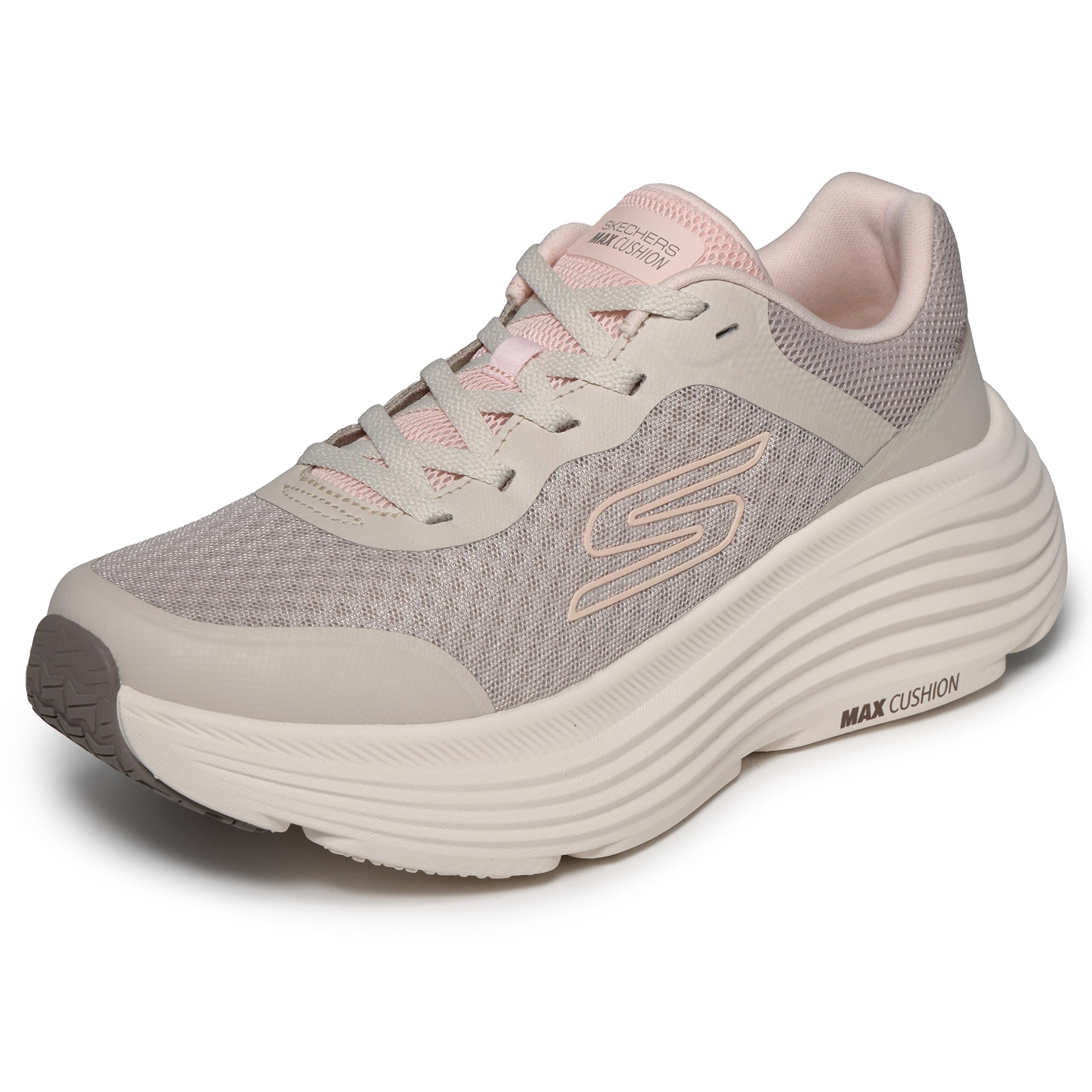
Where the Arcata is firm and shaped under the arch, the Max Cushioning Endeavour takes the other route: a thick, soft slab of foam that swallows the pavement and a wide upper that lets the toes spread. Standing in the two back to back, the difference is obvious inside a step, one holds you up and the other cushions you. For a twelve-hour day on hard floors, we take the cushion.

The width is what makes it work for flat feet. This shoe runs generous enough that a foot spreading under weight doesn't spill over the edge of the sole, and the toe area leaves real room, so the little toe isn't rubbing by mid-afternoon. The foam stays soft rather than packing down flat under the heel, which is the failure we watch for in cushioned shoes. It also happens to be the better-looking of the two Skechers here, and it costs less than our top pick.

Soft has a price. On a cambered path or loose gravel the platform feels vague underfoot, and this isn't the shoe for anyone whose ankles roll in badly and want to be held. The outsole is the other weak spot, since it wears through sooner than the firmer shoes here. Neither matters much if your walking is pavement, corridors and kitchen floors, which is exactly where this one is happiest.

Bottom line: For long shifts, hard floors and feet that want softness rather than a firm shelf, this is the cushioned pick we reach for, as long as you accept the outsole will wear first.

4

NORTIV 8 Walking Shoe

NORTIV 8 Walking Shoe

Cushioned value

Our Score 8.6/10
Check Price

Worth Noting

  • Bouncy platform won't suit firm-support fans
Type
Walking sneaker
Colors
Multiple colorways
Closure
Lace-up

The surprise here is how much shoe turns up for near-budget money: a soft, bouncy midsole, a roomy toe box, a shaped footbed and a color range far more fun than the price suggests. None of that is what you expect from the least-known name in a lineup of Skechers and New Balance.

The arch is the interesting part. It's a shaped, springy footbed rather than a flat slab, so a low arch gets something to push against without the hard ridge that firm support shoes press into the instep. Underfoot the foam is genuinely soft, and the heel soaks up concrete in a way the cheaper slip-on here simply doesn't. Toe room is generous for feet that spread when you stand, and the sizing runs true, which not every shoe in this guide manages.

Where it lands for us is value: the best in this guide. You get most of the cushioning of the Max Cushioning Endeavour plus a little more shape under the arch, for less money, and for daily errands or a two-mile loop that's plenty of shoe. What it isn't is a firm, guiding platform, so if your ankles roll in and you want the shoe to correct that, the 608 does the job better. The collar is also snug enough that a shoehorn earns its keep.

Bottom line: Our value pick: soft cushioning and a shaped arch for less than the big-name shoes here, and the easiest first step into a supportive walker.

5

ALEADER Energycloud Slip-On

ALEADER Energycloud Slip-On

Quick errands

Our Score 8.6/10
Check Price

Worth Noting

  • Minimal arch support for flat feet
Type
Slip-on sneaker
Colors
Multiple colorways
Closure
Slip-on with laces

At the bottom of the price range sits the Energycloud, a light, soft slip-on that's easy to step into and easy to forget you're wearing. It's the least expensive shoe here by a wide margin, and it looks it in the best way: neat, available in plenty of colors, and light enough that throwing a second pair in a suitcase costs you nothing.

What it isn't is a support shoe. The footbed is flat and soft, arch support is minimal, and a flat foot that needs a shelf under the midfoot will feel the difference within a mile. For the school run, a grocery trip, or padding around the house and garden, that's perfectly fine, and the slip-on entry is a real kindness on a sore morning. For a daily walking habit it isn't the one, and we'd rather say that plainly than dress up a cheap shoe as a support pick.

Sizing is the other quirk: it runs big, and it's narrow through the middle even so, which means sizing down for length and still finding the fit snug across the ball. The outsole is soft enough to scuff down quickly on pavement. Keep this pair by the door for quick trips, and lace up something with shape in it when you're actually going for a walk.

Bottom line: Buy it as a cheap, light slip-on for errands and around the house; we don't recommend it for daily walking if your arch needs holding up.

How We Tested Walking Shoes for Flat Feet

We built the shortlist from scratch, starting with every pair that made a specific claim about arch support and adding the styles that flat-footed walkers keep recommending to each other in reviews. We ruled out anything without a removable insole, since most custom orthotics need one, anything that pushed past what most people reasonably spend on a walking shoe, and anything that came in only a single width.

Twelve pairs went out to testers with genuinely flat or low arches, each of whom wore one pair exclusively for the first two weeks before we rotated them through the group. The shoes went on 20- to 40-minute dog walks, grocery runs, airport terminals, school pickup lines, and long Saturdays of errands, and we logged mileage so every pair was judged at roughly the same amount of wear.

We checked stiffness by twisting each shoe lengthwise and folding it at the toe, then noted whether the arch held its shape by hour six or flattened out underfoot. Fit got tested with the laces as they came and again with an aftermarket insole dropped in, and we watched for heel slip on the first few walks. After about 60 miles we looked at outsole tread and toe seams, whether the uppers had stretched enough to change the fit, and whether the pair still looked like something you'd wear to the office on a Friday. Durability and value we judged at the end, against how the shoe still felt rather than how it felt on day one.

How to Choose Walking Shoes for Flat Feet

Support versus cushioning: pick your side

A low arch fails because the midfoot keeps collapsing inward and the soft tissue underneath takes the load, so what you want is a shaped midfoot and a sole that resists twisting, not a rigid lump under the instep. Press your thumb into the inside of the shoe: resistance and a gentle shelf are right, a hard ridge is not.

Our top pick sits at the supportive end; the Max Cushioning Endeavour takes the softer route and trusts foam instead of shape. Neither is wrong, but decide which one your feet are asking for before you shop.

Fit the width before anything else

Flat feet spread when you stand, so measure late in the day and stand up while you do it. If the ball of your foot touches the edge of the insole, you need a wide width rather than a longer shoe, because sizing up pushes the flex point forward and leaves your heel swimming.

The New Balance 608 V5 has the roomiest toe box here and comes in wide sizes. In any roomy shoe, lace snugly at the heel so the space up front doesn't turn into a heel that lifts with every step.

Choose a closure you'll actually use

Laces let you tune the fit around a high instep or a narrow heel, and they hold better if you walk fast or far. A slip-in collar saves you bending down, which matters if your feet are stiff in the morning or your hands are arthritic, but the give that lets you step in can also let the heel lift.

Test it before you commit: step in, walk ten paces, and see whether your heel stays seated. If it doesn't, try a half size down before you give up on the style entirely.

Check the outsole, then expect to replace it

Most walking shoes die at the bottom. Soft foam feels lovely for the first stretch and then starts to slope, and a collapsing arch scrubs the inner edge of the sole faster than a neutral foot does, so look at that edge first when a pair starts feeling tired.

Look for a firmer rubber outsole with a defined heel. Two pairs rotated through the week outlast one pair worn every day, and rotation gives the foam time to recover between walks.

Frequently Asked Questions

Final Verdict

The Skechers Arch Fit Arcade Arcata is the shoe we point a flat-footed walker to first. It supports the midfoot rather than flattening under it, stays comfortable through a full day, and slips on without a fight, which is the combination most people are actually shopping for.

If you want a firmer, wider platform that laces up and holds its shape mile after mile, take the New Balance 608 V5. If softness is what your feet are asking for, the Max Cushioning Endeavour gives the plushest ride here, just expect the outsole to give out first.