Shoes

Best Composite Toe Shoes for Women of 2026

The first time I traded steel toes for composite, I noticed it in the parking lot before I ever hit the shop floor — the same protection over my toes, none of the weight dragging at my ankles. Composite caps do the job of steel at a fraction of the bulk, they don't conduct cold on a February morning, and they don't trip the metal detector at a plant gate. The catch is everything below the cap: a shoe that guards your toes while your arches ache by lunchtime hasn't done you much good.

Here's what first-time buyers learn the hard way: a composite cap doesn't break in, so a pair that pinches on day one will still pinch in week three — fit is the whole ballgame. We've spent the past six months in 12 pairs, on concrete, on ladder rungs, and on long commutes home, and the ones that held up were the ones that got fit, cushioning, and grip right. Below are the pairs we kept reaching for, plus who each one actually suits.

1

CAT Venward Composite Toe

Top Pick
CAT Venward Composite Toe

All-day general work

Our Score 8.8/10
Check Price

Worth Noting

  • Can run a little big between sizes
Fit
Women's-specific
Model
P91483
Safety Toe
Composite

Composite toe protection usually shows up as a shape: a bulbous front, a stiff upper, a shoe that reads as safety gear from across the room. The Venward mostly sidesteps that. CAT builds it on a women's last with a non-metal cap, so you get the protection without the metal, and the profile stays low and sneaker-like — this is the pair here you can wear with jeans after your shift without feeling like you forgot to change.

It's also the most complete shoe in this roundup. Comfort, durability, weight, and looks are all strengths rather than one standout surrounded by compromises, and it handles rougher duty than the low profile suggests. The same shoe that gets you through a shift is the one most likely to survive a weekend of digging, shoveling, and moving rock. That completeness is why it's our top pick: nothing else here is as easy to recommend to as many women.

There's not much left to negotiate. It's comfortable from the first week rather than after a break-in period, it keeps its shape through a long day on your feet, and the cap sits low enough that you don't get the toe-clunk that puts people off safety shoes. Looking this ordinary while doing all of that is the trick, and it's the reason we keep coming back to it.

Bottom line: This is the pair we hand most women first: light, comfortable over a full shift, and tidy enough to wear off the clock.

2

KEEN Vista Energy Low

KEEN Vista Energy Low

Long industrial shifts

Our Score 8.0/10
Check Price

Worth Noting

  • Sole is the first thing to fail in daily industrial use
Fit
Women's-specific
Model
1026662
Safety Toe
Composite

Order up. The Vista Energy runs roughly a full size smaller than marked, and the composite cap crowds the front more than KEEN's roomy reputation would lead you to expect — the famously generous toe box is not what you get here. Buy from somewhere with easy returns, treat the listed size as a starting point, and plan on going at least a half size over your usual work shoe, more if you wear thick socks.

Get the fit sorted and this is the most serious industrial shoe in the group. It's purpose-built rather than a walking shoe with a cap dropped in, it stays light for something with a safety toe, and the styling is genuinely part of why people pick it: it looks like a sneaker, holds its shape, and doesn't turn into a work boot by the end of the month. Arch support is the wildcard — enough for some feet, not for others, so if you already add an insole, plan on doing it here too.

What keeps it off the top spot is the sole. The bottom of a low safety shoe takes everything — heel strike, toe scuff, whatever the floor is made of — and that's the part that goes first, sometimes within a couple of months of hard daily use. At the premium end of this group that's a short working life. If you're on your feet ten hours a day and want the most structure on offer, it's still the pick; just know you're buying support, not longevity.

Bottom line: Order up half a size and we think it's the most serious industrial shoe here — worth the premium if you stand on concrete all shift.

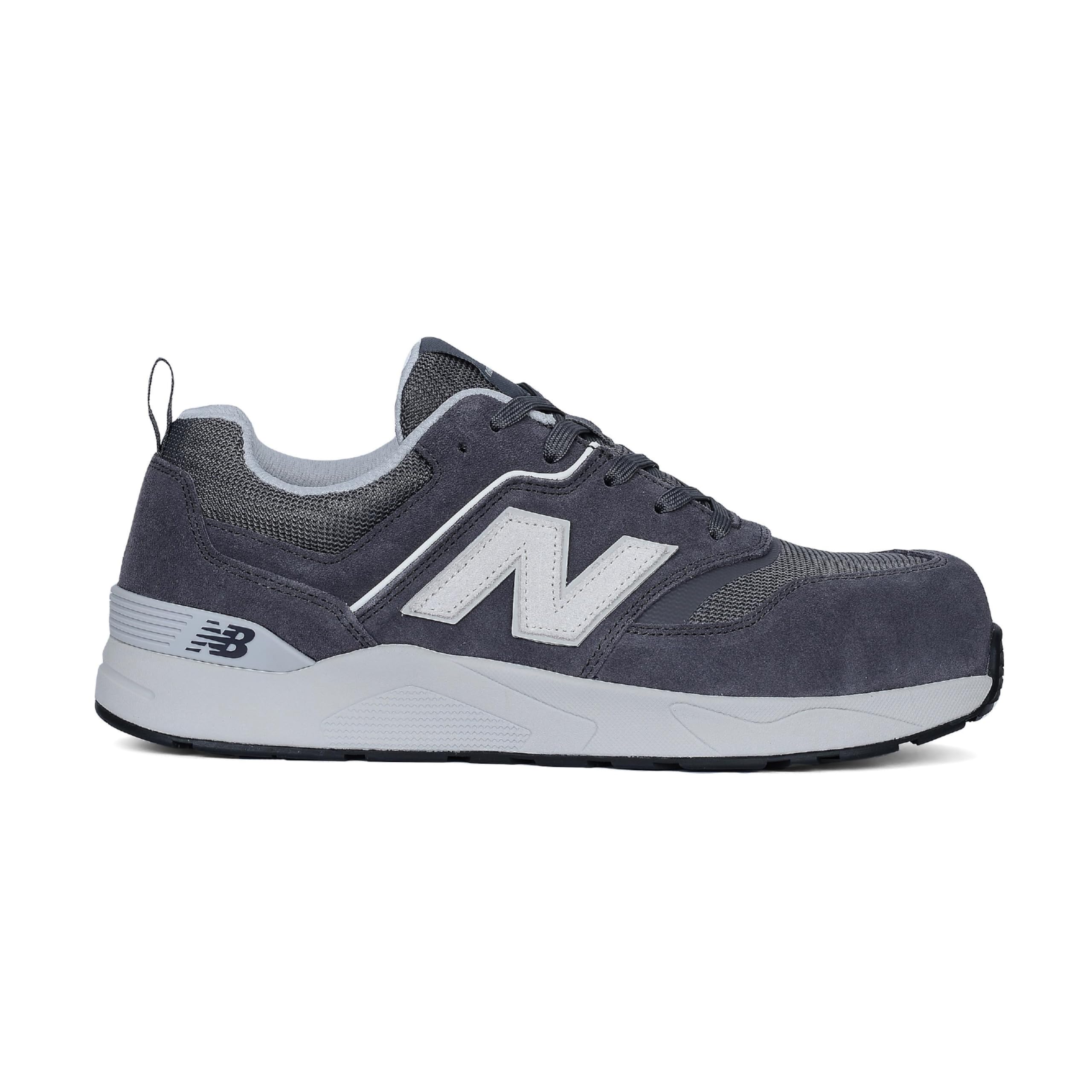
3

New Balance Elite Lite EH

New Balance Elite Lite EH

Live-circuit work

Our Score 8.2/10
Check Price

Worth Noting

  • Sizing runs a little big
  • Bulkier profile than the CAT
Model
WUELEHMO
Rating
EH
Safety Toe
Composite

If your job puts you near live circuits, the field narrows fast. You want a non-metal toe and an EH designation, and most women's safety sneakers in this roundup offer the cap without the rating. New Balance lists this one as an EH industrial shoe built on a women's last, which makes it the obvious answer for electrical work where a metal toe is a liability in itself.

What we like beyond the rating is how little it feels like equipment. It's light for a capped shoe, the upper is clean and understated, and quality and value are the two things it gets most consistently right. Of everything here, it's the pair that feels most like an ordinary sneaker and least like something you put on because a rule says you have to.

It isn't the plushest shoe in the group. Underfoot it's firmer than the KEEN, and if you want a soft landing after twelve hours on concrete, that firmness is the trade you're making for the lighter build. What you get back is a shoe that wears like a sneaker off the clock, which is more than most EH-rated footwear manages.

Bottom line: We keep this one for live-circuit work: a women's-specific composite toe with an EH rating that still feels like a sneaker.

4

ARISIC Composite Toe Sneaker

ARISIC Composite Toe Sneaker

Dry-floor value

Our Score 8.4/10
Check Price

Worth Noting

  • Grip is unreliable on wet or greasy floors
  • Liner and toe-cap fabric wear before the sole does
Fit
Women's (listed)
Safety Toe
Composite
Package Weight
2.78 lb

The ARISIC costs a fraction of what the branded pairs here do, and it gives up less than the price suggests. There's a composite cap, a light build, and a shape that reads as a running shoe rather than a work boot — closer in spirit to the CAT than anything at this end of the range has a right to be.

Comfort is where it earns its place. The cushioning is soft from the first wear instead of after a week of breaking in, the shoe is light enough that the cap disappears, and the styling is the thing it does best: of everything here, this is the pair most likely to draw a compliment. For a first pair, a second pair, or a job that eats shoes, that combination is hard to argue with.

The fit is the catch. It runs big and stays roomy through the middle, so a narrow foot will swim and most people want to go down a half size rather than up. Get that right and it's genuinely comfortable; get it wrong and the shoe feels a size too generous in every direction. The other compromises are the sort you notice in month three rather than on day one, which is the honest trade at this price.

Bottom line: Our value pick: soft, light, and good-looking, as long as your floors are dry and you size down.

5

Skechers Bulkin Balran

Skechers Bulkin Balran

Light women's work

Our Score 8.4/10
Check Price

Worth Noting

  • Runs large; start a half size down
Fit
Women's-specific
Model
108033W
Safety Toe
Non-metal

Skechers' work line trades on the brand's comfort reputation, and the Bulkin Balran mostly lives up to it. The upper is soft enough that there's no break-in to speak of, the shoe is light for something with a safety toe, and the non-metal cap gets you through a metal detector without a second look — the detail that matters most if you badge in through security every morning.

Underfoot is where it falls short. The midsole is firm and the footbed is thin, so a ten-hour day on concrete makes itself felt by the end of the week. That's fixable: there's enough room inside to drop in a thicker insole, and doing so turns a so-so shoe into one you can stand behind. We prefer that arrangement to a plush footbed you can't change.

It's also the women's-specific option at a price where most of this group hands you a unisex last, and that shows in the heel and the arch rather than the length. For light industrial work, warehouse floors, and anyone who wants a safety shoe that reads as a sneaker, it's the sensible middle of the range.

Bottom line: We like this one for lighter women's-fit work: buy it expecting to add an insole and it earns its keep.

6

OWIF Composite Toe Work Shoe

OWIF Composite Toe Work Shoe

Backup pair

Our Score 8.4/10
Check Price

Worth Noting

  • Outsole wears quickly on abrasive concrete
  • Grip is inconsistent once floors get wet
Fit
Unisex, listed as men's
Style
Work sneaker
Safety Toe
Composite

This is the least expensive pair here, and it does the basic job without drama: a composite cap, a light upper that feels broken in from the first wear, and enough comfort that a shift doesn't leave you counting the hours. As a second pair for the truck or the locker — or for the jobs where a good shoe goes to die — it makes obvious sense.

What it isn't is a women's shoe. It's listed in men's sizing, and the fit follows: the shoe runs big, it's snug across the toe on wider feet, and there's no wide option, so you're working with a men's last and hoping it lands. Size down — a men's size runs about a size and a half larger than the women's equivalent — and expect a roomier heel than you're used to.

Build quality tracks the price in the quieter places rather than the obvious ones. The upper is the sturdy part; the compromises sit in the sole and the lining. For dry indoor work where the toe cap is the point and the floor is predictable, that's a fair trade, and it's the cheapest way into a real composite toe in this group.

Bottom line: We treat this as a cheap backup pair for dry indoor work — best on average or narrow feet that can size down.

How We Tested a Dozen Pairs of Composite Toe Shoes

We started by pulling every women's composite toe shoe we could find with an ASTM-rated safety cap and a real range of sizes, then cut the field down to 12 pairs across price points — sneaker-style, low-cut work shoes, and a couple of crossover walking designs. Fit was the first filter: if a brand didn't publish width options or a size chart worth trusting, it didn't make the list.

Each pair went to someone with a reason to wear it — eight-hour shifts on concrete, ladder rungs, a wet commercial kitchen, gravel yards, and the drive home afterward. We noted where the cap pressed, whether the heel slipped, and how a shoe felt at hour one versus hour nine. Before calling anything true to size, we traced each insole on paper and compared it against a Brannock measurement, and we paid attention to arch support by seeing who was still comfortable standing at the end of a shift.

Then we got them dirty. Wet tile, an oily shop floor, loose gravel, and a run of cold mornings showed us which tread held and which slicked over. We checked the upper at the flex crease above the toe for cracking after weeks of kneeling and crouching, and the outsole at the heel edge for rounding off. Every pair got weighed against a steel-toe equivalent, and every wearer was asked the only question that really counts: would you spend your own money on a second pair? Appearance factored in too — these are shoes people wear out of the building, not just inside it.

How to Choose Women's Composite-Toe Work Shoes

Composite or steel: what actually changes

A composite cap is non-metal, which is the whole reason to want one: nothing to set off a detector at the gate, and nothing in the toe pulling heat out of your feet on a cold morning. What the cap is made of tells you very little about protection — that comes from the rating the shoe carries, not the material.

The trap in this category is the title. Sellers routinely stuff both steel toe and composite toe into a single listing to catch search traffic, so read the specification field rather than the headline, and check the label inside the tongue when the box arrives. If your site requires a rated toe, get that in writing before you wear them onto the floor.

Fit is where these shoes go wrong

Most of the fit trouble here is the last, not the size. Pairs sold in men's sizing stay long and wide through the heel even after you convert, and the conversion is bigger than most people assume: a men's size runs about a size and a half larger than the women's equivalent, so a men's 8 is roughly a women's 9.5.

Women's-specific shoes skip that arithmetic entirely, which is why they're worth paying for if your feet are narrow or you're tired of returning things. Measure with the socks you'll actually wear, and treat any listed size as a starting point rather than a guarantee.

The outsole does as much work as the toe cap

A cap protects you from something heavy landing on your toes. It does nothing about the floor, and the floor is where these shoes most often let people down — wet tile, greasy line floors, oil around a machine. Before you commit, test a new pair on a wet patch of the surface you actually work on. If it slides there, it slides worse with a shift's worth of weight on it.

Depth of tread isn't the answer by itself. What you want is a sole that carries a slip-resistance claim and a tread pattern that sheds liquid instead of holding it.

Plan for ten hours, not ten minutes

Past hour six, cushioning matters more than cap material. Composite is lighter than steel, but the gap between two composite shoes can be just as wide, and a well-fitting shoe with a decent insole beats a more expensive one that doesn't fit. If the fit is roomy, plan on adding an insole — a removable footbed is the cheapest upgrade you can make. If the shoe is snug across the instep, don't: an insole eats volume you don't have.

What actually ends a pair's life

Not the toe cap. Caps hold up; soles separate, liners wear through, and the fabric around the cap grinds away — especially if you kneel on concrete. Match the upper to the job: a smooth, tight weave survives kneeling better than a loose mesh, and a rubber wrap around the toe buys you time. Buy somewhere with a workable return window, keep the receipt, and don't wear them outside until you're sure of the fit.

Frequently Asked Questions

Final Verdict

For most women buying a composite-toe shoe for work, the CAT Venward is where to start. It's light, it's built on a women's last, and it gets comfort, durability, and looks right at the same time — rarer in this category than it should be.

Two requirements change the answer. Working around live circuits? The New Balance Elite Lite carries an EH designation the CAT doesn't. On concrete for a ten-hour shift and want maximum structure underfoot? Order the KEEN a size up and accept that the sole is the part you'll wear out first.