Wellness

Best Calcium Supplements for Women of 2026

Calcium is one of those nutrients where the food math rarely works out — a yogurt at breakfast, some almonds, broccoli at dinner, and plenty of us still land under the 1,000 to 1,200 milligrams a day bone health asks for. That's why the supplement aisle is so crowded, and why so many bottles end up half-empty: the pills are enormous, some go down like chalk, and a few leave your stomach unhappy by day three. The right one fixes all of that — a dose you can swallow, absorb, and repeat without dreading it.

My team and I have spent the past four months using 15 different calcium supplements — tablets, caplets, softgels, capsules, and gummies — and the gaps went well past label math. Two things I wish someone had told me sooner: citrate tends to sit easier than carbonate, and "500 mg per serving" means nothing until you check whether a serving is one pill or three. Gummies and chewables solve the swallowing problem but often drag sugar along with them.

1

Citracal Slow Release 1200

Top Pick
Citracal Slow Release 1200

Daily bone support

Our Score 9.4/10
Check Price

Worth Noting

  • Slow-release caplet should not be split
Vitamin D3
25 mcg
Calcium Form
Calcium carbonate and calcium citrate
Calcium Per Serving
1,200 mg
Other Bone Nutrients
Magnesium

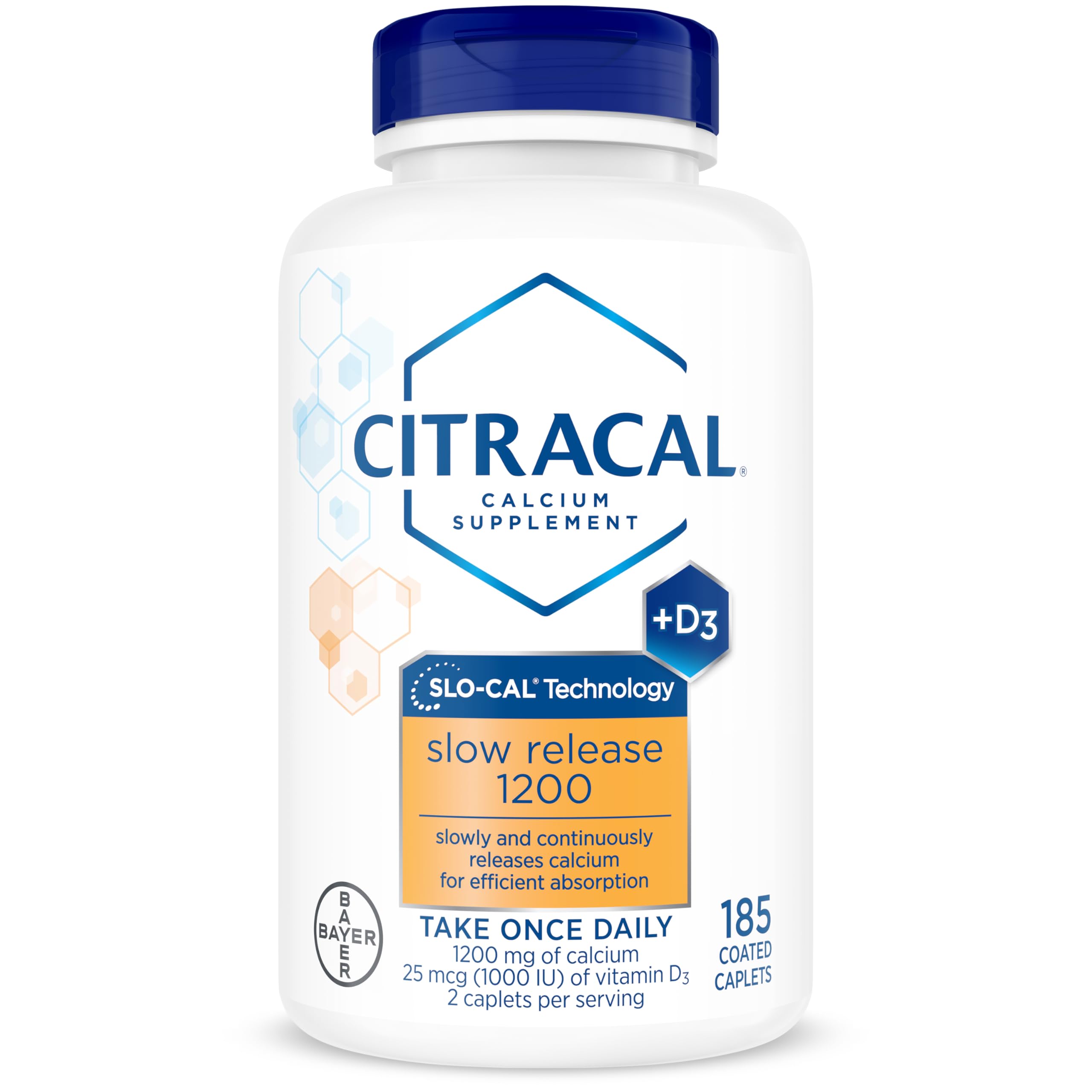
A single daily serving is the reason this Citracal bottle sits at the top of our list. Each serving brings 1,200 mg of calcium from citrate and carbonate, 25 mcg of vitamin D3, and magnesium, and the Slo-Cal formula is designed to release calcium gradually rather than all at once. For a woman who wants one bottle to cover the main bone-support nutrients, that combination is hard to beat.

What we appreciate most is the routine: one serving, once a day. The trade-off is that 1,200 mg arrives in a single hit. If you prefer to spread calcium across meals, the 600 mg Caltrate tablets give you more control. But if once-daily convenience is what keeps you consistent, this is the one we point to.

The caplets are large, and that is the main thing to know before ordering. The coating helps them go down, but the size is still substantial, and the beveled edges are not everyone's friend. If you have trouble with big pills, Citracal Petites is the safer Citracal to try.

The 185-count bottle is sized for a daily habit, not a trial. We keep it on the counter because the once-daily serving is easy to remember, and the added magnesium means one less bottle in the cabinet. That convenience is what earns it the top spot, not a longer ingredient list.

Bottom line: We make this the default for women who want one daily serving with calcium, D3, and magnesium, as long as they can handle a large caplet.

2

Caltrate 600+D3

Caltrate 600+D3

Split dosing

Our Score 9.6/10
Check Price

Worth Noting

  • Bottles can arrive short-dated
Bottle Count
200 tablets
Calcium Per Tablet
600 mg
Vitamin D3 Per Tablet
20 mcg

If you want to split your calcium across the day, the 600 mg tablet is the useful unit. Caltrate gives you 600 mg of calcium and 20 mcg of vitamin D3 in each tablet, so two tablets deliver 1,200 mg without forcing it all into one dose. That flexibility is why this bottle stays in our runner-up group.

We also noticed the vitamin D dose is generous at 20 mcg per tablet. If you already take a separate D supplement, add up the labels before doubling up. For a simple two-tablet routine, though, the combination is clean and easy to remember.

The tablet is large, and that is the trade-off for the 600 mg dose. If you routinely struggle with big pills, the smaller Citracal Petites is the more comfortable route. The coating does help, but it does not turn this into a small tablet.

The 200-count bottle lasts through a two-a-day routine, which is the point: this is a workhorse, not a sampler. We keep it as the straightforward choice for anyone who wants to control the dose without measuring powder or chewing gummies. It is not the bottle for someone who needs extras beyond D3.

Bottom line: Choose Caltrate if you want to split your calcium into 600 mg tablets without giving up a high vitamin D dose.

3

Pure Encapsulations Calcium Citrate

Pure Encapsulations Calcium Citrate

Sensitive stomachs

Our Score 9.6/10
Check Price

Worth Noting

  • No vitamin D included
  • Premium price
Formula
Free from common allergens
Vitamin D
None
Bottle Count
180 capsules
Calcium Form
Citrate

No vitamin D and no extra minerals—Pure Encapsulations is calcium citrate and little else. That sounds like a drawback until you meet the person who already takes D3 separately and wants a clean citrate capsule that does not upset a sensitive stomach.

The capsules are small and easy to swallow, and the citrate form is the one we look for when someone wants to take calcium without food or has had trouble with chalky tablets. We also appreciate that the formula leaves out fillers and common allergens, which matters if you are stacking several supplements and want to know exactly what you are taking. The 180-count bottle is straightforward.

We think the premium is justified only if the simplicity is the point. You are buying a specialist calcium capsule, not a complete bone-health formula, so budget for a separate vitamin D3. For anyone who has been through the tablet-size wringer, that trade is often worth it. It is not the bottle we hand to someone who wants an all-in-one bone supplement, and that is the honest boundary.

What we kept coming back to is the lack of afterthought: no chalky coating, no extra minerals to tolerate, no D3 dose to second-guess. If your routine is already built, this slot fits quietly.

Bottom line: We reach for this pure citrate capsule when a sensitive stomach or a separate D3 routine makes a simpler formula worth the premium.

4

Vitafusion Calcium Gummies

Vitafusion Calcium Gummies

Pill avoiders

Our Score 9.4/10
Check Price

Worth Noting

  • Sugar-coated gummies
  • Only 500 mg per two-gummy serving
Supply
50 days
Vitamin D3
Included
Serving Size
2 gummies
Calcium Per Serving
500 mg

The first calcium supplement we hand to someone who dreads pills is a gummy, and these are the easiest to recommend. Two gummies deliver 500 mg of calcium and vitamin D3, and the fruit-and-cream flavor makes them feel more like a treat than a supplement.

They are soft, chewy, and genuinely pleasant, which matters if the alternative is a tablet you avoid. The catch is the serving math: 500 mg per two gummies means a higher daily target takes multiple servings. The bottle is a 50-day supply at two a day, so it is not the longest-lasting option here. You will want to keep the bottle where you can see it, because it is easy to treat them as candy.

We also minded the sugar. These are sweet, sugar-coated gummies, and if you are watching added sugar, that is the detail to weigh before making them a daily habit. For everyone else who needs calcium to be easy, the trade is worth it. They are the one pick here that makes a supplement feel like a snack, and that is exactly why they get used.

Bottom line: For anyone who dreads swallowing pills, these gummies make a 500 mg calcium serving taste like a treat.

5

Garden of Life Raw Calcium

Garden of Life Raw Calcium

Plant-based routines

Our Score 9.4/10
Check Price

Worth Noting

  • Four-capsule serving
  • Premium price
Magnesium
357 mg
Serving Size
4 capsules
Vitamins Included
D3 and K2
Calcium Per Serving
1,100 mg

Four capsules is a lot to ask before breakfast. Garden of Life makes the case with what is inside them: 1,100 mg of plant-based algae calcium, 357 mg of magnesium, plus vitamin D3, K2, boron, silica, and probiotics.

We like this for the person who wants a whole-food, plant-based formula and is willing to take a handful of capsules to get it. The K2 and magnesium are the extras that make it more than a calcium pill, and the 120-capsule bottle is sized for a 30-day routine at four a day.

It is not the easiest formula for every stomach. Some people do fine; others find the four-capsule serving and the added ingredients too much. If you know you have a reactive stomach, this is not the first bottle to try.

The price is the other barrier, and we think it is fair only if you value the plant-based sourcing and the broader nutrient mix. If you just need calcium and D3, a simple tablet does the job for less. This is the premium option for a reason, not the default.

Bottom line: This is our pick for a plant-based, multi-nutrient calcium routine, provided you will take four capsules a day.

6

Citracal Petites

Citracal Petites

Smaller caplets

Our Score 9.4/10
Check Price

Worth Noting

  • Not truly petite for every swallower
  • 400 mg per serving is low
Vitamin D3
12.5 mcg
Bottle Count
375 caplets
Calcium Form
Citrate
Calcium Per Serving
400 mg

Petite is a relative word in calcium supplements, and Citracal Petites is the clearest example. These caplets are smaller than Citracal Maximum Plus, but they are still calcium caplets, not tiny pellets.

We recommend them for the person who has failed with bigger tablets and wants a citrate formula that can be taken with or without food. Each serving provides 400 mg of calcium and 12.5 mcg of vitamin D3, so the trade-off is dose: you may need more than one serving to reach a higher daily target. That lower dose is not a flaw if you are splitting calcium anyway, but it is a poor fit for someone who wants one-and-done convenience. The 375-count bottle helps offset that.

The coating makes them easier to swallow, and the lack of aftertaste is a small but real pleasure. Just do not expect the word Petite to mean you can take one and be done. If you need 1,200 mg, the serving count adds up quickly. For us, they are the compromise bottle: not the smallest calcium pill on the shelf, but the one that makes a citrate routine feel manageable.

Bottom line: Citracal Petites is the smaller-caplet compromise, but only if you accept a 400 mg serving and a still-substantial pill.

7

Nature Made Calcium Magnesium Zinc

Nature Made Calcium Magnesium Zinc

Budget combo

Our Score 9.6/10
Check Price

Worth Noting

  • Up to three tablets daily
  • Calcium amount is not on the front label
Vitamin D3
Included
Bottle Count
300 tablets
Other Bone Nutrients
Magnesium and zinc
Third-party Verification
USP Verified

Calcium, magnesium, and zinc in one tablet is the appeal here, not a megadose of any single mineral. Nature Made packs 300 tablets in the bottle, and the label directs up to three tablets daily with water and a meal.

The USP Verified mark is the detail that makes us comfortable with the value. It is a third-party verification, and it gives this budget bottle more credibility than the price alone would. The combination is also convenient if you are already shopping for magnesium and zinc separately. The front label is not where you will find a precise calcium number, so read the supplement panel if dose is your main concern.

We recommend it for the person who does not mind taking a tablet with each meal and wants a low-cost bone-support combo. If you prefer one daily dose, this is not the bottle for you. The up-to-three-tablet routine is the trade-off, and it is a real one. It is a good value, but only if the three-times-a-day rhythm fits your day.

Bottom line: We recommend this as the budget bone-support combo for anyone who does not mind taking tablets with meals.

8

Nature's Bounty Calcium 1200 Softgels

Nature's Bounty Calcium 1200 Softgels

High-dose softgel

Our Score 9.2/10
Check Price

Worth Noting

  • Serving may be more than one softgel
  • Not the best choice for sensitive stomachs
Format
Softgel
Vitamin D3
1,000 IU
Bottle Count
220 softgels
Calcium Per Serving
1,200 mg

If you prefer a softgel to a chalky tablet, this is the high-dose option in our set. Each serving contains 1,200 mg of calcium and 1,000 IU of vitamin D3, and the bottle holds 220 softgels.

We like the format for people who have trouble with hard tablets. Softgels are slippery and easy to swallow, and the 1,200 mg serving means you are not juggling multiple tablets. The trade-off is that the serving may be more than one softgel, so check the label before you assume the bottle is a full supply.

If you have a sensitive stomach, a citrate formula is the safer bet; this softgel is not sold on that promise. For a straightforward high-dose softgel, though, the formula is simple and the D3 dose is generous. If you have had trouble with calcium tablets before, start with a smaller serving or choose a citrate formula rather than assuming a softgel will solve it.

We keep it as an also-consider because it serves a specific preference well: softgel, high dose, one bottle. If you need a smaller pill or a citrate formula, the Citracal picks are the better fit.

Bottom line: A high-dose softgel with D3 for people who prefer softgels, as long as they check the serving count before buying.

How We Tested the Calcium Supplements

We started with more than 60 calcium supplements on the market and cut the list to 15 by reading labels instead of reviews: how much elemental calcium a serving actually delivers, whether that serving is one pill or three, whether vitamin D3 and magnesium come along for the ride, whether the source is citrate or carbonate, whether the brand publishes third-party testing, and what 1,000 milligrams costs rather than what the bottle costs. Pill size eliminated a surprising number of candidates before anyone swallowed anything.

Then 15 of us — different ages, different diets, a few dairy-free — took an assigned supplement every morning for four months. Half took theirs with breakfast and half deliberately on an empty stomach, since that's where carbonate and citrate part ways. Everyone kept a short daily note: how many ounces of water the pill needed, whether it stuck going down, and what their digestion did over the first two weeks — bloating, cramping, constipation, or nothing at all. We also weighed a sample of tablets on a kitchen scale to see how consistent the dose was from pill to pill.

Gummies and chewables got their own protocol: tasted cold from the fridge and again at room temperature, with notes on grittiness, chalkiness, and how long the aftertaste lingered. We tallied sugar per serving against what you'd get from a small cookie, because two gummies can absolutely get you there. Effectiveness is the hardest thing to judge in four months, so we treated it as two answerable questions — is the label dose independently verified, and would you still be taking this in month five? — and let adherence tell us the rest.

How to Choose a Calcium Supplement for Women

Start With the Dose You Can Take

Calcium is bulky, so labels express it per tablet or per serving, and those are not always the same. A 600 mg tablet gives you a clean unit to split across meals; a 1,200 mg serving is convenient but often means two large caplets at once. We match the number to the routine: one daily dose if you need simplicity, 600 mg tablets if you prefer to spread calcium out. Check the serving count on the back before you compare bottles.

Choose the Form for Your Stomach and Schedule

Calcium citrate is the form we point to when someone wants to take a supplement without food or has a sensitive stomach. It is the base of the Pure Encapsulations and Citracal picks here. Calcium carbonate is the more common tablet form and relies on stomach acid, so it is usually taken with a meal. That does not make one universally better; it makes citrate the easier fit for an empty-stomach routine and carbonate the one to take at breakfast or dinner. If you have had heartburn or constipation with calcium before, start with a citrate option and a smaller serving.

Read the Vitamin D and Extra Minerals

Vitamin D3 is the partner nutrient that helps your body absorb calcium, so we prefer a formula that includes it unless you already take D separately. Magnesium, zinc, and vitamin K2 are useful extras for some buyers, but they are not a reason to ignore the calcium dose or the pill size. The Garden of Life bottle is the most complex here, with magnesium, D3, K2, and probiotics; the Pure Encapsulations capsule is the opposite, with no D at all. Neither approach is wrong. Decide whether you want an all-in-one formula or a simple calcium source you can build around.

Be Realistic About Pill Size and Sugar

Calcium tablets are large because the mineral is bulky, and no coating fully solves that. If swallowing is the barrier, the Citracal Petites caplets and the Vitafusion gummies are the practical alternatives, but each asks for a compromise: Petites provide only 400 mg per serving, and the gummies are sweet and sugar-coated. Do not choose a bottle you dread opening. A supplement you take consistently at a lower dose is more useful than a high-dose tablet that stays in the cabinet.

Look for a Quality Mark and a Decent Date

USP Verified is the clearest quality signal in this group; the Nature Made bottles carry it, and it tells you the product was made to a recognized standard. Expiration dating matters too, especially with large bottles. A 200- or 300-count bottle is a commitment, and a short-dated bottle undercuts the value. Check the date when the bottle arrives, and buy a count you can finish before it expires. If the date is close, return it rather than letting it sit.

Frequently Asked Questions

Final Verdict

Citracal Slow Release is the bottle we recommend first for most women: one daily serving, 1,200 mg calcium, 25 mcg D3, and magnesium, with a slow-release design that makes the once-a-day routine feel deliberate rather than forgetful. The caplets are large, so it is not the right choice for every swallower.

If you prefer to split your dose, choose Caltrate 600+D3; if your stomach is the deciding factor, Pure Encapsulations Calcium Citrate is the gentler specialist, provided you add your own D3.