Wellness

Best Vitamin D3 Supplements for Women of 2026

The vitamin D conversation usually starts the same way: a lab result, a note from your doctor, and a recommendation to pick up a supplement on the way home. Then you reach the shelf and find the same dose printed two ways — 25 mcg on one label, 1,000 IU on the next — with softgels ranging from tiny to genuinely intimidating. What you actually need is simpler than that shelf suggests: a dose that matches what your doctor recommended, a pill you can swallow without dread, and a bottle you'll still be reaching for in March.

I've taken vitamin D every morning for years, and over the past five months my team and I worked through 14 supplements to see which ones earn that habit. We swallowed the softgels, chewed the gummies, sniffed every bottle — a few have a fishy edge that lingers on your hands — and compared cost per serving against what you actually get. One thing worth knowing before you shop: vitamin D is fat-soluble, so it absorbs better alongside a meal with some fat in it. The picks below are the ones we were still reaching for by month five.

1

Nature Made Vitamin D3 1000 IU

Top Pick
Nature Made Vitamin D3 1000 IU

Everyday maintenance

Our Score 9.6/10
Check Price

Worth Noting

Form
Softgel
Count
300 softgels
Potency
1000 IU (25 mcg)
Daily Supply
300 days

The most useful bottle isn't the strongest one — it's the one you'll open every morning without thinking about it. This is that bottle. One 1,000 IU (25 mcg) softgel a day, 300 softgels in the count, which is close to a year of doses from a single order. What we especially like is the strength: 1,000 IU is a dose you can take on your own judgment, so a supplement stays a habit rather than becoming a medical decision.

The capsule earns its keep too. It's small enough to swallow with a sip of water, it leaves no taste behind, and there's nothing to chew or count out. The label is clean where it counts: gluten free, no color added, no artificial flavors, one softgel daily with water and a meal — ideally one with some dietary fat in it, since D3 is fat-soluble and the bottle tells you so.

The ceiling is the only thing worth flagging. At 1,000 IU this bottle can't get you to 2,000 or 5,000 IU without two or five softgels a day, so it's a maintenance bottle rather than a correction bottle. For everyday bone and immune support, though, we don't have a real complaint: it's the cheapest per dose here, tiny going down, and it lasts long enough that you forget when you bought it.

Bottom line: For everyday D3, this is the bottle we recommend: a 1,000 IU softgel small enough to swallow without thinking and a 300 count that lasts nearly a year.
2

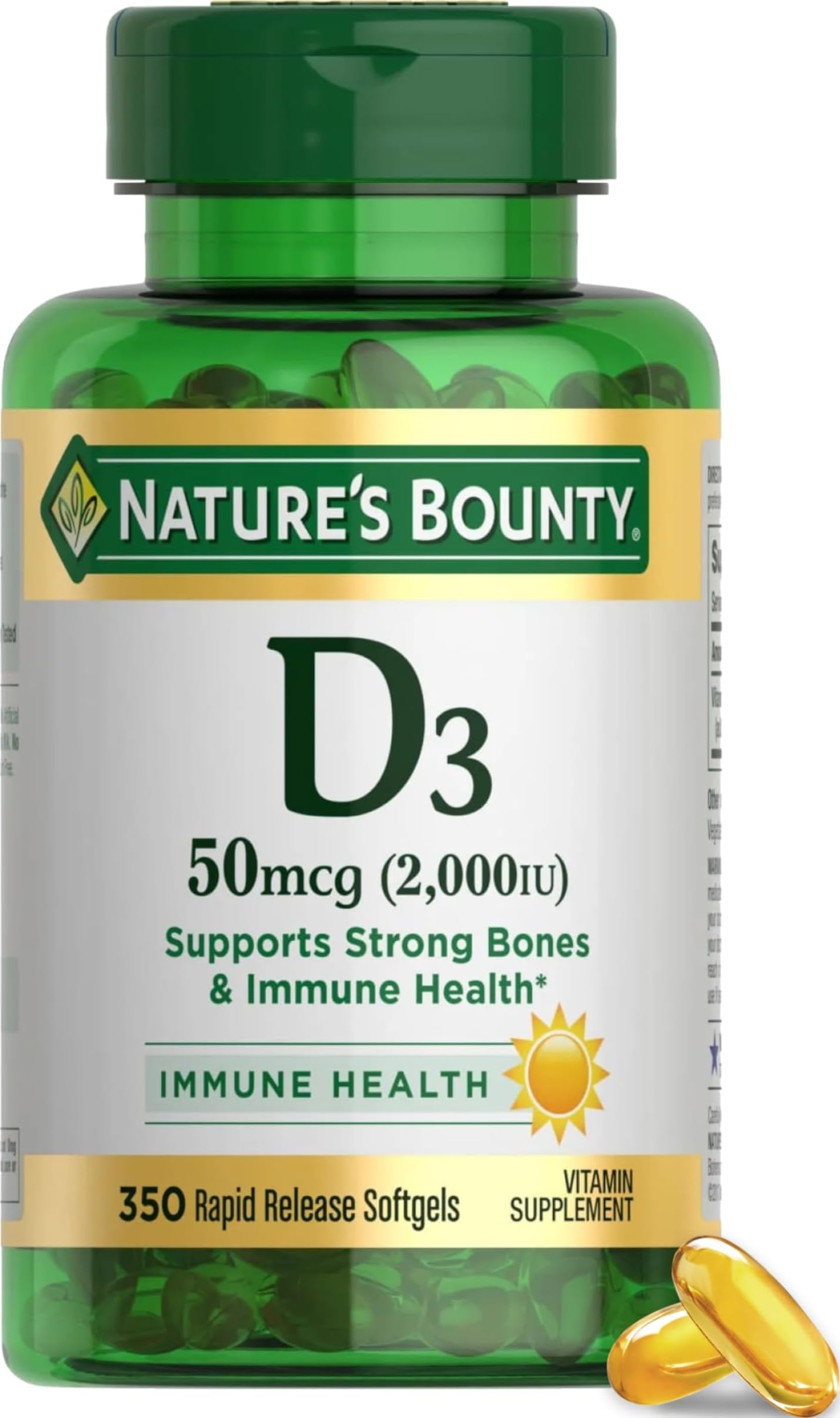
Nature's Bounty Vitamin D3 2000 IU

Nature's Bounty Vitamin D3 2000 IU

Value and supply

Our Score 9.6/10
Check Price

Worth Noting

  • Bottle can smell strong when first opened
Form
Softgel
Count
350 softgels
Potency
2000 IU

Three hundred and fifty softgels is the number that stops us here. At one a day that's nearly a full year from a single bottle, at twice the strength of our top pick, and the capsule is small enough that 2,000 IU doesn't feel like a chore. If you already know you want more than basic maintenance, this is the most days of D3 you can get for your money in this group.

We preferred this size to the smaller bottle of the same softgel for the obvious reason: same capsule, more than twice the days. The formula is non-GMO, gluten- and sugar-free, with no artificial colors or sweeteners, and there's no aftertaste to complain about. Two thousand IU sits in the middle of the over-the-counter range — a step up from 1,000 IU without the clinician's conversation a 5,000 IU bottle asks for. When a reader's question is simply how far a dollar stretches, this is the answer.

Bottom line: The value pick of this group: 2,000 IU in a small softgel, 350 of them in the bottle, for the lowest cost per daily dose on the list.

3

Vitafusion Vitamin D3 Gummies

Vitafusion Vitamin D3 Gummies

Pill avoiders

Our Score 9.6/10
Check Price

Worth Noting

  • Two gummies a day, so a bottle lasts 75 days
Form
Gummy
Count
150 gummies
Potency
2000 IU (50 mcg) per 2 gummies
Daily Supply
75 days

Peach, blackberry and strawberry, and a chew that's soft rather than tacky — these are the D3 gummies we hand to anyone who has quietly given up on pills. Two gummies carry 2,000 IU (50 mcg), which is a real dose rather than a token sprinkle, and the bottle holds 150 of them.

We were braced for candy with a vitamin in it and got something better. The gummies stay soft down to the bottom of the bottle, and the formula skips high-fructose corn syrup, artificial sweeteners and synthetic FD&C dyes, with no gluten and no dairy. That's a longer list of no's than most gummies bother with, and it's the reason these are our gummy pick rather than a compromise.

The trade-off is the format itself. Gummies are what melts: after a warm delivery, a bottle can arrive with the pieces fused into a block. Chill it for an hour and shake it hard and they usually separate; if they don't, send them back. Keep the bottle out of a hot car and away from the stove and you won't meet the problem again.

Bottom line: For anyone who has given up on pills, these are the D3 gummies we hand over: a real 2,000 IU dose in a soft chew that tastes like fruit, not vitamins.

4

NatureWise Vitamin D3 5000 IU

NatureWise Vitamin D3 5000 IU

Higher-dose needs

Our Score 9.6/10
Check Price

Worth Noting

  • One-year supply at a dose you may need to revisit
Count
360 mini softgels
Potency
5000 IU
Carrier Oil
Organic cold-pressed olive oil
Certification
NSF contents certified

NSF contents certified is a phrase that doesn't appear on many bottles in this group. It means an outside body has tested what's inside against what the label claims — accuracy and purity — and on a 5,000 IU product, where the dose is high enough to be worth getting right, that's the detail that made us look twice.

The formula is unusually specific about its carrier, too. The D3 is suspended in organic, cold-pressed olive oil rather than soybean oil, produced without heat or hexanes, and the softgels are gluten-free and made in a US facility that follows cGMP and takes third-party audits. None of that changes what the pill does. It does tell you the manufacturer expects to be checked.

Where this bottle earns its place is the pairing of a high dose with a small pill. 5,000 IU isn't a guess-it-yourself number; it's the strength you take when a lab result says your level is low, and at that dose a horse pill would be hard to live with. This isn't one. The mini softgel goes down as easily as the 1,000 IU capsules we take all year.

The commitment is real: 360 softgels at one a day is a year at 5,000 IU, and most people on that dose are back for a blood test long before the bottle empties. It costs more than the maintenance picks here, which is fair for a certified high-dose bottle — but if you expect your dose to come back down, the 180-count bottle is the smarter buy.

Bottom line: When a blood test says you need more than maintenance, this is the high-dose bottle we reach for: 5,000 IU, mini softgels, and contents certified by NSF.

5

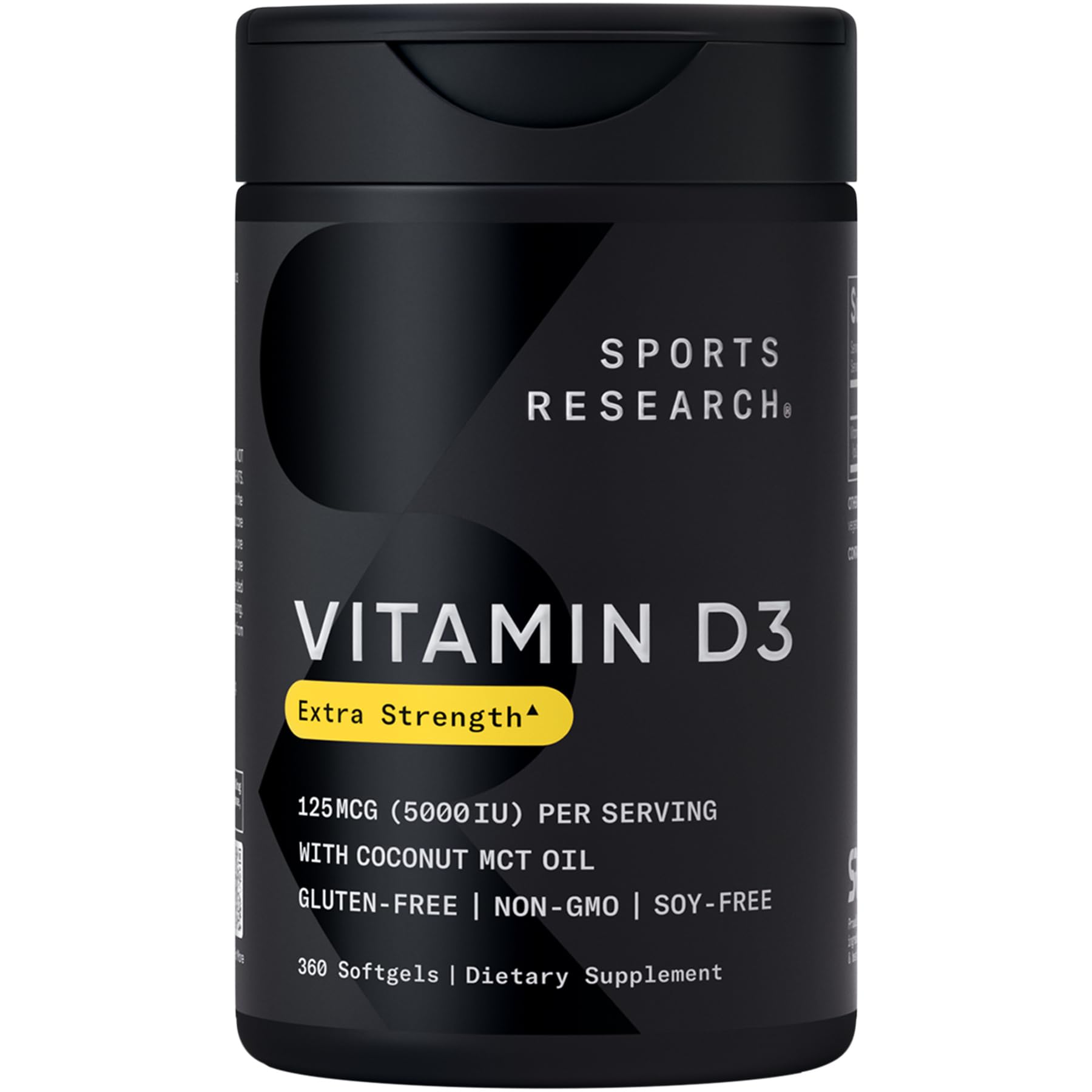
Sports Research Vitamin D3 5000 IU

Sports Research Vitamin D3 5000 IU

Smallest high dose

Our Score 9.6/10
Check Price

Worth Noting

  • Costs more per softgel than our NatureWise pick
Form
Mini softgel
Count
360 mini softgels
Potency
5000 IU (125 mcg)
Carrier Oil
Cold-pressed virgin coconut oil

The softgel we noticed most is the smallest one. Sports Research fits 5,000 IU (125 mcg) into a mini softgel you can take without a second glass of water, and suspends it in cold-pressed virgin coconut oil instead of soybean oil — a detail that matters if you already read labels for soy.

Carrier oils are where these bottles differ most in the hand. Coconut oil is solid in a cool kitchen, and the softgels stay firm and separate in the bottle rather than slick. The label makes the absorption point itself: D3 is fat-soluble, so it wants to be taken with fat, and the coconut oil supplies some of it. We still take ours with breakfast, because a softgel's worth of oil is not a meal's worth of fat.

The catch is cost. Per softgel this runs more than the NatureWise bottle with the same count and the same dose, and what you're paying for is coconut oil rather than olive and a pill built for people who struggle with size. If neither of those details changes your morning, the cheaper certified bottle is the better buy. If coconut oil is the carrier you want and the smallest possible pill is what gets it swallowed, this is the one.

Bottom line: If you want 5,000 IU in a softgel you barely notice swallowing, this coconut-oil version is the one we keep recommending to pill-shy readers.

6

NOW Vitamin D3 2000 IU

NOW Vitamin D3 2000 IU

Restricted diets

Our Score 9.6/10
Check Price

Worth Noting

  • Gelatin softgel, so it isn't vegetarian
Form
Softgel
Count
240 softgels
Dietary
Halal, kosher, gluten-, soy-, corn-, dairy- and egg-free
Potency
2000 IU

Corn free, dairy free, egg free, soy free, made without gluten, non-GMO, halal and kosher — that list is the reason this bottle is in the guide at all. Plenty of D3 softgels are gluten-free and nothing else; this one was built for people whose diet rules out most of the category.

Underneath the checklist it's a straightforward 2,000 IU softgel: 240 to a bottle, eight months at one a day, small and tasteless going down, from a company with its own ISO/IEC-accredited labs and an A-rated third-party certification of its manufacturing.

What we didn't expect was how much difference that checklist makes once you need it. If you keep halal or kosher, or you're managing a soy or corn sensitivity, most D3 bottles quietly rule themselves out and this one doesn't. If none of that applies to you, our value pick simply gives you more days for the money; the NOW bottle is the one that survives the checklist.

Bottom line: Halal, kosher, soy-free, corn-free: if a restricted diet is what makes D3 complicated, this is the bottle that clears the checklist at 2,000 IU.

7

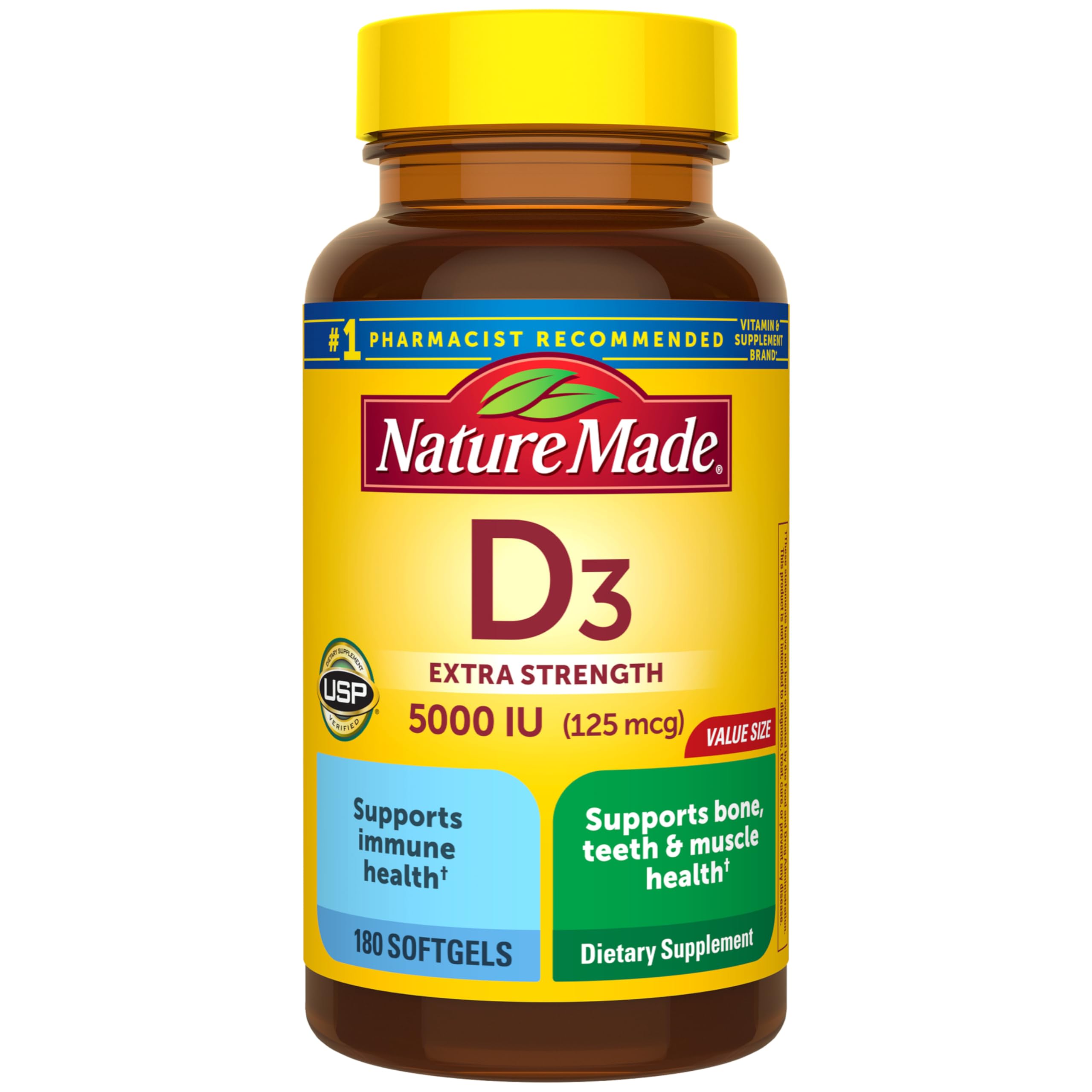
Nature Made Vitamin D3 5000 IU

Nature Made Vitamin D3 5000 IU

Brand familiarity

Our Score 9.6/10
Check Price

Worth Noting

  • Highest cost per softgel of the high-dose picks
Form
Softgel
Count
180 softgels
Potency
5000 IU (125 mcg)
Daily Supply
180 days

Read the third bullet on this bottle and you find the most honest sentence in the category: it's for people with higher vitamin D needs or a deficiency as determined by a healthcare professional. We paid close attention to that line, because it sets the terms for everything else here.

What you get is 5,000 IU (125 mcg) in a small softgel, 180 to the bottle — half a year at one a day — gluten-free, with no color added and no artificial flavors, taken with water and a meal that includes some fat.

The number that gives us pause is cost per dose. This is the most expensive way on this list to take 5,000 IU, above both the NatureWise and Sports Research bottles, and the 180 count means you buy twice as often as you would with either of them.

So why include it? Because a familiar name is not nothing. If the bottle that actually gets opened every morning is the one you already trust from a pharmacy shelf, that's worth more than the difference in cost per dose. We reach for it when brand recognition is what keeps the habit going, and when a 180-day bottle lines up neatly with a follow-up test.

Bottom line: The 5,000 IU bottle for someone who wants a name they already trust, with a label that hands the dosing decision back to a healthcare professional.

How We Chose and Tested Vitamin D3 Supplements

We built the shortlist by pulling every vitamin D3 supplement we could find in the 1,000 to 5,000 IU range, then narrowing to those that named cholecalciferol on the label, printed the dose in both IU and mcg, and carried a third-party testing mark where one was available. From there we filtered by format and price per serving, since a bottle that costs twice as much for half the supply rarely survives a daily habit. Fourteen made it into the test.

Each bottle lived on a kitchen counter for five months and was taken with breakfast, usually something with a little fat in it, because that's how most people actually take a supplement. We kept the gummies in a steamy bathroom for a week to see whether they'd fuse into one lump, packed a few bottles into carry-ons for long weekends, and noted which caps fought back at 6 a.m.

Pill size got measured against a standard multivitamin and against each other, and we swallowed every one with a normal sip of water to see which needed a second gulp. We unscrewed each cap and smelled the contents, then checked whether the odor lingered on our hands or repeated on us afterward. Value came down to cost per 1,000 IU rather than cost per bottle, so a 5,000 IU softgel and a 1,000 IU one could be compared honestly.

Effectiveness is the one thing we can't measure on your behalf, so we treated it as dose clarity plus whether we were still reaching for the bottle in week twelve. The ones that stayed on the counter had small softgels, no smell, and a cap that opened one-handed.

How to Choose a Vitamin D3 Supplement

Pick the dose before the brand

Most women start at 1,000 IU, which is a dose you can take daily on your own judgment, and step up to 2,000 IU if they want more than basic maintenance. 5,000 IU is a different kind of purchase: the labels themselves direct it to people whose need a healthcare professional has determined.

The trap is buying the biggest number because it looks like more value. It isn't if it isn't your dose, and you can't split a softgel to make it smaller. Decide the strength first, then shop that strength — it narrows the field to two or three bottles.

Softgel, mini softgel, or gummy

Form decides whether the habit survives. A softgel is one piece, tasteless, and easy to take with a meal; mini softgels exist for people who genuinely struggle with pills, and they cost nothing in dose — our 5,000 IU picks are both minis.

Gummies solve swallowing at a price: two pieces per serving and a much shorter bottle. Vitafusion's 150-count is 75 days, where a 300-count softgel is 300. Count servings, not pieces, before deciding which looks cheaper.

The carrier oil matters less than the meal

D3 is fat-soluble, so every label here tells you to take it with a meal containing some fat. That instruction does more work than the oil inside the capsule. Olive oil and coconut oil are both fine carriers, and we don't think the difference between them is worth paying much for.

What's worth checking is what isn't in there. NatureWise and Sports Research both skip soybean oil, which matters if you avoid soy. And if your routine is a softgel with black coffee and nothing else, move it to breakfast or dinner.

Check the certification and the exclusions

Look for an outside check on the label. NatureWise carries NSF contents certification, NOW points to an A-rated audit of its manufacturing, and either is more reassuring than a badge the brand invented for itself.

Then scan the allergen and diet lines — gluten, soy, corn, dairy, gelatin, halal and kosher — because that's where most bottles quietly disqualify themselves. If you keep halal or kosher, the softgel shell is the detail that decides it.

Frequently Asked Questions

Final Verdict

If you want one bottle and no fuss, buy the Nature Made 1,000 IU softgels: small, tasteless, 300 days of doses, and a strength you can take on your own judgment. When one requirement changes, the pick changes with it — that's the whole decision.

If a blood test has put you in higher-dose territory, the NatureWise 5,000 IU mini softgel with NSF-certified contents is the one we carry. If swallowing pills is why you've never stuck with D3, the vitafusion gummies are the reason to finally start.