Skincare

Best Mineral Sunscreens of 2026

Mineral sunscreen does its job by sitting on top of your skin — zinc oxide or titanium dioxide scattering UV rays before they get through — which is exactly why it's the default for sensitive skin, eczema, kids, and anyone who has had a chemical filter sting their eyes on a sweaty run. It's also exactly why so many tubes end up abandoned in a beach bag: the ghost-white mask, the greasy sheen, the smell, the way it balls up under makeup. A good mineral formula gives you broad SPF protection without any of that. The trick is finding one you'll actually want to reapply in public.

I've burned through more chalky, chalky-smelling tubes than I'd like to admit, so over the past six months my team and I worked our way through 14 mineral sunscreens — tinted and untinted, face and body, baby formulas and sport ones — on morning runs, in the backyard, and through a week of beach humidity. One thing I learned the hard way: the percentage of zinc on the label tells you almost nothing. How finely the minerals are milled and how they're suspended in the lotion matters far more, which is why a 10 percent formula can feel lighter than a 20 percent one. What follows are the ones worth the shelf space.

1

Blue Lizard Baby Mineral SPF 50+

Top Pick
Blue Lizard Baby Mineral SPF 50+

Babies and families

Our Score 9.6/10
Check Price

Worth Noting

  • Leaves a visible white layer on deeper skin
  • Can turn tacky over a rich moisturizer
SPF
50+
Size
5 oz tube
Formula
Fragrance-free, vegan
Water Resistance
80 minutes

The cap on this tube shifts color in strong sun, which sounds like a gimmick until you're the one deciding whether a toddler has had enough for the afternoon. It's the detail we ended up checking most often, because it answers the reapply question without a phone in a sandy hand.

As a household default, this is the bottle we hand people first. It's a broad-spectrum SPF 50+ mineral lotion, fragrance-free and vegan, with calendula extract and organic aloe doing the soothing, and it delivers the full 80 minutes of water resistance it claims — as high as that claim goes. On a wriggling child the real test is whether a lotion covers a shoulder before they twist away, and this one spreads thinner and faster than most mineral lotions we tried.

The trade-off is visual. On deeper skin tones the untinted formula can leave a visible white layer, and over a rich moisturizer it can turn tacky before it settles. At a pool or on a beach neither matters much, because a faint haze is what you accept in exchange for zinc staying put; both matter if you want to wear this to the office.

What surprised us is how little it takes. A thin layer covers far more than expected, which is the quiet reason a 5 oz tube keeps outlasting the fancier bottles in the cabinet — this is not a product you have to ration.

Bottom line: We point friends with young children here first: it's gentle enough for an infant, fragrance-free, and holds its water resistance, with the spreadable texture that keeps a wriggling toddler covered.

2

TiZO3 Facial Mineral Primer SPF 40

TiZO3 Facial Mineral Primer SPF 40

Matte makeup base

Our Score 9.4/10
Check Price

Worth Noting

  • Single sheer tint, not a real shade range
SPF
40
Finish
Sheer matte tint
UVA Rating
PA+++
Water Resistance
80 minutes

A mineral sunscreen that dries down matte and holds makeup in place is rare enough that we noticed it within the first minute of wearing it. It goes on like a silicone primer — silky, faintly blurring — and it stays that way instead of sliding into shine by mid-afternoon.

The spec sheet explains part of it: SPF 40 with a PA+++ UVA rating and 80 minutes of water resistance, in a formula with no chemical filters, dyes, fragrance, oils, or preservatives. The sheer tint does the rest, cutting the ghostly cast that makes most zinc formulas hard to wear and blurring redness without looking like foundation.

The catch is choice. One sheer shade has to serve every skin tone, and it disappears most completely on the fair-to-medium end — deeper complexions get a light veil rather than a match. If a real shade range matters to you, our Colorescience pick is the better conversation.

Where it earns its keep is on the mornings you'd otherwise skip sunscreen because you're putting on makeup anyway. This replaces the primer step instead of adding to it, and a small amount covers a full face.

Bottom line: If your sunscreen has to disappear under makeup, this is the one we recommend: a sheer matte tint that doubles as a primer and never leaves a cast.

3

Thinkbaby SPF 50+ Sunscreen

Thinkbaby SPF 50+ Sunscreen

Big family bottle

Our Score 9.2/10
Check Price

Worth Noting

  • Leaves a white film until fully rubbed in
SPF
50+
Size
6 oz tube
Free From
PABA, parabens, phthalates, BPA
Recommended Age
6 months to 5 years

Open the tube and you get coconut — a real, mild coconut rather than a perfume counter, which is an odd thing to enjoy in a baby product and the reason we kept reaching for it on ourselves. It's also the first hint that this isn't the chalky, unscented paste people brace for.

For a family that goes through sunscreen fast, the 6 oz tube and the spreadability are the selling points. It's SPF 50+, water resistant, and free of PABA, parabens, phthalates, and BPA, and it rubs in without the tug-of-war most zinc lotions put up. It doesn't sting eyes either, which matters more than any label once a kid is wiping their face with a sandy hand.

Thickness is where the split happens. That body is exactly what you want in the sun — it stays where you put it — but it takes a proper washcloth and body wash at bath time, and a thin film can linger at the hairline after a first pass.

Adults wearing it under makeup will find it settles once it dries, which is more than most baby formulas manage, and 6 oz means you're not rationing it across three children and a beach bag.

Bottom line: Buy it when one bottle has to cover several kids and a couple of adults — the coconut scent and easy spread are why ours got used up first.

4

Coppertone Sport Mineral SPF 50

Coppertone Sport Mineral SPF 50

Sport and travel

Our Score 9.4/10
Check Price

Worth Noting

  • Leaves a white film until worked in
  • Lotiony finish feels heavy in humidity
SPF
50
Size
5 fl oz
Free From
Oxybenzone, octinoxate, PABA, parabens, phthalates, dyes, fragrances
Active Filter
Zinc oxide

Mineral sunscreen and a sweaty afternoon are usually a bad match, so we were skeptical of a zinc-only sport formula. This one holds: it stayed where we put it through a long, sticky stretch outdoors instead of running into the eyes or balling up at the hairline.

The formula is naturally sourced zinc oxide at SPF 50, free of oxybenzone, octinoxate, PABA, parabens, phthalates, dyes, and fragrances, and it rubs in more easily than a sports sunscreen has any right to. The 5 fl oz tube is the right shape for a gym bag, a glove box, or a hiking pack, and it's the one we'd hand someone who wants a single bottle for arms, shoulders, and a nose.

Where it gives ground is looks. It isn't invisible — worked in fast it's fine on light skin, less so on deep skin tones — and the finish is lotiony, so it's a body product first and a face product by necessity. For a run or a day on the water the trade is worth it; for a workday, reach for something tinted.

Buy two if you can. A sport sunscreen is only useful when there's one within reach, and this is the tube that lives in the car without being missed.

Bottom line: Our pick for heat, sweat, and long days outdoors: zinc-only protection that spreads fast and stays put, as long as you're not fussy about a body lotion finish.

5

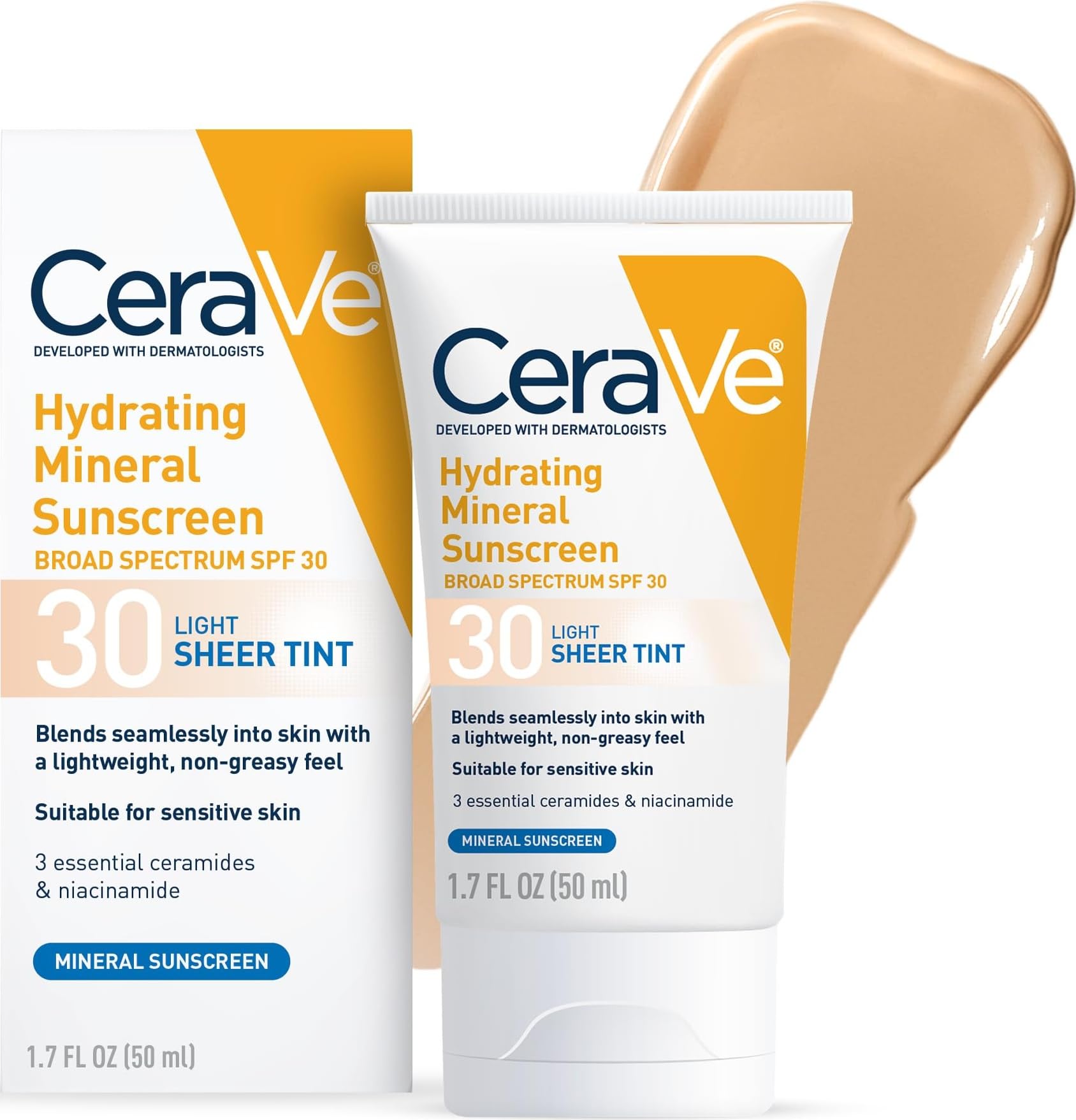
CeraVe Tinted Mineral SPF 30

CeraVe Tinted Mineral SPF 30

Budget daily tint

Our Score 8.8/10
Check Price

Worth Noting

  • Shades run warm and can pull orange
SPF
30
Size
1.7 oz
Shades
3 tinted shades
Filters
Zinc oxide, titanium dioxide

Three tinted shades is unusual at this level, and it changes how you shop: instead of accepting whatever a universal tint does to your face, you pick a depth and adjust. They're sheer enough that the wrong guess isn't fatal, but they run warm, so lighter skin tones should err downward.

What's in the tube is why it's worth the fiddling. Alongside zinc oxide and titanium dioxide you get ceramides, niacinamide, and hyaluronic acid, the same supporting cast as CeraVe's moisturizers, and it feels like one: creamy, hydrating, and dewy rather than powdery. Oily skin will feel that by lunchtime; dry skin will be grateful for it.

We rate it the best value among the tinted face options here, with one honest caveat. SPF 30 is the lowest number in this group. For a commute, a school run, or lunch outside that's plenty, but it isn't the bottle to take to the beach.

The tint is built on iron oxides, which is the ingredient to look for if you're protecting against pigmentation as well as sunburn — a detail that matters more than the SPF gap for anyone prone to melasma.

Bottom line: For daily tinted protection on a budget, this is our pick — choose a shade lighter than you think and expect a dewy finish that oily skin won't love.

6

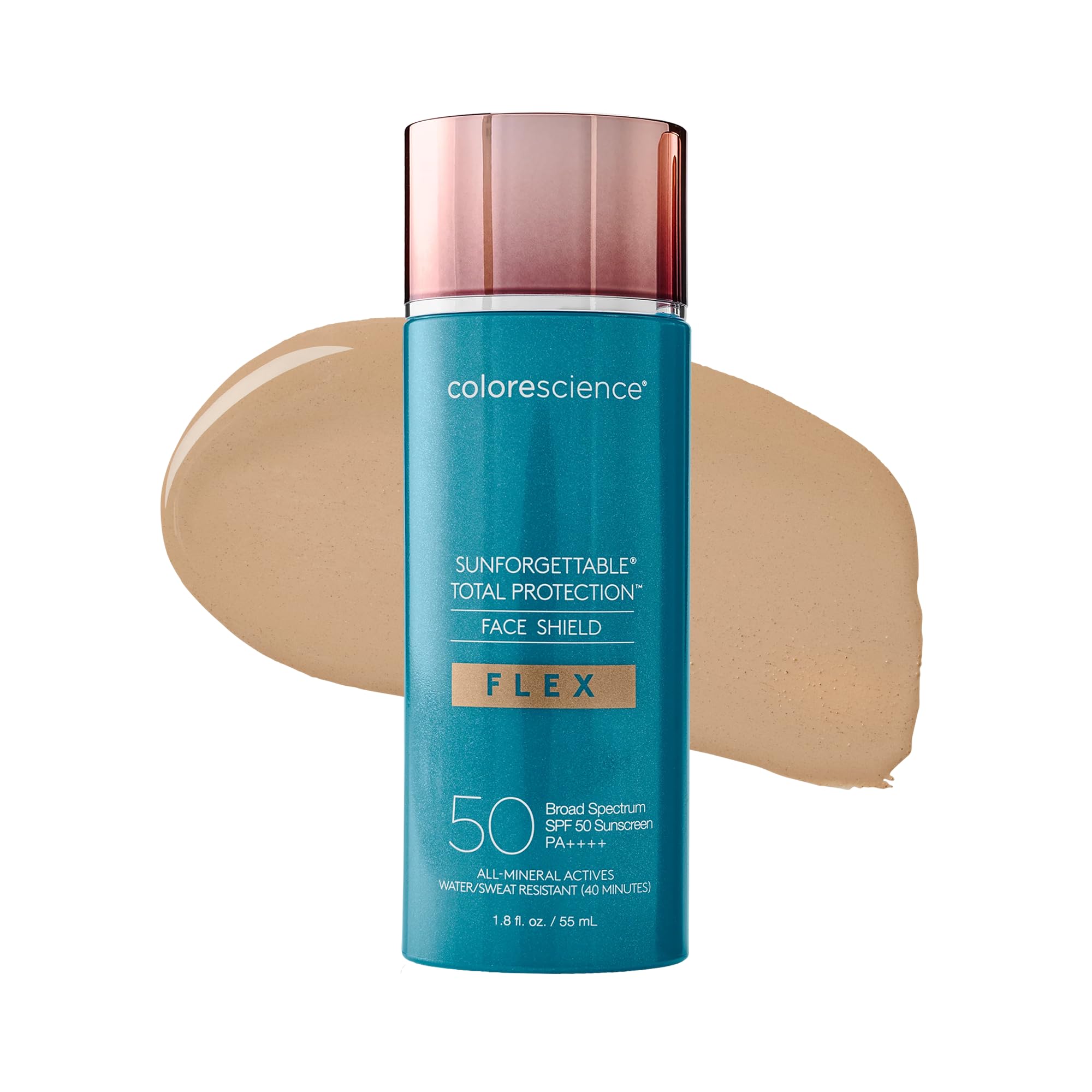
Colorescience Face Shield Flex SPF 50

Colorescience Face Shield Flex SPF 50

Full-coverage tint

Our Score 9.0/10
Check Price

Worth Noting

  • Can pull orange on cooler skin tones
  • Transfers onto collars and screens
SPF
50
Finish
Demi-matte
Shades
Six adaptive shades
Coverage
Buildable medium

This is the closest thing here to foundation with a sunscreen label. It comes out of the tube pale and adapts as you blend, building to a medium coverage that evens out redness and shadow without reading as a mask.

Six adaptive shades is a real range for a mineral formula, and the iron oxide pigments do double duty: they're what kills the white cast, and they're why the coverage holds up in daylight. The finish is demi-matte, so it stands up to a warm afternoon better than a dewy tint.

We rate it the best coverage in this group and the pick for anyone who wants to skip foundation entirely. It asks for a proper base underneath, though: on dry or flaking patches it catches, and oily skin can find it sliding by late afternoon.

You need less than you'd think — a few thin lines across the cheeks and forehead cover a full face — so the small bottle goes further than the size suggests, which is the argument for buying it once rather than three times.

Bottom line: This is the one to buy if you'd rather wear coverage than a veil — six adaptive shades, a demi-matte finish, and enough pigment to replace foundation.

7

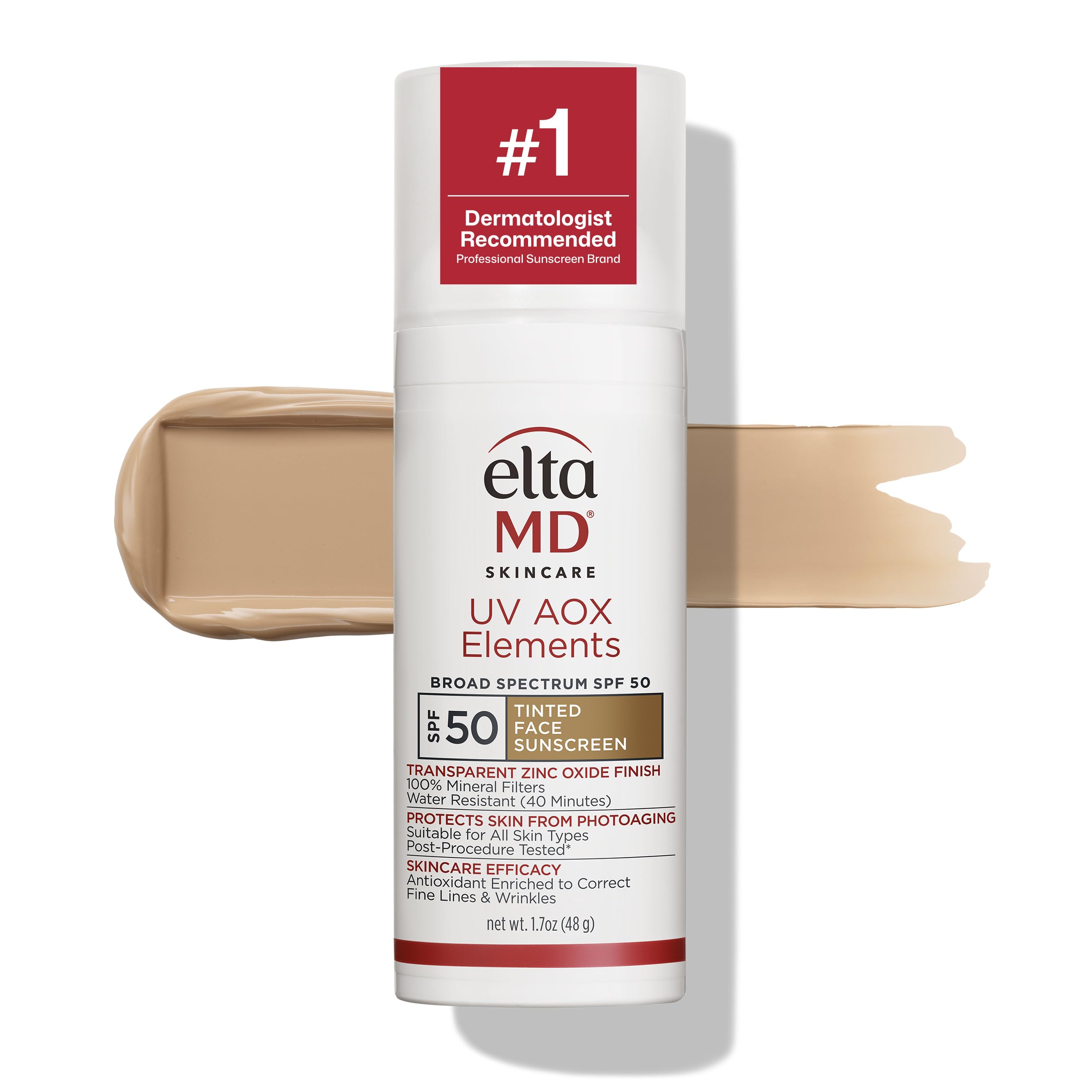
EltaMD UV AOX Elements SPF 50

EltaMD UV AOX Elements SPF 50

Dry, sensitive skin

Our Score 9.2/10
Check Price

Worth Noting

  • One tint that runs dark on fair skin
SPF
50
Size
1.7 oz
Filters
Titanium dioxide, zinc oxide
Coverage
Medium tinted

Dry, reactive skin is the hardest to shop for in mineral sunscreen: zinc dries, tints grab, and fragrance sets off the redness you were trying to cover. UV AOX Elements is built for that skin, with hyaluronic acid, bisabolol, and ginger root extract sitting alongside titanium dioxide and zinc oxide, and no fragrance, dye, or oil in the formula.

The finish is creamy and moisturizing, closer to a tinted moisturizer than a primer, with enough pigment to soften redness. We had the best luck over a light serum rather than a heavy cream, because the formula is rich enough that anything else underneath pushes it toward shine.

Its protection numbers are the most complete here: SPF 50, both mineral actives, a water-resistant formula, and antioxidants aimed at environmental stress. That combination is why it ends up on the shortlist for anyone who burns easily and reacts to everything.

Our reservation is the tint. There's one shade, it's aimed at medium skin, and on fair complexions it can read several steps too dark; on deep skin it isn't a match at all. If that's you, the sheerer tint of TiZO3 or the six shades of Colorescience solve it. Otherwise this is the most comfortable SPF 50 face formula here for skin that complains.

Bottom line: We recommend it for dry, easily irritated skin that needs SPF 50: the creaminess is the point, and the single tint is the reason to look elsewhere if you're fair or deep.

8

Baby Bum Mineral SPF 50 Lotion

Baby Bum Mineral SPF 50 Lotion

Diaper-bag size

Our Score 9.4/10
Check Price

Worth Noting

  • Leaves white residue unless worked in thoroughly
SPF
50
Size
3 oz
Formula
Vegan, cruelty-free
Active Filter
Zinc oxide

A 3 oz tube is the size that actually gets used. It fits a diaper bag pocket, a stroller basket, or the glove box, and it's the one we'd take on a short trip rather than wrestling the family-size bottle into a tote.

The formula is zinc oxide plus coconut oil, shea butter, and cocoa butter — vegan, cruelty-free, pediatrician and dermatologist tested, and unscented. It spreads more easily than a pure zinc paste, though it isn't the slickest lotion in this group, and the butters leave skin soft rather than tight after a day in chlorine.

Protection is solid at SPF 50 with the standard reapply-after-80-minutes-of-swimming instruction, and the recommended age runs from 6 months to the teenage years, so one tube covers a family of children instead of a single age bracket.

Where we hesitate is reactive skin. A mineral-and-butter formula is a lot for a baby who's already rash-prone, and it can bring out a reaction on a child who's sensitive to plant oils, so patch test an arm the day before you rely on it at the beach. For a toddler with unremarkable skin, it's a good tube to keep packed.

Bottom line: A good small tube for the diaper bag, especially for kids with unremarkable skin — unscented, easy to spread, and gentle enough for regular use.

How We Tested the Mineral Sunscreens

We started with a list of roughly 50 formulas and read every ingredient panel. Anything marketed as mineral but still hiding a chemical filter got cut, as did anything that couldn't document broad-spectrum coverage or water resistance where it claimed it. From there we filtered by price per ounce, SPF level, whether an option came in tinted and untinted versions, and whether it was fragrance-free — which narrowed things to 14 contenders. We deliberately included a few baby formulas, a few sport-oriented lotions, and several tinted face options, since those are shopped for different reasons even though they sit on the same shelf.

Testing ran for six months and happened where sunscreen actually gets used: school-morning faces before camp, a 5-mile run in full sun, a Saturday of yard work, an afternoon at the pool with reapplication every two hours, and a humid beach week where everything in the bag got hot. I also wore several of the tinted ones to the office under foundation to see which ones pill, and handed tubes to testers with a range of skin tones so the white-cast question wasn't answered by the fairest person in the room.

We noted how long each one took to rub in and whether it left a visible film, then checked back after 20 minutes and again after four hours. Greasiness got judged with a tissue pressed to the forehead and by how quickly a phone screen picked up fingerprints. Sun protection was tracked honestly — burn checks after long exposures, and whether protection survived a swim. For stain removal, we smeared each formula on white cotton T-shirts and car seat fabric, let it sit overnight, and washed normally to see what came out. Value came down to cost per ounce plus how many full-body applications a tube actually delivered, and consistency meant watching whether a tube separated or turned gritty after a hot afternoon in the car. Fragrance and moisturizing were simpler: did anyone wince at the smell, and did dry shins still feel tight an hour later.

The formulas that rose to the top shared a few traits — they sank in fast, held their texture in heat, and didn't leave a cast on deeper skin tones. The rest are still in the rotation and we'll update as we keep using them.

How to Choose a Mineral Sunscreen

Check the filters, then stop chasing SPF

Every product here relies on zinc oxide, titanium dioxide, or both. That's what makes a sunscreen mineral: the filters sit on the surface and deflect UV rather than absorbing it the way avobenzone or oxybenzone do.

The SPF gap is smaller than it looks. SPF 50 filters roughly 98% of UVB and SPF 30 a touch less, so the difference between reapplying and not reapplying is bigger than the difference between the two numbers. We'd rather you buy a formula you'll actually reapply than pay more for a 50 you'll wear once.

Decide whether you need a face formula or a body formula

A 5 or 6 oz body lotion is how you cover shoulders, arms, and legs without wincing, and a 1.7 oz face formula is what disappears under makeup. The trap is swapping them: a body lotion on your face is usually thicker and shinier, and a face formula will not stretch across a family.

If you use sunscreen daily, budget for both. Our top pick covers the household and the beach bag; a tinted face formula covers the mornings when you'd otherwise skip it.

Work out what the tint will do on your skin

Iron oxides are why a tinted mineral sunscreen can hide a white cast, and they're also the reason a tint can help with visible-light pigmentation. What they can't do is suit everyone from one tube.

Be suspicious of a universal shade. If you're fair or deep, look for a real range — three shades at minimum, six if you want coverage — and when a tint runs warm, choose a shade lighter than you think you need.

Match the format and water resistance to how you'll use it

Water resistance is a labeled claim with a time attached, and 80 minutes is as high as it goes. That's the number to look for if there's a pool, an ocean, or a long sweaty afternoon in your week; for commuting and errands, it's not the deciding spec.

Lotions give the most reliable coverage and tubes travel best, which is why almost everything here is one. Whatever you choose, the reapplication rule doesn't change: every two hours, and again the moment you towel off.

Frequently Asked Questions

Final Verdict

Most people want one bottle that works for the whole household, and the Blue Lizard Baby Mineral Sunscreen is that bottle: gentle enough for an infant, fragrance-free, water resistant for the full 80 minutes, and thin enough to spread over a wriggling child. It's the one we'd buy first.

If your sunscreen is really a daily face product, the decision splits. TiZO3 gives you a matte, primer-like finish with no white cast; EltaMD UV AOX Elements is the kinder choice for dry, reactive skin; Colorescience is the one to take if you'd rather have coverage than a veil.