Fashion

Best Lab Coats for Women of 2026

A lab coat is one of the few work garments you buy sight unseen, and the gamble shows up fast — shoulders that fit but sleeves that swallow your hands, a length that lands right until you sit down, buttons that gape the moment you reach for a shelf. What a good one fixes is everything else about your shift: it keeps whatever's on the bench off your clothes, holds a phone, two pens, and a pair of gloves, and still looks crisp after its twentieth wash. Get the fabric and the fit right and the coat disappears into your day.

I've worn these through long clinic days and washed enough of them to know the cheap ones go limp and gray within a month. Over the past six months, my team and I put 12 women's lab coats through actual shifts, from morning rounds to late charting, and the gaps between them were obvious. One thing I've learned the hard way: sleeve length can be tailored, but only if there's enough fabric turned under the cuff to let it out. The coats below are the ones we kept reaching for.

1

Healing Hands Flo Lab Coat

Top Pick
Healing Hands Flo Lab Coat

Everyday clinical wear

Our Score 9.4/10
Check Price

Worth Noting

  • Runs a size large
Cut
Women's
Fabric
Soft stretch
Pockets
4

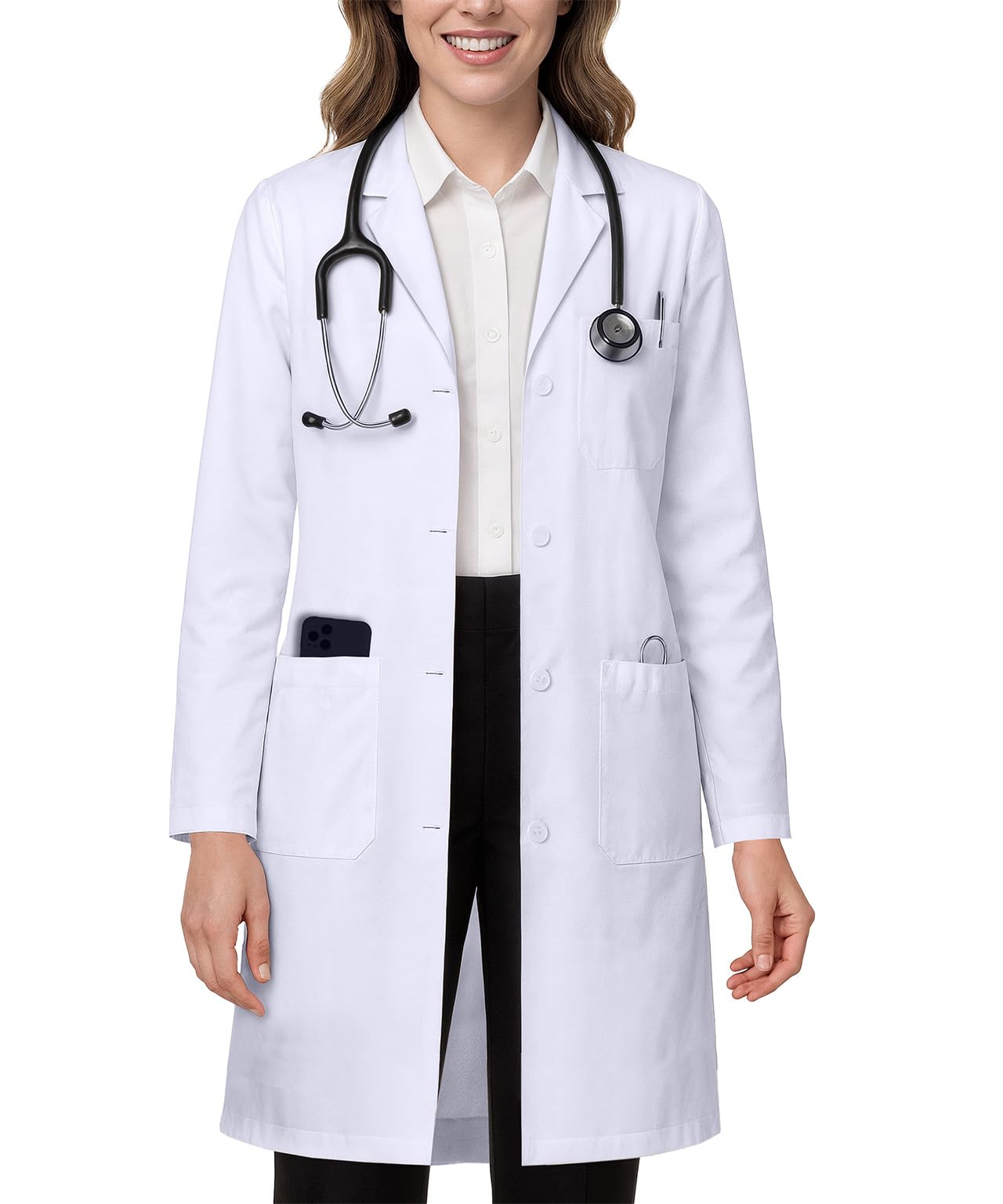
The fabric is what you notice first: a soft, slightly brushed stretch that feels closer to a good scrub top than to the crisp cotton coats this category is known for. It drapes rather than standing away from the body, and it stays opaque under bright lab lighting, which several cheaper white coats here don't manage. Four pockets sit where your hands go, and the two lower ones are deep enough for a folded clipboard or a phone.

That combination is why it's our top pick. Of everything here, it's the coat that asks the least of you: wash it, dry it, and it comes out ready to wear with no ironing and no steaming. The white holds its brightness, the stretch gives you room to reach across a bench or help a patient up, and it reads as clothing rather than a uniform requirement.

The sleeves are our one hesitation for shorter wearers. Around 5 feet, expect them to reach past your wrist until you turn them up, which the soft fabric makes easy and which nobody will notice. Otherwise the fit is generous without being baggy, and the coat keeps its shape from the start of a shift to the end of it.

It sits in the middle of the price range here — more than the budget coats, less than the most expensive one — and the difference buys fabric and finish rather than a label. If you wear a lab coat several days a week, that's exactly where the money should go.

Bottom line: If you want one lab coat you can wash, dry, and wear without fuss, this is the one we recommend — soft, opaque, and smart enough for clinicals.

2

Grey's Anatomy Hannah Lab Coat

Grey's Anatomy Hannah Lab Coat

Polished professional look

Our Score 9.2/10
Check Price

Worth Noting

  • Sleeves run short on long arms
Cut
Women's
Fit
Classic
Length
31.5 inches

A 31.5-inch coat that narrows slightly at the waist and flares over the hip does something a unisex pattern can't: it makes a white lab coat look like it was cut for you. This is the most polished coat in this group, and it's the one we point to when someone wants to look established rather than borrowed. The hem lands around mid-thigh on most frames — long enough to cover a scrub top, short enough to walk in without thinking about it.

The fabric carries a lot of that impression. It's thick and soft with some give, so it holds its shape across a long shift without feeling like cardboard, and it steams smooth in a few minutes instead of demanding an ironing board. The pockets are deep, the front closes cleanly over a layer underneath, and the white is very slightly warm rather than blue-white, which reads a little more expensive than the budget coats.

It's also the most expensive coat here, and the sizing runs large, so check the measurement chart and plan to go down a size if you're between. What you're paying for is fabric and shape that will still look right after a few years of wear; if you need something for a single semester, the cheaper picks make more sense.

Bottom line: The coat to buy when you want to look polished at work: thick fabric, a shaped waist, and deep pockets that stand up to daily wear.

3

Dickies 37-Inch Twill Lab Coat

Dickies 37-Inch Twill Lab Coat

Full-length coverage

Our Score 9.0/10
Check Price

Worth Noting

  • Runs small through the chest and shoulders
Fit
Contemporary
Fabric
Twill
Length
37 inches

Thirty-seven inches is a lot of coat. On most people this one lands somewhere around the knee, which is the difference between a layer that covers your scrub top and one that covers your lap, your thighs, and whatever you're leaning against. If your day involves perching on a stool at a bench, bending over a teaching demo, or walking between rooms, that extra length earns its keep.

The fabric is a cotton twill with a brushed finish — thick enough that a colored shirt doesn't show through, sturdy enough to hold a crease, and soft enough that it doesn't feel like a horse blanket. The pockets are the other reason we like it: two slanted hip pockets, a pen setup in the right one, and a small pager-style pocket. It washes well and the wrinkles fall out with a quick steam.

For full-day clinical work, this is the coat we reach for when coverage matters more than a tailored line. It runs slightly small through the chest and shoulders, so size up if you plan to layer underneath, and the contemporary cut is straighter than the Grey's Anatomy coat — you get some shape, but not a nipped waist. It's a workhorse, not a statement.

Bottom line: Our pick for maximum coverage: a heavy twill coat that protects your clothes, holds its shape, and takes repeated washing in stride.

4

Adar 28-Inch Tab-Waist Lab Coat

Adar 28-Inch Tab-Waist Lab Coat

Warm exam rooms

Our Score 9.0/10
Check Price

Worth Noting

  • Thin enough that a colored shirt can show
Fit
Tab-waist
Fabric
Stretch
Length
28 inches

The tab at the back is the detail that makes this coat. It pulls in the waist so the 28-inch cut falls in a straight line instead of hanging like a smock — short coats often look like an afterthought, and this one doesn't. The hem sits around the hip, which keeps it clear when you're at a desk, at a keyboard, or moving between exam rooms.

We like it most for warm rooms and desk-heavy days. The stretch is the real story: it moves when you reach up or twist, and it stops the coat pulling across the shoulders. The pockets hold a stethoscope, pens, and a badge without sagging, and the fabric is light enough to wear through a summer shift without overheating.

It wrinkles. Pull it from the wash and it needs a pass with an iron before it looks sharp, which is the trade for the stretch and the light weight. If you want a coat you can take straight from the dryer to the floor, this isn't it; if you don't mind the iron, it's the sharpest short coat in this group.

Bottom line: A short, stretchy coat for warm rooms and desk work — tailored-looking, comfortable, and willing to take an iron once a week.

5

Cherokee CK451 Lab Coat

Cherokee CK451 Lab Coat

Petite everyday wear

Our Score 8.8/10
Check Price

Worth Noting

  • Thin fabric that looks inexpensive
Care
Easy care
Lengths
28 and 30 inches
Pockets
3

Petite frames get a raw deal in this category: the sleeves run long, the shoulders sit wide, and the hem lands somewhere near the knee. This coat is cut for the other end of the height chart. It comes in 28- and 30-inch versions, and on someone around 5 foot 1 to 5 foot 3 it lands where a lab coat should — covering the hip and the top of the thigh without swallowing you.

It's also the least fussy coat here to keep clean. It resists wrinkles, washes and hangs without much attention, and stays presentable through a week of shifts. If you're on a rotation or in a job where the same coat goes through the machine twice a week, that's worth more than a slightly heavier fabric.

The pockets are big and easy to reach, the material is light and breathable, and it layers over a long-sleeve tee without feeling tight. Because it comes in two lengths, you can choose the one that suits your height instead of hemming a coat that was never cut for you.

For anyone under about 5 foot 4 who'd rather not think about their lab coat between washes, this is our pick. It does its best work in clinics, classrooms, and offices, where the coat is a barrier layer rather than a piece of armor.

Bottom line: The easy-care choice for shorter frames — wrinkle-resistant, light, and cut so the sleeves and hem land where they should.

6

NY Threads Side-Slit Lab Coat

NY Threads Side-Slit Lab Coat

Budget lab classes

Our Score 8.8/10
Check Price

Worth Noting

  • Runs large, with wide sleeves
Cut
Women's
Pockets
3
Pocket Access
Side slits

The detail that sold us is the side slits: they sit at the pocket line, so you can reach your own scrub or trouser pockets without unbuttoning the coat. If your phone, keys, or badge live on your body rather than in the coat, that's a small thing you'll use twenty times a shift. At the budget end of this group, it's the coat we recommend first for lab classes.

The fabric is soft and breathable, with more drape than the stiffer budget coats, and it comes through a wash without shrinking or going stiff. Three pockets handle a pen, a notebook, and a phone, and the finish looks tidier than the price would suggest. Sleeve length lands well on an average arm, which is not a given here.

Where it stops being enough is a clinical floor where the coat has to look structured all day; it's a soft, unfitted coat and it reads that way. For classes, teaching labs, and anyone who needs a clean white coat by the start of the semester, it's plenty.

Bottom line: Our budget pick: a soft, breathable coat with side slits that let you reach your own pockets — ideal for lab classes and teaching.

7

Utopia Wear Mid-Length Lab Coat

Utopia Wear Mid-Length Lab Coat

Classroom lab days

Our Score 8.8/10
Check Price

Worth Noting

  • Sizing runs big and inconsistent
Cut
Women's
Length
Mid length
Sleeve
Long sleeve

The fabric is the surprise here. It's heavier than most coats at this end of the price range, with a canvas-like hand that hangs straight and hides whatever you're wearing underneath. That weight is why it works for science teachers and lab classes: it feels like a proper lab coat rather than a thin white layer.

The mid length puts the hem around the hip on most people, a useful middle ground if you can't decide between a short consultation coat and a long one. Long sleeves give full arm coverage, and the roomy cut leaves space for a sweater underneath on a cold morning.

Get the size right and it's a lot of coat for the money — heavier than the other budget options here and better looking in a classroom than its price suggests. If you want something that reads as professional for a teaching demo or a first rotation, this one holds up.

Bottom line: A budget coat with a heavier, more substantial fabric than the price suggests — the pick when you want a straight mid-length cut for very little.

8

Natural Uniforms 40-Inch Lab Coat

Natural Uniforms 40-Inch Lab Coat

Long unisex coverage

Our Score 8.8/10
Check Price

Worth Noting

  • Stiff, rough fabric out of the bag
Fit
Unisex
Length
40 inches
Sleeve
Long sleeve

This is a unisex coat, and it fits like one: straight through the body, wide across the shoulders, with sleeves cut for a longer arm. If you want a coat that follows your shape, this isn't it. If you want a plain white barrier layer that covers as much of you as possible for as little as possible, it gives you more coat for the money than anything else here.

Forty inches is the longest in this group. On most people it falls below the knee, which means full coverage over street clothes — useful for a lab class, a demo, or a day spent moving between a bench and a hallway. A fastener at the back lets you pull the waist in a little if the straight cut feels too wide.

The upkeep takes some adjusting. It doesn't iron well, so steam it rather than pressing it, and the sleeves are long and wide enough that shorter wearers will be rolling them. The overall look is borrowed-from-the-stockroom rather than cut for a person, which is the price of a coat this long at this end of the range.

For a first lab class or a backup coat you don't have to worry about, it makes sense: long, inexpensive, and simple to fasten with buttons that work in a hurry. Go in knowing you're buying coverage rather than tailoring, and it does exactly what you paid for.

Bottom line: The cheapest route to full-length coverage — a long, plain, unisex coat for lab classes and backup duty, not for a tailored look.

How We Tested Women's Lab Coats

We started with a long list of more than 30 women's lab coats pulled from scrub shops, uniform suppliers, and the big retailers, then filtered by fabric content, length, pocket layout, size range, and price until 12 were left. Every one was ordered in the size we'd normally wear so we could check it against its own brand's size chart rather than against the other coats.

Those 12 coats went to work — a hospital clinic, a university teaching lab, and a small veterinary practice — worn by a med student on rotation, a research tech, and a vet assistant over six months. We noted where the sleeves landed with arms at the sides and how far they rode up reaching for a shelf overhead, how each coat behaved through an hour of seated charting, and whether the buttons gaped at the bust or pulled across the hips. Pockets got loaded the way they do in real life (phone, two pens, folded gloves, a pocket notebook) to see if seams strained or the whole coat sagged. We also mixed short consultation cuts with longer coats to judge which read as polished and which looked like a dressing gown.

Every coat went through weekly laundering per its care label, and we tracked shrinkage, pilling, and the grayish cast that cheap white fabric picks up after a dozen washes, dabbing coffee and saline on cuffs and pockets to see what came out. For wrinkle resistance, one of each was hung overnight while a duplicate was folded into a duffel, then the two were compared at 7 a.m. At the end, we set each coat's cost against the number of wears it had survived.

How to Choose a Women's Lab Coat

Start With the Cut, Then the Size

A women's pattern is shaped through the waist and shoulder, while a unisex coat is cut straight and looks wide no matter which size you order. If you want a coat that reads as professional rather than borrowed, buy the women's cut; that single choice changes more than any pocket or fabric detail here. Then check the brand's measurement chart, because these coats run all over the place: the Grey's Anatomy coat runs large enough that many buyers step down a size, while the Dickies twill runs slightly small through the chest.

Match the Length to the Work

Short coats such as the 28-inch Adar, and the Cherokee in its shorter version, end around the hip and suit warm rooms, desk work, and long stretches of sitting. Longer coats, from the 31.5-inch Grey's Anatomy up to the 40-inch Natural Uniforms, cover more of your clothes and make better sense for bench work, teaching, and settings where splashes are part of the day. Petite wearers should treat length and sleeve together: a long coat on a short frame is long in the arm too.

Weigh Fabric Against Your Laundry

Thick cotton twill keeps its shape, stays opaque, and looks the most professional, but it holds warmth and takes longer to dry. Stretch blends move with you and need less ironing, though the lighter ones can go faintly translucent under bright overhead light. Be honest about the iron: the Adar wrinkles and needs pressing to look sharp, while the Cherokee and the Healing Hands coat come out of the dryer presentable. If you won't iron, don't buy the coat that demands it.

Count the Pockets You'll Actually Use

Two deep lower pockets and a chest pocket cover most jobs. Depth matters more than number: a pocket that swallows a folded clipboard or a stethoscope without sagging is worth two shallow ones that spill a pen every time you bend. If your phone and badge live in your own trousers or scrubs, look for side slits at the pocket line, like the ones on the NY Threads coat, so you can reach them without unbuttoning.

Decide What the Price Is Buying

The least expensive coats here are perfectly serviceable for a semester of classes, and a couple of them use heavier fabric than the mid-priced options. Moving up the range buys stretch, better shaping, and tidier finishing. At the top you're paying for thick fabric and a tailored cut that will still look right after a few years of wear. If you'll wear it three or more days a week, spend once and stop thinking about it.

Frequently Asked Questions

Final Verdict

The Healing Hands Flo is the coat we recommend to most people: soft, opaque, easy to wash and wear, with four pockets that hold what a shift requires. If a polished look matters more than a soft hand and the budget stretches, the Grey's Anatomy Hannah is the better-looking coat, with a shaped waist and thicker fabric.

Buy a cheaper coat when the timeline is short — a semester, a rotation, a backup that lives in a locker — and don't apologise for it. Just get the size right before the first lab.