Makeup

Best Foundation Brushes for Liquid Foundation of 2026

A foundation brush has one job: make liquid base look like skin, not like it was applied with a spatula. The wrong brush drinks up product, leaves streaks, or turns a five-minute routine into a buffing session. The right one spreads foundation evenly, blends around the nose and jaw without lifting texture, and still feels soft enough that you don't dread using it. It also has to survive regular washing without turning into a shedding, splayed mess.

I've tested plenty of brushes that felt lovely in the package and went scratchy after two washes. Over six months, my team and I used 14 foundation brushes on real mornings—rushed workdays, weekend full-coverage tests, and the occasional bare-face day—and the differences came down to bristle density, flexibility, how much product each one held onto, and whether each brush earned its keep. A brush that's too small takes forever to cover a cheek; one that's too large makes precision work around the eyes clumsy. The picks below are the ones that earned a permanent spot in the cup by my sink.

1

Real Techniques Expert Face Brush

Top Pick
Real Techniques Expert Face Brush

Everyday liquid foundation

Our Score 9.4/10
Check Price

Worth Noting

  • Compact head takes longer on full-coverage days
Length
8.25 in
Weight
1.34 oz
Bristles
Synthetic, vegan
Head Shape
Domed

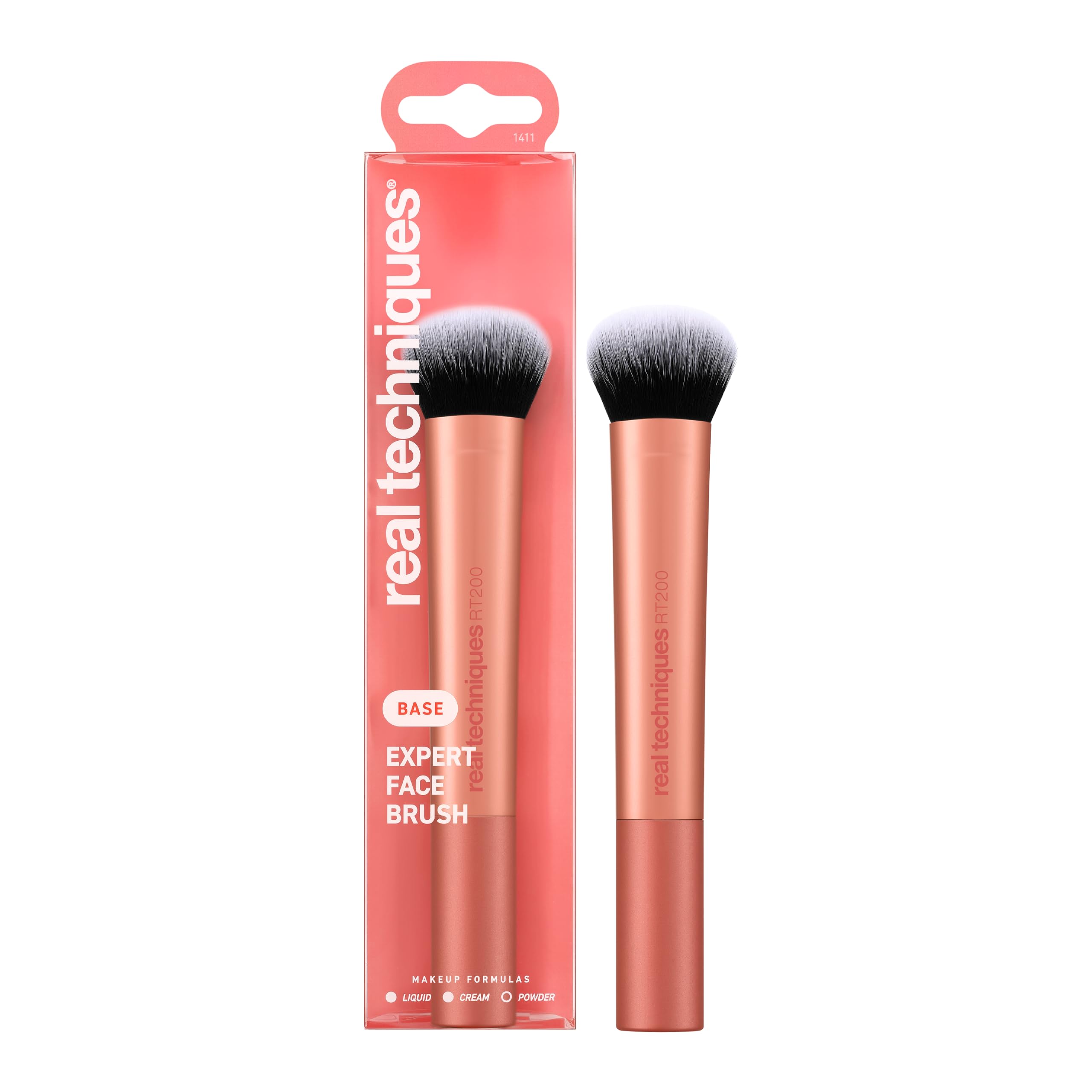
The Expert Face Brush has less handle than most of the brushes in this group, which sounds like a corner cut until you use it. With your hand that close to the face you can feel where the bristles are working, so you press foundation into the center of the face and sweep the remainder outward instead of dragging a long handle across a wet cheek. That control is why it became our default for everyday liquid foundation, and it stayed our default after we ran it against the denser flat-tops.

The head is domed, and Real Techniques builds this one specifically for liquid and cream foundation and skin tint, with custom-cut UltraPlush synthetic fibers meant for tapping and sweeping rather than scrubbing. A dome is more forgiving than a flat top: it follows the curve of a cheek without leaving a hard edge where the brush lifts off, and it sheers a heavy foundation down at the jawline. It's dermatologist tested and fully vegan, which counts for something if your skin reacts to brushes more readily than it reacts to makeup.

The fibers release product rather than drinking it, so a pump of foundation covers more of the face than the same pump does on a sponge, and there's no damp-blender routine to keep up with in the morning. Ours has been washed repeatedly and the head still springs back into shape, which is the test that matters with a brush you'll use most days.

Bottom line: We recommend it first for liquid foundation: the domed head and short handle give you more control than a flat-top, and it blends foundation and tint without streaks.

2

KESHIMA Flat Top Kabuki Brush

KESHIMA Flat Top Kabuki Brush

Full-coverage buffing

Our Score 9.2/10
Check Price

Worth Noting

  • Bristles can shed over time
  • Head runs small for a full face
Length
5.71 in
Weight
1 oz
Bristles
Synthetic
Head Shape
Flat top

Where our top pick is domed and forgiving, the KESHIMA is a flat wall of densely packed synthetic bristles, and that difference decides which job it does. It runs 5.71 inches and about an ounce, so it sits light in the hand while the head stays stiff enough to press foundation into the skin instead of skating over it. The fibers are non-porous and don't drink a runny liquid formula, which is half the reason a flat top can build coverage so quickly.

We got the most convincing full-coverage finish in this set from this brush. Stipple it straight on — press and lift, don't drag — and the flat face covers a cheek in two or three passes; then buff in small circles and the edges melt away. A cream foundation doesn't make it grab, either.

It's simple to live with, too. The head rinses clean quickly because the fibers don't hold onto product, and the shorter handle fits in a crowded cup. Because it handles powder and cream as well as liquid, it can be the only base brush in a small kit.

Bottom line: This is the brush we reach for when we want full-coverage liquid foundation buffed in fast; the dense flat top presses product into the skin and leaves no streaks.

3

e.l.f. Ultimate Blending Brush

e.l.f. Ultimate Blending Brush

Budget all-rounder

Our Score 9.4/10
Check Price

Worth Noting

  • Handle can separate from the head
Bristles
Densely packed synthetic
Formulas
Liquid, powder, mousse
Head Shape
Dome

If you want one brush to handle liquid foundation and the powder that goes over it, this is the one we point people toward. The dome is densely packed but still fluffy at the edges, so it picks up a sensible amount of product and lays it down evenly, and e.l.f. cuts it for powder, liquid and mousse rather than a single formula. The fluffiness is what makes it work with a thin liquid foundation: it sheers product out instead of pushing a thick line across a cheek.

Softness is the quality we noticed most. It's gentle enough to buff over a dry patch without dragging, and it rinses clean faster than the denser brushes here, which is not nothing when you're washing it every week. For someone building a routine from scratch, it covers the base step and the finishing steps without a second purchase.

Bottom line: The brush we point to when you want one tool for liquid foundation and the powder over it: dense enough to buff, soft enough to blend, and the best value in this set.

4

BK Beauty 101 Contoured Brush

BK Beauty 101 Contoured Brush

Premium finish

Our Score 9.4/10
Check Price

Worth Noting

  • Large head is awkward around eyes and nose
Weight
0.71 oz
Bristles
Vegan synthetic
Head Shape
Contoured

You can feel where the money went the moment you pick the 101 up. The fibers are the softest in this group by a distance, the handle has real weight to it, and the contoured head is shaped to press foundation into the skin rather than sweep it around. BK Beauty designs its brushes with mature skin in mind, and this one is aimed squarely at that: coverage that presses in without settling into fine lines.

We think it earns the premium if foundation is the step you care most about. The fibers pick up less product than the budget brushes here — a pump that disappears into a fluffy dome goes further with this one — and the finish is the closest to airbrushed in this set. It also blends over sunscreen and moisturizer without pilling.

The head is big: good across a cheek, awkward around the eyes and the sides of the nose, where you'll want a smaller tool. Treat it gently when you wash it — the fibers are fine enough that a rough scrub is the quickest way to spoil the shape. Looked after, it's the brush here that feels like an investment rather than a consumable.

Bottom line: The one to buy if you wear liquid foundation daily and want the softest, least streaky application here — the premium is real, and so is the difference.

5

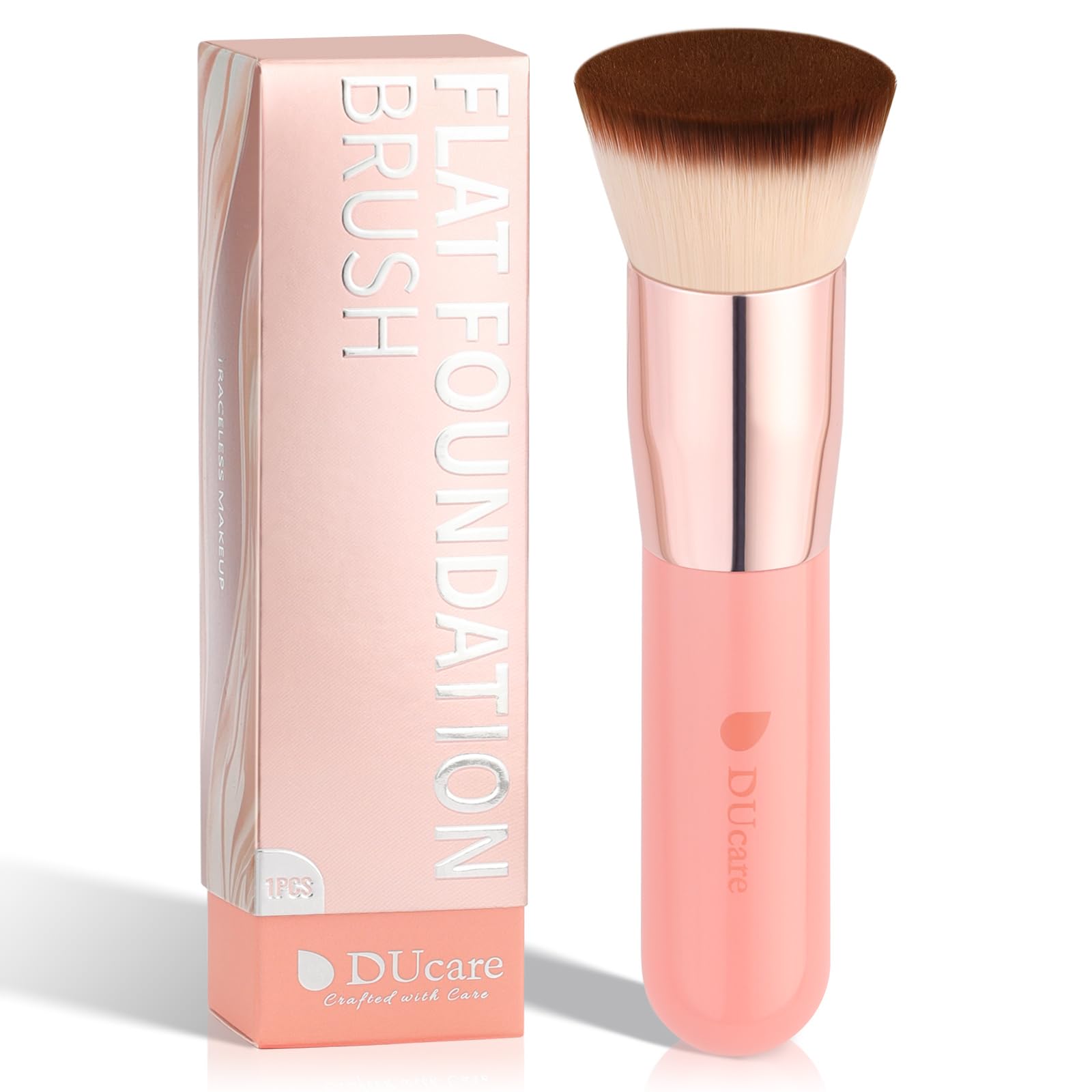
DUcare Flat Top Foundation Brush

DUcare Flat Top Foundation Brush

Quick full-face

Our Score 9.4/10
Check Price

Worth Noting

  • Bristles can loosen with repeated washing
Length
5.71 in
Weight
1.76 oz
Bristles
Cruelty-free synthetic
Head Shape
Flat top

Density is the whole story here. The flat head is packed tight, and at 5.71 inches and 1.76 ounces it has noticeably more heft than the KESHIMA, so it feels like the brush is doing the work rather than your wrist. The fibers are synthetic, cruelty-free and non-porous, which means a liquid foundation sits on the surface instead of soaking in.

Spread a pump across a cheek and coverage arrives in two or three strokes; buff in circles and the edges soften out. We got an even, streak-free finish from a medium-coverage liquid, and a thicker cream formula didn't make the head skip. If you want to build coverage on one spot rather than sheer it out, stipple instead of dragging.

The weight cuts both ways. It's steady over a full face, but it isn't the brush you reach for around the eyes. The density also means foundation works its way deep into the head, so it needs a proper wash rather than a rinse — a drop of gentle soap worked through the bristles, then a thorough rinse with the head pointing down.

For full-coverage days we think it's the most efficient flat top in this group: it covers ground quickly and doesn't waste product. If you want one brush that does base and detail, a dome serves you better.

Bottom line: A dense, weighty flat-top that lays liquid foundation down fast and evenly; we recommend it for full-coverage days when you want the brush to do the work.

6

TEOYALL Domed Foundation Brush

TEOYALL Domed Foundation Brush

Precise blending

Our Score 9.4/10
Check Price

Worth Noting

  • Head is small for fast full-face coverage
Weight
1.06 oz
Ferrule
Metal
Head Shape
Domed

The head here is smaller than the kabuki-style picks in this group, and for some faces that's the whole appeal. The dome is dense enough to move a liquid foundation around without it pooling, but compact enough that you can work a cheek and then the crease beside the nose without repositioning your hand. It weighs about an ounce, and the metal ferrule holds the head firmly on the handle.

Application surprised us. Soft synthetic bristles usually mean a brush that smears, and this one blends cream and liquid down to a thin, even layer if you work in small circles. It also buffs powder over the top without disturbing the base underneath, which isn't a given with a dense head.

We like it best as a second brush, or as the only brush for someone with a smaller face who finds a wide flat top unwieldy. It gets into the corners around the nose and the inner cheek without smearing work you've already done, and it's an easy brush to keep clean and keep using.

Bottom line: A compact, soft dome for precise liquid application around the nose and eyes; it suits smaller faces and anyone who blends in small sections.

7

e.l.f. Complexion Duo Brush

e.l.f. Complexion Duo Brush

Foundation plus concealer

Our Score 9.2/10
Check Price

Worth Noting

  • Two halves can come apart at the join
Ends
Foundation and concealer
Length
7.76 in
Bristles
Vegan synthetic

Two ends, one handle: a large end for foundation and a smaller one for concealer and the corners around the nose. It measures 7.76 inches end to end, so it sits a little longer in the cup than a single-ended brush, and both ends use the same synthetic, vegan fiber e.l.f. puts in the rest of its line. For liquid foundation the big end is dense enough to buff and soft enough to press product in without dragging.

The second end is where it earns its place. Under-eye concealer is the step most people keep a separate small brush for, and having one on the other end of the tool you're already holding means you finish the base without putting anything down. It works with powder as well, though we prefer it for liquids.

The head is compact — this is a smaller brush than it looks in photographs — so a full-coverage face takes a little longer, and the small end is better for pinpoint work than for blending a wide area. As a travel brush or a one-brush solution for a small kit, it's the most sensible thing here.

Bottom line: One tool for foundation and concealer, which is exactly what makes it the brush to pack for a trip or a small bathroom shelf.

8

Daubigny Flat Top Kabuki Brush

Daubigny Flat Top Kabuki Brush

Travel with case

Our Score 9.0/10
Check Price

Worth Noting

  • Head can come unglued from the base
Weight
2.08 oz
Includes
Protective case
Head Size
60 mm
Head Shape
Flat top

The case is the first thing you notice: a round plastic cover that clips over the head. That's more useful than it sounds if your makeup travels in a bag, because it stops the bristles splaying against a mascara tube and holds the shape of a head that measures 60 mm across — wide enough to cover a cheek in a single pass.

The handle is shaped like a petal and sits comfortably between thumb and fingers, and at 2.08 ounces it's the heaviest brush here. That weight does some of the pressing for you. The bristles are dense and soft rather than stiff, so a liquid foundation spreads evenly and the finish comes out smooth rather than buffed to a shine.

It handles cream and powder as well as liquid, and the width covers the neck and jaw faster than the smaller domes here — worth having if you extend foundation past the jawline every morning.

We think it's the pick here for travel and for covering a lot of face quickly, and the case is a real part of that. One care note: a head this wide holds more foundation than you expect, so wash it as often as a smaller brush — a stiff, product-heavy flat top is exactly what leaves streaks.

Bottom line: A wide flat-top that comes with its own protective case — our pick for a brush that travels and covers a lot of face per pass.

How We Tested Liquid Foundation Brushes

We began by reading reviews and product listings for foundation brushes—bristle type, density, head shape, handle length, and cleaning instructions—then narrowed the field to flat-top kabukis, domed buffers, and stippling brushes suited to liquid formula. We cut anything with sparse bristles, a flimsy ferrule, or a head so small it would turn a cheek into a ten-minute project. The shortlist: 14 brushes, each used for six months.

Those 14 lived in a cup by my bathroom sink and in my travel makeup bag. I used each with the same three liquid foundations, and two teammates with drier and oilier skin did the same, so application and blending got tested on more than one face. On rushed weekday mornings I counted how many dips it took to cover my cheeks and jaw; on weekends I pressed and buffed fuller coverage and checked for streaks and how well each brush blurred the edge at my hairline. After every use I washed each one with soap and warm water, then checked for shedding, splayed bristles, a wobbly ferrule, and whether it dried soft or stiff. I also noted head width and handle length while working under my eyes and around my nose, where an oversized brush smears and a tiny one takes too long.

Softness got judged on bare skin and during buffing, especially after washing—some brushes felt plush new but scratchy by week three. The ones that stayed in contention picked up and released foundation evenly instead of swallowing it, kept their shape after repeated cleanings, and felt worth reaching for over a sponge. Value came down to how many good mornings a brush delivered before it splayed or shed. The final group reflects that mix of brush quality, comfort, and durability rather than a strong first impression.

How to Choose a Foundation Brush for Liquid Foundation

Start With Head Shape

Flat-top kabukis — the KESHIMA, the DUcare and the Daubigny here — press foundation into skin with a broad, even surface. They're the quickest route to full coverage, and the flat face makes stippling easy: press and lift rather than drag. Domed brushes such as our top pick and the TEOYALL sheer product out and follow the contours of the face, which suits tinted moisturizer, skin tints, and anyone who wants to see skin through the base.

A dual-ended tool like the e.l.f. Complexion Duo trades head size for a second, smaller end that covers concealer, so you carry one tool instead of two. It's a convenience decision, not a coverage one.

Density and Softness Decide the Finish

Two qualities pull against each other. Densely packed bristles give you the pressure to buff foundation into skin so it doesn't sit on top; softer, fluffier fibers blend edges and sheer out a heavy formula. Most brushes here sit between the two, and the best of them let you do both — press with the center of the head, blend with the outer edge.

If your skin is sensitive or reactive, favor the softer end of the range. The Real Techniques and BK Beauty brushes are the gentlest in this group.

Watch What the Bristles Absorb

Synthetic fibers are the right choice for liquid foundation because they're non-porous: the product stays on the surface and goes onto your face rather than into the brush. Natural hair drinks liquid foundation and is better kept for powder. Even among synthetics, density matters, because a loose, fluffy head spreads foundation over more surface and leaves more of it behind.

Pump foundation onto the back of your hand, dab the brush in it, and build in thin layers instead of loading the head straight from the bottle.

Match Head Size and Handle to Your Face and Grip

A wide head covers a cheek in one pass but crowds the eyes and the sides of the nose; a compact head gives precision and costs you speed. Short handles put your hand close to the face for control, longer ones give reach.

If your face is small, a 60 mm head like the Daubigny's will feel enormous, and one of the narrower domes will serve you better. If you cover a full face and neck every morning, that width is the whole point.

Plan for Washing — It's What Ends a Brush's Life

Every brush here can be washed, and the ones that fail do so in the same two places: the bristles loosen, or the head comes away from the handle. Both are usually a washing problem. Work a drop of gentle soap through the bristles with the head pointing down, rinse until the water runs clear, and keep water out of the ferrule — soaking is what softens the glue.

Dry the brush head-down or flat, never standing on its base, and wash a daily-use foundation brush about once a week.

Frequently Asked Questions

Final Verdict

The Real Techniques Expert Face Brush is the one we recommend as a default. The domed head and short handle make liquid foundation easy to control, it blends without streaks, and it holds its shape through repeated washing — the three things that matter most in daily use.

Choose the KESHIMA instead if you wear full coverage and want the speed of a flat-top kabuki. Choose the BK Beauty 101 if the finish matters more than the price and you want the softest application in this set. Everyone else can stop at the Real Techniques and be happy.