Makeup

Best Foundation Brushes of 2026

For years my foundation routine was two fingers and a hopeful expression, which worked fine until I saw my jawline in daylight. What finally switched me over was a dense, flat-topped brush that buffed liquid foundation into something that looked like skin — no sponge drinking half the bottle, no tide lines along the hairline. A good brush spreads product evenly, then works what's left into the skin, and the differences between them come down to density, the cut of the bristles, and whether they still look the same after a month of washing.

My team and I spent four months with 14 foundation brushes, through rushed weekday mornings and slow Saturday makeup. Softness got judged against my own cheek, not a description on a box, and blending was the real test — could a brush stipple around the nose and under the eyes without leaving a visible edge? We washed them all weekly to see which ones shed. The picks below are the ones I still reach for.

1

KESHIMA Flat Top Kabuki Brush

Top Pick
KESHIMA Flat Top Kabuki Brush

Everyday liquid foundation

Our Score 9.2/10
Check Price

Worth Noting

  • Small head means more passes on a full face
Bristles
Dense synthetic
Brush Length
5.71 inches
Head Diameter
1.2 inches
Foundation Types
Liquid, cream, powder, mineral

Flat, dense, and 1.2 inches across — that's the KESHIMA's whole pitch, and it's enough. The synthetic fibers are packed tightly enough that a pump of liquid foundation sits on the surface of the brush instead of sinking into the middle of it, which is the difference between buffing color onto your face and painting on streaks. It's the brush we reach for when we want the same result on a rushed morning as on a careful one.

At 5.71 inches it's a compact tool, so your hand sits close to your cheek and you can feel how much pressure you're using. That matters with a flat top, because pressing too hard is exactly how you get patches around the nose. Liquid, cream, and pressed powder all behave: buff in small circles for a sheer wash, pat for more coverage over redness, and build rather than load.

The small head is also why it works in the tight spots. Where the DUcare set's 1.57-inch kabuki covers a cheek in two passes, this one takes three or four, and in exchange you can work under the eye and around the nostril without dragging foundation you've already placed.

Cleaning is uneventful, which is the highest praise a brush can get. The fibers rinse clear, dry back into shape, and ours hasn't shed into the sink or onto a face. For a first foundation brush, or a replacement for one that's gone scratchy, this is the one we point people toward.

Bottom line: We recommend it as the default foundation brush: a dense flat top that buffs liquid, cream, or powder to an even finish, with a compact head that reaches where wide kabukis can't.
2

Real Techniques Expert Face Brush

Real Techniques Expert Face Brush

Sensitive skin

Our Score 9.4/10
Check Price

Worth Noting

  • Smaller head than a kabuki, so coverage is slower
Bristles
UltraPlush synthetic
Formulas
Liquid and cream foundation, skin tint
Head Shape
Domed
Skin Suitability
Sensitive skin, dermatologist tested

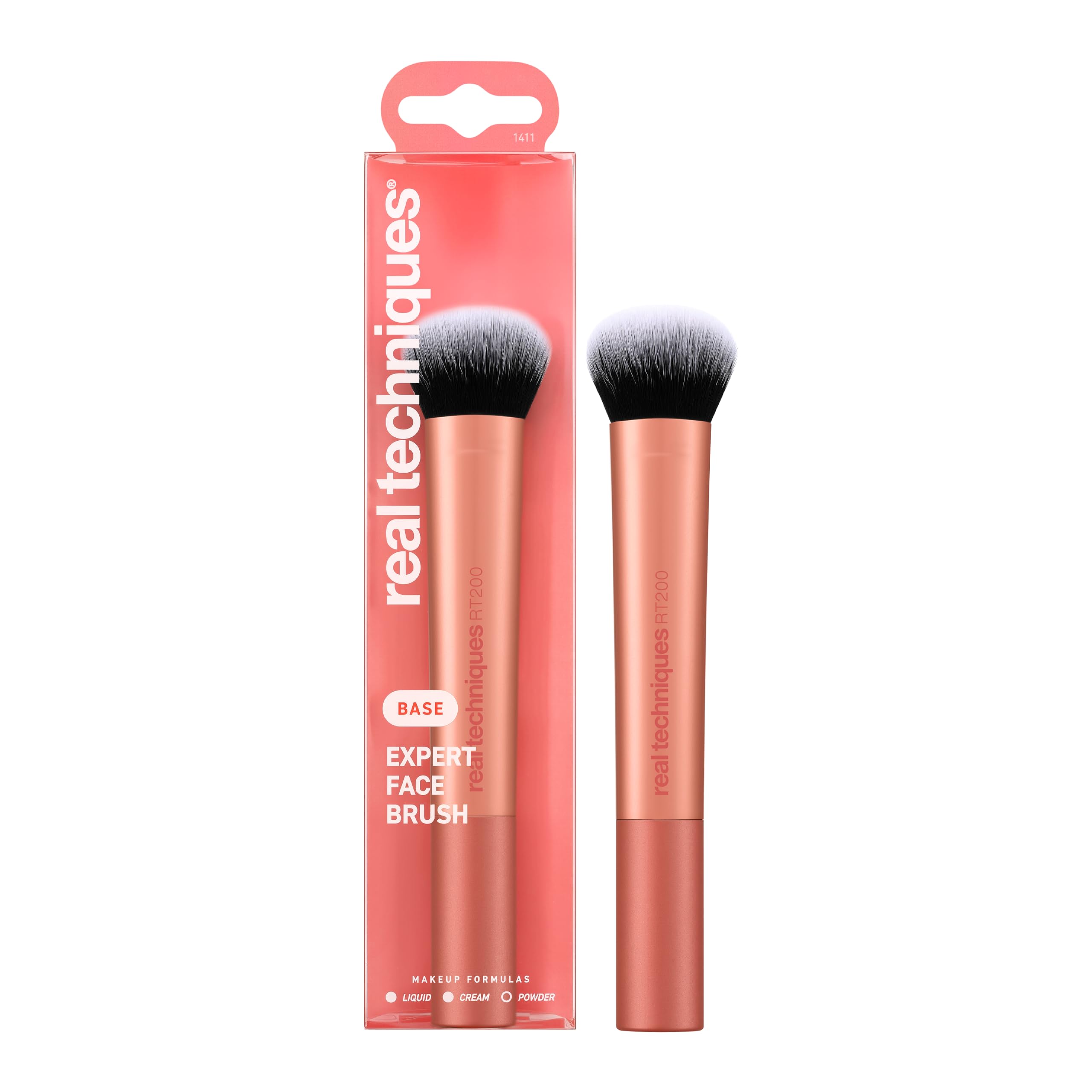
The dermatologist-tested label on this one isn't decoration. Real Techniques cuts and finishes its UltraPlush synthetic bristles soft enough that they skim rather than scratch, and the brush is described as suitable for sensitive skin — which is why it's the one here we suggest for skin that reacts to everything. It's 100% vegan and cruelty-free, and synthetic fibers don't hold onto product the way natural hair can.

The domed head does the rest. Instead of a flat press you get a rounded surface that diffuses as it moves, so tapping and sweeping motions blend foundation and skin tint into the edges of the face rather than stopping at the jaw. Of the picks here, this is the one we hand to a beginner, because it's forgiving: you can go back over an area without lifting what's underneath.

Cream and liquid are its home turf, and the same dome buffs powder blush without leaving a hard edge, so it earns its space in a small kit. Ours has been through repeated washing with the bristles still where they started. If you want maximum coverage in minimum passes, a flat-top kabuki beats it; if you want a brush that never makes your face sting, this is the gentler buy.

Bottom line: We choose this one for reactive skin — soft, dermatologist-tested bristles and a forgiving dome make blending easy without dragging, even if coverage takes a pass or two longer.

3

DUcare Flat Top Kabuki Set (3 pcs)

DUcare Flat Top Kabuki Set (3 pcs)

A full kit

Our Score 9.4/10
Check Price

Worth Noting

  • Bristles can loosen after washing
Formulas
Liquid, cream, powder, concealer
Set Size
3 brushes
Brush Length
5.91 inches
Head Diameter
1.57 inches

Three brushes for about what one mid-range kabuki costs is the reason this set made the list, and each one carries a 1.57-inch flat head — wider than the KESHIMA's — so a full face takes fewer passes. The 5.91-inch handles give a little more reach, and the flat tip is built for patting foundation into textured or uneven areas rather than sweeping over them.

Density is what you're paying for, and there's plenty. The bristles go through a seven-step process meant to stop shedding, and the flat surface presses cream and liquid in without the drag marks a sparse brush leaves. We ended up using one brush for foundation, one for concealer, and one for cream blush, which is the practical advantage of a set: you stop laundering a single brush midweek.

Where it gives ground is at the join. Bristles can come loose after washing, so keep the water pressure low, rinse bristle-down, and dry them upright. For someone building a kit from scratch, or anyone tired of washing one brush every other day, three solid brushes beat one good one you're constantly cleaning.

Bottom line: We like this set for anyone building a kit: three wide flat tops, each dense enough for full coverage, so you can stop re-washing one brush all week.

4

e.l.f. Ultimate Blending Brush

e.l.f. Ultimate Blending Brush

One-brush routines

Our Score 9.4/10
Check Price

Worth Noting

  • Head can separate from the handle
Uses
Foundation, bronzer, blush
Bristles
Ultra-fine synthetic, vegan
Formulas
Powder, liquid, mousse
Head Shape
Large dome

If a flat-top kabuki feels like too much pressure on your skin, this dome is the softer route to the same finish. The e.l.f. Ultimate Blending Brush is densely packed but rounded, so it works in and around the contours of the face instead of pressing product flat against it, and the result reads closer to airbrushed than buffed. For a single tool that handles foundation, bronzer, and blush, it's the most useful brush in this group.

It picks up powder, liquid, and mousse without overloading, and the hand-cut ultra-fine fibers keep product near the surface where you can move it. Cleaning is easy and the head comes back into shape. The weak point is the join: the head can separate from the handle with heavy use, so don't pull at the ferrule when you wash it. Ours is still intact, and at this price it's a brush you replace without much regret.

Bottom line: We reach for this when we want one brush for the whole face: a dense dome that blends foundation, bronzer, and blush without the flat-top press.

5

Laura Geller Retractable Airbrush Kabuki

Laura Geller Retractable Airbrush Kabuki

Travel and touch-ups

Our Score 9.0/10
Check Price

Worth Noting

  • Costs more than the other single-head brushes here
Design
Retractable kabuki
Bristles
Densely packed synthetic
Formulas
Powder and liquid foundation

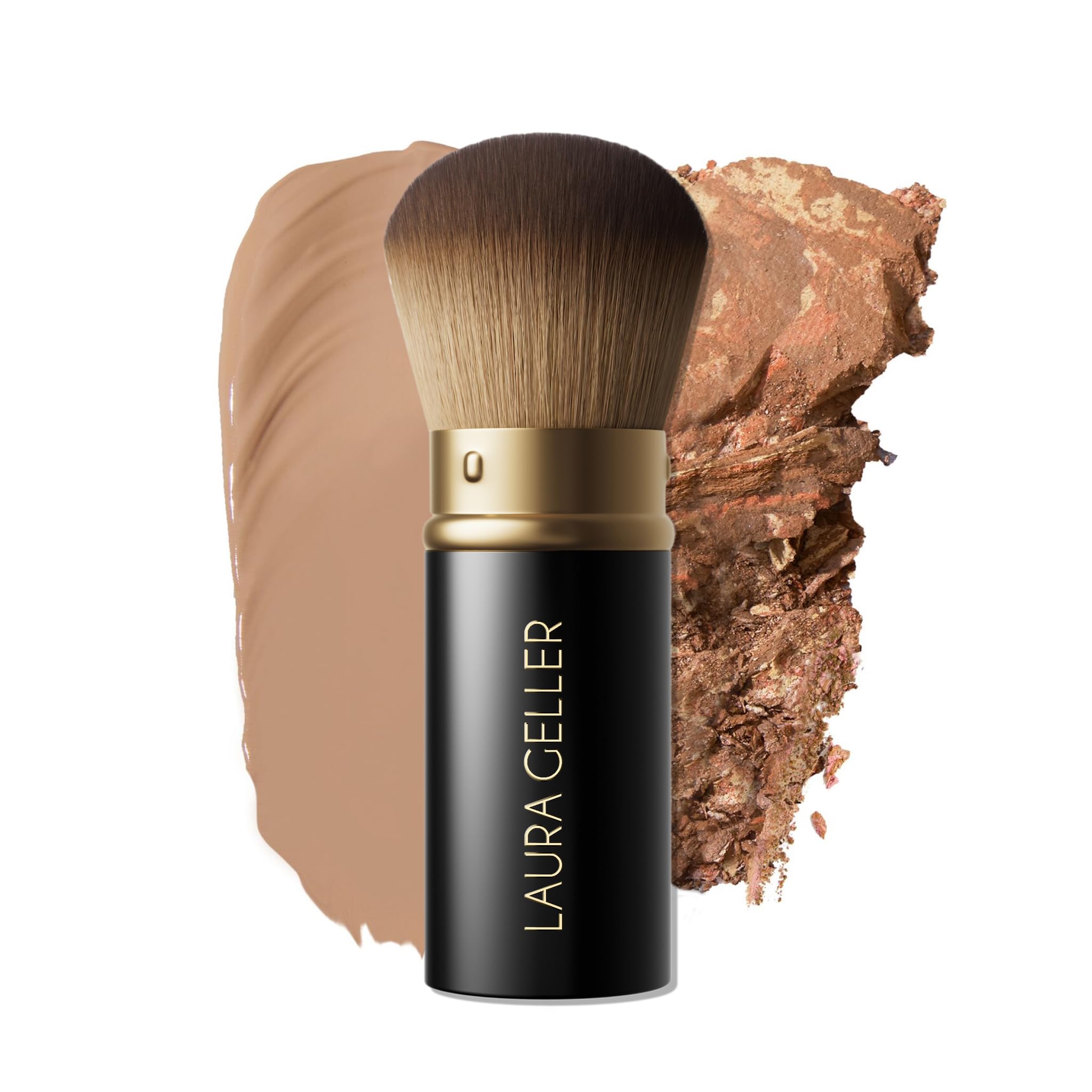
The sleeve is what sells this one, and not for the obvious reason — it's less about travel than about what doesn't happen in your makeup bag. The Laura Geller retractable airbrush kabuki twists shut so the bristles sit inside their own case, keeping dust off the head and powder residue off everything else between uses.

Densely packed bristles give it a firm press for powder foundation, and it handles liquid too, though we preferred it with pressed and loose powders where the density really shows. Swept in circles it leaves no brush lines; patted, it builds coverage. The mechanism holds at any height, so you can shorten the bristles for a stiffer press around the nose and lengthen them for a soft pass over the cheeks.

Two things to know. Coverage can come up sheerer than the full-coverage billing suggests with a light powder — build in thin layers rather than loading the brush and it behaves. And it's the priciest single-head brush here, so you're paying for the mechanism as much as the fibers. If you powder on the go, that's a fair trade.

Bottom line: We keep this one in a bag — the sleeve protects the bristles, and the dense head presses powder foundation to an even finish while you're out.

6

Daubigny Foundation Brush

Daubigny Foundation Brush

Full-face coverage

Our Score 9.0/10
Check Price

Worth Noting

  • Base can come unglued with heavy washing
Handle
Petal-shaped
Bristles
Dense synthetic
Included
Protective round case
Head Width
60 millimeters

A 60-millimeter head is the widest here by a clear margin, and it changes the job the brush does. Two or three passes cover a cheek and jaw, so this is the one for mornings when foundation has to happen fast, or for anyone who takes base down the neck as well as across the face. It arrives in a round protective case that keeps the bristles shaped, and the petal-shaped handle gives your fingers somewhere to sit.

Soft but firm is the balance it strikes — dense enough to press cream and liquid foundation in evenly, soft enough that it doesn't drag over dry patches. It's billed as multi-purpose, and we got a decent, diffused result with powder blush when we wanted a wide placement rather than a precise one.

What it isn't is precise. Under the eyes and around the nostrils a 60-millimeter head is simply too broad, and you'll want a smaller brush or a damp sponge for those areas. For the broad strokes — cheeks, jaw, forehead, neck — nothing else here covers ground this quickly.

Bottom line: We pick it when speed matters: the 60-millimeter head covers cheeks, jaw, and neck in a couple of passes, though it's too broad for detail work.

7

DUcare Dual-Ended Foundation Brush

DUcare Dual-Ended Foundation Brush

Travel kits

Our Score 9.2/10
Check Price

Worth Noting

  • Bristles can loosen with repeated washing
Ends
Dense foundation head, angled contour head
Design
Dual-ended
Length
6.89 inches
Bristles
Soft synthetic

The angled end is the reason to buy this one; the foundation end is the reason you'll keep picking it up. One side is a dense head for buffing foundation across the cheeks and forehead, and the other is a tapered, angled brush that fits along the side of the nose and under the brow bone — the two places a wide kabuki can't reach without wiping off what you've already laid down.

The gold-plated ferrule and glitter handle are a look, and we like it, but the useful part is the 6.89-inch length: hold it near the end for light sweeping, choke up for buffing. Cream and powder both apply cleanly, with the dense side pressing cream foundation in and the angled side blending contour or blush with a lighter touch.

Two ends also mean one tool in a travel bag instead of two, which is where dual-ended brushes earn their keep. Clean one end at a time and dry the brush flat so the two heads don't cross-contaminate, and the shape survives packing.

The bristles are the thing to watch. They can come loose with repeated washing, so keep the water pressure low and don't scrub the fibers against your palm. For a small kit or an overnight bag, two working ends for the price of one ordinary brush is a trade worth making.

Bottom line: We recommend it for small kits and travel: a dense foundation end plus an angled end that reaches the nose and brow bone, on one handle.

8

TEOYALL Flat Top Buffing Brush

TEOYALL Flat Top Buffing Brush

Tight budgets

Our Score 9.4/10
Check Price

Worth Noting

  • Smaller head than the rest of the flat tops
Ferrule
Metal
Bristles
Ultra-soft synthetic
Head Shape
Flat round top

This is the cheapest brush here, and it does the one thing a flat-top kabuki has to do: it buffs. The densely packed head has a flat round top that presses foundation into the skin in small circles without the streaks a sparse brush leaves. If you're buying your first foundation brush and don't want to spend much finding out whether you like the format, start here.

The bristles are softer than the price suggests, and the metal ferrule holds them without wobble at the join — the usual weak point on inexpensive brushes. It washes clean, dries back into shape, and ours hasn't shed yet.

Use less product than you think. Dot foundation in five places and buff outward from the center of the face rather than dipping the brush into a puddle; a dense flat top pushes product around instead of absorbing it, so a little goes further than it does with a sponge.

Against the KESHIMA it's a close call: similar flat top, similar density, a lower price. What you give up is head width and a little refinement. For a beginner, or a second brush to keep in a gym bag, that's the sensible entry point.

Bottom line: We suggest it as a first foundation brush: a dense flat top that buffs without streaks for the least money here, as long as a compact head suits you.

How We Tested Foundation Brushes on Real Faces

We started with every brush our editors had used, borrowed, or seen recommended, then filtered by price, head shape, bristle type, and handle length until 14 remained — flat-top kabukis, domed buffers, and a dual-ended design or two, ranging from drugstore singles to small sets.

Testing happened at bathroom mirrors, not lab benches. Each brush got a full week of real use: liquid foundation on weekday mornings before work, cream and powder formulas on weekends, then blush and bronzer with whatever was left on the bristles. To compare blending head-to-head, a tester applied foundation with one brush on the left side of her face and a rival on the right, then checked both in daylight for streaks, patchy edges, and product settling into pores. We noted how long a full face took to even out and where product collected, since brushes that load too heavily near the ferrule leave obvious lines at the jaw.

Softness was scored by feel on the cheek and around the nose, where scratchy bristles announce themselves first. We measured handle and head size, then flagged which brushes reached the sides of the nose easily and which felt clumsy in the hand. Every brush was washed after use, and after eight washes we checked for shedding, splayed bristles, and heads that had gone floppy. Value came down to cost per use set against how a brush behaved after those washes — a cheap brush that sheds is more expensive than a good one that lasts.

How to Choose a Foundation Brush

Start with the head shape, not the brand

A flat-top kabuki is a press: the flat surface pushes foundation into the skin in small circles and gives the fullest, fastest coverage of the shapes here. A dome is a diffuser — rounded and slightly fluffier, better at tapping and sweeping product into the edges of the face, and more forgiving over texture. Angled and small heads are for precision: the nose, under the eye, the brow bone.

Decide which motion you actually use in the morning, then buy that shape. If you buff in circles, look at the KESHIMA or the DUcare set. If you tap and sweep, the e.l.f. dome or the Real Techniques brush will feel more natural in your hand from the first use.

Density decides coverage, softness decides comfort

Two brushes of the same shape can behave completely differently. Densely packed fibers hold foundation near the surface so it transfers to your face, which is why a dense flat top can give full coverage from a single pump. A looser, fluffier head absorbs and diffuses more, sheering the product out — lovely with a tinted moisturizer, frustrating when you're trying to cover redness.

Softness is a separate question. Fibers can be dense and still gentle, so if your skin stings easily, prioritise a finished-soft head over the most densely packed one you can find. The Real Techniques brush is the one here built around that trade.

The join is what fails first

Almost every brush complaint eventually comes back to the ferrule — the metal collar where the bristles meet the handle. Water sitting in that join softens the glue, which is why brushes shed and heads detach after a few months of enthusiastic washing.

Rinse with the bristles pointing down so water runs away from the collar, never leave a brush soaking in the sink, and dry it flat or bristle-up rather than standing it in a cup of water. A cheap brush washed carefully outlasts an expensive one drowned weekly.

Cases, sleeves, and dual ends earn their price if you travel

A brush loose in a tote splays, collects lint, and dusts powder over everything it touches. A retractable sleeve, like the one on the Laura Geller kabuki, or a rigid case, like the Daubigny's, keeps the head shaped and clean between uses. Dual-ended designs solve the same problem a different way: two working ends, one handle, half the space.

If your makeup lives on a bathroom shelf, skip the premium and put the money into density. If it lives in a bag, the case isn't a gimmick — it's the difference between a brush that still works in six months and one that looks like a whisk.

Frequently Asked Questions

Final Verdict

Most people should buy the KESHIMA. It's dense enough to buff liquid or cream to a streak-free finish, it handles powder too, and the compact head gets into corners a wide kabuki misses. If your skin reacts to everything, the Real Techniques Expert Face Brush is the gentler choice; if you apply on the move, the Laura Geller retractable kabuki keeps its bristles covered in a bag.

Match the brush to the way you actually apply — press and buff, tap and sweep, or detail with a small end — and you'll stop buying replacements every few months.