Wellness

Best Earplugs for Sleeping of 2026

A snoring partner, a garbage truck at 5 a.m., the neighbor's bass line through the floor — the sounds that keep you up are rarely ones you can do anything about. Earplugs are the cheapest fix in the sleep aisle and the easiest to get wrong. A plug that seals beautifully can leave your ear canal aching by 4 a.m.; one that feels like a cloud works its way out around midnight. What you want is a plug that kills the rumble, stays put for seven hours, and then disappears from your awareness.

That's a lot to ask of a bit of foam the size of a pencil eraser. The noise reduction rating on the box is measured with a trained lab fit — get the seal wrong and a 33dB plug performs like a 12. My team and I have spent the past four months sleeping, napping, and flying with 14 different pairs, and the gap between the best and the rest kept coming back to fit and softness rather than any printed number. The picks below are the ones we'd hand a light sleeper without a caveat.

1

Howard Leight Laser Lite

Top Pick
Howard Leight Laser Lite

Everyday sleep

Our Score 9.2/10
Check Price

Worth Noting

  • Works loose in narrow or angled canals
  • Two or three nights per pair
Supply
50 pairs
Plug Size
Small diameter
Plug Shape
Tapered foam
Noise Reduction Rating
32 dB NRR

The first thing you notice about the Laser Lite is that it gives you something to hold. The contoured T-shape flares at the base, which makes it easy to grip with two fingers and, more usefully, keeps you from pushing it deeper into the canal than you meant to at one in the morning. That base is a large part of why this is our pick: of everything in this guide, it has the strongest record of getting people through the night with the plug still where they left it.

Thirty-two decibels is a lab figure measured with a perfect seal, so treat it as a ceiling rather than a promise about your bedroom. What matters is that the seal holds. This foam has a smooth, closed-cell skin that resists grit and the small movements that break a seal overnight, and it stays firm enough to keep gentle pressure on the canal wall instead of slowly backing out. Snoring, a hallway conversation, a truck idling at the curb: all of it lands at a distance. An alarm still gets through, which is the balance most sleepers are actually after.

Insertion is unusually forgiving. The flared base sits proud enough that you can feel whether the plug is seated, and the shape makes it genuinely hard to shove in too far, which is a real reassurance when you're doing it by feel in the dark. It's low-profile enough that lying on your side doesn't drive the base into your ear, either, which the longer plugs here can't always say.

One practical note before you order: they arrive in a plain cardboard box, not a dispenser. If your nightstand routine involves reaching for a plug without turning on a light, decant a week's worth into a small dish or a zip-top bag and leave the rest in a drawer.

Bottom line: Our pick for most sleepers: the strongest all-night record in this guide, a shape that resists going in too deep, and a box big enough to stop hoarding.
2

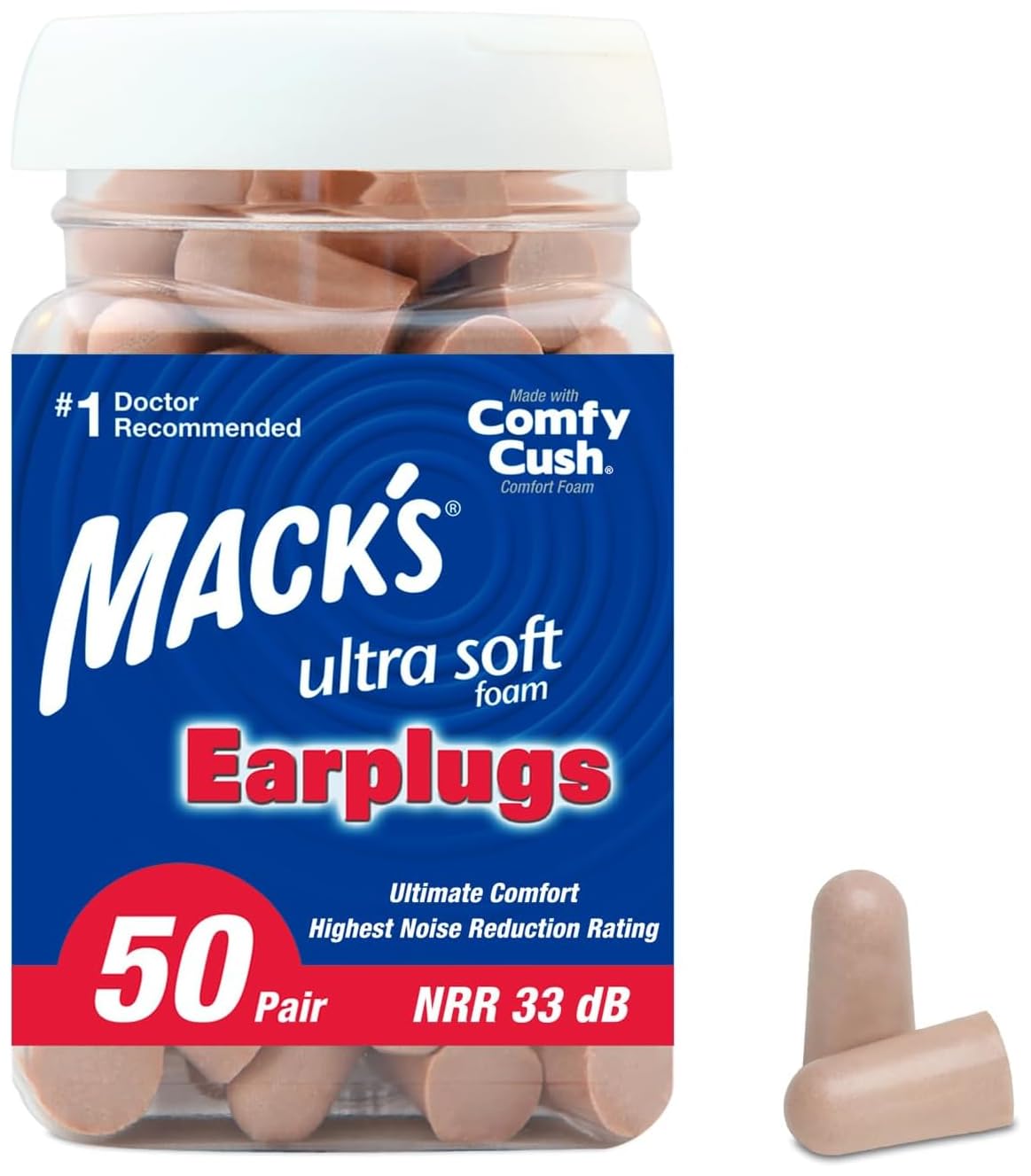
Mack's Ultra Soft Foam

Mack's Ultra Soft Foam

Bulk supply

Our Score 9.0/10
Check Price

Worth Noting

  • New-foam smell needs a day to air out
  • Pair stops springing back after a few nights
Supply
50 pairs
Container
Flip-top jar
Foam Type
Slow-release, low-pressure
Noise Reduction Rating
33 dB NRR

Fifty pairs in a flip-top jar, and the jar is half the reason to buy it. It lives on the nightstand, the lid opens one-handed, and you can fish out a single plug in the dark without unscrewing anything. That sounds trivial until you've spent a week digging foam out of a crumpled bag at 2 a.m.

The foam inside is among the softest in this guide, a low-pressure, slow-release formula that squashes down easily and doesn't leave your ears feeling bruised by morning. At 33 dB it also sits level with the highest rating here, which is where the enthusiasm needs tempering: a rating assumes a perfect seal, and this is a soft plug that can creep out overnight, especially if you move around. If plugs have migrated on you before, a firmer foam will hold better.

Set expectations on the noise. Soft foam compressing against a pillow gives up some seal, and a snoring partner still registers as a low rumble. Where these shine is the everyday: traffic, a loud hallway, a television two rooms away. They make a bad room sleepable rather than silent. Once they're in, there's nothing to notice either, no seams, no hard edges, no pressure point against the canal.

Bottom line: The one to buy in bulk: soft, low-pressure foam and 33 dB of reduction, provided your ears hold a gentler plug in place all night.

3

Moldex Softies

Moldex Softies

Side sleeping

Our Score 9.0/10
Check Price

Worth Noting

  • Longer body can catch on a pillow and shift
Supply
50 pairs
Foam Type
Soft low-pressure foam
Pack Options
20 to 60 pairs
Noise Reduction Rating
33 dB NRR

Every plug feels fine for the first ten minutes. The test comes at hour six, when you've rolled onto your side, your ear is pressed into the pillow, and the plug turns into a small hard object between your skull and the mattress. That's the moment the Softies were designed for.

The foam is genuinely low-pressure, soft enough to compress against a pillow without the focused ache a denser plug produces, and it keeps that give through the night instead of stiffening up. Blocking holds too: at 33 dB it's level with the highest-rated plugs here, and it sits near the top of this set for making a snoring partner ignorable. It stays quiet without sealing you into a vacuum, so an alarm still lands in the morning.

What tips it for us is the balance. Soft enough for a pillow, dense enough to keep a seal, and sold in packs from 20 to 60 pairs, so you can start with a small box and find out how your ears take it. That's the sensible way to try any plug, and it's rare to get the option; most of these come in one size of box and expect you to commit.

Bottom line: If you sleep on your ear, start here: soft foam that presses into a pillow without a morning ache, and enough blocking to make a snorer ignorable.

4

Mack's Pillow Soft Silicone

Mack's Pillow Soft Silicone

Small ear canals

Our Score 8.6/10
Check Price

Worth Noting

  • Picks up hair and lint
  • Fewer pairs per box than any foam pick
Fit
Molds over ear opening
Form
Moldable silicone putty
Reuse
Reusable until tack fades
Supply
18 pairs

Nothing goes into the ear canal. You warm a blob of silicone putty between your fingers, press it over the opening, and it flattens to the shape of your ear, sealing on the outside rather than plugging from within. If foam leaves your canals sore, this is the first thing to try, and it's also the option that works when your canals are simply smaller than any foam plug assumes.

The moldability is real, and it's why this earns a place: it fills the ear you actually have instead of asking your ear to accommodate a cylinder. Because nothing protrudes, side sleeping is comfortable, since the putty sits flush and turning over doesn't drive anything into your head. It also doesn't rub against the pillowcase the way a foam plug does.

Noise blocking is good rather than absolute. Fresh, warmed putty seals well and takes the edge off traffic, a television, and a snoring partner, but it's a muffler and not an off switch, and a determined snore still gets through. The putty also picks up oil with use, and once the surface stops feeling tacky the seal goes with it.

Then there's the count. Eighteen pair against the fifty-pair jars, at a higher price, makes this the most expensive way to buy a quiet night in this guide. We still think it earns its spot, because for a certain set of sleepers the cheap foam never worked at all, and this is the plug that finally did.

Bottom line: Worth the extra for anyone whose canals ache after a night of foam: moldable, flush against the ear, and nothing pushed inside.

5

Flents Protechs Quiet Time

Flents Protechs Quiet Time

Light sleepers

Our Score 8.8/10
Check Price

Worth Noting

  • Foam stiffens after a few nights
  • Fit varies in narrow canals
Supply
70 pairs
Foam Type
Slow-recovery foam
Ideal Noise Level
Light to moderate
Noise Reduction Rating
33 dB NRR

Seventy pairs is the biggest supply in this guide, which is the obvious reason to look at these if you're forever running out. The less obvious reason is the noise level they're built for: this is a plug for a room you can't quite sleep in, not for a room you need to disappear from.

On paper it matches the best of them, with 33 dB NRR and slow-recovery foam that takes about half a minute to expand fully. In the ear it behaves like a good mid-weight foam: it rounds off traffic, conversation, and a partner's snoring, and it leaves enough sound that an alarm still registers. That last part isn't a compromise; for plenty of light sleepers it's the whole point, because a plug that blocks everything makes every morning a gamble.

Insertion technique counts for more here than with the softer foams. Roll it thin, reach over your head and pull the top of your ear up and back to straighten the canal, then give it the full half minute before you lie down. Rush that and you get a plug that seems to do nothing, which is most of what goes wrong with foam in general.

Bottom line: A light sleeper's plug in the biggest box here: quiet enough to sleep through traffic, open enough that your alarm still gets through.

6

3M E-A-R Classic

3M E-A-R Classic

Warm, humid rooms

Our Score 9.2/10
Check Price

Worth Noting

  • Firmest foam in this guide
  • Lowest rating here at 29 dB
Reuse
Disposable
Moisture
Sweat and humidity resistant
Plug Shape
Cylindrical foam
Noise Reduction Rating
29 dB NRR

These are the plugs that stay where you put them. The Classic is a plain yellow cylinder of firmer foam, and where the softer picks here can migrate by morning, this one holds its seal. That's the best retention in this guide, and it's the reason to buy them if you're tired of fishing a plug out from under your shoulder.

Firm cuts both ways. The same density that keeps them in place makes them the least forgiving option here for tender ears: they go in stiff and soften with body heat, and if you're used to the plush give of something like the Mack's Ultra Soft, the first ten minutes will feel like work. What you get back is a seal that survives movement, whether that's rolling over, a pillow pressed against the ear, or an hour of restless fidgeting.

The rating is the lowest here at 29 dB, which sounds worse than it is. Attenuation figures assume a perfect insertion, and a cylinder is easier to seat consistently than soft foam because it holds its shape while you place it. They also resist sweat and humidity, which matters in a stuffy bedroom, since a damp plug loses its grip on the canal quickly. If you sleep hot, this is the pick that complains least.

Bottom line: Buy these if your plugs keep ending up in the sheets: firmer foam with the best retention here, and a little less cushioning in exchange.

7

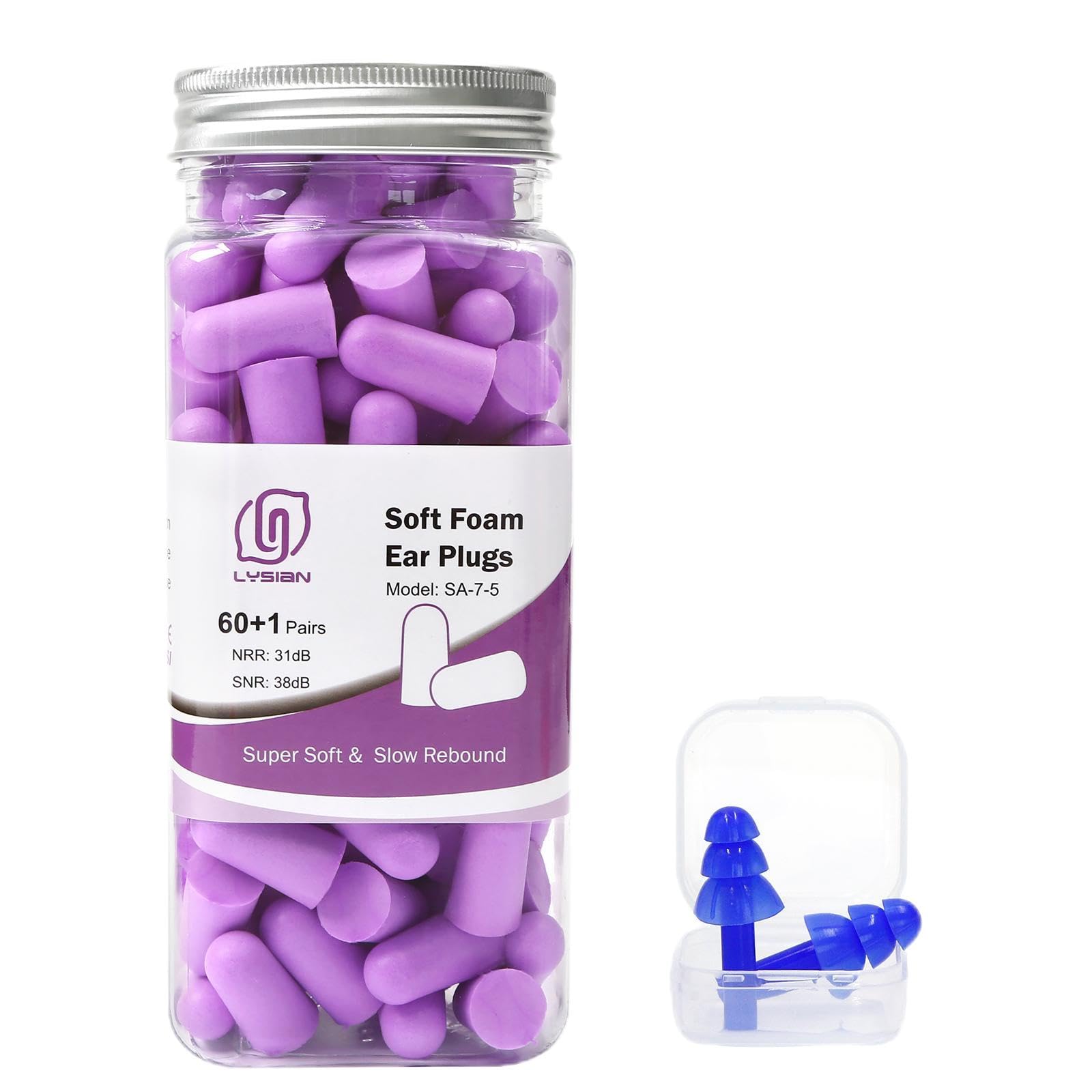
LYSIAN Soft Foam

LYSIAN Soft Foam

Travel and guests

Our Score 8.6/10
Check Price

Worth Noting

  • Weakest noise blocking in this guide
  • Foam varies from pair to pair
Extras
Reusable pair and case
Supply
60 pairs
Foam Type
Slow-expanding foam
Noise Reduction Rating
31 dB NRR

The extras are the interesting part. Sixty pairs of foam come with one pair of reusable silicone plugs and a small hard case, the only genuinely pocketable container in this guide. That makes the box a sensible buy for a guest room, a gym bag, or a run of hotel nights where a jar on the nightstand isn't happening.

The foam expands slowly, somewhere between twenty and sixty seconds depending on the pair, which cuts both ways. It gives you time to seat the plug properly, but it also means the first half minute feels like you're wearing nothing. Wait it out. The seal that forms at the end is decent rather than remarkable, and a restless night can break it.

Our read is that this is a volume purchase with a real bonus, not a snoring solution. The blocking is the weakest in this guide; plenty of sleepers find it takes the edge off a busy house, and plenty find a partner's snoring comes straight through. For guests and travel it's an easy yes. For sleeping through something specific and loud, put the money toward the Laser Lite or the Softies instead.

Bottom line: A big, cheap box with a genuinely useful travel case: fine for guests and hotel nights, too inconsistent at sealing for a serious snorer.

8

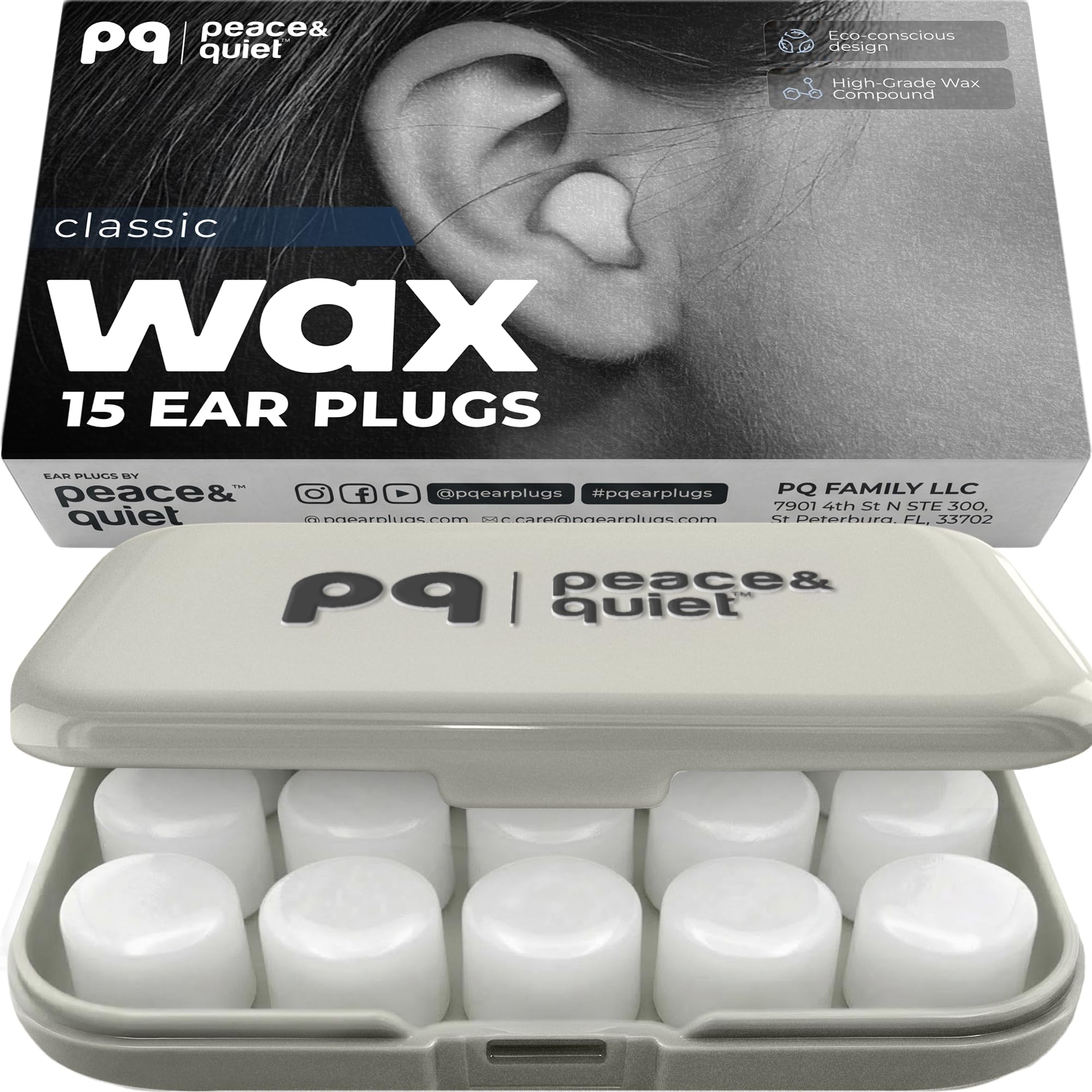
Peace&Quiet PQ Wax

Peace&Quiet PQ Wax

Low-profile fit

Our Score 8.6/10
Check Price

Worth Noting

  • Crumbles and dries out after a few uses
Fit
Shaped by hand, sits flush
Form
Moldable wax pillows
Extras
Carrying case
Supply
15 pillows

Wax plugs have one failure mode, and it's your hair. The putty grabs strands as you shape it, and by morning you can find it knitted in, which is why the worst complaints about these tend to involve scissors rather than noise. If you sleep with long hair loose, this is the pick in the guide to skip, or to wear tied back or under a bonnet.

Everything else about the design is smart. Wax molded by hand sits flush against the ear with nothing protruding, so side sleepers feel nothing between ear and pillow, and the low profile makes these the least noticeable thing you can wear to bed. Fifteen pillows, each of which splits in half, adds up to a lot of nights from a small tin, with a case to keep them in.

Noise-wise, wax muffles. It softens traffic, a ticking clock, a neighbor's television, and it takes the hard edge off snoring, but it won't erase a loud snorer and it doesn't claim to. What it does better than foam is stay put: a shaped pillow of wax doesn't need to expand, so the seal you make is the seal you get.

The catch is lifespan. Wax crumbles as it dries, and once a pillow stops holding together in your fingers it's finished. Some give you several nights, some give you one, and there's no telling from the outside. That variability is the honest downside of the format, and it's why a small tin is a reasonable experiment and a large one isn't.

Bottom line: The low-profile choice for side sleepers: hand-shaped wax sits flush, seals without pressure, and costs less per night than silicone putty.

How We Tested the Best Earplugs for Sleeping

We started with the wall of earplugs in drugstores and narrowed it by reading labels: the published noise reduction rating, the material, whether the plugs came in more than one size, and the cost per pair once we did the math on a multipack. That left 14 we were willing to actually sleep on — disposable foam, moldable silicone putty, and wax blends — which we rotated through over four months.

Every pair got at least a full night. I slept on both sides on a firm pillow, took sets on a red-eye and into a hotel room beside an elevator, and wore them through a Saturday morning of leaf blowers to see which ones let the high whine through. Each morning I logged whether the plug was still in the ear, whether my canal felt sore or itchy, and how rested I felt — a plug that seals but aches by dawn is no better than nothing.

For the foam, we rolled each one as tightly as we could and timed how long it took to re-expand, since a plug that springs back before it's seated never gets deep enough to work. We also noted consistency inside a single box: cheap foam varies pair to pair, and a batch where half the plugs are denser than the rest is a quality problem you feel by Wednesday. With the silicone putty, we checked stickiness directly — whether it left a film on the ear, pulled at hair, or stuck to the pillowcase. And to compare noise cancellation without trusting the label, we played the same pink noise and a phone alarm at a fixed volume and noted exactly what still got through.

How to Choose Earplugs for Sleeping

Pick a form before you pick a brand

Foam is the default for good reasons: it costs the least per night, it's disposable, and it compresses enough to suit a wide range of canals. Its weakness is consistency, because the seal depends on how well you roll and seat it, and that's harder at midnight than it looks in daylight.

Moldable silicone putty and wax sit outside the canal instead, shaped by hand over the opening. They suit small or sensitive canals and anyone who doesn't want anything pressing inward, and they cost more per night for it. If foam leaves your ears sore, change form rather than brand.

The decibel rating is a lab number

Every rating here is an NRR measured under controlled conditions with the plug seated perfectly. In a real bedroom, a 29 dB plug that seals beats a 33 dB plug that half-seals, which is why the highest number in this guide doesn't automatically buy you the quietest night.

Treat any figure as a ceiling. The realistic goal is a much quieter room rather than an anechoic one, and no plug on this list will soundproof a wall shared with a night-shift neighbor.

Fit, and the side-sleeping test

Canal size varies enormously, and it's the usual reason a plug fails. A tapered plug seats easily and stays comfortable; a straight cylinder holds firmer but can feel blunt. If you wake with sore ears, the plug is too big or too firm, so move to a moldable option or a smaller cut, and never trim a foam plug down, which ruins the seal.

Side sleepers should weight profile over everything else, because anything protruding meets the pillow first. A flush putty or wax, or a short soft foam, is the difference between sleeping through the night and waking up to take the plug out.

How many nights you get for the money

Foam is good for a handful of nights before it stops recovering; putty and wax last until the surface stops being tacky or starts to crumble. That is the real cost comparison, not the number on the box.

A 70-pair jar only saves money if you actually swap the pair out when it goes limp. Buy the supply that matches how disciplined you are about throwing plugs away.

Frequently Asked Questions

Final Verdict

Buy the Howard Leight Laser Lite and stop shopping. It seals, it stays, and it leaves just enough sound in the room that your alarm still reaches you, which is what most people actually need from a sleep plug.

Change that only for a specific reason: the Moldex Softies if you sleep on your side and want less pressure against the pillow, or the Mack's Pillow Soft Silicone if a night of foam leaves your canals aching. The rest of the list solves narrower problems than those three.