Skincare

Best Dermaplaning Tools of 2026

Dermaplaning is just a blade held nearly flat against your cheek and drawn down in short strokes, shaving off peach fuzz and the dead surface cells sitting on top of it. The payoff is real: foundation stops catching on fuzz, serum sinks in faster, and skin feels smoother for a few days. The catch is that you're the one holding the blade. Every tool in this category lives or dies on how forgiving that edge is — whether it glides over a jawline or nicks it, whether it dulls after a single pass, whether it leaves your cheeks flushed for an hour.

I've been dermaplaning at the bathroom sink for years, and I've learned the hard way that a fancy handle matters far less than a fresh, well-guarded blade. Over four months, my team and I worked through 16 tools, from cheap multi-packs to stainless-steel singles, using each on dry skin, over gel, and along the brow line. A few cleared a cheek in four strokes with no tugging at all; others scraped and left me blotchy. The keepers are below.

1

Schick Hydro Silk Touch-Up

Top Pick
Schick Hydro Silk Touch-Up

First-time dermaplaning

Our Score 9.2/10
Check Price

Worth Noting

  • Disposable format; no reusable handle
Cover
Precision cover
Handle
Disposable
Pack Count
9 razors
Blade Guard
Micro-guards

The micro-guard is the detail that makes the Schick our default dermaplaning tool. Fine guards sit over the blade, so the razor skims peach fuzz and surface flakes without feeling as exposed as a bare blade. We also like that it can shift from cheeks to upper lip to eyebrow cleanup without changing tools.

The nine-razor pack is the practical part. Each has a precision cover, and the slim handle fits a makeup bag or a bathroom drawer; we kept one in a travel kit and one at home. The short blade is easy to angle around the jaw and lip, though you still need light, short strokes rather than pressing down.

No guarded razor is foolproof. If you use it over active irritation, or press hard on a dry face, it can scrape; we treat it as a tool for smooth, prepped skin and stop if a blade starts tugging. As a first dermaplaning purchase, the balance of control and low commitment is hard to beat.

Bottom line: We recommend the Schick for most faces: its micro-guarded blade makes a first dermaplaning pass feel controlled, and the nine-pack covers regular touch-ups.
2

Tinkle Dermaplaning Tool

Tinkle Dermaplaning Tool

Budget beginners

Our Score 9.2/10
Check Price

Worth Noting

  • Sharpness can vary between razors
Handle
Disposable
Pack Count
12 razors
Blade Cover
Attached safety cover
Pack Format
4 packs of 3

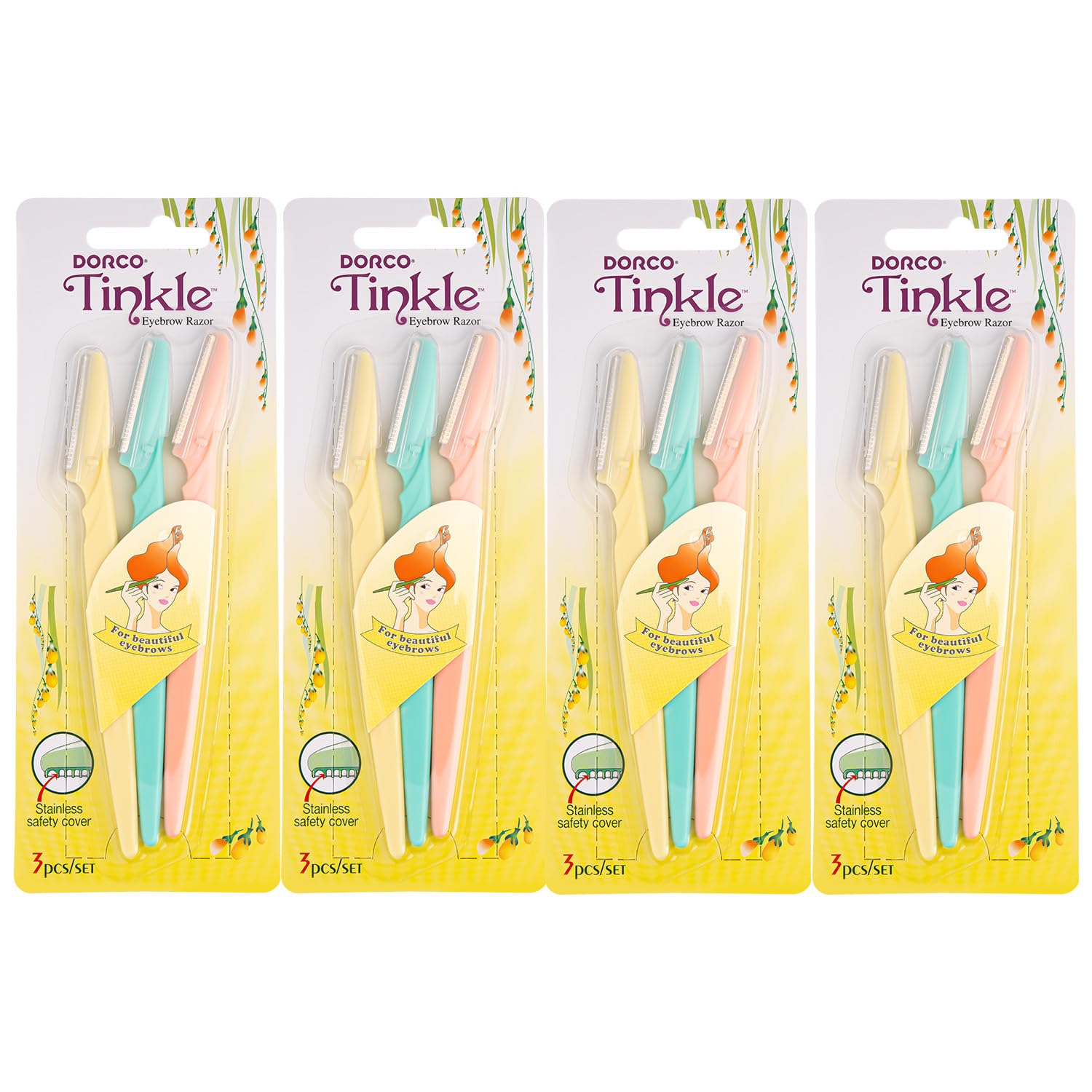
The Tinkle looks almost toy-like next to a metal razor, but that is part of its appeal for a first-timer. Each blade has an attached safety cover that keeps the edge from sitting fully exposed, and the 12-pack arrives as four little packs of three. If you are still learning how much pressure to use, that combination lowers the stakes.

We think it is the easiest budget pick for brows and quick touch-ups, not a precision tool for a perfect hairline. The covered blade glides over peach fuzz and upper-lip hair, and the small size is easy to stash in a makeup bag. Around the brow, the longer blade takes more care than a narrow trimmer; we used short, downward strokes and kept the tool angled away from the eye.

The plastic handle is light, and after using the Tweezerman we noticed the difference in control, but for short passes on the face it is not a problem. Keep the cover on between uses and store the pack somewhere dry; for a beginner who wants a fresh blade without spending much, the Tinkle is an easy place to start.

Bottom line: We think Tinkle is the easy first buy for beginners: the covered blade feels less exposed, and the 12-pack keeps the cost per tool low.

3

Tweezerman Facial Razor

Tweezerman Facial Razor

Reusable precision

Our Score 9.2/10
Check Price

Worth Noting

  • Replacement blades add ongoing cost
Handle
Stainless steel
Blade Cover
Cap included
Product Dimensions
0.75 x 2.52 x 8.11 inches
Replacement Blades
3 included

The steel handle is what separates the Tweezerman from the disposable crowd. It has a balanced, slightly weighty feel that made us slow down and use lighter strokes, and the narrow head fits around the temples, upper lip, and brow without the blade feeling bulky. For a tool you keep on the shelf rather than toss after a few uses, that control is the reason to pay more.

You get three replacement blades plus the one already fitted, which changes the ownership math: instead of buying another box, you swap the blade and keep the handle. The cap protects the edge, and cleaning with alcohol before and after use is simple. We did find that a replacement blade needs to be seated firmly; check it before the first stroke, because a loose blade can slide.

Sharpness is good when the blade is fresh, though some replacement blades can dull faster than expected. The handle is also heavier than a plastic razor, which we liked for control but not everyone will want in a travel kit. If you want a reusable tool with a more substantial feel and less repeated plastic, this is the one we reach for.

Bottom line: For a reusable tool that feels balanced in the hand, we choose the Tweezerman; its steel handle and three replacement blades make it the nicer long-term buy.

4

About Face Fuzz-Free

About Face Fuzz-Free

Travel touch-ups

Our Score 9.0/10
Check Price

Worth Noting

  • Blades can dull after a few uses
Pack Count
3 razors
Safety Guard
Included
Blade Material
Japanese steel
Product Dimensions
0.25 x 3.13 x 7.88 inches

About Face sells its Fuzz-Free razor as a salon-style dermaplaning tool in a slim, travel-friendly body, and the Japanese-steel blade is the part that matters. The three-pack is small enough to keep in a makeup bag, and each razor has a safety guard that sits over the edge. The shape is closer to a brow razor than a full-face shaver, which suits quick touch-ups more than a long session.

For travel and small areas, About Face is our pick. The narrow blade reaches the upper lip and side of the nose neatly, and the Japanese steel gives it a precise feel on small areas. We did find the guard can drag on coarser hair; on a fuller patch of peach fuzz, shorter strokes worked better than one long pass. It is not the tool for someone who wants a wide, fast sweep across the cheeks.

The blade is still exposed enough to demand attention, so use it on clean, prepped skin and keep the angle shallow. The three-pack makes sense as a travel or touch-up tool; for a single do-everything razor, the Schick or Tweezerman is more versatile.

Bottom line: About Face earns the travel slot in our kit: the slim Japanese-steel razor is precise around small areas, and the safety guard adds reassurance for a low-cost tool.

5

Revlon Face Defuzzers

Revlon Face Defuzzers

Brow shaping

Our Score 9.0/10
Check Price

Worth Noting

  • Narrow head is slower for full-face passes
Head
Narrow design
Pack Count
2 defuzzers
Blade Material
Japanese stainless steel
Product Dimensions
0.36 x 2.76 x 8.09 inches

The Revlon Face Defuzzer is built around a narrow head, and that is exactly why it earns a place here. Instead of trying to cover a cheek in one pass, it lets you work along the brow line, upper lip, and sideburn with short, controlled strokes. The long handle gives you a clear view of the edge, which matters when you are working close to an eyebrow.

Two defuzzers come in the pack, and the stainless-steel blade has been reliable for quick cleanup in our testing. The snug cap takes a little patience to pull off, though it stays put in a bag. We also found the narrow head easier to steer than a broad razor when the skin is not flat.

This is the one we reach for when the job is brows. The short edge gives more control around the arch and the corners of the mouth, and the two-pack means one can live in a travel kit. If shaping and edges are your priority, the extra passes are worth the control.

Bottom line: We reach for the Revlon when the job is brows and edges: its narrow head gives more control than the broader face razors here, and the two-pack covers touch-ups.

6

Amazon Basics Dermaplaning Tool

Amazon Basics Dermaplaning Tool

Simple starter set

Our Score 8.8/10
Check Price

Worth Noting

  • No refillable handle; whole razor is disposable
Pack Count
3 razors
Blade Cover
Included
Blade Guard
Microguard
Product Dimensions
0.26 x 2.44 x 7.94 inches

Amazon Basics keeps this one simple: three dermaplaning razors, a microguard blade, and a cover for each. It is the pack to buy when you want to try dermaplaning without building a whole routine around it.

The razor is light—the whole tool weighs well under an ounce—and that makes it easy to keep in a gym bag or guest bathroom. The microguard gives the blade a little more protection than a bare edge, and the slim handle is straightforward to angle. It is not as controlled as the Tweezerman's weighted handle, but for quick passes it does the job.

Our verdict is that this is a spare, not the centerpiece. If you already know you like dermaplaning, a reusable handle or a more precise blade is worth the upgrade. But as a low-cost way to try the technique, or a pack to keep in the car for stray hairs, the Amazon Basics three-pack is easy to justify.

Bottom line: The Amazon Basics three-pack is the spare we keep for a first try or a travel bag; the microguard blade and cover make it low-drama.

7

Colovis Eyebrow & Face Razor

Colovis Eyebrow & Face Razor

Bulk sharing

Our Score 8.8/10
Check Price

Worth Noting

  • Light plastic handles feel less precise
Colors
3 colors
Storage
Case included
Pack Count
66 razors
Blade Guards
Protective net and plastic cover

The Colovis box is less a single beauty tool than a household supply: 66 eyebrow and face razors in three colors, with a protective net and plastic cover on each. The case is the useful part—it keeps the loose razors together instead of rattling around a drawer. If you share grooming supplies or go through blades quickly, the format makes sense.

The razors have stainless-steel blades and plastic handles, and the full length is about 5.8 inches. We found the colors handy for assigning a razor to a travel bag, a bathroom shelf, and a partner's kit; the protective net is best left on until you are ready to use it.

The trade-off is consistency. With a pack this size, some blades can feel sharper than others, and you need to keep the case somewhere dry so the unused razors do not sit in bathroom dampness. Keep the blade angled shallow and swap to a fresh razor if one drags; at this quantity, you are not saving anything by pushing a dull edge.

So the Colovis is not the one we choose for a careful brow shape or a single luxurious tool. We choose it when the priority is having a clean blade within reach and not thinking about the next purchase. It is the bulk buy we keep in a shared bathroom.

Bottom line: We treat the Colovis box as the household refill: 66 razors in three colors, with a protective cover and a case, make it easy to keep a clean blade within reach.

How We Tested: Four Months, 16 Blades, One Bathroom Mirror

We built the shortlist from retailer bestsellers and a handful of dermatologist roundups, then filtered by blade material, whether a guard or cover came with the tool, pack size, and cost per blade. Anything priced higher per blade than a drugstore razor, or shipped with no cover at all, came off the list before testing began.

Most of the testing happened in our own bathrooms on Sunday nights, because that's when a lot of us actually do this. Each tool got one dry cheek and one cheek over aloe gel, plus the upper lip and the space between the brows. We counted how many strokes it took to clear a cheek, noted whether the blade dragged or skipped, and checked the skin ten minutes later for redness, bumps, and stray patches the tool had missed. Testers who shave also ran each tool along the jawline to see whether stubble clogged the teeth.

Sharpness got its own pass: a rushed stroke along the jaw and an awkward angle under the nose, followed by an honest note about whether the blade caught skin or slid past it. For durability, we rinsed and dried each blade and reused it until it pulled instead of glided, logging the number of uses before that happened and watching for rust on the stainless options. Value came down to simple math — price divided by blade count, weighed against how many good shaves we actually got. The tools that stayed sharp without biting are the ones that earned a spot.

How to Choose a Dermaplaning Tool

Start With the Blade

The blade does the work, so sharpness and consistency matter more than a decorative handle. A blade that tugs is pulling hair instead of slicing it, and a guard or microguard can make the edge feel less exposed without turning a dull blade into a good one. We prefer a smaller pack of crisp blades to a giant box that drags halfway through. If your skin is sensitive, start with a guarded razor and replace it at the first sign of tugging.

Match the Head to the Area

Broad heads clear cheeks quickly; narrow heads give more control around brows, the upper lip, and sideburns. The trap is buying one shape for every job. A long blade feels efficient across a cheek and clumsy at the arch of a brow, while a narrow defuzzer like the Revlon takes more passes on a full face. If you do both, keep a narrow tool for edges and a wider guarded razor like the Schick for the rest.

Decide Between Disposable and Refillable

Disposable packs lower the entry cost and are easy to travel with; a reusable handle costs more upfront but uses replacement blades and creates less repeated plastic. The Tweezerman is the refillable example here, while the Tinkle and Colovis packs are disposable. The real question is whether you will keep track of a handle and fresh blades, or prefer to pull out a fresh razor each time.

Buy for Your Actual Pace

Pack count is not a virtue by itself. If you dermaplane weekly, share with a partner, or want a blade in several bags, a bulk pack like the Colovis 66 makes sense. If you use a tool once a month, a three- or 12-pack is easier to store and less likely to sit around in bathroom dampness. Keep unused razors dry and covered, and let the first tug—not the calendar—tell you when to swap.

Prep, Pressure, and When to Stop

A dermaplaning tool is not a scrubbing tool. Use light, short strokes on clean skin, with a thin layer of cleanser or facial oil if the blade drags; a heavy cream can hide the edge. A guard does not make it safe to press harder. Stop if you feel stinging or see redness, and avoid broken or actively irritated skin. If you have active breakouts, wait until the skin settles before using a face razor.

Frequently Asked Questions

Final Verdict

Schick Hydro Silk Touch-Up is still the one we hand to most people: the micro-guarded blade makes a first pass feel controlled, and the nine-pack is enough to learn on and keep a spare in a travel bag. If you want a reusable tool with more heft, the Tweezerman is the upgrade. For a forgiving starter pack built around brows and quick touch-ups, the Tinkle is the budget choice.