Shoes

Best Basketball Shoes for Women of 2026

Shopping for women's basketball shoes usually starts with math: converting a men's size into yours, then guessing whether to go up a half or stay put. Most of the good ones are sold as unisex, so the fit you get was built around a wider, flatter foot than yours. I've played in pairs that felt like flippers for a month and pairs that pinched through an entire season. What a good pair actually fixes is smaller and more useful than the spec sheet suggests: you stop thinking about your feet and start thinking about your defender.

A shoe also has to survive more than game day. Plenty of the women I play with wear theirs to the gym, the grocery store, and their kid's practice, so colorways and how they look with real clothes matter more than anyone admits out loud. Over six months we put 12 pairs through league games, drills, and a lot of outdoor blacktop, and the gap between a pair that holds up and one that doesn't shows itself fast. The ones below kept their shape, their cushioning, and their looks — here's what made the cut.

1

Adidas Dame Certified 3

Top Pick
Adidas Dame Certified 3

All-around play

Our Score 9.0/10
Check Price

Worth Noting

Sizing
Unisex adult
Shelved As
Women's basketball
Item Weight
2.43 lb
Model Number
34DC094-OFW

The Dame Certified 3 is the only shoe in this guide that a retailer files under women's basketball rather than men's, and that small difference makes it the one we point most players toward first. It's also the least expensive pair here. If you're buying a first pair, a backup pair, or a shoe for a season you're not sure you'll finish, that combination answers most of the question before you get to anything else.

Comfort is what seals it. Of the four shoes here, this is the one that's comfortable on the first wear, without a break-in period or a half-size judgement call. The fit runs true, the upper is soft enough to play in straight out of the box, and it works as hard walking to the gym as it does on the court. It's also the pick that reads as a sneaker first and a basketball shoe second, which is why it ends up worn with jeans long after the game.

Durability is the quiet advantage. This is the pair with the best record here of coming through a full season or two intact, and that matters more than any single feature when you're buying one shoe for the year.

One thing to sort out before you order: the Dame ships in unisex sizing even in the women's section, so measure your foot and convert rather than assuming a women's last. If you land between two sizes, take the larger one. A court shoe that's half a size short is the most common way a good pair goes wrong.

Bottom line: The pair we recommend to most women: true to size, comfortable from the first wear, and still going after a season or two of regular play.

2

Nike G.T. Jump Academy

Nike G.T. Jump Academy

Ankle support

Our Score 8.8/10
Check Price

Worth Noting

  • Firmer underfoot than a deep-cushion shoe
Sizing
Unisex adult
Model Line
G.T. Jump Academy
Shelved As
Men's basketball

Support is the whole reason this shoe is here. The ankle is held rather than just covered, the arch gets real backing instead of a token bump, and none of it comes with the cast-like stiffness that makes a new pair miserable for a week. If you've rolled an ankle before and you're tired of thinking about it, that's the thing you're paying for.

We rank it second on comfort here, behind the Dame, and not by much: a full session goes by without you thinking about your feet, and the long break-in that firm, supportive shoes usually demand doesn't really apply. That's the part that surprised us, because support this solid normally comes with a price in feel.

Two practical notes before you commit. The fit is snug through the width, so a wide forefoot should go up half a size rather than hope the upper stretches. And it sits at the top of this group's price range, which is honest enough: the money goes into the support, and for a player with ankle history that's the right place for it.

Bottom line: Our pick for anyone with ankle history: the most support in this group, comfortable for a full session, and nowhere near as stiff as that usually feels.

3

Under Armour Lockdown 7

Under Armour Lockdown 7

Rec league play

Our Score 9.0/10
Check Price

Worth Noting

  • Runs about a half size small for some feet
Sizing
Unisex adult
Model Line
Lockdown 7
Shelved As
Men's basketball

The Lockdown 7 asks for a break-in, and that's the first thing to say about it. The upper is a stiff, leather-style material rather than a knit, and it makes itself known around the foot for the first few sessions. Wear them for short workouts before a game, lace them looser across the instep at first, and the payoff is a shoe that holds its shape instead of stretching out.

What you get for the patience is the most secure-feeling shoe in this group after the G.T. Jump Academy. Ankle support is where it's strongest, secure without being rigid, and durability is the other half: this is the pair here with the deepest record of surviving regular court play.

It also crosses over more easily than anything else here, from gym class and pickup to a pickleball court and then errands, and it's the pick that looks least out of place once you're off the court. We keep coming back to it as the sensible pair: not the softest shoe here, and not trying to be, but the one we hand a player who plays twice a week and doesn't want to think about their feet.

Bottom line: Our rec-league pick: a structured shoe that asks for a short break-in and then holds up to a season of twice-a-week games.

4

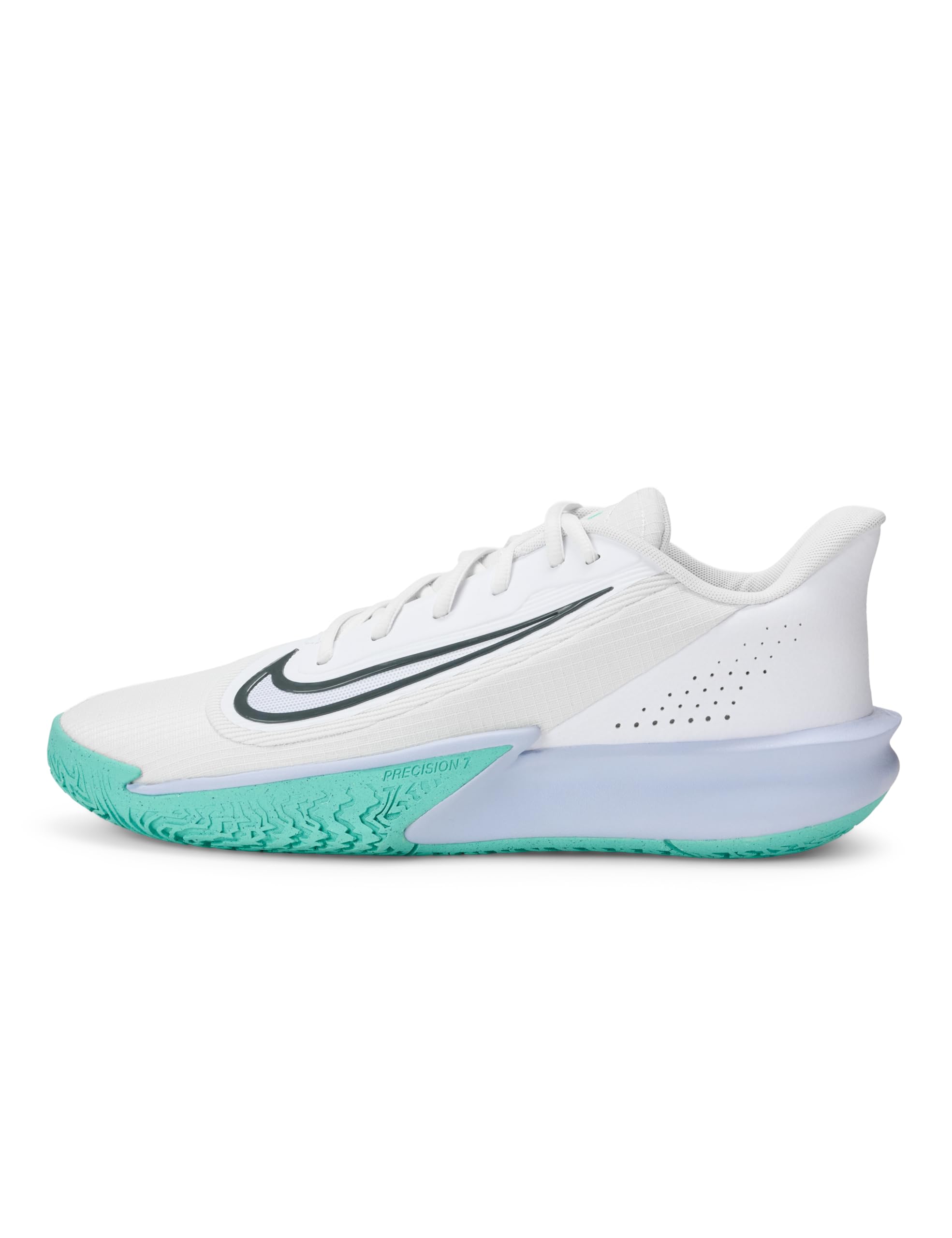
Nike Precision 7

Nike Precision 7

Court feel

Our Score 9.0/10
Check Price

Worth Noting

  • Runs tight through the toe box
Sizing
Unisex adult
Model Line
Precision 7
Shelved As
Men's basketball

Compared with the G.T. Jump Academy, the Precision 7 puts its budget somewhere else. Where the G.T. Jump holds your ankle, this one lets you feel the floor: the shoe disappears on your foot, the grip is the first thing you notice, and lateral movements feel direct rather than mushy.

We like it most for guards and anyone who plays low and quick. Comfort lands a step behind the Dame's, with padding that's there without being plush, but it's the kind of shoe you forget about once the ball goes up, which is about the highest compliment a court shoe gets.

The trade is support: there's less structure around the ankle than the G.T. Jump Academy gives you, and if you've had ankle trouble, that's the difference that decides between the two. For everyone else, the Precision 7 is the light, grippy, uncomplicated pair, and the one you stop thinking about the moment the game starts.

Bottom line: Our pick for players who want court feel over padding: quick underfoot, stable on cuts, and the cheaper of the two Nikes.

How We Sized, Played In, and Wore Out 12 Pairs

We started by pulling every court shoe in the $50 to $200 range sold in a full women's size run or with a clear unisex conversion, then cut anything that was really a lifestyle sneaker dressed up as a basketball shoe — thin outsoles, no lateral support, foam that flattens in a month. That left 12 pairs, which we ordered in our normal converted size and wore for six months of league games, open runs at a rec center, and outdoor sessions on asphalt. Three testers rotated through them, including one with a wide forefoot and one with a narrow heel, since fit complaints almost always land in one of those two spots.

Every new pair got the same first session: two hours of shooting, defensive slides, and sprint-and-stop drills, followed by a log of where the toes pressed, whether the heel lifted on a hard cut, and how much room was left at the end of the insole once we pulled it out and measured it against a ruler. Testers who needed a half size up said so; if a shoe only felt right after ten minutes of lacing and relacing, that went in the notes too. We tracked blisters and hot spots until they stopped, and counted how many sessions each pair took to stop feeling stiff.

Outdoors is where shoes separate. Each pair spent at least three sessions on blacktop, after which we checked the tread under the ball of the foot and at the pivot point for balding, looked for scuffs after deliberately dragging a toe, and examined stitching and glue lines for separation. Every pair was photographed in daylight when it arrived and again at the end, so we could see whether white uppers yellowed and whether marks wiped off with a damp cloth. We also wore them off the court — to the gym, on errands, through a full workday — because most of us only own one pair at a time.

How to Choose Basketball Shoes for Women

Sizing Comes First, and Unisex Isn't Women's

Three of the four shoes here sit on a men's shelf and ship in unisex sizing; the Dame Certified 3 is filed under women's but uses the same unisex size run. The usual conversion between the two charts is a size and a half, so a women's 8 lands at a men's 6.5. Start there, then adjust for the individual shoe: the Precision 7 runs tight, the Lockdown 7 runs small for plenty of feet, and both are easier to live with a half size up.

If you're between sizes, go up rather than down. A court shoe that pinches at the toe doesn't relax into comfort as it breaks in; it relaxes into a blister.

Match the Support to How You Play

Support isn't one feature. It's the collar holding your ankle, the heel counter keeping your foot from sliding sideways, and a midsole firm enough not to roll under a hard cut. The more of that a shoe has, the less floor you feel through it, which is why the G.T. Jump Academy suits a player with ankle history and the Precision 7 suits a guard who wants to feel the court. Decide which of those you are before you compare anything else, because it eliminates half the shelf.

Traction Is About the Court as Much as the Shoe

Every shoe here grips a clean floor. The difference shows up on a dusty one, and it's usually solved with a towel rather than a new pair: wipe the outsoles between games and keep a spare in your bag. Surface matters just as much. Soft indoor rubber is wasted on concrete, which grinds it down, and a tread pattern goes from grippy to slick long before the upper looks tired. Check the pivot point and the toe drag area, not the parts you can see from above.

What the Price Actually Buys

Price in this group tracks cushioning and support, not longevity. The least expensive shoe here, the Dame Certified 3, has the best record of the four for coming through seasons intact, while the most expensive puts its money into holding your ankle. Work out what you're shopping for: if you want one pair to last a year of rec games, buy on fit and durability; if you replace shoes annually anyway, pay for the support that keeps you on the floor.

Frequently Asked Questions

Final Verdict

For most women, the Adidas Dame Certified 3 is the pair to buy. It's the only shoe here sold in the women's section, it runs true to size, it costs the least of the four, and it has the strongest record of surviving a full season, which is the entire job when you're buying one pair for the year.

If ankle support is the thing you're worried about, the Nike G.T. Jump Academy is worth the extra. It's firmer underfoot and it costs more, but nothing else here holds the ankle and arch as securely, and a shoe you trust on a cut is worth more than a soft landing.