Skincare

Best Azelaic Acid Serums of 2026

Azelaic acid doesn't work the way most breakout and dark-spot ingredients do. Instead of stripping oil or forcing skin to peel, it calms the inflammation that shows up as redness, slows the pigment production that leaves a mark behind after a pimple heals, and gently clears the pore lining — which is why it gets recommended for rosacea and melasma as often as for acne. What decides whether it works for you is the formula built around it: a watery serum with soothing panthenol behaves nothing like a thick suspension that pills the moment you add sunscreen. Get the pairing right and redness quiets down, old marks soften, and texture smooths out over a couple of months. Get it wrong and you're left with a stinging film you quietly stop reaching for by week two.

1

Anua Azelaic Acid 10 Serum

Top Pick
Anua Azelaic Acid 10 Serum

Redness and blemishes

Our Score 9.0/10
Check Price

Worth Noting

  • 10% ceiling for stubborn pigmentation
Size
1.01 fl oz
Texture
Lightweight watery serum
Azelaic Acid
10%
Key Additions
Hyaluronic acid, panthenol, cica

Two jobs in one bottle is the pitch: 10% azelaic acid for tone, texture, and redness, plus three weights of hyaluronic acid, panthenol, and a cica-and-blue-tansy complex for the calm and moisture azelaic acid doesn't supply on its own. It's a watery serum, faintly green from the botanicals, and it disappears into skin in seconds.

That balance is why it's the one we recommend first. Azelaic acid is a slow, unglamorous active, and the serums people abandon are usually the ones that sting, drag, or leave a film under sunscreen — this one stays comfortable and layers cleanly, which is most of the battle in a morning routine. Two or three drops after cleansing, a minute to settle, then SPF. We like that it doesn't force a choice between treating redness and hydrating dry cheeks, which is a real problem from November onward.

Go slower than the bottle suggests at first. One or two drops a few times a week, building toward twice daily; reactive skin can still tingle for the first few minutes, and a compromised barrier makes that sharper. If your cheeks flush easily, put it on over a light moisturizer rather than on bare skin for the first couple of weeks.

What it does best is the everyday work: the diffuse redness across the cheeks, the flat brown a spot leaves behind, the rough patch beside the nose. And because it's pleasant enough to use twice a day, it actually gets the stretch of weeks azelaic acid needs before you can judge it. Sunscreen still matters more than the serum does.

Bottom line: Our default pick: a genuine 10% azelaic serum in a watery, hydrating base that sinks in fast and layers under sunscreen — the version most people will keep using.

2

Good Molecules 10% Azelaic Acid Treatment

Good Molecules 10% Azelaic Acid Treatment

Budget daily use

Our Score 9.0/10
Check Price

Worth Noting

  • Can feel gritty on the skin
  • Minimal hydration beyond the active
pH
4.5
Size
30 ml / 1.01 fl oz
Fragrance
Fragrance-free
Azelaic Acid
10%

Fragrance-free, paraben-free, vegan, and pH-balanced at 4.5: the Good Molecules treatment reads like a short ingredient list with a number attached, which is what we want from a first azelaic acid. That pH figure does real work — azelaic acid behaves best in an acidic formula, and a brand willing to state its pH has at least thought about it.

The texture is thin, closer to a light lotion than the watery Korean serums here, and it absorbs fast enough to layer under moisturizer and sunscreen without a fight. There's nothing else in the bottle, though: no hyaluronic acid, no panthenol, no calming botanicals. On oily or combination skin that's fine; on dry or reactive skin you'll want a moisturizer on top and possibly a buffer underneath.

None of that stops it being the smartest first buy. If you don't yet know whether azelaic acid suits you, spending the least in this group to find out is the right order of operations, and a plain formula makes it easier to tell whether the active is working or whether something else in the routine is. We hand this to someone building a first routine, or to anyone who wants one active and no fragrance anywhere near their face.

Bottom line: Buy this one first if you're new to azelaic acid: fragrance-free, pH-stated, and the least expensive way to find out whether the ingredient suits you.

3

The Ordinary Azelaic Acid Suspension 10%

The Ordinary Azelaic Acid Suspension 10%

Cream texture fans

Our Score 9.0/10
Check Price

Worth Noting

  • Can ball up under makeup
Use
AM and PM
Size
1.06 oz
Texture
Cream-like suspension
Azelaic Acid
10%

Thick is the first thing to know, and it's why this one divides people. The Ordinary's azelaic acid is a cream-like suspension rather than a serum, sitting on the skin for a minute or two before it settles into something velvety. On bare skin at night that's a pleasure: no drips, nothing running between your fingers, and a finish that feels like a moisturizer rather than an active.

The 10% does the work the ingredient is known for — the redness and flaking around the nose and mouth, the bumpy texture along the jaw, the flat marks a breakout leaves behind. It's also the least expensive cream-format azelaic acid in this group, which matters if you're already paying for a retinoid and don't want another premium step in the routine.

Keep it for the evening. Applied to clean skin and left to settle before anything goes on top, the finish stops being an issue; hurried under foundation on a weekday morning, it isn't so forgiving. The 1.06-ounce tube also has a habit of arriving looking short of full, though a pea-sized amount covers the whole face, so it lasts longer than that first impression suggests.

Bottom line: Thick, velvety, and best saved for night — the cream-format option for anyone who dislikes watery serums running through their fingers.

4

Cos De BAHA Azelaic Acid 10% Serum

Cos De BAHA Azelaic Acid 10% Serum

Rosacea-prone skin

Our Score 8.6/10
Check Price

Worth Noting

  • Can sting on reactive skin despite the soothing base
Base
Aloe leaf extract
Size
1 fl oz (30 ml)
Azelaic Acid
10%
Key Additions
Niacinamide, panthenol

If your redness behaves like rosacea — flushing, stinging, bumps along the cheeks and nose — this is where we start. Cos De BAHA builds its 10% azelaic acid on an aloe leaf base with niacinamide, panthenol, green tea, and a handful of soothing botanicals, and the serum goes on cool and light, closer to a hydrating essence than to an active.

Calming is the word for it, and that's the reason it holds a place here. Plenty of azelaic serums fade marks; this one is for the weeks when your face is hot and reactive and you still need to treat it. The aloe and panthenol do the soothing, the niacinamide handles oil and post-blemish marks, and there's no fragrance to trip a flare — not a small thing when scent is such a common trigger.

It isn't magic for everyone, and the caution is standard: patch test along the jaw for a few nights before you commit a whole face, and expect the calming to be gradual rather than instant. Where it earns its keep is maintenance — once a flare has settled, this is gentle enough to keep using twice a day without starting another one.

Bottom line: For redness that behaves like rosacea, we start here: an unscented, aloe-based 10% serum with niacinamide and panthenol to calm as it treats.

5

Paula's Choice 10% Azelaic Acid Booster

Paula's Choice 10% Azelaic Acid Booster

Blemish-prone skin

Our Score 8.6/10
Check Price

Worth Noting

  • Small bottle for a premium price
  • Two exfoliating acids can overwhelm a barrier
Size
1.06 oz
Fragrance
Fragrance-free
Azelaic Acid
10%
Second Active
Salicylic acid

Spread is the difference between this and The Ordinary's suspension. Paula's Choice comes as a cream-gel that glides thin and vanishes, and it's the one here we put under foundation without thinking twice about it.

It's doing more than azelaic acid, too. Salicylic acid comes along as a second exfoliant aimed at pores and blackheads, and the formula is oil-free and fragrance-free — nothing to argue with, nothing to clog a combination complexion. For the chin-and-nose congestion that so often travels with redness, that pairing makes real sense.

The instructions offer something the others don't: use it alone, or mix a couple of drops into your moisturizer. That's genuinely useful in winter, when a full layer of 10% feels like too much, and it's how a small bottle stretches further. Keep it off the same evening as a retinoid, though — two exfoliating acids and a retinoid in one night is how a barrier ends up angry.

The sticking point is the price against a 1.06-ounce bottle, and the grumbling about that is fair. Buy it if you want a polished, fragrance-free formula that doubles as your pore treatment and you'll use it twice a day; if azelaic acid is the only thing you're after, the budget picks do that job for far less.

Bottom line: The most polished formula here: a fragrance-free cream-gel that spreads thin, adds salicylic acid for pores, and mixes into moisturizer.

6

Naturium Azelaic Topical Acid 10% Jumbo

Naturium Azelaic Topical Acid 10% Jumbo

Large-bottle value

Our Score 8.8/10
Check Price

Worth Noting

  • Noticeable sour, earthy smell
Size
2 oz
Azelaic Acid
10%
Key Additions
Niacinamide, vitamin C, coffee seed

Two ounces is the whole argument. Every other facial serum here comes in a one-ounce bottle; the Naturium jumbo doubles it, and that changes how you use the stuff. There's enough to take down the neck and across the chest, the places where pigment actually shows and where a small bottle disappears in a matter of weeks.

Under the lid it's a 10% glycinated azelaic acid complex with niacinamide, vitamin C, and coffee seed extract, and Naturium points to an eight-week clinical study on exfoliation, redness, and tone. The vitamin C is a sensible addition for evening out marks, though it does mean one more active in the mix — if you're already on a retinoid, this isn't the gentlest place to add another.

We rate it as the bottle for anyone who goes through azelaic acid quickly or wants to treat below the jaw, and the two-ounce size makes that affordable in a way the one-ounce picks don't. It's an exfoliating formula rather than a plain one, so start every other night and see how your barrier takes it before you go twice daily.

Bottom line: The bottle to buy if you go through azelaic acid quickly: two ounces of 10% with niacinamide and vitamin C, enough for face, neck, and hands.

7

Sesderma AZELAC RU Serum

Sesderma AZELAC RU Serum

Dark spots

Our Score 9.2/10
Check Price

Worth Noting

  • Azelaic acid percentage isn't stated
  • Retinol adds an adjustment period
Size
1.0 fl oz
Skin Types
Dry, oily, combination
Key Actives
Azelaic acid, retinol, vitamin C

Three actives in one bottle is the pitch, and it's a real shortcut if you already use all of them. Sesderma pairs azelaic acid with retinol and vitamin C in a liposomal base aimed at sun spots, age spots, and the pigment that accumulates over years of daylight — the most targeted formula here for dark spots, and the one we suggest for mature skin that has already made peace with retinol.

What the formula doesn't tell you is how much azelaic acid is in it. Sesderma states no percentage, so this isn't the pick if you want a documented 10% and a clean comparison with the rest of the group. Retinol also brings its own adjustment period and its own reason to be diligent about sunscreen. Buy it for the combination and the elegant base rather than for a number on the label, and expect to pay for the privilege.

Bottom line: Azelaic acid with retinol and vitamin C in one step — the most targeted formula here for sun spots, provided you already tolerate retinoids.

8

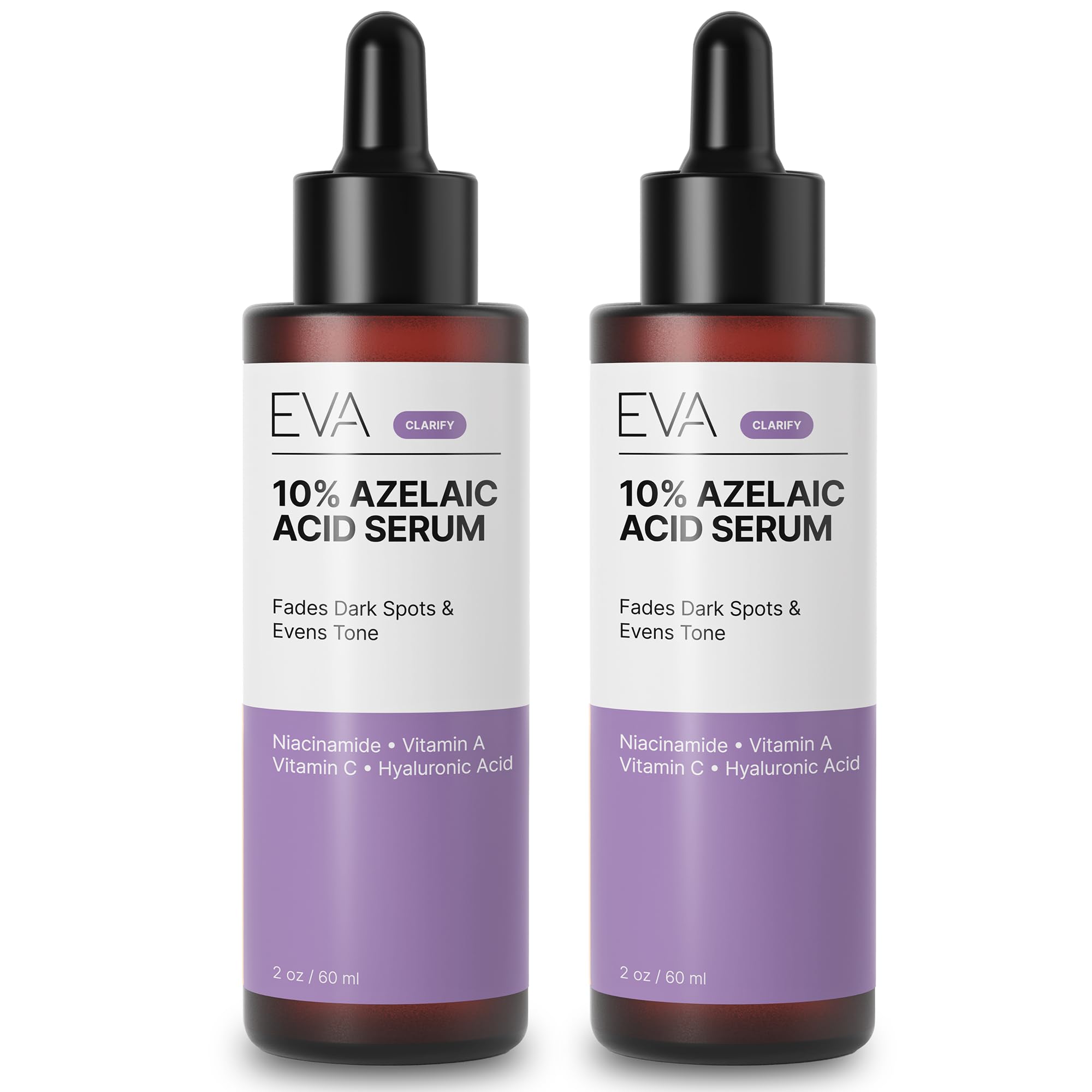
Eva Naturals Azelaic Acid 10% Serum

Eva Naturals Azelaic Acid 10% Serum

Two-bottle supply

Our Score 8.6/10
Check Price

Worth Noting

  • Scented formula is polarizing
  • Irritation comes up more than with the unscented picks
Size
2 oz, 2 pack
Free From
Parabens and sulfates
Azelaic Acid
10%
Key Additions
Niacinamide, hyaluronic acid

Scent decides this one, so start there. The Eva Naturals serum is perfumed — a soft, sweetish fragrance that some find pleasant and plenty find overpowering — and unlike the fragrance-free options here, there's no getting away from it on a full-face application.

What you get is four ounces: two 2-ounce bottles of a lightweight 10% azelaic acid serum with niacinamide and hyaluronic acid, at the lowest cost per ounce in this group. That's the point of it. A bottle this size is the one you can use on your neck, your chest, the backs of your arms, and the routine maintenance that a small premium bottle never stretches to.

Tolerability is the other caveat. Burning and breakouts sit alongside the praise for this one in a way they don't for the unscented picks, and a scented formula on top of that is a lot to ask of skin that's already reactive. Patch test along the jaw for a week before you commit, and if your barrier is currently unhappy, start somewhere gentler.

So this is a bulk buy for someone who already knows azelaic acid agrees with them, and a poor first choice for anyone with reactive skin or a low tolerance for fragrance. Used as a body product as much as a facial one, it's also the bottle that stops you rationing — which, across four ounces, counts for more than it sounds.

Bottom line: A four-ounce bulk buy: two bottles of 10% azelaic acid with niacinamide, cheap enough to use everywhere — if you don't mind a scented serum.

How We Tested Azelaic Acid Serums

We started by reading ingredient lists rather than marketing copy — where azelaic acid sat in the order, whether the concentration was stated or implied, what carrier ingredients surrounded it, and how far down the list any fragrance appeared. We filtered out anything that couldn't be used twice a day without a second thought, compared cost per ounce across sizes, and set aside products that were only intermittently in stock. That narrowed a very long shelf to 12 formulas.

Testing ran six months with a panel whose skin ranged from oily and congestion-prone to sensitive and redness-prone to plain combination. Every tester spent the first three nights applying a small amount along the jawline only, so a reaction would be obvious and contained. From there, each person used their assigned formula morning and night and kept a daily log.

The real work happened in ordinary routines. On weekday mornings, testers applied it to clean skin before moisturizer and sunscreen, then checked at lunch whether makeup had pilled, rolled, or gone patchy on top of it. At night, some layered it under a heavier cream and others used it over moisturizer to see whether buffering changed how it felt. We noted how fast each one sank in, whether it left a film, how quickly any tingle arrived and how long it lingered, and whether the smell — some are noticeably unfragranced, some carry a light scent — faded or hung around. Once a week, everyone took photos of the same cheek in the same window light to compare redness and post-blemish marks. Anyone who flaked, stung, or broke out stopped immediately, and we logged it rather than encouraging them to push through.

How to Choose an Azelaic Acid Serum

Match the Texture to Your Morning

Three formats run through this group: a watery serum (the Anua, the Cos De BAHA), a cream-gel that can be mixed into moisturizer (Paula's Choice), and a thick cream suspension (The Ordinary). The difference barely matters at night and matters a great deal at 7 a.m. If you wear sunscreen and makeup daily, a water-based serum is the one that vanishes under both; a cream-format azelaic acid belongs in the evening, where a slower settle costs you nothing.

Skin type usually points the same way. Dry skin likes the creams for the extra slip and the buffer they provide; oily and combination skin tends to prefer the serums, which don't add another layer of occlusion to a face that already has enough.

Ten Percent Is a Starting Point, Not a Score

Nearly everything here is a stated 10%, which is the standard over-the-counter concentration; the 15% and 20% versions are prescription strengths in the U.S. and are not automatically better. Azelaic acid is a slow active — this is a months-long relationship, not a week-long experiment — so judge a serum after two to three months of consistent use rather than after ten days.

Frequency beats concentration every time. A 10% formula you apply four nights a week will do more than a stronger one you avoid because it stings.

Read the Ingredient List Past the Azelaic Acid

What sits alongside the active decides who the bottle is for. Niacinamide — in the Cos De BAHA, the Naturium, and the Eva Naturals — adds oil control and help with post-blemish marks. Panthenol and hyaluronic acid make the step hydrating rather than drying. Salicylic acid, as in Paula's Choice, turns it into a pore treatment as well.

Retinol and vitamin C, which is the Sesderma's approach, push a serum toward pigmentation and aging concerns, but they also mean more to tolerate and a stricter sunscreen habit. Match the supporting cast to your actual concern, not to the longest ingredient list.

Fragrance Is the Quiet Deal-Breaker

Two picks are explicitly fragrance-free, the Good Molecules and Paula's Choice, and the rest of the field runs from unscented in practice to noticeably perfumed. The Eva Naturals is the sweetest of the group; the Naturium has an earthy base note that reads as sour to plenty of noses.

If you're treating redness, flushing, or a barrier that's already irritated, cut fragrance first. It's a common trigger and it does nothing for the treatment. A scented formula is fine on body skin; it's harder to justify on a hot cheek.

Start Slower Than the Label Says

Most of these bottles tell you to use them twice daily. Ignore that for the first fortnight. Two or three nights a week, one or two drops, applied over moisturizer if your skin is reactive, is enough to learn how you tolerate azelaic acid — and it's the difference between a tingle that fades in five minutes and a sting that lasts all evening.

Don't stack it with a retinoid or an AHA on the same night, and give it a month before you draw conclusions. Buy the one-ounce bottle first if you're new to the ingredient; move up to the two-ounce once you know it works.

Frequently Asked Questions

Final Verdict

Azelaic acid is a slow worker, so the serum you'll actually keep using beats the one with the most impressive label. For most people that's the Anua: a genuine 10% in a watery, hydrating base that layers under sunscreen and calms as it treats, at a price that isn't painful to replace.

Two situations call for something else. If your main concern is stubborn dark spots and you already tolerate retinol, the Sesderma puts three actives in one step. If you simply want to find out whether azelaic acid suits your skin, start with the Good Molecules and spend as little as possible on the answer.