Makeup

Best Airbrush Kits for Beginners

An airbrush does one simple thing: compressed air pulls thinned paint through a needle-fine nozzle and turns it into a mist you steer with your fingertip. Everything that separates a kit you keep using from one that ends up in a closet sits around that nozzle — steady pressure, a compressor that doesn't cook itself on your first model, and a body you can take apart without wanting to throw it. Thin the paint too little and it clogs; too much and it spiders across the surface; a weak compressor makes both problems worse. A good beginner kit takes most of those variables off your plate and leaves you with the one thing you actually want, which is a smooth coat on the first try.

Over the past nine months my team and I ran 11 kits through model cars at the kitchen table, nail tips, fabric stencils, and a lot of cookie icing. The pattern held: the kits people kept reaching for had steady pressure and fast cleanup, and the sputtery, clog-prone ones got abandoned by week two. One bit of advice before you scroll — buy for the compressor, not the paint colors. Everyone counts the bottles in the box, but the compressor is the part you'll live with and the part you can't upgrade later. The picks below are the ones that earned their counter space.

1

MEEDEN Airbrush Kit

Top Pick
MEEDEN Airbrush Kit

First complete kit

Our Score 9.0/10
Check Price

Worth Noting

  • Three airbrushes mean more cleaning
Airflow
23 L/min
Compressor
1/5 hp, 47 dB
Paint Included
24 colors, 30 ml each
Included Airbrushes
Three (two gravity, one siphon)

Three airbrushes and 24 bottles of paint in one box is the reason we make this our top pick: it removes the two extra purchases that stall a first project. The set includes two gravity-feed guns and one siphon-feed gun, with 0.5 mm, 0.25 mm, and 0.35 mm tips, so you can start with broad coverage and move to fine detail without buying another body. The 30 ml paint bottles cover 22 classic colors and two fluorescents, which is more range than most beginners need on day one but a useful palette once mixing starts.

The compressor is rated at 1/5 hp, 23 L/min, and 47 dB. We like the 47 dB figure for a spare room or shared apartment: it is one of the quieter units in this group, and the 1/5 hp motor has enough airflow for a 0.5 mm nozzle without running flat out. The six-foot hose gives you room to move the gun around a desktop without dragging the compressor forward.

The trade-off is that this is a tabletop system, not a travel kit: the compressor weighs 6 kg, so it wants a permanent spot near an outlet. That size buys stability and a quieter motor, but it is the reason this one stays home. If you only paint miniatures, the 24-color set and three guns are more than you need, and the Timbertech is the leaner choice.

Where the MEEDEN earns its premium is the completeness: the cleaning set, color wheel, hose, and spare siphon cups are already there, so you are not improvising a station. The 24 paints include two fluorescents, a small detail that makes the kit feel less like a starter set and more like a usable palette.

Bottom line: For a beginner who wants one quiet box with three airbrushes and paint, this is the kit we recommend.

2

TIMBERTECH Airbrush Kit

TIMBERTECH Airbrush Kit

Value-minded beginners

Our Score 9.0/10
Check Price

Worth Noting

  • No paint or cleaning kit included
  • One airbrush body rather than three
Noise
50 dB
Airflow
20-23 L/min
Nozzle Sizes
0.2, 0.3, 0.5 mm
Working Pressure
1 to 2.5 bar

A regulator, a pressure gauge, and three nozzle sizes are the practical core of this kit. The 0.2, 0.3, and 0.5 mm nozzles let you move from fine lines to broader coverage, while the regulator and manometer let you set working pressure between roughly 1 and 2.5 bar instead of guessing. We also like the oil-free piston design and the 50 dB rating; this is a compressor you can run in a spare room without feeling like you need to shout.

The value case is straightforward: this is a low-cost way to get a regulated compressor, a dual-action airbrush, and three nozzle sizes in one purchase. It is not a paint bundle, though. You need to add paint and a cleaning bottle, and the single airbrush body means you swap nozzles rather than pick up a second gun. We minded the missing paint less than the missing cleaning kit.

For a beginner who already owns paint and wants the most straightforward path to a first spray, this is the value pick in the group. The six-foot hose is long enough to keep the compressor on the floor beside a desk, and the auto start-stop between 3 and 4 bar keeps it from running continuously while you think about the next pass.

Bottom line: We keep this as the value choice for beginners who already own paint and want a regulated, quiet compressor.

3

VEVOR Airbrush Kit

VEVOR Airbrush Kit

Detail and coverage

Our Score 9.4/10
Check Price

Worth Noting

  • No paint or cleaning kit included
Compressor
120W, 23 L/min
Hose Length
70.8 inches
Nozzle Sizes
0.2, 0.3, 0.8 mm
Included Airbrushes
Three

The 0.8 mm airbrush is the outlier here. Most beginner kits stop at 0.5 mm, so a third gun that wide is genuinely useful for primer, large craft pieces, and broad coverage that would take forever with a detail needle. The other two guns are 0.2 mm and 0.3 mm, which means you can keep one set up for fine work and another for coverage instead of breaking down and rebuilding the same brush.

The compressor is rated at 120 watts and 23 L/min, with a 70.8-inch hose and a 9.4-pound body. We like the airflow figure because it gives the 0.8 mm gun enough air to spray without constantly chasing the regulator, and the weight is heavy enough that it stays put on a bench. The kit is air hardware only: no paint, no cleaning bottle, no starter palette.

That makes it the best choice in this set for a beginner who already knows they want both fine detail and broad coverage, and who is prepared to buy paint separately. If your first projects are makeup or tiny miniatures, the 0.8 mm gun is the wrong place to start; use the 0.3 mm and treat the broad brush as a second tool. The 0.8 mm gun is a specialty tool, not the default, and that is exactly why it earns a place.

Bottom line: This is our pick for a beginner who wants three dedicated airbrushes, especially a broad 0.8 mm gun, and can buy paint separately.

4

imyyds Airbrush Kit

imyyds Airbrush Kit

Cordless makeup

Our Score 8.4/10
Check Price

Worth Noting

  • Battery life suits short sessions
  • 75 dB is loud for a handheld
Noise
75 dB
Power
Rechargeable battery
Weight
15.9 oz
Maximum Pressure
32 PSI

A 450-gram handheld compressor changes where you can airbrush. We like this one for makeup, nails, and quick touch-ups because there is no hose to drag across a desk, and the dual-action trigger still gives you separate control of air and paint. The 32 PSI maximum is high for a handheld, and the option to connect a braided hose makes it more flexible than the all-in-one cigar-style units.

The trade-off is session length. Battery life varies with pressure and how thick the paint is, so plan on short bursts and recharge between them rather than treating it like a desk compressor that runs all afternoon. The 75 dB rating is also loud enough to notice in a quiet room. Cleaning is straightforward because the cup and nozzle come apart, and the small body stores in a drawer.

Where it earns a place is the work that does not justify a full compressor setup: a makeup refresh, a nail detail, a small model repair. It is not the one for a large priming job or a long painting session. The hose option is the detail that makes it more than a travel gadget, because you can run it from the handheld body or with the hose when the job gets longer.

Bottom line: We like this for makeup, nails, and quick touch-ups where a cordless 450-gram body matters more than long sessions.

5

InoKraft Airbrush Kit

InoKraft Airbrush Kit

Quiet small spaces

Our Score 8.6/10
Check Price

Worth Noting

  • 4.92 kg body is not truly portable
  • Only four paint colors included
Noise
47 dB
Pressure
34 PSI
Nozzle Sizes
0.2, 0.3, 0.5 mm
Paint Included
4 colors

A 47 dB compressor is the detail that makes this kit easy to live with. That is quiet enough for a shared apartment or a late-evening session, and the 34 PSI working output with an adjustable valve should cover general acrylics and light priming. The package includes three nozzle sizes, four starter paints, a cleaning kit, an airbrush holder, and an oil-water separator, so it is closer to a station than a box of parts.

The three tips are 0.2, 0.3, and 0.5 mm, which is the right spread for a beginner moving between detail and coverage. Four paints are enough to test the setup without buying a full palette, but not enough to carry a whole project; think of them as samplers. The 1/6 hp oil-free compressor has a handle and a stable base, and the holder gives the gun somewhere to sit between passes.

At 4.92 kg, it is not truly portable despite the handle. That weight buys a stable base and quieter running, but it also means this one lives on a desk or a shelf. The hose and holder are there, but the kit still wants a permanent spot rather than a bag.

We recommend this to a beginner in a shared room who wants quiet more than maximum pressure. The 34 PSI ceiling is modest for thick paint, and four colors will not last, but the quiet motor and included accessories remove the usual first-kit friction. The 47 dB rating is the reason to choose it over a louder budget compressor.

Bottom line: Our choice for a shared room: a 47 dB compressor, three tips, and starter paint in one tidy setup.

6

Gaahleri Turbox Kit

Gaahleri Turbox Kit

Desktop control

Our Score 8.2/10
Check Price

Worth Noting

  • Only one 0.35 mm airbrush included
  • 30 PSI ceiling limits thick paint
Size
5.5 x 3.9 x 2.3 inches
Noise
Under 48 dB
Nozzle
0.35 mm
Pressure Range
8-30 PSI

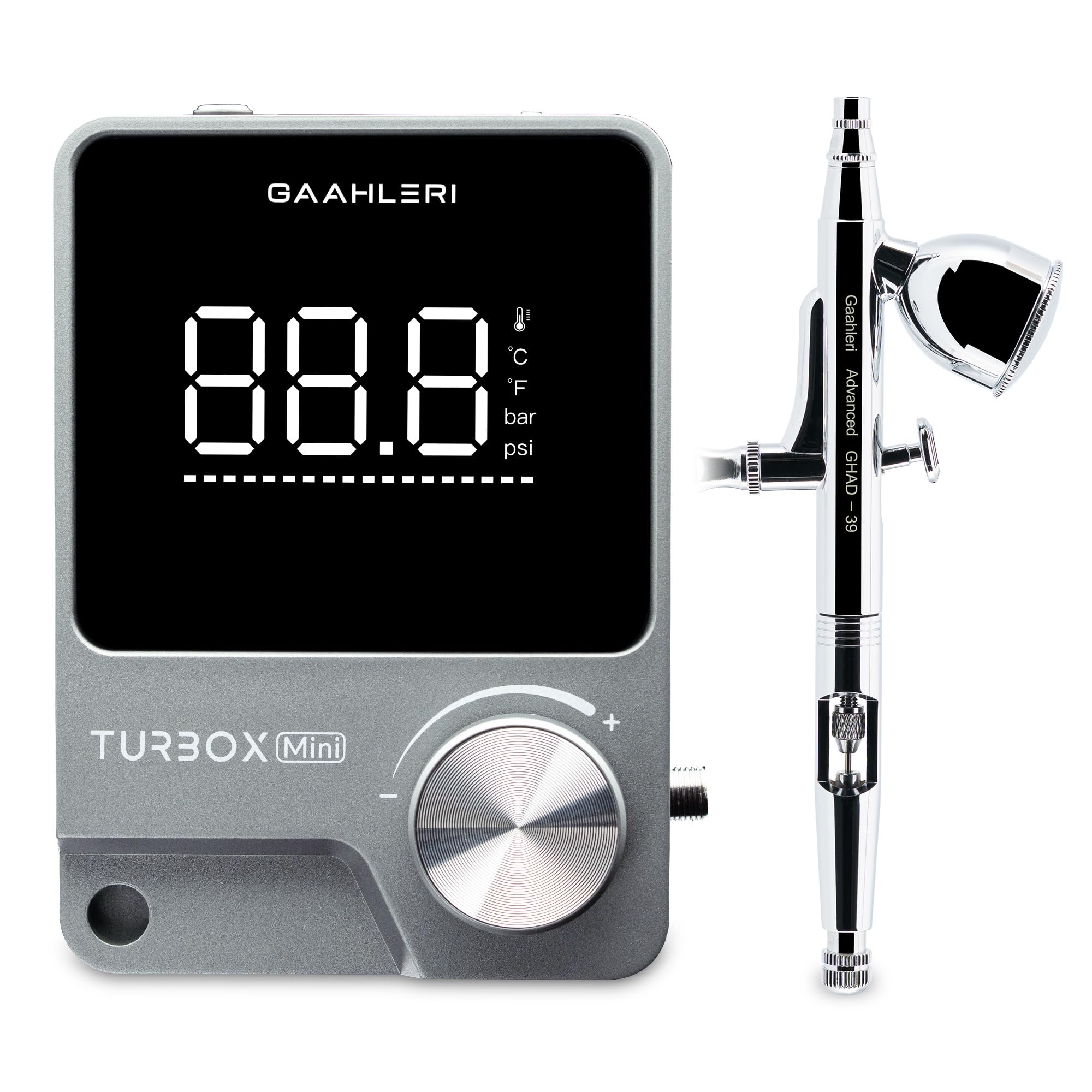
A digital pressure display on a beginner compressor is unusual, and it is the first thing we noticed here. The dial switches between low, medium, and high presets, then lets you fine-tune across an 8 to 30 PSI range with the current pressure shown while you spray. For a beginner, that takes one guess out of the setup: you can see what the brush is getting instead of reading a needle from across the desk.

The compact body measures 5.5 by 3.9 by 2.3 inches and is rated under 48 dB, so it fits beside a monitor and stays quiet enough for a shared room. We think the 8 to 30 PSI range is the right window for general acrylics and light priming, though it is a narrower ceiling than the full-size compressors here. The 0.35 mm airbrush is a sensible general-purpose size, but it is the only one in the box.

One airbrush and one nozzle mean you cannot switch to a 0.2 mm detail setup or a 0.5 mm coverage brush without buying another gun. The built-in overheat warning and protection are reassuring for a compact unit, and the digital control is genuinely useful once you start changing paints. This is a precise small kit, not the most versatile first kit.

Bottom line: We recommend this for a beginner who wants digital pressure control and a compact, quiet compressor, and can live with one nozzle.

7

Oasser Airbrush Kit

Oasser Airbrush Kit

Budget light use

Our Score 8.0/10
Check Price

Worth Noting

  • Short 3-foot hose
  • No paint included
Noise
30 dB
Power
12V DC
Airflow
10.5 L/min
Nozzle Sizes
0.2, 0.3, 0.5 mm

The auto-stop compressor is the feature that makes this budget kit feel smarter than its price. It shuts off when you stop spraying, which cuts idle noise and wear, and the 30 dB rating is the lowest in this set. The kit also includes three nozzles at 0.2, 0.3, and 0.5 mm, a 10.5 L/min airflow rating, and stepless pressure control, so you are not locked into a single spray width.

The 12V DC corded design avoids the battery fade that makes handheld kits frustrating, but it also ties you to an outlet. The three-foot hose is shorter than the six-foot hoses on most of the others, so the compressor has to sit close to your work. The package includes cleaning needles, brushes, a wrench, a dropper, seal rings, and a 12V adapter, but no paint.

For light, occasional craft work, that package is enough. Long-term reliability is the open question, so we treat this as a small-job kit rather than the one to trust with a full production run. If noise is your first concern and you mostly spray in short bursts, the 30 dB rating and auto-stop make it the quietest budget option here.

Bottom line: We see this as a quiet, occasional-use kit for a tight budget, as long as the short hose and light-duty expectations fit.

How We Chose and Tested Beginner Airbrush Kits

We started with every beginner kit we could find that included its own compressor rather than relying on cans of propellant, then narrowed by price, by whether replacement needles and nozzles were actually sold for that model, and by how much of the setup was plastic where it should be metal. From that list we bought 11 kits and lived with them for nine months — not on a lab bench, but in the places people really airbrush.

Most sessions happened at the kitchen table on newspaper, with a drop cloth in the garage for fabric work and a friend's nail station for the detail spraying. A colleague who had never held an airbrush was handed each kit cold: we timed how long it took to go from sealed box to first spray, then watched whether they could lay an even coat on a plastic spoon without drips, spitting, or spidering. Everyone also sprayed model parts, nail tips, thinned acrylics through a stencil onto a t-shirt, and royal icing onto cookies.

Cleanup got a stopwatch. We timed a full color change — dump the cup, flush, backflush, wipe the needle — and noted when pigment hid in the nozzle and reappeared in the next color. Each cordless unit sprayed continuously until the battery quit, and we recorded the minutes. Pressure went on an inline gauge, and we ran the same paint at the low and high ends of the dial to find where the spray turned blotchy. Compressors ran 20- to 30-minute sessions while we checked body heat by hand, listened for the motor laboring, and noted whether a thermal cutoff tripped. Last, every kit was packed and unpacked into its case repeatedly to see whether threads stripped, plastic fittings cracked, or hoses wept at the connection.

How to Choose a Beginner Airbrush Kit

Put the Compressor First

A beginner needs steady, adjustable air more than maximum pressure. Look for a compressor with a regulator and a moisture filter, plus an auto-stop or bleed valve so it is not running flat out between passes. For general acrylics and model paint, a working range around 15 to 30 PSI covers most starting work; thick paint needs more thinning, not a bigger number. Corded units such as the Timbertech and MEEDEN hold pressure better for longer sessions, while a handheld like the imyyds trades some of that for freedom.

Choose Nozzle Sizes for Your First Projects

The nozzle decides what the brush can do. A 0.35 to 0.5 mm setup is the forgiving all-rounder for models, crafts, and general coverage; 0.2 to 0.3 mm is for fine lines and small details; 0.8 mm is for broad coverage and heavier material. A kit with swappable needles covers more, but each change adds cleaning. We like three dedicated guns on the VEVOR and MEEDEN for that reason, while the Gaahleri's single 0.35 mm brush is simpler to learn on but less flexible.

Count What Is Actually in the Box

A compressor and hose are the minimum, not a complete kit. Check for a cleaning kit, a holder, spare nozzles or needles, and paint if you want to start the same day. Paint is the most common gap: the Timbertech and VEVOR leave it out, while the MEEDEN and InoKraft include it. We also look for an oil-water separator and a matching nozzle and needle set, because mismatched parts are a frustrating first repair.

Plan for Cleaning and a Place to Put It

Cleanup is part of the hobby, not an afterthought. A cup that comes off, a nozzle you can reach, and a cleaning bottle in the box make a beginner far more likely to keep the airbrush ready. Place the compressor on a stable surface with room for the hose to move, and keep paint away from the intake. Noise figures around 47 to 50 dB are comfortable in a shared room; a 75 dB handheld is better for short jobs.

Pick Corded or Cordless by Session Length

Corded compressors are the safer first buy for sustained painting: no battery fade, no charging break, and usually more consistent pressure. A cordless handheld is the better fit for makeup, nails, and touch-ups, where a 450-gram body and no hose matter more than an hour of run time. If you plan to paint a whole model or a batch of miniatures, choose corded; if you want to work at the mirror or away from a desk, choose cordless and treat the battery as a short-session limit.

Frequently Asked Questions

Final Verdict

MEEDEN is the kit we point a first-timer toward when the goal is one quiet box with everything needed to start. The three airbrushes cover detail and coverage, the 24 paints remove a shopping trip, and 47 dB keeps it usable in a shared room.

If you already own paint and want to spend less, the Timbertech is the better value; its regulator, three nozzles, and 50 dB compressor do the essential job. Choose the VEVOR instead when a broad 0.8 mm gun matters more than paint in the box.