Hair Care

Best Straighteners for Black Hair of 2026

A flat iron for Black hair has to do more than get hot. It has to press roots straight without scorching ends, glide through thick 4C hair without snagging, and hold up on wash day when you're working in small sections. I've had irons that hit high heat in seconds and still left my hair crispy, and cheap ones that pulled so hard I quit halfway through. What you want is control: fast, even heat and a plate that glides.

Over eight months, my team and I tested a dozen straighteners on natural hair, relaxed hair, and wigs — through wash days, rushed weekday touch-ups, and one humid wedding. The ones that earned a spot heated quickly, straightened in fewer passes, left hair smooth instead of singed, and felt worth the money. We also watched the unglamorous stuff: cords that fray, auto shut-off that actually works, and whether the glue bundled with a hot comb is worth using. The picks below are the ones that made wash day feel less like a chore.

1

Remington Shine Therapy 1-Inch

Top Pick
Remington Shine Therapy 1-Inch

Everyday straightening

Our Score 9.2/10
Check Price

Worth Noting

  • Buttons sit under the thumb and get bumped mid-pass
Plates
Ceramic with argan oil and keratin
Weight
1.01 lb
Dimensions
10.8 x 1.2 x 1.2 inches
Plate Width
1 inch

The plates on the Shine Therapy have argan oil and keratin worked into the ceramic, and on dry, coily hair that coating earns its keep. A section that drags against bare ceramic slides through this one, and we got a clean pass on resistant new growth without going over the same inch of hair three times.

That glide is why we send most people here first. The heat is adjustable across a wide range and climbs high enough — around 450°F at the top — to press coarse roots, then drops far enough for fine edges, relaxed hair, or a child's hairline. Plenty of irons that cost more can't do both ends of that.

One inch looks narrow next to the two-inch irons, and for this hair type it's right. Coily hair gets pressed in sections you can see through, and a narrow plate gets close to the root without putting hot ceramic on the scalp. The trade is time: more sections, more passes, a longer appointment.

Two details we came to appreciate: it's light enough to hold through a whole head without your wrist complaining, and the automatic shut-off has saved us the walk back to the bathroom more than once. Neither is the reason to buy it — the even heat across the plates is — but both are why it stays within reach instead of going in a drawer.

Bottom line: We tell most people to start here: it's hot enough for coarse new growth, the coated plates glide instead of dragging, and the shine holds for days.

2

Hot Tools Black Gold 1 1/4-Inch

Hot Tools Black Gold 1 1/4-Inch

Thick, dense hair

Our Score 9.2/10
Check Price

Worth Noting

  • Can stop heating within a few months
Max Heat
455°F
Heat Levels
27 digital settings
Plate Width
1 1/4 inches
Auto Shut-Off
2 hours

If your hair is dense enough that a one-inch iron turns a press into an evening, the extra quarter inch here earns its keep. The plates measure 1 1/4 inches, the range climbs to 455°F across 27 digital levels, and the heat holds rather than sagging halfway down a section — which is usually the difference between one pass and three.

The rounded edges are the part we ended up using most. Square-edged irons press well and curl badly; this one flicks a wave into the ends after straightening, so a single tool covers a silk press, a body wave, or a bump at the front. The two-hour auto shut-off and dual voltage are the sort of thing you don't think about until a hotel bathroom in another country — and the temperature control sits right where a thumb rests, so check the setting before each pass.

Longevity is where we keep our guard up. These irons can stop heating within a few months, so buy from a seller with a painless return and register the warranty the day it arrives. That caveat aside, for genuinely thick hair this is the one we reach for first.

Bottom line: For thick, dense hair this is the faster iron: wider plates, steady 455°F heat, and edges that curl, as long as you buy somewhere with a generous return window.

3

InfinitiPRO by Conair 1-Inch

InfinitiPRO by Conair 1-Inch

Coarse, resistant hair

Our Score 9.0/10
Check Price

Worth Noting

  • Plates can catch hair at the outer edges
  • Some units shut off or fail within months
Max Heat
455°F
Plate Width
1 inch, extra-long
Heat-up Time
15 seconds
Heat Settings
30

Think of this as the Remington's more adjustable cousin: thirty heat settings instead of a handful, extra-long plates, and the same 455°F ceiling. You're paying for control and coverage, not for more heat.

The extra length on the plates sounds like a spec-sheet detail until you're pressing a shoulder-length head. Each pass covers more hair, and the floating mounts keep contact through the point where a coil turns over, which is where a fixed plate tends to lose the section.

Thirty settings is the reason we reach for it. Coarse new growth wants the top of the range; relaxed ends and a fine hairline want the bottom third; and being able to name a number instead of guessing between five clicks is worth the step up for anyone pressing their own hair every week.

Heat-up takes about fifteen seconds, the body is light enough for a full press, and the auto shut-off is a genuine convenience rather than a nuisance. In a house where two people with different textures share one iron, that numbered dial settles arguments.

Bottom line: If you want to dial in an exact temperature and hold it, this is the most adjustable iron here, and the extra-long plates suit shoulder-length hair.

4

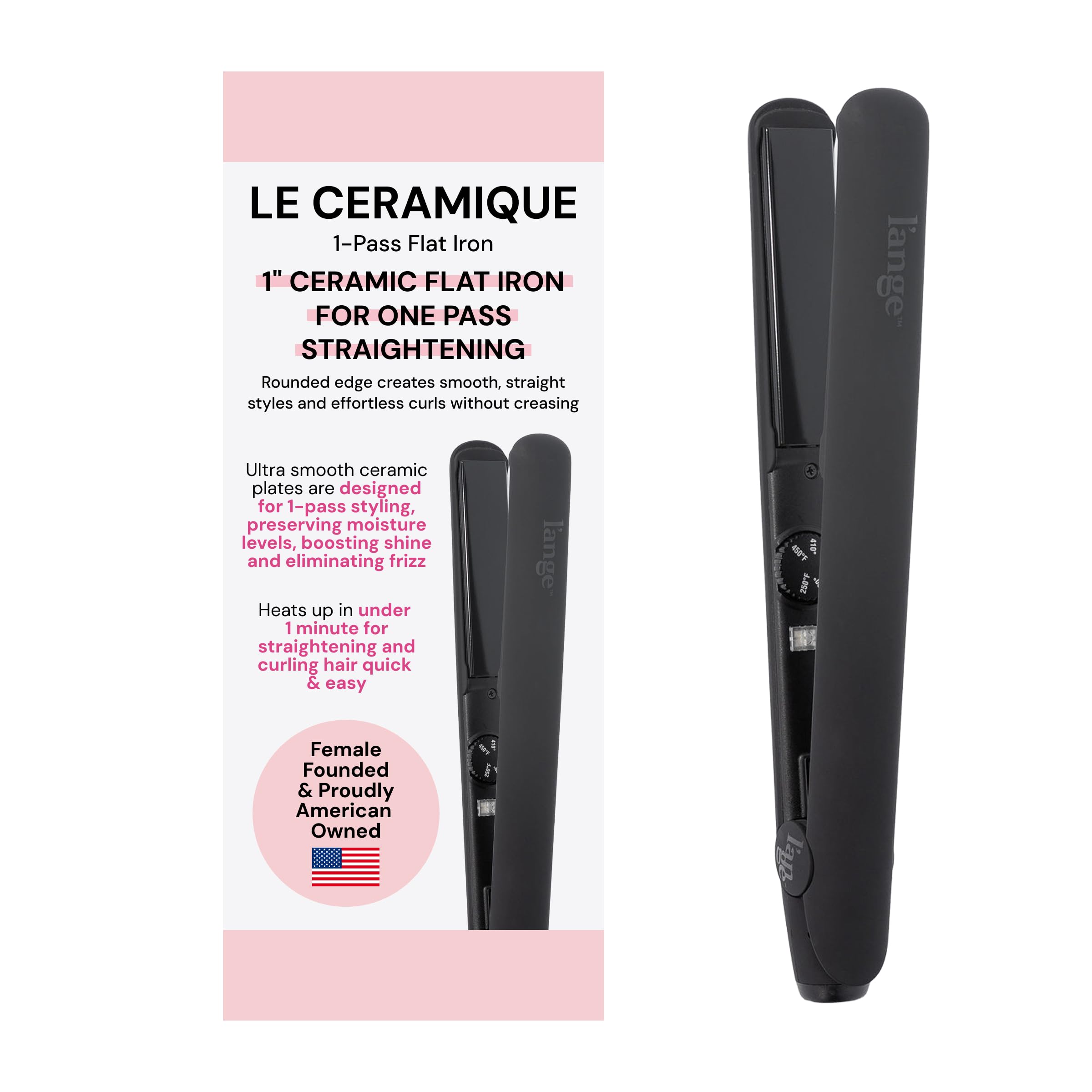
L'Ange Le Ceramique 1-Inch

L'Ange Le Ceramique 1-Inch

Fast full-head passes

Our Score 9.0/10
Check Price

Worth Noting

  • One-inch plates mean more sections on dense hair
Edges
Rounded
Plates
Ceramic-coated
Weight
1.46 lb
Plate Width
1 inch

A full head of 4C hair is a long appointment, and this is the iron we finished fastest with. Most sections came smooth in a single pass at 450°F, and the crown — always the stubborn part — took a second.

The ceramic coating is the reason. It's built to hold moisture in rather than bake it out, and the result feels like hair afterward: soft, with a shine that reflects light instead of the flat, pressed look you get from an iron running too hot. The soft-touch matte body also stays comfortable in a warm hand, which sounds trivial until minute thirty.

One inch of plate makes it as useful on short hair and fine edges as on coils, and the rounded edges mean it can curl what it just straightened. On very dense hair you'll still work in small sections and you'll still spend the time — the speed is in the glide, not in magic.

Bottom line: Our pick if you judge a straightener on the finish: it presses smooth in one pass and leaves hair soft rather than scorched, and the rounded edges curl.

5

CHI G2 Titanium 1-Inch

CHI G2 Titanium 1-Inch

Travel and dual voltage

Our Score 9.2/10
Check Price

Worth Noting

  • Auto shut-off circuit can fail
Display
Digital LCD with presets
Voltage
Dual voltage
Max Heat
425°F
Plate Width
1 inch

Dual voltage is the reason this one goes in the suitcase. It switches for outlets abroad with nothing more than a plug adapter, which is the difference between doing your hair on a trip and hoping the hotel dryer is enough.

The digital display is the second reason. It shows the actual temperature rather than a numbered dial you have to trust, and the presets cover fine, medium, and coarse hair. The ceiling is 425°F — below the hottest irons here, but plenty for a press when your sections are thin and your pass is slow.

Titanium-infused ceramic behaves the way titanium usually does: quick to temperature, even across the surface, and smooth on the pass. Coarse hair pressed cleanly at 425°F in our testing as long as we kept sections narrow, and smoothness is near the top of this set.

What gives us pause is the electronics. The auto shut-off circuit is the part that fails — irons that won't power back on — and at the premium end of this group you're paying for the display and the voltage switch rather than for a longer life. Travelers and anyone who wants to read the number will find it worth the money; if the iron never leaves the bathroom, the Remington does the same job for less.

Bottom line: The travel pick: dual voltage, a readable temperature display, and a 425°F ceiling that presses coarse hair cleanly in small sections.

6

Revlon Ceramic 2-Inch

Revlon Ceramic 2-Inch

Wide-section styling

Our Score 9.2/10
Check Price

Worth Noting

  • 400°F ceiling is modest for resistant coils
  • Body feels plasticky next to the pricier picks
Plates
Ceramic-coated
Weight
10.1 oz
Max Heat
400°F
Plate Width
2 inches

Two-inch plates are the entire argument for this Revlon. On thick hair, wide plates mean fewer passes and less arm work, and if you're straightening someone else's hair — a daughter, a sister, a friend on a Sunday — that difference shows up as minutes saved.

The ceiling is 400°F, the lowest top end in this group, and it's the number to think hardest about. On medium texture and relaxed hair it's enough. On tight 4C new growth you'll be slowing your pass and thinning your sections to compensate, and in humid weather the press may not hold as long as one from an iron running hotter.

For a first iron, a spare, or a household where the hair is thick but not the most resistant, it does the job for the least money here. It's also the lightest iron in this group at just over ten ounces, which sounds like a small thing until you've held your arm up for forty minutes.

Bottom line: The budget choice: two-inch plates cover big sections fast, and 400°F is enough for thick, wavy hair as long as it isn't the most stubborn new growth.

7

Remington Anti-Static 1/2-Inch

Remington Anti-Static 1/2-Inch

Edges and short hair

Our Score 9.2/10
Check Price

Worth Noting

  • Too narrow for a full head of thick hair
  • On/off switch has failed on some units
Plates
Titanium with ceramic coating
Plate Width
1/2 inch
Heat-up Time
15 seconds
Heat Settings
9 digital

Half-inch plates aren't a compromise here — they're the point. This is the iron for edges, baby hairs, a short crop, a hairline touch-up after a press, and the last inch at the nape that a one-inch plate keeps missing. If you already own a full-size iron, this is the second tool that completes it.

Fifteen seconds to heat, nine digital settings, plates longer than the half-inch width suggests, and a 60-minute auto shut-off. The anti-static claim is a 50% reduction, a figure we take with some salt; what we can say is that the ceramic-and-titanium surface glides and leaves a hairline defined rather than crispy.

The longer plates matter as much as the width. You get a straight, finished edge in one pass along the hairline instead of chasing the same few strands, and the iron is light enough to hold close to the face without your hand shaking.

Two boundaries worth knowing. It won't press a full head of thick hair — the sections would be absurd and you'd be there all evening. And the on/off switch has been the failure point on some units, so work the power a few times inside the return window before you rely on it.

Bottom line: The detail iron: half-inch plates reach edges, hairlines, and short hair that a full-size flat iron can't, and it heats in fifteen seconds.

8

Goiple Electric Hot Comb Set

Goiple Electric Hot Comb Set

Pressing and wigs

Our Score 9.2/10
Check Price

Worth Noting

  • Comb doesn't get hot enough for thick new growth
  • Glue in the kit is inconsistent
Type
Electric pressing comb
Heat-up Time
20-30 seconds
Kit Includes
Wig glue, melting spray, wax stick
Temperature Control
Yes

This isn't a flat iron in a different shape. It's a heated pressing comb, sold in a kit with the pieces you need to lay a frontal: wig glue, melting spray, a wax stick, and the small tools that usually get bought separately.

A comb works differently from plates. The teeth get down to the scalp and through the root in a way a flat iron can't, which is why pressing combs still exist for short natural hair, hairlines, and anyone who wants the root flat rather than merely smooth. It heats in about half a minute.

The comb itself is light in the hand, which matters when you're working along a hairline at close range, and the temperature control gives you a low setting for lace and a higher one for hair. For someone laying a first frontal, the kit removes a shopping trip.

Heat is the weak point. The comb doesn't get hot enough to press thick new growth in a single pass, so it suits short hair, edges, and wig work more than a full head of dense coils. The glue is inconsistent too — sometimes it holds for a week, sometimes it's dried in the tube — so buy this for the comb and treat the rest as a bonus.

Bottom line: Buy it as a pressing comb and a wig-install starter kit: it reaches the root in a way plates can't, though it won't press a full head of dense coils.

How We Tested Straighteners for Black Hair

We started with a long list of flat irons and hot combs sold for Black hair, then narrowed it by plate material, heat range, plate width, cord length, auto shut-off, and price. A dozen made the cut, and we spent eight months with them — long enough to see which ones stayed reliable after weekly wash days and which started snagging or losing heat.

Every iron went through the same routine: a full wash-day press on natural 4C hair, a quicker pass on relaxed hair, and at least one refresh on a lace-front wig. We timed each one from a cold start to 350°F and 400°F, then checked the plate with an infrared thermometer to see whether the dial told the truth. On hair, we counted passes per section, checked whether the roots actually got straight, and felt each section for roughness or leftover frizz. If an iron pulled at the ends or caught on a tangle, we noted it — snagging was a dealbreaker.

We also tested the details that only show up over time: we set a timer and walked away to see whether auto shut-off clicked off, checked cords and hinges for wear after eight months, and weighed what came in the box — heat mat, case, glove — against what the iron cost. The hot comb kit included wig glue and a wax stick, so we used them on a lace front and checked whether the glue held for a full day or turned tacky. And because straight hair has to survive real life, we wore our smoothest styles out into a humid July afternoon — one tester's wedding — and looked for reversion at the roots and ends.

How to Choose a Straightener for Black Hair

Match the heat range to your texture

Resistant, coily new growth usually needs somewhere around 400°F to 450°F to press smooth, while relaxed, color-treated, or fine hair wants to sit well below that. The number that matters isn't the maximum — it's whether you can set something in between and hold it.

An iron with thirty settings gives you a temperature you can name; a five-click dial gives you a guess. Our top pick and the InfinitiPRO both clear 450°F, and both drop low enough to finish a fine hairline afterwards.

Pick plate width by hair volume and patience

One-inch plates are the sweet spot for coily hair: narrow enough to reach the root without laying hot ceramic on the scalp, wide enough to move through a section. Step up to 1 1/4 inches if a press currently takes you an hour — that is the entire case for the Hot Tools.

Two-inch plates cover the most ground, as the Revlon does, but they're clumsy at the hairline and they sit further from the root. Wider is not automatically better; it's faster on thick hair and worse on detail.

Look at how the plates meet, not just what they're made of

Floating plates tilt to follow a section as a coil turns, which keeps contact without extra pressure. Rounded edges let one tool finish the press and put a bend in the ends; square edges press well and curl badly.

Then check the seam. An iron whose plates don't meet evenly will catch hair at the outer edge, and the cost is a pass plus a few strands. Keep sections narrower than the plate and most snagging disappears.

Plan for the long session

A press takes time, so weight, cord, and control placement matter more than they do on a five-minute style. Look for a swivel cord, a body near a pound, and buttons that sit away from where your thumb lands when you close the iron.

Auto shut-off is a genuine convenience, but on more than one iron here the shut-off circuit is also the part that fails. Buy from a seller with an easy return and keep the receipt until you've used it a dozen times.

Frequently Asked Questions

Final Verdict

Start with the Remington Shine Therapy. It presses coarse, resistant hair smooth, the coated plates glide where cheaper ceramics drag, and it has the range to finish a fine hairline on the same day. If your hair is dense enough that a one-inch iron turns wash day into an evening, go to the Hot Tools for the wider plates and steadier heat.

And if you press your own hair regularly, add the half-inch Remington for edges. It's the tool most people don't know they're missing until a hairline stops fighting back.