Fashion

Best Ski Socks for Women of 2026

There's a particular misery that starts in your toes: you click into your bindings, the chairlift stalls, and by the time you reach the top your feet are numb before you've made a turn. A ski sock shouldn't be an afterthought. Too thin and the cold bites through; too thick and the extra bulk changes how your boot fits, which can throw off your control on the way down. Over one full ski season, my team and I wore 14 pairs through resort days, storm cycles, and long lift rides, and the differences were obvious.

The socks that rose to the top shared a snug, not-tight fit through the calf, cushioning where the boot cuff presses, and fabric that managed moisture instead of holding onto it. I also learned to check the seam over the toes before buying a pair—a tiny ridge can turn into a blister by lunchtime. Some of our picks are warmer than others, and a couple are better for wide calves or narrow boots, but they all earned their place on the mountain.

1

WEIERYA Merino Ski Socks

Top Pick
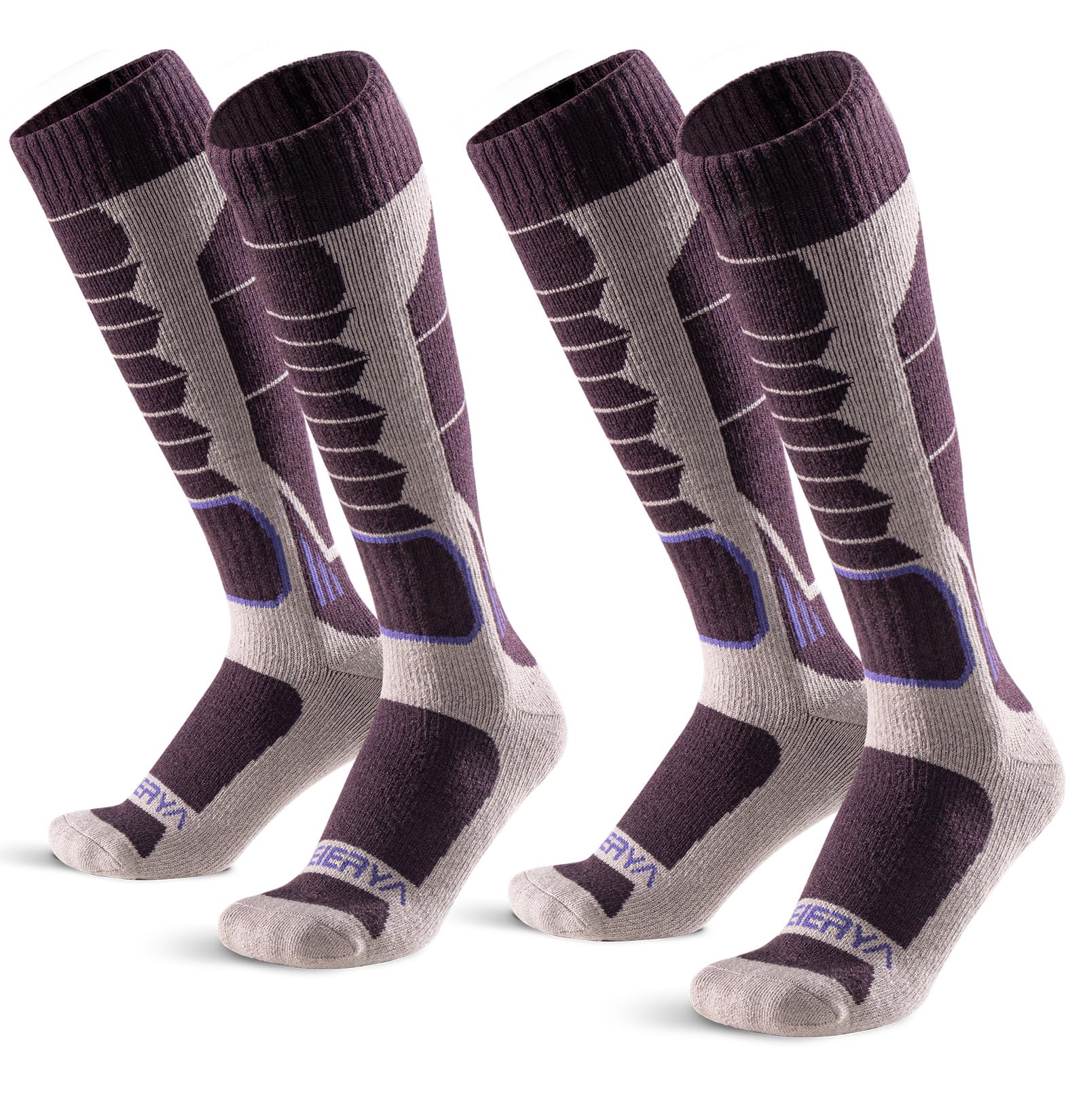
WEIERYA Merino Ski Socks

All-day skiing

Our Score 9.2/10
Check Price

Worth Noting

  • Full cushion fills a close-fitting boot
Rise
Over the calf
Material
Merino wool
Cushioning
Full cushion

Value is the headline here, but it isn't why this pair is our top pick. WEIERYA's over-the-calf merino sock is fully cushioned from cuff to toe, and it does the two things a ski sock has to do without asking anything of you: it keeps feet warm and it stays where you put it. It also costs less than anything else in this group, which is how a good sock becomes one you buy twice.

The cushioning is the part we noticed most. It runs under the whole foot rather than sitting in a token heel patch, and it puts a real layer between your shin and the front of the boot cuff, which is the spot that takes the pressure when you're holding a forward stance all morning. Through a full day the shaft stayed put: no creeping down into the heel pocket, no bunching at the ankle, which is the failure that ends a day faster than cold does.

Merino is what makes the warmth work. The wool keeps the sock hot on a cold lift without turning into a sweatbox on the ride down, and a wool sock can go a couple of days between washes without announcing itself. They feel soft against the skin from the first wear, with none of the prickle you get from a coarse wool knit.

Sizing is the one part to do deliberately. The range is unisex, so work from your boot size rather than your usual women's number, and expect the shaft to sit high on the calf — that's the job, since it has to clear the liner. Beyond that there's very little to think about: pull them on, ski, take them off. Few socks at any price manage that.

Bottom line: This is the pair we point most women to: full-cushion merino that stays up over a full ski day, at the lowest price in this group.

2

OutdoorMaster Merino Ski Socks

OutdoorMaster Merino Ski Socks

Cold days

Our Score 9.4/10
Check Price

Worth Noting

  • Ankle can wear through early
Toe
Seamless
Pack
2 pairs
Rise
Over the calf
Fabric
30% merino wool blend

Thirty percent merino is the number that matters here, and it's a larger share of wool than most of the blends in this group. What it buys you is warmth: this is the pair that separates itself on a genuinely cold day, and it manages that without the stiff, board-like feel of a pure wool sock. For anyone whose feet go cold first, that's the whole argument.

The rest of the blend earns its keep. Acrylic and nylon give the knit enough stretch to hug the calf without squeezing it, the elastane holds the shaft where you put it, and the seamless toe means there's no ridge rubbing the front of your boot by the afternoon. We also like that the merino is fine enough to wear against bare skin all day without thinking about it.

They come two to a pack, and the over-the-calf cut does what it's supposed to: the cuff doesn't roll, the heel doesn't drift, and there's enough length to clear a tall liner. Warmth without bulk is the trick, and this pair gets closer to it than most.

Fit is the least settled thing about them. There's plenty of room through the calf, but if your feet sit at the bottom of the size range the heel can come up long — nothing a ski boot won't hide, and worth knowing before you commit. Everything above that is why we keep a pair in the boot bag from December to March.

Bottom line: If your feet go numb on the lift, start here: warmth is this sock's strongest suit, and they come two to a pack.

3

CELERSPORT Wool Ski Socks

CELERSPORT Wool Ski Socks

Groups and families

Our Score 9.4/10
Check Price

Worth Noting

  • Wool content isn't broken out
Pack
2 to 4 pairs
Material
Wool
Cushioning
Shin and foot padding

If you're outfitting three or four people for a ski week, start here. CELERSPORT sells these two to four pairs at a time for roughly what one pair of the pricier socks here costs, and the saving doesn't come out of the parts that matter. Nobody in the group has to think about their feet all day, which is the most you can ask of a sock you're buying by the handful.

The detail we appreciate most is the shin. There's extra material across the front of the calf, exactly where a boot cuff presses, and it's the difference between finishing the day thinking about your turns and finishing it thinking about your legs. The fit holds too: the sock hugs the calf without cutting in, and it doesn't sag into the boot by mid-afternoon.

Where they give ground is warmth per thickness. This is a lighter knit than the merino blends in this group, which makes it excellent in a snug boot and on a spring day, and less than ideal when the mountain is at single digits. If your season is a holiday trip and a handful of weekends, that's a trade worth making.

Bottom line: Our value pick: a wool ski sock with real shin padding and a fit that stays put, at budget-pack money.

4

Welwoos Merino Ski Socks

Welwoos Merino Ski Socks

Wide calves

Our Score 9.2/10
Check Price

Worth Noting

  • Heels can wear through in a season
Pack
3 pairs
Rise
Knee high
Material
Merino wool

Calf pressure is what makes people take a ski sock off at lunch, and this is the pair that doesn't cause it. Welwoos knits the top with enough give that it sits gently instead of gripping, and still gets the shaft to stay up — a combination that's rarer than it should be, because most socks solve one by giving up the other.

Warmth is solid rather than extreme. It's a soft merino knit, comfortable out of the bag and softer after a couple of washes, and it handles a cold day on the hill without turning your boots into an oven on the lift. Three pairs come in the pack, which is a rotation for a long weekend without doing laundry at night.

What we like is that the comfort doesn't cost you the fit. There's no sagging at the ankle, no bunching under the arch, and no readjusting at the top of the lift — the sock goes on in the lodge and stays there. For anyone who has finished a ski day with a red ring around the calf, that's the feature worth paying for.

They're a mid-weight knit rather than a full-cushion sock, which is the right call in a boot that already fits properly and the wrong one if you're relying on socks to fill space in a roomy rental. Get the boot right and these do everything you need.

Bottom line: For calves that feel strangled by ski socks, these are the ones we hand over: soft, warm and gentle at the top, in a three-pack.

5

Sandsuced Merino Ski Socks

Sandsuced Merino Ski Socks

Cushioned comfort

Our Score 9.2/10
Check Price

Worth Noting

Pack
3 pairs
Rise
Knee high
Material
Merino wool

Cushioning is the first thing you notice about this knit, and it's why the pair is here. The sock is thick through the foot and up the shaft — thick enough to fill a boot without bunching at the ankle, which is where a heavy sock usually gives itself away.

It holds up on the mountain as well as in the hand. Warmth is the strongest single thing about it, the knit copes with sweat instead of going clammy on the way down, and the softness survives repeated washing rather than matting into felt.

What we keep noticing is the shape. The cuff is generous enough that it doesn't leave a mark after six hours, the shaft stays put over a liner, and the patterns are genuinely good-looking — a small thing until you're the one wearing them in the lodge at four in the afternoon with your boots off.

Three pairs at a time is the only way they come, and the sizing is unisex, so go by your boot size rather than your usual women's number. Neither is a dealbreaker; both are worth knowing before you order.

Bottom line: The most generously cushioned pair here, and the one we suggest when comfort on the mountain matters more than the price.

6

Hylaea Merino Ski Socks

Hylaea Merino Ski Socks

Women's sizing

Our Score 9.0/10
Check Price

Worth Noting

  • Heels can develop holes early
Pack
3 pairs
Rise
Knee high
Sizes
Women's 5.5 to 14.5
Material
Merino and Thermolite

This is the only pair here that lists women's sizes, and for a search about women's ski socks that counts. Medium covers women's 5.5 to 7.5, large 8 to 11, and extra-large 11.5 to 14.5 — a real range, including the larger end unisex socks usually ignore.

The build is aimed at skiing rather than general winter wear, and we think that's the right call: moderate compression through the shaft, an elastic arch band that keeps the sock from sliding, and terry-loop padding at the forefoot, heel and toe. On the leg it feels supported rather than squeezed, and it stays exactly where you put it for a full day.

Merino blended with Thermolite is a sensible combination for cold weather, and the knee-high shaft clears most liners without a fight. There's plenty of stretch, so they go on easily even over a thin liner sock.

The honest caveat is underfoot. The terry loops read plush in the description, but the knit is thinner under the sole than the full-cushion pairs here, and on a single-digit morning you'll feel it. That's the trade for a close-fitting sock that doesn't change how your boots and skis feel.

Bottom line: We recommend it if you have long feet or a tall calf: it's the only pair here with a women's size chart, and it has the compression to match.

How We Chose and Tested Ski Socks for Women

We built the shortlist from socks that kept coming up in customer reviews and gear conversations—merino blends, synthetic mixes, cushioned models, and lighter options—then filtered by available size range, sock height, and whether the maker published a clear cushioning map. That left 14 pairs, which we treated as a full-season test rather than a quick try-on.

From December through April, those socks went into the same ski boots for full resort days, from first chair to the last run. We paid attention to whether they bunched at the shin, slipped at the heel, or left a seam ridge across the toes, and we wore them around the lodge and on the drive home to see how they felt after the boots came off. Each pair also got a run under a normal wash cycle every few ski days, then a check for pilling, thin spots at the heel and toe, and stretched-out cuffs.

Warmth was judged on cold lift rides and windy summit laps, with notes on whether feet stayed dry or turned clammy inside the boot. Fit was tested across a range of calf sizes and boot volumes, and we flagged any pair that ran small or large. Thickness got checked against the same boot shell so we could feel when a sock changed the fit. Value came down to how many seasons a pair looked likely to survive, not just the price on the tag.

How to Choose Ski Socks for Women

Start with shaft height

An over-the-calf sock isn't a style choice — it's what stops the top of your liner from rubbing a raw line into your shin. The shaft should finish above the liner's top edge, not level with it, so pull your liner on and find where it ends before you order.

Knee high on a listing is a description, not a standard, and two socks with the same label can sit at very different heights on the same leg. If you're between lengths, take the longer one: you can push a little excess down into the boot, but you can't add height.

Read the fibre breakdown

Merino is the reason a ski sock can be warm without going clammy, but the label rarely tells you how much of it you're getting. A knit that opens with 30% merino, as the OutdoorMaster pair does, is doing something real; a sock called merino with no percentages anywhere is a different proposition, and the acrylic and nylon carrying the rest are what supply the stretch and the staying power.

As a rule, more wool means more warmth and less odor, more synthetic means better shape retention and a longer life. Find the breakdown before you pay merino money.

Match cushioning to your boot

Cushioning is where the choice turns personal. A full-cushion sock takes up volume, which is a blessing in a roomy rental boot and a problem in a performance boot that was fitted on a thin sock. If your boots were dialed in at a shop, adding a thick knit changes the fit you paid for.

Think about placement too. A padded shin cushions the boot cuff, which matters most when you're learning to hold a forward stance; a thinner sole gives you a closer read on the ski.

Sort out sizing and stay-up

Most ski socks are sold in men's ranges, which is an awkward match for women's feet. Where a listing gives a women's conversion — the Hylaea pair runs from 5.5 to 14.5 — use it. Where it doesn't, work from your boot size and expect the heel to sit a little long or the shaft a little high; that's the difference, not a fault.

A sock stays up because of elastane and the right shaft length, not because it's tight. Don't size down to stop sagging — you'll just get a tight sock that sags.

Frequently Asked Questions

Final Verdict

Buy the WEIERYA pair first. Full-cushion merino that stays up for a full day, for the least money on this list, is the combination most women need, and it leaves budget for a second pair.

If cold feet are the specific problem, the OutdoorMaster pack is warmer and worth the step up. If your calves hate a tight cuff, go to Welwoos; and if you need a genuine women's size above an 11, Hylaea is the only pair here that lists one.