Makeup

Best Primers for Oily Skin of 2026

Most mattifying primers make a promise they can't keep: they blur your pores for an hour, then go chalky and flaky by mid-afternoon, or they control shine just fine and leave your face feeling tight and itchy. A good one does neither. It sits between your moisturizer and your foundation, grips the makeup so it doesn't slide off your T-zone, softens the look of pores, and keeps the shine down without drying you out — which, if your skin runs oily, is a much narrower ask than it sounds.

I've been the oily-skin friend my whole life, and over the past five months my team and I have worn 14 primers through real mornings: humid commutes, long stretches under office lighting, the occasional sweaty walk home. Two things we learned the hard way — oil-free on the label doesn't guarantee your skin will agree with it, and a primer layered on too soon after moisturizer will pill no matter how expensive it was. The picks below are the ones still holding up past lunch without turning your face into a powder compact.

1

Lancôme La Base Pro

Top Pick
Lancôme La Base Pro

All-over smoothing

Our Score 9.4/10
Check Price

Worth Noting

  • Premium price next to the drugstore picks
Size
0.8 fl oz
Finish
Soft-focus satin
Formula
Oil-free
Skin Types
All skin types, including oily

Oil-free is the phrase that matters when your T-zone turns shiny by mid-morning, and La Base Pro is the primer here that pairs it with a formula built for the whole face rather than a spot treatment. Lancôme lists it for normal, oily, and combination skin as well as dry, and that range is the point: an oily forehead usually arrives with cheeks that don't behave the same way. It takes the top spot because it smooths and blurs across all of it without the powdery, chalky finish that gives mattifiers a bad name.

The mechanism is silicone and emollient, a silk-like network that fills the look of fine lines and diffuses light, so foundation sits on a smoothed surface instead of settling into texture. A pea-sized amount covers the face, and the instruction to let it set for a few seconds before going in with base is worth following. Rushed, it can feel slippery under foundation rather than gripping.

It smooths and blurs more than it blocks oil. Shine still comes through later in the day on a genuinely oily T-zone, and that's the trade for a formula that never looks chalky or flat. If your main complaint is a shine breakthrough at lunchtime, a mattifier built around kaolin is the better tool, and the e.l.f. Matte Putty below is where we point that shopper.

Bottom line: If your whole face gets oily and you want a base that smooths texture rather than just soaking up shine, we think this is the one worth the spend.

2

e.l.f. Matte Putty Primer

e.l.f. Matte Putty Primer

Budget shine control

Our Score 8.8/10
Check Price

Worth Noting

  • Blurring is subtler than the name implies
Size
0.74 oz
Finish
Matte
Formula
Oil-free
Key Ingredients
Kaolin and white charcoal

A putty comes in a small pot, not a tube, and that changes the routine before the formula does. You swipe a fingertip across the surface, warm a thin layer, and press it into the areas that shine first. e.l.f. sells a separate applicator for exactly this, and if you're breakout-prone it's worth having, because dipping bare fingers into the same pot every morning isn't the hygienic option.

The formula is why it's our value pick. It's oil-free and leans on kaolin and white charcoal, ingredients whose job is pulling shine down, rather than on the light-diffusing silicones that handle most of the blurring in pricier primers. So buy it for shine control first and pore-filling second; that ordering is what keeps expectations honest.

The trick worth knowing is eyelids. e.l.f. suggests tapping the putty on before eyeshadow to lock color in place, and for anyone whose shadow creases by noon, that's a second job out of the same pot. Under foundation the finish stays matte without turning powdery, which is the balance oily skin usually pays more for.

Bottom line: We send oily-skin shoppers here first when the budget is tight: it's oil-free, mattifying, and shine control is the job it does best.

3

Benefit POREfessional

Benefit POREfessional

Visible pores

Our Score 9.4/10
Check Price

Worth Noting

  • Spot treatment only, no all-over shine control
Size
0.75 oz
Finish
Matte
Format
Translucent balm
Key Ingredient
Vitamin E derivative

When the complaint is specific, foundation sinking into the cheeks or pores showing on the nose no matter what goes over them, POREfessional is the one we reach for, and pore coverage is the dimension where it leads this group. It's a translucent balm you press into the areas that need it rather than a base for the whole face, which is exactly why it works there: the blur is concentrated where the texture is.

The balm fills the look of pores and fine lines and dries down matte rather than dewy, so foundation goes on over a smooth surface instead of catching on the edges of open pores. Because it's translucent, it won't shift your foundation shade, and Benefit lists it for use under makeup, over it, or on bare skin. That last option is genuinely useful on a hot day when the rest of your base has given up.

Two things to plan for. It's the priciest formula per ounce here, so use it where it counts rather than sweeping it across the whole face. And it can pill if you press it over a rich moisturizer that hasn't finished absorbing, so give your skincare a minute and use a patting motion instead of a rub.

Bottom line: We keep this balm for the nose-and-cheek zone, where it blurs pores more convincingly than anything else in this guide.

4

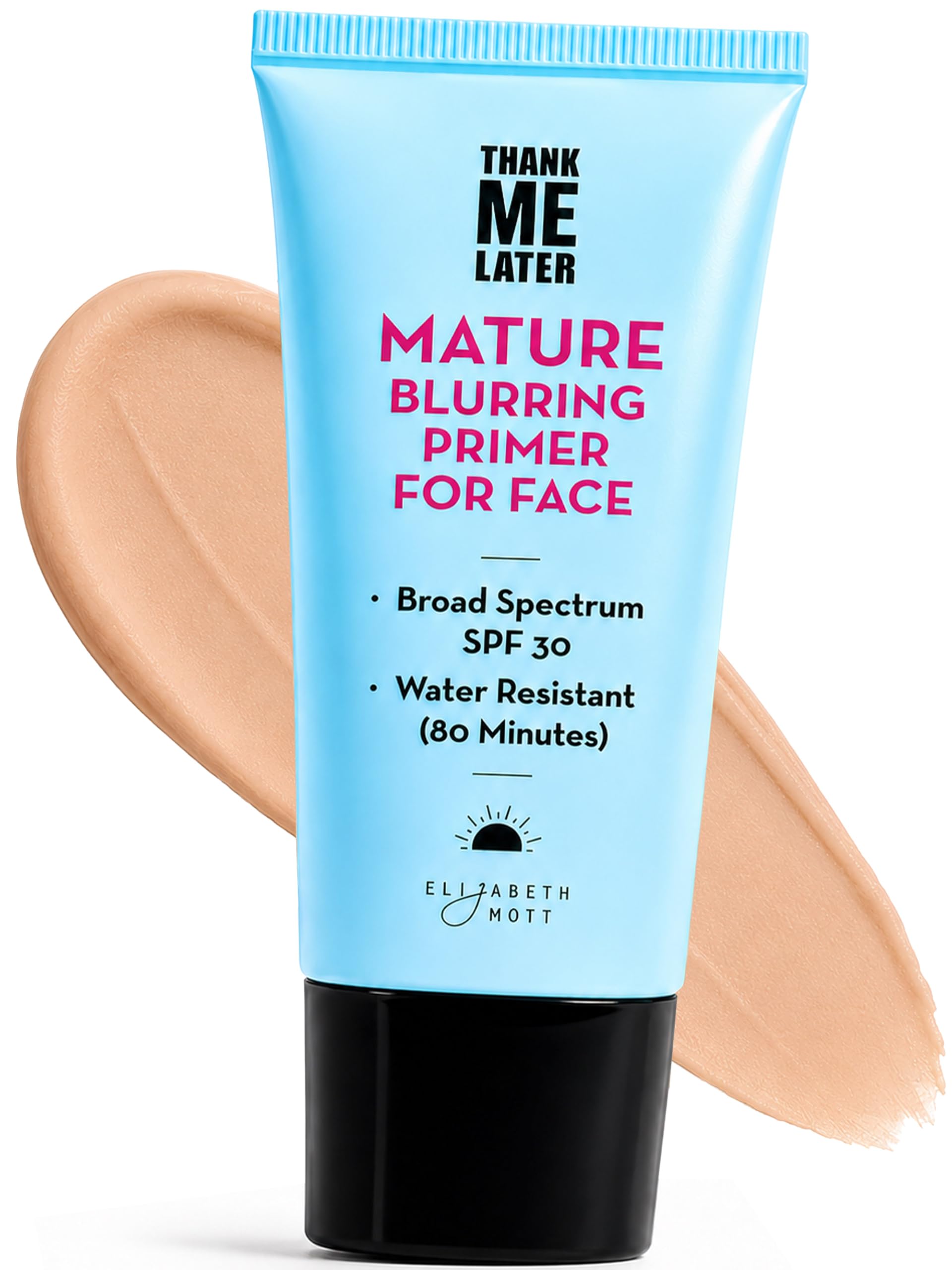
Elizabeth Mott Thank Me Later SPF 30

Elizabeth Mott Thank Me Later SPF 30

Sun and blur

Our Score 8.6/10
Check Price

Worth Noting

  • Blur is softer than a dedicated pore balm
SPF
30
Size
1.06 oz
Finish
Demi-matte velvet

Two jobs in one bottle is the pitch here: a blurring primer with SPF 30 built in, in a cream rather than a slippery gel. Elizabeth Mott builds it around a soft-focus, demi-matte finish, velvet rather than flat, and lists it for all ages and skin types. It goes on like a moisturizer, and it blurs enough to wear on its own on days you skip foundation altogether.

For oily skin, the finish is the selling point. Shine comes down without the powdery flatness of a hard matte, which suits skin that's oily through the T-zone and normal everywhere else. Longevity is the other strength: this is the pick here for a humid afternoon or a long event, when a lighter blur would slide off before the evening.

It's more mattifying than it is moisturizing, so it isn't the formula for skin that's tight straight after cleansing, and the blur is gentler than a dedicated pore balm gives you. Neither is a dealbreaker. What you're buying is a base that takes down shine, evens the look of texture, and adds a layer of sun protection in a single step.

Bottom line: We like having a blurring base and SPF in one layer, and this one delivers both without a greasy film.

5

Smashbox Photo Finish

Smashbox Photo Finish

Photo-ready blur

Our Score 8.8/10
Check Price

Worth Noting

  • Small tube for the price
Wear
Long-wearing
Finish
Blurring matte
Key Ingredients
Vitamins A and E

Photo Finish is built around a lightweight barrier enriched with vitamins A and E, and it goes on closer to skincare than to the slip of a straight silicone primer. What it does for oily skin is the pair of jobs that usually take two products: it blurs the look of pores and fine lines, and it takes shine down to a matte finish in the same layer.

The texture is what earns it a place. It spreads thin, so you aren't adding another heavy layer under foundation on a humid morning, and it doesn't leave the greasy film that makes an oily complexion look worse an hour after you finish your makeup. Shine control is the dimension where it holds up best against the rest of this set.

The catch is the tube. It's small for the money, which makes it a poor choice if you prime every single day and a good one for the days that matter: a wedding, a shoot, a long stretch of meetings. On those days the blur and the shine control do the work, and you end up using less foundation over the top.

Bottom line: What we like most is how much blurring and shine control it packs into one thin layer under foundation.

6

Rimmel Stay Matte Primer

Rimmel Stay Matte Primer

Very oily skin

Our Score 8.6/10
Check Price

Worth Noting

  • White cream can leave a cast on deep skin tones
Size
1 oz
Finish
Matte
Formula
Ultra-lightweight
Shine Control
Up to 8 hours

Rimmel is the only primer here that puts a number on its shine control: up to eight hours. Treat that as a ceiling rather than a promise, since how long a mattifier lasts depends on how much oil your skin produces and what you layer over it, but the ambition is right for oily skin. It's also the least expensive way into a matte base in this guide.

It dispenses as a white cream rather than a clear gel, and that's the detail that decides whether it works for you. On deeper skin tones, apply it thin and blend past the jawline, or it can leave a chalky cast that shows in daylight and in photographs. Under foundation it dries down matte and stays light on the face, with no heavy scent to argue with.

Our read: it's the right buy when you want a matte base and a small spend, and the wrong one if you expect a formula at this price to hold a fully oily T-zone past mid-afternoon. What it does well is give foundation a smooth, non-greasy start, and for plenty of oily skin that's the difference between makeup that lasts to lunch and makeup that doesn't.

Bottom line: For very oily skin on the tightest budget, we think it's worth trying, applied thin to keep the white cream from casting.

7

e.l.f. Acne Fighting Putty

e.l.f. Acne Fighting Putty

Acne-prone skin

Our Score 8.8/10
Check Price

Worth Noting

  • Adds an active to an already busy routine
Size
0.74 oz
Finish
Clear matte
Skin Types
Acne-prone and oily
Key Ingredients
1.8% salicylic acid, zinc, kaolin

Salicylic acid at 1.8%, plus zinc and kaolin, inside a product whose day job is holding makeup in place: that's the unusual thing about this putty, and it's why it exists as its own formula rather than as a variation on the brand's matte version.

Each ingredient is doing something specific. Salicylic acid is oil-soluble and works inside the pore, which is why it's the standard ingredient in acne treatments rather than a surface exfoliant; zinc and kaolin absorb oil and mattify on top. Together they suit skin where breakouts and shine are the same complaint, and e.l.f. lists the putty for acne-prone, combination, and oily skin accordingly.

It applies clear and dries to a velvety matte, so it adds a canvas rather than coverage, and you still need concealer for anything active. Like the brand's other putty primers it comes in a small pot, which means an applicator or clean fingers and a thin press rather than a scoop.

Where it fits: your skin breaks out along the T-zone, you're already mattifying, and you want one step that treats while it primes. Where it doesn't: if you're on a prescription retinoid or already using a strong exfoliating acid, adding a third active is how a routine tips into irritation, so keep this one for the stretches when everything else is gentle.

Bottom line: Salicylic acid, zinc, and kaolin in one step: we think this is the pick for oily skin that breaks out as much as it shines.

How We Chose and Tested Primers for Oily Skin

We started with the primers that keep showing up on drugstore shelves and in customer reviews, then cut anything that wasn't oil-free or explicitly mattifying, anything that only came in a sample-sized tube, and anything whose cost per ounce was hard to justify for a product you use every day. Ingredient lists mattered too, since a few formulas include salicylic acid for acne-prone skin and others lean on silicone for blurring — we wanted both represented. That left us with 14 primers, which we rotated among testers over five months.

Each primer got applied to clean, moisturized skin, with fingers on one half of the face and a damp sponge on the other so we could feel how it spread, how tacky it stayed, and whether foundation dragged or pill'd on top. We timed how long each one needed to set before makeup, and noted whether it felt greasy, silicone-slick, or chalky going on. Testers with reactive skin patch-tested theirs along the jawline for two straight weeks and logged any stinging, redness, or new breakouts.

Shine was the number that decided most of it. We pressed blotting paper to forehead and nose at noon and again at 4 p.m., compared how much oil came away, and took close-up photos of the same cheek and nose area each morning to see whether pores actually looked smaller or just looked powdered. We also tracked how far a single pump went, so the value question came down to real cost per use rather than the sticker on the box.

How to Choose a Primer for Oily Skin

Decide Which Problem You're Solving

Mattifying, oil-free, blurring, and pore-minimizing get used interchangeably on packaging, but they mean different things. A mattifier uses clays and powders, kaolin and charcoal among them, to hold shine down through the day. An oil-free primer simply avoids adding oil while it smooths. A blurring primer leans on light diffusion to fill the look of pores. Work out what bothers you at 3 p.m.: a shiny forehead, foundation settled into your cheeks, or both. If it's both, a putty like the e.l.f. Matte Putty does a measure of each.

Match the Texture to What's Underneath

Creams and balms layer predictably under liquid foundation; putties need warming between the fingers; gels grip hardest and can feel tacky. The failure mode across all of them is pilling, where the primer balls up and takes foundation with it. That is usually a quantity problem rather than a formula problem: use less than you think, and give moisturizer and sunscreen a minute to absorb before you press primer over them. A heavy blurring layer over a watery, hydrating foundation can also set the base sliding.

Expect Blurring, Not Smaller Pores

Nothing you apply before foundation shrinks a pore. Blurring is optical: a balm or silicone fills the dip and diffuses light, so the shadow that makes a pore look deep gets softened. That means results track with your pore size and with how you apply. A pore balm pressed into the nose and inner cheeks does more than a sheer layer spread over the whole face. It also means the effect washes off with your makeup, so judge a primer on how it looks under foundation rather than on what it promises to fix over time.

Watch for Cast on Deeper Skin Tones

Translucent doesn't always mean invisible. White creams and powder-heavy mattifiers can leave a grey or chalky cast on medium and deep skin tones, particularly when they go on thick to control shine. Test along the jaw rather than the back of your hand, which is a different color on most people, and blend past the hairline. If a formula looks ashy, use less and let foundation do the rest. A tinted or color-correcting primer solves the opposite problem by evening out redness, but it adds a step to your routine.

Treat Built-In SPF as a Bonus

An SPF primer is a welcome second layer of defense, not your sun protection. Reaching the number on the label takes far more product than anyone applies as a primer, and the thin, even layer that makes foundation sit well is nowhere near it. Put a dedicated sunscreen on first, let it set, then press the primer over the top. Choose an SPF primer because you like the finish it gives, and treat the protection as a small extra rather than the reason to buy it.

Frequently Asked Questions

Final Verdict

If you want one primer that handles a whole oily face, Lancôme La Base Pro is the one we hand you first: oil-free, silky, and blurring enough that foundation stops catching on texture. If shine is the entire complaint and the budget is small, the e.l.f. Matte Putty does that job for a fraction of the cost.

And when the issue is specifically visible pores rather than all-over oil, Benefit's balm pressed only where they show is the most effective thing here, so long as you don't need it to work across the whole face.