Skincare

Best Numbing Creams of 2026

Numbing cream is a small purchase with a hard deadline attached: the tattoo session is Thursday, the injection is at nine, the sunburn has already happened. The trouble is that the strongest formula isn't automatically the kindest one — a 5 percent lidocaine cream can sting on contact, take a solid 40 minutes to peak, and then wear off halfway through the very appointment it was meant to cover. What you actually want is something that sets quickly, numbs evenly, and rinses off without a fight.

I've kept 14 of these creams within arm's reach of my bathroom sink for the past four months, putting them to work before tattoo sessions, on a hair-trigger sunburn, and through a run of minor dermatology appointments — and the differences come down to texture and timing more than the percentage printed on the label. A cream that feels slick and greasy is one you'll dread applying, and one that smells like a hospital gives you away in a crowded studio. The picks below are the ones I'd hand to a friend the night before their appointment.

1

Ebanel 5% Lidocaine Numbing Cream

Top Pick
Ebanel 5% Lidocaine Numbing Cream

Procedures and tattoos

Our Score 8.2/10
Check Price

Worth Noting

  • 1.34 oz tube runs out on large areas
  • Numbing is uneven on thick, callused skin
Size
1.34 oz
Stated Onset
3–5 minutes
Stated Wear Time
1–2 hours
Active Ingredient
5% lidocaine

Three to five minutes to start working, twenty to twenty-five to peak, one to two hours at strength: Ebanel prints its timeline on the label, and that is the number we plan around. Of everything in this guide, it is the first tube we reach for. A numbing cream earns its keep on one question — does the needle feel like pressure instead of pain — and 5% lidocaine in a water-based formula answers it more reliably than anything else here.

Texture is where most of these give themselves away, and this one doesn't. It is water-based and fragrance-free, so it sinks in without a greasy film and without announcing itself in a small treatment room. It is non-staining too, which matters if you have ever had a cream bleed through a shirt collar on the drive to an appointment. Our one practical gripe is size: 1.34 ounces disappears quickly across a full back or both legs.

The caveat is the one that runs through this whole category. Numbing is uneven from person to person, and thick, callused skin — palms, soles, the outside of a knee — is where lidocaine struggles. So is any spot where the cream gets wiped away before its twenty minutes are up. Give it the full wait, follow the label on how much to use, and it does what the timeline promises; rush it and you will decide it doesn't work.

Bottom line: We recommend it first because it states exactly when it starts, when it peaks, and how long it lasts — and then does all three.

2

Hempvana Lidocaine 5% Relief Cream

Hempvana Lidocaine 5% Relief Cream

Daily aches and joints

Our Score 8.6/10
Check Price

Worth Noting

  • Labeled for aches, not procedures
Size
3 oz
Finish
Non-greasy, absorbs quickly
Added Oil
Hemp seed oil
Active Ingredient
5% lidocaine

Sunday morning, knees stiff from a long walk the day before: this is the tube that gets picked up. Hempvana puts 5% lidocaine in a 3-ounce cream cut with hemp seed oil, and it is built for the ordinary aches that settle into joints and lower backs rather than for a needle.

What we appreciated most is how completely it disappears. It goes on non-greasy, absorbs quickly, and leaves nothing behind — no smell on your hands, no film on your clothes, no reason to wash up afterwards. That is why it ended up in daily rotation instead of being saved for bad days, and why a 3-ounce tube doesn't feel like overkill.

Where it stops is the procedure. This one is labeled and built for muscle and joint aches, so it is not the tube to reach for before a tattoo or a mole check; the top pick's stated timeline is a far better guide for that. As an everyday cream, though, it is the one we use without thinking about it, and being unremarkable to apply is exactly why it gets used.

Bottom line: For knees, shoulders, and backs that ache daily, this is the cream we keep by the sink: 5% lidocaine with no scent and no film.

3

Aspercreme Lidocaine Cream, Eucalyptus

Aspercreme Lidocaine Cream, Eucalyptus

Feet and legs

Our Score 9.2/10
Check Price

Worth Noting

  • Scent lingers and is hard to miss
Size
3 oz
Scent
Eucalyptus essential oil
Finish
Non-greasy
Active Ingredient
4% lidocaine

Open the cap and you will know: eucalyptus, clean and a little sharp, and it hangs around for a while. If you want a numbing cream that leaves no trace, this isn't the one. If you like a scented rub at the end of a long day, it is the pleasantest thing in this guide.

Under the scent is a straightforward 4% lidocaine cream in a 3-ounce tube that rubs in faster than most. We used it on feet and lower legs, where an evening of burning or tingling is hard to reach with anything else, and it soaked in without the sticky film that makes socks unbearable. Nothing came off on the sheets, and it is equally at home on a stiff shoulder.

Of these picks, this is the one we choose when the discomfort sits low — feet, ankles, calves — and when a little scent is a feature. It is 4% rather than 5%, and on a foot at the end of the day we could not tell the difference. Skip it if you work somewhere a eucalyptus cloud would be noticed.

Bottom line: Our choice when the ache sits in your feet and lower legs, and the eucalyptus smell is a bonus rather than a dealbreaker.

4

HealthWise Lidocaine Plus+ 4%

HealthWise Lidocaine Plus+ 4%

Budget first-aid kit

Our Score 8.8/10
Check Price

Worth Noting

  • Brief sting on broken or irritated skin
Size
3 oz
Active Ingredients
4% lidocaine plus 10% benzyl alcohol
Applications Per Tube
Up to 30

Two things make this the tube we buy in multiples: it is the least expensive cream here, and it is the only pick that pairs lidocaine with benzyl alcohol. One lives in the bathroom cabinet, one in the car, and neither feels precious enough to ration.

It is thinner than the other creams in this guide, closer to a lotion, so squeeze carefully — it comes out fast and a dime-sized amount covers a scrape. Once it is on, it dries down quickly, isn't sticky, and doesn't stain, and the scent is faint enough to ignore. The label reckons a 3-ounce tube covers about 30 applications at that rate, which is a lot of first aid for the money.

Two things to know before you buy. It can sting for a few seconds on broken or irritated skin before it settles, and it is a surface numb rather than a deep one, so it is the wrong pick for a two-hour session under a needle. For the scrapes, itches, and sore spots that make up most of what these creams get used for, it is more than enough — and at this price you can afford to be generous.

Bottom line: The budget pick we actually restock: fast surface numbing, a fast-drying lotion texture, and enough cream for about 30 applications.

5

Gold Bond Pain & Itch Cream

Gold Bond Pain & Itch Cream

Bug bites and sunburn

Our Score 9.2/10
Check Price

Worth Noting

  • 1.75 oz spot-treatment tube
  • Too thick to spread over large areas
Size
1.75 oz
Labeled For
Pain and itch from minor skin irritation
Active Ingredient
4% lidocaine

Bug bites, sunburn, a patch of irritated skin that will not stop itching: this is the tube we reach for when the problem is itch rather than a needle. Gold Bond puts 4% lidocaine in a thick cream that stays where you dab it, which is exactly right for a welt on your ankle.

The relief arrives fast and lasts long enough to stop the scratching, which is the whole point — a bite you leave alone heals faster than one you keep worrying at. There is almost no scent, so it does not compete with anything else you have put on, and the cream doesn't slide around once it is in place.

The limits are size and body. A 1.75-ounce tube is a spot-treatment amount, and the cream is thick enough that covering a whole sunburned back would take most of it. Keep it for bites, small burns, and the itchiest square inch of skin, and a small tube lasts a whole summer.

Bottom line: The itch specialist: bites, sunburn, and small angry patches settle fast, and the thick cream stays exactly where you dab it.

6

Dr. Numb 5% Lidocaine Cream

Dr. Numb 5% Lidocaine Cream

Short-notice appointments

Our Score 8.6/10
Check Price

Worth Noting

  • Smallest tube here at a premium price
  • Effect can fade before the stated window
Size
1.06 oz
Stated Onset
15 minutes
Stated Wear Time
2–4 hours
Active Ingredient
5% lidocaine

Fifteen minutes is what Dr. Numb promises, against the three to five our top pick claims — and if you have ever applied a cream in a parking lot before an appointment, you know that gap is the whole product. Five percent lidocaine, a 30-gram tube, and a stated two to four hours of relief.

In the hand it is the nicest of these to apply. The formula is water-based and silky rather than thick, it glides over a wide area without dragging, and it absorbs to nothing — no film, no tackiness, nothing to wipe off before someone touches the skin.

The arithmetic is the problem. Thirty grams is the smallest tube here and it is priced like a premium product, so per use it is the most expensive thing in this guide. The stated two to four hours is also the optimistic end of what a lidocaine cream does; when this one lets go, it lets go quickly.

Our call: buy it for a short appointment you are running late for, when fifteen minutes of waiting beats thirty and the tube only has to cover a small area. For a long session, plan on a top-up either way and buy the tube that covers more skin.

Bottom line: Pay for speed, not mileage: fifteen minutes to numbness suits a short appointment, and the tiny tube won't survive a long one.

7

BLUE-EMU Lidocaine Pain Relief Cream

BLUE-EMU Lidocaine Pain Relief Cream

Hard-to-reach areas

Our Score 8.8/10
Check Price

Worth Noting

  • Stiff cap is hard to open
Size
2.7 oz
Applicator
Sponge tip
Stated Wear Time
Up to 8 hours
Active Ingredient
4% lidocaine

The sponge tip is the reason to look at this one. Under the cap sits a domed sponge that delivers cream straight to the skin, so you can reach your own shoulder blade without a second pair of hands or a palm full of lidocaine.

Underneath it is a 4% lidocaine cream, 2.7 ounces, odor-free and non-greasy, and the label claims up to eight hours — the longest claim in this guide. Treat eight hours as a ceiling rather than a promise. What we noticed is that it dries down fast and leaves nothing on a shirt.

For a sore back, a stiff neck, or a shoulder you cannot comfortably reach, this is the one that gets used, because the applicator removes the friction that otherwise stops people applying anything at all. That is a real advantage, and it is why it is here despite being 4% where most of our picks use 5%.

Where it is less useful is a flat, easy-to-reach area, where a sponge gives you less control than a fingertip. It is a one-trick applicator, but it is a trick none of the others here can do.

Bottom line: The sponge tip is worth the trade if you live alone and your sore shoulder is the one place you can't reach.

8

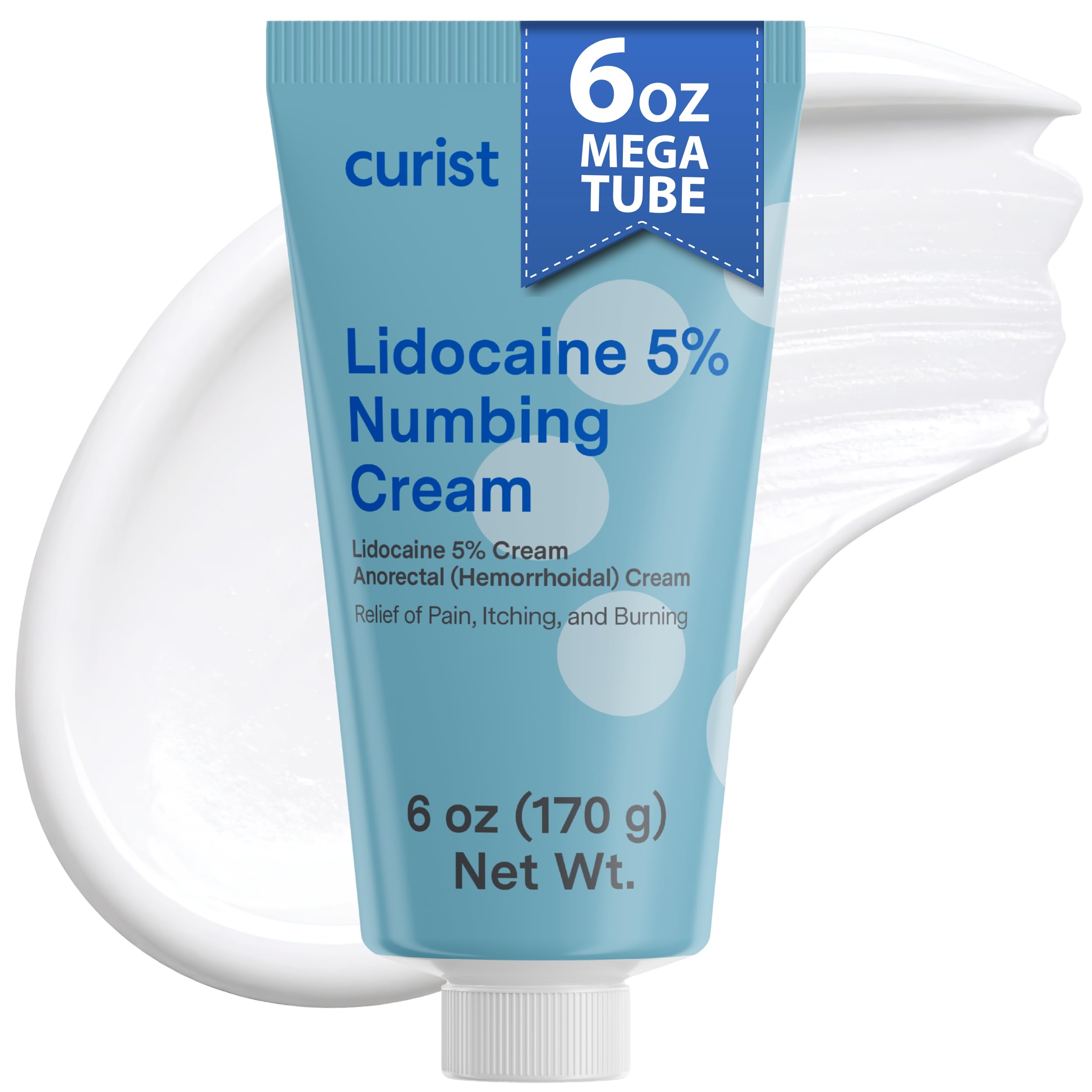
Curist 5% Lidocaine Numbing Cream

Curist 5% Lidocaine Numbing Cream

Large external areas

Our Score 8.8/10
Check Price

Worth Noting

  • Labeled for external anorectal use
Size
6 oz (170 g)
Labeled Use
External anorectal use
Active Ingredient
5% lidocaine

Six ounces is the biggest tube in this guide, and 5% lidocaine puts it at the same strength as our top pick. Read the label first, though: Curist writes this one around external, anorectal use, and that is the job it is built and labeled for.

For that job it is well judged. The cream is thick enough to stay where it is put without being pasty, it is not sticky, and there is essentially no odor — which matters more than usual in a product used several times a day in a sensitive spot.

It is also the most economical lidocaine here. Six ounces goes a long way, and a tube that size means you are not rationing it the way you ration a 30-gram one. If a large area of skin needs quieting down, that is the practical argument for it over a smaller, fancier tube.

What it is not is a pre-procedure cream. Nothing on the label points at tattoos, waxing, or injections, and we don't treat it as one. Buy it for the use it carries on the label and for the size, and choose a different tube when the needle is the point.

Bottom line: We like it as the economy tube for the external use on its label, not as the cream you take to a tattoo appointment.

How We Tested 14 Numbing Creams Over Four Months

We started with labels, since that's where most of this category gets decided: sorting 4 percent lidocaine from 5 percent, noting which tubes carried a second active for itch or burn relief, and comparing actual fill weight. Tubes here run from about 1 ounce up to 6, so the sticker price means very little until you divide it out per ounce. From that list we bought 14 creams and used each one across four months, replacing the ones that ran out so no single appointment became the only data point.

Testing happened where numbing cream actually lives: in the bathroom ten minutes before leaving for a tattoo appointment, in a waiting room before a round of injections, on a sunburned forearm, and on a kitchen burn that made the case for keeping a tube in a drawer. At each application we noted whether it stung in the first 30 seconds, then checked the skin every five minutes with a fingernail press and a dragged ice cube to find the moment it went numb and the moment it quit. We also timed how long the numbness held after the tube was capped, and how much product it took to cover a palm-sized patch.

Two measures did most of the separating. Ten minutes after application, a colleague stood an arm's length away and told us whether they could identify anything on the skin — a handful of tubes failed that outright. We also checked for shine, tackiness, and transfer onto dark fabric, because a cream that leaves a mark on a bedsheet or an artist's chair is one you stop reaching for. Ease of use got the same treatment: whether the nozzle allowed a thin, even layer and how cleanly it washed off with warm soapy water. Cost came last, calculated per ounce. The creams that scored best were the ones we forgot we were wearing.

How to Choose a Numbing Cream

Start With the Active Ingredient

Most of the tubes on this page are lidocaine, at 4% or 5%, and one adds benzyl alcohol for a second numbing agent. In practice the gap between 4% and 5% is smaller than the gap between leaving a cream on for five minutes and leaving it on for twenty-five.

What we avoid is a tube that never names its active ingredient or its percentage. Some products in this category describe a cooling, soothing sensation and list botanicals like arnica and emu oil without ever stating a drug strength. If numbness is what you are paying for, that line on the label is the first thing to find.

The Wait Is the Product

A numbing cream is not a wipe. It needs time on the skin, and the timelines differ: our top pick starts in three to five minutes and peaks at twenty to twenty-five, while another pick here states fifteen minutes to onset.

Plan backwards from the appointment rather than forwards from the tube. Cream applied in the parking lot delivers a fraction of the effect, and wiping the area down before the needle undoes most of what you waited for. Ask the practitioner how they want the skin prepared, then follow the label on how much to use.

Match the Stated Duration to the Session

Labels here range from one to two hours to a claimed eight, and the claim is a ceiling rather than a promise. A long tattoo session will outlast any cream in this guide, so plan a top-up and ask the artist how they prefer to handle it.

Short jobs — a blood draw, a mole check, a wax — need the least duration and the least product. If one tube has to do everything, favor the honest timeline over the biggest number on the box.

Read the Label for Where It Goes

Some of these are general-purpose skin creams; others are written specifically for external, anorectal use. That is a real boundary, not small print, and a tube labeled for one area should stay there.

Broken, cut, or infected skin is not a numbing target unless a clinician says so, and a patch test on the inner forearm is worth the day it costs — especially with a scented or botanical formula. Keep the cream out of eyes and off mucous membranes unless the label allows it.

Think About the Tube, the Texture, and the Cap

You will use this in a hurry, sometimes one-handed. A thick cream stays on a bite; a thin lotion covers a calf faster but runs off a fingertip; a sponge applicator reaches your own back. Texture is a genuine part of the decision, not a cosmetic detail.

The closure matters more than it sounds. Several child-resistant caps in this category are hard to open with arthritic hands, so if grip strength is a problem, buy a tube with a simple cap or decant a little into a jar you can manage. A dime-sized amount per small area is the usual rate, and a 3-ounce tube runs to roughly 30 applications.

Frequently Asked Questions

Final Verdict

Buy the Ebanel 5% Lidocaine Numbing Cream if you want one tube that handles a procedure, a tattoo, or an afternoon of irritated skin. It states its timeline, it disappears into the skin, and it is the formula we trust in a small room with a needle in it.

If your discomfort is everyday — knees, shoulders, a lower back that stiffens by four in the afternoon — buy the Hempvana instead; it is the one we keep by the sink and use without thinking. And if the appointment is in twenty minutes, the fifteen-minute onset of Dr. Numb is the reason to pay more for less.