Nails

Best Nail Files of 2026

A nail file's grit number is the whole story, and hardly anyone explains it: lower numbers are coarser and take length off fast, higher numbers refine the edge, and skipping a step is exactly how nails end up peeling and snagging on every knit sweater you own. Most of us grab whatever's rattling around in the bathroom drawer, saw back and forth, and then wonder why the tips look shredded a week later. A file matched to your nail type, used in one direction, keeps the edge sealed and smooth so nails grow out instead of flaking away. That's the problem these picks solve, and we spent four months with 15 files and file sets — glass, emery, metal, and buffing blocks — to find the ones that actually do it.

What surprised me most is that material matters less than condition. A dull file, whether glass or emery, does more damage than a cheap fresh one, which is why durability and value turned out to be the same conversation. I keep one in my bag, one by the couch, and one in the bathroom drawer, and I've quietly stopped lending out the good ones. The picks below cover natural nails, gel, acrylics, and everything from a two-second touch-up to a full Sunday-night reshape.

1

Bona Fide Beauty Czech Glass Nail File

Top Pick
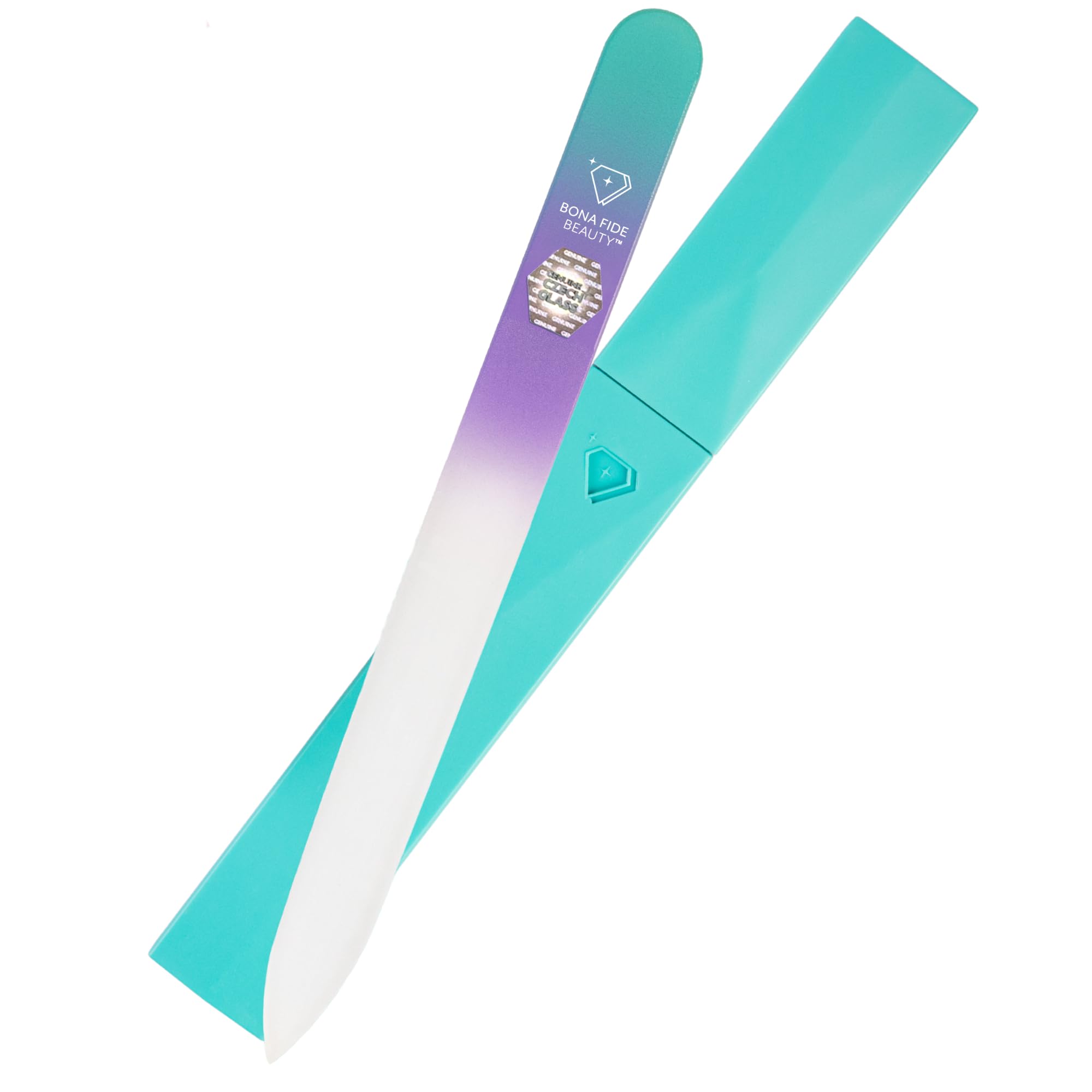
Bona Fide Beauty Czech Glass Nail File

Natural nail care

Our Score 9.4/10
Check Price

Worth Noting

  • Glass edge can chip if dropped outside its case
  • A single file costs more than a whole emery pack
Case
Hard case included
Material
Tempered Czech glass
Dimensions
5.31 x 0.43 x 5.31 inches
File Direction
Both directions

Every ten-pack in this guide pairs a coarse side with a finer one, and that coarseness is where thin nails get into trouble. The Bona Fide Beauty file takes the opposite approach: a tempered Czech glass file with a fine, continuous abrasive surface that removes material slowly and leaves an edge you do not have to work back smooth. We made it our top pick because it suits the widest group of buyers here — people filing their own nails who want a clean shape and a smooth edge without thinning the nail to get there.

The detail we kept coming back to is direction. Glass has no grain, so you can shape in short back-and-forth strokes and correct a corner without worrying which way the file is pointed. On a paper board that habit lifts the layers at the nail edge; here it costs you nothing. That is also why this is the file we hand someone whose nails are already peeling, since the fine surface polishes as it shapes rather than leaving a fuzzy rim behind.

The hard case is less of an accessory than it looks. Tempered glass does not wear out the way sandpaper does — there is no grit to shed — but it will chip at the edge if it rattles around a bag with keys, and a chipped edge scratches. The case is slim, closes, and gives the file a home between uses. Rinse the file under water to clear filings, dry it, and put it back; a wipe with an alcohol pad between manicures is enough if it travels with you.

Where this file stops earning its keep is bulk removal. If you are taking real length off before shaping, or you work in gel and dip, start on a coarse board and finish here. For weekly maintenance on natural nails, one glass file takes the place of a drawer of boards, and it rewards a light hand in a way a 100-grit board never does.

Bottom line: We point anyone with bare natural nails here first: a tempered glass surface that shapes gently in both directions and a case that keeps it intact.
2

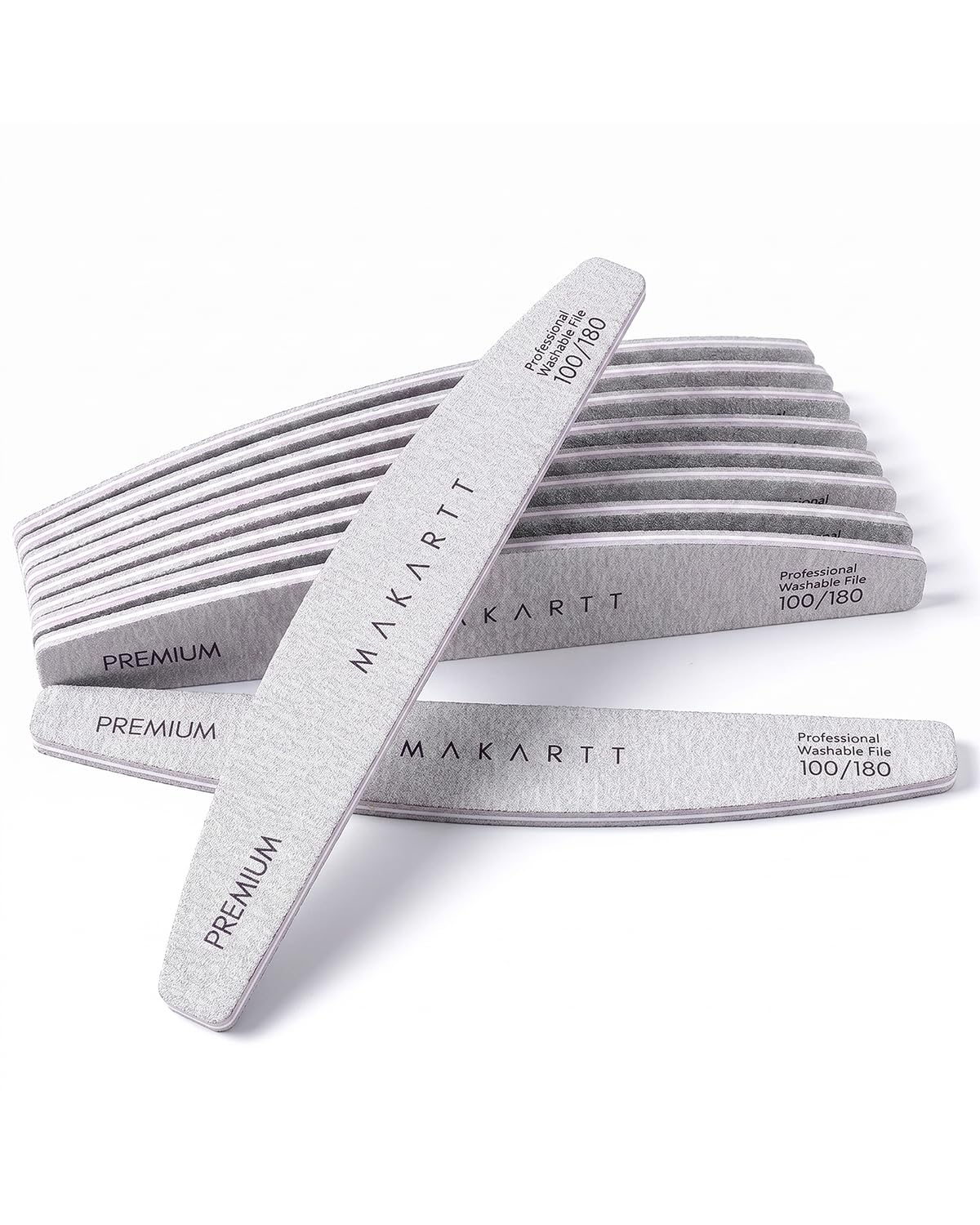
Makartt 100/180 Grit Nail Files

Makartt 100/180 Grit Nail Files

Acrylic and gel

Our Score 9.6/10
Check Price

Worth Noting

  • Too coarse for thin natural nails
Edge
Pre-buffed safe edge
Grit
100/180
Count
10 files
Dimensions
7.09 x 1.1 x 0.16 inches

Two grits, ten boards. The Makartt pack is a working set for artificial nails, and the numbers tell you what each side is for: 100 is coarse enough to shorten a gel or dip overlay without sawing at it, and 180 refines the shape before you cap. If you do your own sets at home, those are the only two jobs you actually have.

We think it is the strongest pick here for anyone maintaining gel, dip, or acrylic between appointments. The boards are thick enough not to bow in the middle of a stroke, and each one is pre-buffed before packing, which is the difference between a comfortable pass near the sidewall and a nick. Ten in a pack means a fresh board is never an emergency.

At 7.09 by 1.1 by 0.16 inches, these are full-size boards rather than purse files — you get a proper grip and enough surface to work a long edge in a couple of passes. They are washable too, so a rinse and a dry clears the dust between manicures instead of loading the grit.

One thing to expect: heavy filing eats a board faster than a natural-nail touch-up does. That is what the ten-pack is for — you work through a few on a full removal and still have spares in the drawer.

Bottom line: For gel, dip, and acrylic sets, this is the pack we keep on the desk: 100 to move product, 180 to finish, and nine spares behind the first board.

3

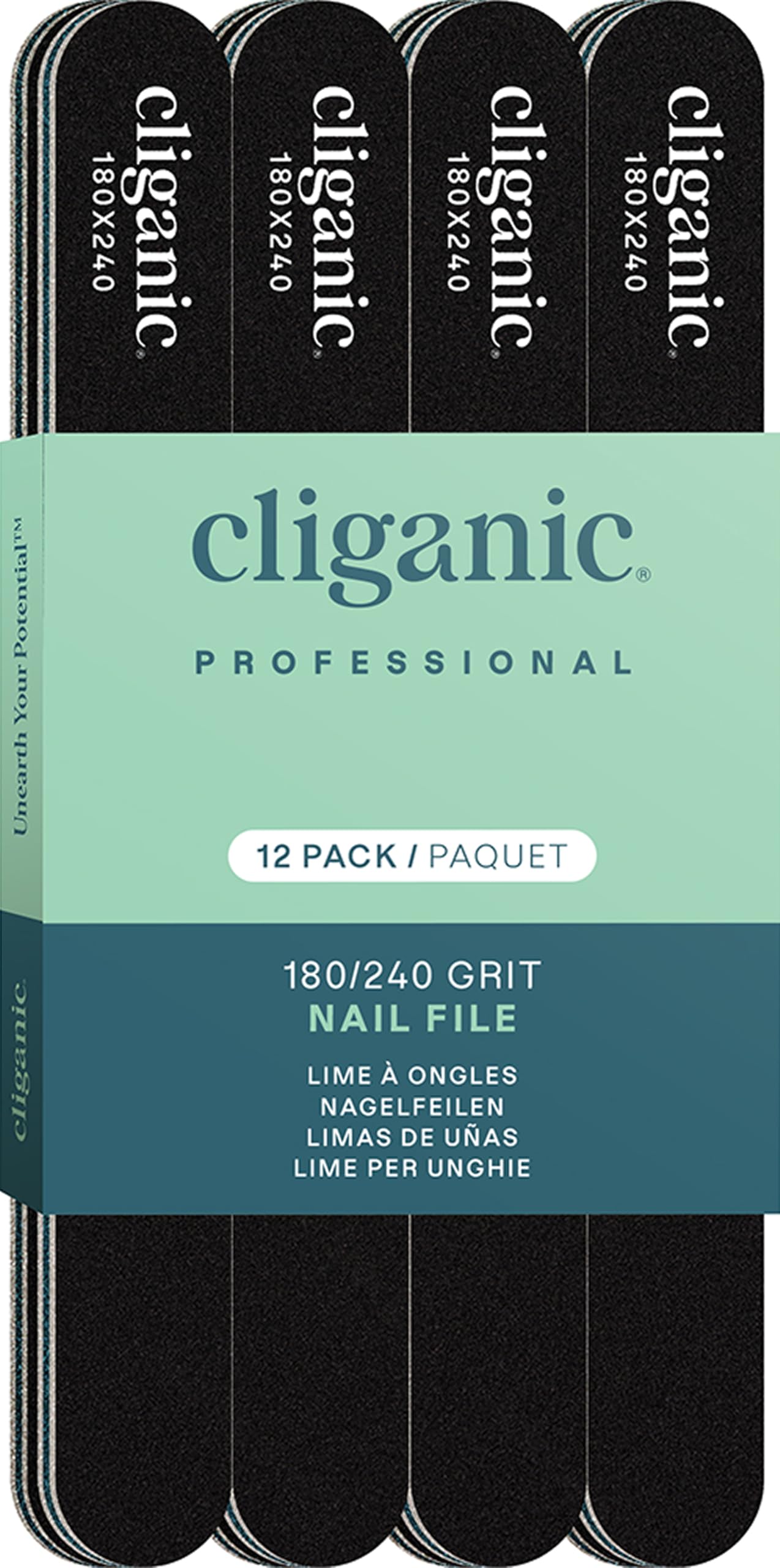
Cliganic 180/240 Nail File Set

Cliganic 180/240 Nail File Set

Finishing natural nails

Our Score 9.2/10
Check Price

Worth Noting

  • No coarse side for shortening long nails
Grit
180/240
Count
12 files
Length
7 inches (178 mm)
Thickness
0.16 inch (4 mm)

Most multipacks here pair 100 with 180. Cliganic goes the other way, with 180 on one side and 240 on the other, which makes this the gentlest twelve-pack in this guide for a bare natural nail. The 180 shapes a free edge; the 240 is fine enough to finish it without the fuzzy rim a coarser board leaves behind. We recommend it for anyone whose nails are thin, ridged, or prone to peeling.

The boards are 7 inches long and 0.16 inch thick, so there is plenty to hold and they stay straight instead of curling around your thumb. That length is what makes a fine grit usable: short strokes at the tip, longer passes along the side, and your knuckles stay out of the way. They are washable with soap and water, which matters more on a fine file, because dust packed into the grit stops it cutting long before the abrasive is done.

The grit rewards a light hand. Start on one nail with the 240 side to see how much it takes, then drop to the 180 if nothing is happening — pressing harder on a fine board only loads it with dust. It is also the easiest of these to hand to someone else, because the two sides are labelled by grit and the order is obvious.

Twelve boards and a 90-day warranty round it out. They rinse and reuse without shedding at the edges, which is what makes the count go further than it sounds on paper.

Bottom line: We recommend this twelve-pack for natural nails that need finishing rather than shortening: 180/240 is the gentlest pairing here, and the boards stay straight through a wash.

4

3 Swords Germany Sapphire File Set

3 Swords Germany Sapphire File Set

Long-term use

Our Score 9.4/10
Check Price

Worth Noting

  • Narrow files can slip off the nail if you rush
Sides
Coarse and fine
Extras
Integrated cuticle pusher
Material
Sapphire-coated stainless steel
Set Contents
5 files and a 3-way buffer

Five files in five widths, a three-way buffer, and a cuticle pusher built into the grip: the 3 Swords set arrives as a small kit rather than a single tool. The abrasive is a sapphire coating bonded to stainless spring steel, made in Solingen, so there is no paper layer to lift at the edge the way there is on an emery board.

We take this set when we want a file to keep. The coarse side shapes quickly and the fine side finishes, and because the coating sits on spring steel, the file flexes slightly under pressure instead of snapping. Five sizes matter more than they sound: the narrow ones suit little nails and the sides of a toenail, while the longest handles a full free edge in one stroke.

The trade-off is that steel cuts fast. The narrowest files can skate off a nail if you rush the stroke, and you will get a cleaner result from a lighter hand than you would use with paper. The buffer is the piece we use least — it works, but it is not why you buy the set.

No case comes with it, and none is needed: rinse the files, dry them, and they go back in a drawer. Where paper boards slowly go bald, these keep a surface you can still see and feel, which is why the set stays in the drawer while the cheap packs get used up.

Bottom line: If you want a set to keep rather than a pack to use up, we point to these five sapphire files: fast on the shape, smooth on the finish, nothing to peel.

5

Teenitor Nail File and Buffer Set

Teenitor Nail File and Buffer Set

Home manicure kit

Our Score 9.2/10
Check Price

Worth Noting

  • Pieces wear out with regular use
  • Smaller blocks are awkward to hold
Pieces
6
Cleaning
Washable
Includes
Files, buffer blocks, shine file
Grit Range
100 to 4000

File, buff, shine — the Teenitor set is built around that sequence, and the pieces are labelled to match, so you are not guessing which of the six does what. Three emery files at 150/180/240 shape the nail, two buffer blocks at 100/180 and 220/280 smooth ridges, and a 1000/4000 file finishes for shine.

The buffing is what changes the result if you have only ever used a board. A few passes with the 220/280 block knock down the ridges that make polish sit unevenly, and the 1000/4000 file gives a natural gloss with no polish at all. The set is washable, so the blocks come back after a rinse under soapy water.

We think it is the best kit here for building a home manicure from nothing, because it covers three steps a single file cannot, and the labelling means you can hand it to someone else and let them work through it in order.

If you use only one extra piece beyond the file, make it the 220/280 block. Ridges are what make a home manicure look homemade, and that block is the cheapest fix in the box. Keep the 4000 side for bare nails and use it last, lightly.

Bottom line: Nine grits across six pieces, and a shine step no single file here can match: we think it is the best kit for building a home manicure from nothing.

6

Revlon Compact Emery Boards

Revlon Compact Emery Boards

Purse and travel

Our Score 9.2/10
Check Price

Worth Noting

  • Abrasive can lift at the edges with heavy use
Count
10 boards
Sides
Coarse and smoothing
Dimensions
1.95 x 0.35 x 7.65 inches

There is almost nothing to the Revlon compact board — a thin, flexible strip that takes up less room in a bag than a pen. That is the point. The ten-count pack ends up in purses, desk drawers, and glove compartments, and it is the file we hand someone who needs a repair rather than a full manicure.

Each board has two sides: a coarse brown surface for shaping and a beige side for smoothing the edge afterwards. The flexibility helps on a curve, because the board follows the nail instead of fighting it, and you can work the corner of a nail without the file digging in.

We keep a pack of these because they are the ones we do not mind losing. A glass file in a bag needs its case and a certain amount of care; this one can rattle around with keys and still work when you pull it out. When a nail catches on a sweater at a restaurant, this is the file that is actually there.

Bottom line: For touch-ups away from home, we keep a pack of these around: thin, flexible, and easy to replace when one goes missing.

7

HomeyEra 100/180 Nail Files

HomeyEra 100/180 Nail Files

Wide-grip filing

Our Score 9.4/10
Check Price

Worth Noting

  • Coarse 100 side needs a light hand on thin nails
Grit
100/180
Count
12 files
Shape
Square
Length
7.1 inches

At 7.1 inches, the HomeyEra boards are the longest in this guide, and the square shape gives you a full flat surface plus a corner. Twelve come in the pack, double-sided at 100/180, built from sandpaper and emery board over an EVA core.

Length is the whole argument. A big board puts your hand further from the tip, so the stroke stays straight and the shape comes out even. These also hold their shape rather than curling at the corners, which is the failure that retires most cheap emery boards early.

Rinse them and let them dry before they go back in the drawer; the surface clears of dust quickly and does not need soap. The square corner is the quietly useful part — it gets under a free edge to clear dust without hunting for anything else.

Our take: these are the boards we reach for when we are filing on the sofa rather than at a table, because the length gives us something to hold and the square edge stays where we put it. Twelve of them means we are never filing with a bald board because the good one is in another room.

Bottom line: We like these for the length: long, firm boards that stay steady in the hand, sold in a twelve-pack that covers a lot of manicures.

8

Canvalite Half-Moon Nail Files

Canvalite Half-Moon Nail Files

Gel and dip

Our Score 9.2/10
Check Price

Worth Noting

  • Too coarse for bare natural nails
Grit
100/180
Count
10 files
Shape
Half-moon
Dimensions
7.08 x 1.18 x 7.08 inches

The half-moon curve is the reason to pick up the Canvalite pack. The rounded edge follows the line of the cuticle, so you can shape the sides of a nail without dragging a square corner into the skin, and ten boards come in the pack at 100/180 grit.

These are boards for gel, dip, and acrylic work. The 100 side clears product with light pressure rather than sawing, and the 180 side refines an extension edge before you smooth the surface. The core is stiff, so the board does not bow in the middle of a stroke and skate across the nail.

Control comes from pressure, not from the board. The 180 side still bites, so check the edge every few passes instead of working a corner down in one go; short strokes around the curve do more than long ones do.

We keep a pack of these in the gel kit rather than in the bathroom drawer, and that is the honest summary: efficient at removing product, shaped for the corners, and easy to replace when a board loads up.

Bottom line: If you remove your own gel or dip, we recommend these: the half-moon edge gets into the corners and the coarse side clears product fast.

How We Tested the Best Nail Files

We started with more than 40 files and file sets, then narrowed to 15 based on how honestly the grit was labeled, whether that number was printed on the file itself, the price per individual file, and whether the manufacturer specified natural nails, gel, or acrylic. Pack sizes varied wildly, so we calculated cost per file before anything else. Over four months, each one got used the way people actually use them — not on a lab bench.

Every file handled the same jobs: taking down a broken corner at 11 p.m., weekly shaping on natural nails, and a full reshape on gel and acrylic tips to see whether the abrasive clogged or kept cutting. We counted strokes to shorten a nail from long to short, then shaped an oval and dragged the finished edge across a pair of pantyhose and a knit sleeve to catch snags. Each file got a dry cotton-pad wipe afterward so we could see whether a coating came off on the pad or left any film on the nail plate, and we noted how the surface felt in the hand — too rough, too slick, or grippy enough to control.

Durability was the long game. Each file saw weekly use, and we logged the week it started skating across the nail instead of cutting, then washed it in warm soapy water and tried again to see if cleaning brought the grit back. Along the way we watched for warped boards, cracked handles, worn-off grit printing, and discoloration, since a file that looks wrecked after a month rarely gets picked up again. The ones that survived four months without shredding an edge or slicking over are the ones that made the list.

How to Choose a Nail File

Match the grit to the nail you have

Grit numbers run backward from what most people expect: 100 is coarse, 240 is fine, and the higher the number, the less the file removes. The 100/180 pairing on most multipacks is a working board for gel, dip, and acrylic, where you need to move product fast and then refine it. For bare natural nails, 180/240 is the safer pairing — the 180 shapes a free edge and the 240 finishes it. The trap is buying a coarse all-purpose pack for thin nails: a 100-grit board takes layers off a natural nail and leaves an edge that snags on fabric for days.

Treat the number as a guide rather than a standard. Grit is not measured identically by every maker, so a 180 from one brand can bite harder than a 180 from another. Test any new board on a single nail before you work through all ten.

Glass, sapphire-coated steel, or emery board

Glass files use a fine, continuous abrasive etched into tempered glass. There is no grit to shed, they work in both directions, and after a rinse they keep cutting — which is why one glass file can replace a drawer of boards. They chip if dropped on a hard floor, so a case is not optional.

Sapphire-coated steel bonds the abrasive to spring steel: fast cutting, washable, available in several widths. Emery boards are paper abrasive on a foam or EVA core — the cheapest way to file and the shortest lived, with edges that can lift after heavy use. Buy one glass or steel file for everyday shaping and a cheap pack for coarse work.

Shape and length decide how much control you get

A straight board with a square edge gives you a flat surface to work against, which is what you want when you are taking down length. A half-moon curve follows the cuticle line and is quicker around the corners, which is why it turns up on files aimed at gel and acrylic work. Narrow metal files reach the sides of a nail but skate off if you rush the stroke.

Length is about leverage: a 7-inch board gives you something to hold and keeps your wrist steady, while a compact board is the one that lives in a bag. Thickness matters too. A stiff board will not bow under pressure; a thin one flexes to the curve of the nail and wears faster.

Cases, cleaning, and keeping a file useful

Rinse a file under water to clear nail dust, dry it completely, and store it dry — a file that stays damp in a bag goes dull fast. An alcohol wipe between users is enough if the file gets shared. Glass belongs in its case, because a chipped edge will scratch a nail every time you use it.

Where the file lives matters more than it sounds. A glass file on a vanity, a pack in the car, and a compact board in a bag means you always file with a clean surface instead of hunting for one.

Frequently Asked Questions

Final Verdict

If your nails are your own and you file them every week or two, buy the Bona Fide Beauty glass file. The fine surface shapes without thinning the nail, it works in both directions, and the case means it survives a bag instead of chipping in it.

Working in gel, dip, or acrylic changes the answer. The Makartt ten-pack moves product and leaves spares for the day a board loads up, while Cliganic's 180/240 pack is the better buy if you only ever finish natural nails. One good file plus one coarse pack covers nearly everyone.