Fashion

Best Low Rise Jeans for Women of 2026

Low-rise jeans have a reputation, and it's mostly deserved — by the bad ones. The tug at the back when you stand up, the waistband that migrates by mid-afternoon, the gap when you sit down: none of that comes from the rise itself so much as from a cut drafted for a different body. A good pair sits on the hips where it was actually designed to sit, and then stays there.

We spent four months in 12 pairs — full workdays at a desk, weekend errands, a few long dinners — and the ones that stayed put had one of two things going on: a back rise slightly higher than the label implies, or a denim with enough stretch to move and enough memory to snap back. Length and flare change how the same waistband reads entirely, which is why the fit notes below matter as much as the size chart. Start there.

1

Levi's Superlow Loose

Top Pick
Levi's Superlow Loose

First low rise

Our Score 8.6/10
Check Price

Worth Noting

  • Rigid cotton leaves no room for sizing error
Leg
Loose straight
Rise
Superlow
Stretch
Rigid, minimal give

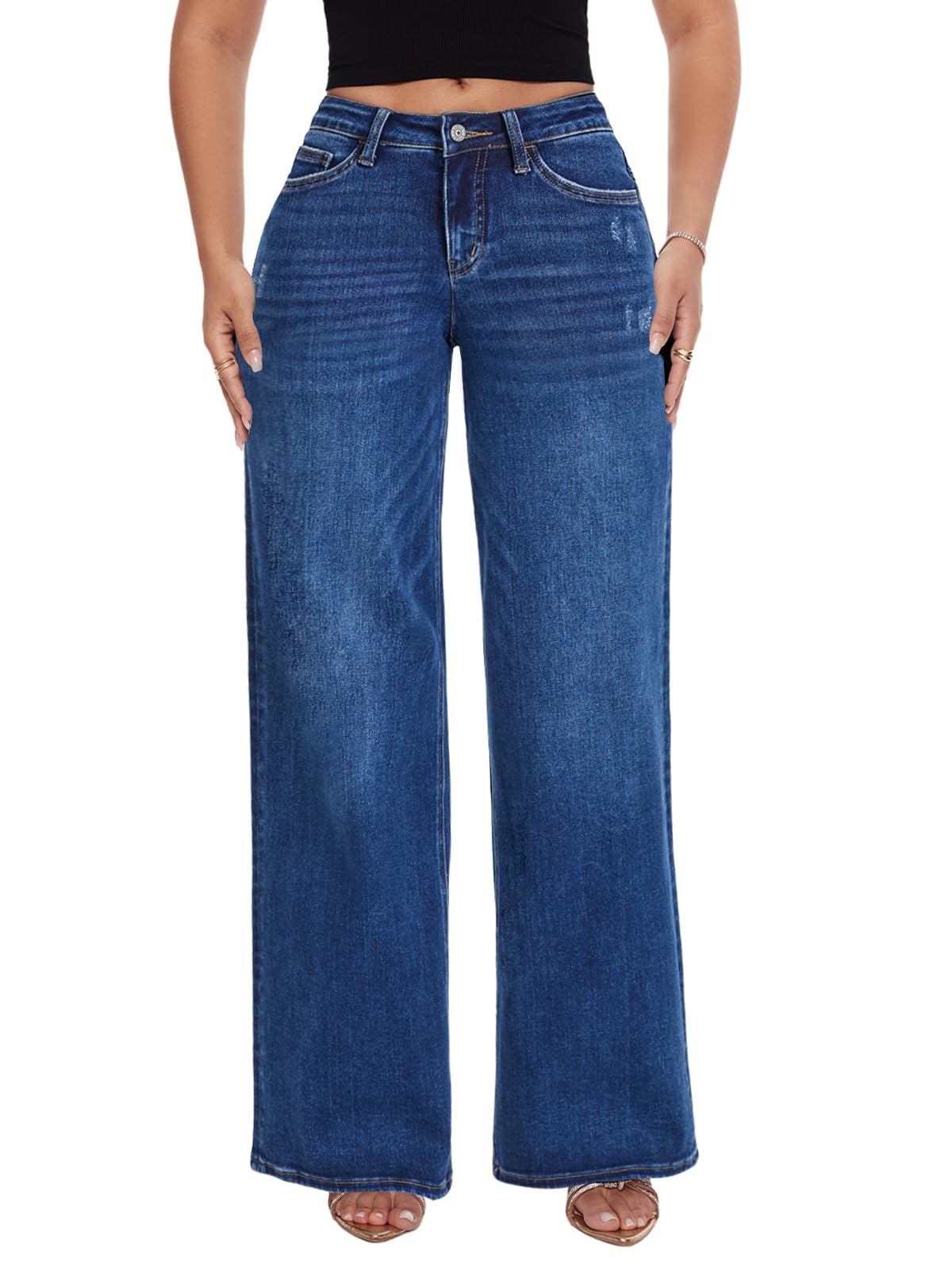
Superlow is the name and the cut lives up to it: the waistband lands just below the navel rather than out at the hip bone, which is what most of us mean when we say low rise. That is the whole appeal — it changes the line of a tucked-in shirt without giving you a pair you have to think about every time you sit down.

The leg is what makes it wearable day to day. It is loose through the thigh and straight to the hem, roomy without tipping into baggy. A low rise with a wide leg reads very 2000s; a low rise with this much ease reads like jeans you can wear to lunch. The denim is heavy cotton with almost no give, so it holds its shape instead of stretching out by mid-afternoon.

That rigidity cuts both ways. There is no forgiveness in the waist, so if you are between sizes, take the larger one; this fabric will not give you the benefit of the doubt. What you get in return is a pair that stays exactly where you put it, all day, without a belt — no small thing in a low rise. The front pockets are deep enough for a phone, and the soft blue wash looks broken in from the first wear.

Length is the one thing to check before ordering. These run long, and anyone on the shorter side will be planning a hem, which is a five-minute errand rather than a flaw. The black wash is the one we reach for after dark, since it reads sharp with a heel and nothing like weekend denim.

Bottom line: Our default recommendation for most shoppers: a genuinely low waistband that sits below the navel, a roomy leg, and rigid denim that stays where you put it.
2

ONESO Wide Leg

ONESO Wide Leg

Stretchy wide leg

Our Score 8.6/10
Check Price

Worth Noting

  • Rise sits closer to mid than low
  • Inseam runs long
Leg
Wide leg
Rise
Mid-low
Stretch
Stretchy denim

There is no break-in period with these. The denim is soft and stretchy, closer to a heavy knit than to raw cotton, and it drapes instead of standing away from the leg. We noticed it most on long days: nothing digs in at the waist, and the wide leg does not collapse into a shapeless tube by evening.

The rise is where the honest caveat sits. ONESO calls it mid-low, and that is fair — it lands closer to the top of the hip bone than to the space below the navel. On a long torso that reads as a proper low rise; on a short one it can feel more mid. If you want the lowest waistband in this guide, look at the Levi's. If you want a low-slung baggy shape you can wear all day, this is the most comfortable version of it here.

Sizing runs generous because of the stretch, so if you are between sizes, go down rather than up, and do not expect much shrink-back after a wash. The leg is wide but not a tent — the pair is tidy enough for a blouse and loafers, which is not something we expected from a baggy jean. The light blue wash is the most versatile of the colors, and the black keeps its depth instead of fading to gray.

Bottom line: If you want the baggy low-slung look without stiff denim, this is the pair we hand people — it is the softest, stretchiest denim in this group.

3

ELLEVEN Baggy Straight

ELLEVEN Baggy Straight

Baggy straight

Our Score 8.6/10
Check Price

Worth Noting

  • Cut runs large through the hip
  • Inseam runs short for taller wearers
Leg
Baggy straight
Rise
Low
Stretch
Soft stretch denim

Low rise is on the label, but where the waistband lands depends on your torso. On a shorter frame it sits closer to the navel than the hip bone, which makes it a mid rise in all but name; on a longer torso it reads properly low. That is the first thing we tell people about it, because the rest of the jean is very good.

The fabric does most of the work. It is a substantial denim with real stretch that does not go limp, so the baggy straight leg keeps its shape through a day of sitting instead of stretching into a sag at the knee. The finish looks more expensive than the pair costs — the black especially has a clean, dry surface rather than the shine cheaper stretch denim gets.

The cut runs generous through the hip and thigh, and the leg is wider than the product photos suggest: this is a true baggy straight, not a relaxed one. Taller wearers will find the hem sitting above the ankle in flats. On the right frame, though, it is the pair that makes a baggy jean look deliberate, and it is the cheapest baggy cut in this guide.

Bottom line: A soft, stretchy baggy straight at a modest price — best on a long torso, where the low rise actually lands low.

4

True Religion Stella

True Religion Stella

Slim low rise

Our Score 8.6/10
Check Price

Worth Noting

  • Sizes run small against the chart
  • Long inseam for petite frames
Leg
Skinny
Rise
Low
Stretch
Stretch denim

Same premium money as the Levi's, opposite leg. Where the Superlow is loose and rigid, the Stella is skinny and forgiving, and it is the pair we point to when someone wants a low rise that does not widen them through the hip and thigh.

The stretch is the good kind. It moves when you sit and recovers when you stand, so you are not hitching them up by mid-afternoon — the difference between denim with stretch and a jegging. The rise is genuinely low, landing a couple of inches below the navel on a shorter frame, which is where it should. It also sits close enough at the back that it does not gap when you sit down.

The finish is what sells it. The denim has a soft hand and a faint sheen that reads dressed up, so the jeans work with a blazer as easily as with a tee, and it is the most polished pair in this group. Nothing about it announces itself as low rise until you notice where the waistband sits.

Bottom line: For a low rise with a skinny leg, this is the pair: a genuinely low waistband, stretch that springs back, and no sagging by evening.

5

Vidiva Pull-On Wide Leg

Vidiva Pull-On Wide Leg

Pull-on comfort

Our Score 8.0/10
Check Price

Worth Noting

  • Inseam runs long
Leg
Wide leg
Rise
Low-mid
Waistband
Pull-on elastic

This is the pair for anyone who likes the look of a low-slung wide leg but not the ritual of buttons, zippers and belts. The waistband pulls on, with stretch built through the back, so there is nothing digging in when you sit. That sounds like a small thing until you have spent a day in a stiff pair.

Weight is the other thing that sets it apart. Thin and soft, almost linen-like in the hand, it is built for hot weather and still holds a wide-leg line, which is more than most lightweight denim manages. It is opaque in daylight too, and that is the usual trade-off with a summer-weight jean.

The rise sits between low and mid: low enough to change the proportion of a top, high enough to stay put when you bend. Length is the catch — the inseam runs long, and on a shorter frame the hem pools on the floor. Hemming a wide leg is a straightforward job, and this is one of the cheaper pairs here, so there is room for it.

The one thing to plan for is how the fabric behaves over a day. It relaxes with wear, giving a little through the hip and knee, so if you are between sizes, take the smaller one and let it settle into you.

Bottom line: Denim that pulls on like sweatpants — an elastic waist, a soft wide leg, and the easiest way to wear a low rise all day.

6

Aeropostale Low Rise Flare

Aeropostale Low Rise Flare

Petite flare

Our Score 8.4/10
Check Price

Worth Noting

  • Flare is wider than the photos suggest
Leg
Flare
Rise
Low
Inseam
Short option available

At the budget end of this group, the Aeropostale flare earns its place with us on two things: a short inseam that works on a petite frame, and a flare that is shaped rather than costume.

Short lengths are rarer than they should be in a low rise flare, and this is the only pair in this guide that offers one. On a 5 foot 2 frame the hem lands where it should instead of pooling around the ankle, which is the difference between wearing them out of the box and booking a tailor.

The denim is soft with a comfortable amount of stretch, and it keeps its shape rather than collapsing into a bootcut after a few washes. The waistband sits low without gaping, which is the hard part with a flared leg: a flare needs the hip to fit precisely or the whole line goes wrong.

It runs large, so size down if you are between sizes; the stretch means there is no need to leave room. A smaller size also keeps the waistband where it belongs, which matters more here than in a straight leg, because the entire shape follows the hip.

Bottom line: The flare pick, and the only pair here sold in a short length that genuinely fits a petite frame — soft, stretchy and easy on the budget.

How We Found the Low-Rise Jeans That Actually Stay Put

We began with a long list of roughly 60 styles and cut anything that didn't publish a front-rise measurement, which narrowed it fast. From there we filtered by fabric content — rigid versus stretch — size range, and price, then pulled 12 pairs to test over four months.

Before the first wear, I laid each pair flat and measured the front and back rise myself, because the number on the product page rarely matches what shows up. Then they went into rotation: full days at a desk, in and out of a car, Saturday errands, a couple of long dinners. I sat, squatted, climbed stairs, and checked at the four-hour mark where the waistband had ended up and whether there was a gap at the back when I sat on a bench.

Each pair got worn with flats and with a boot to see where the hem broke, and I noted whether a flare dragged on the ground or a wide leg puddled. Stretch pairs were watched for knee bag-out by hour six; rigid pairs for how much they eased in over a day. After every wash I compared the color against the listing photo and checked belt loops, inseams, and hems for pulling. Value came down to fabric weight, stitching, and hardware — the things that decide whether a pair survives a second season.

How to Choose Low Rise Jeans

Rise Is a Number, Not an Adjective

Rise is measured from the crotch seam to the top of the waistband. A low rise usually lands around 8 inches, a mid rise around 10, and a high rise 11 or more — which is why a pair a brand calls low can read as mid on a short torso. Two of the jeans here sit closer to mid than the name suggests, and on a long torso that same number reads properly low.

Ask for the rise figure, or measure a pair you already like and compare. It is the one number that decides whether a low rise feels like a change of proportion or like a pair that has simply slipped down.

Rigid or Stretch

Rigid cotton holds its line, keeps a sharp crease and stays where you fasten it; it also has no give, so a sizing mistake has nowhere to hide. Stretch denim is comfortable from the first wear and molds to you, but it can relax through the day and bag at the knee if the recovery is poor.

Our rule of thumb: go up a size in rigid, consider going down in stretch. If you want a low waistband that stays put without a belt, rigid is the safer bet. If you want to forget you are wearing jeans, choose the stretch.

Length and Inseam

Most of the pairs here run long, which is normal for denim cut to be worn with a heel. Check the inseam and whether a short length exists — our flare pick is the only one in this group that offers one — and price a hem into anything you order online.

The good news is that a wide or straight leg is easy to shorten without losing its shape. A flare is fussier, because the hem has to keep the width the flare was drafted for.

Match the Leg to the Rise

A low rise with a wide leg reads very Y2K and needs a closer-fitting top to balance it. A low rise with a straight leg is the version that works almost anywhere. A skinny low rise is the most classic of the three and the easiest to wear with boots, while a flare wants some volume underneath it.

Think about what is already in your closet before you choose the shape. The rise is the part you notice every time you sit down; the leg is the part everyone else sees.

Frequently Asked Questions

Final Verdict

The Levi's Superlow Loose is the pair we recommend to most people, because it does the one thing a low rise has to do — sit low without making you think about it — and the rigid denim holds that line all day. Start there unless something specific pulls you elsewhere.

If softness matters more than structure, the ONESO wide leg is the alternative; if you want a skinny leg, the True Religion Stella has the truer low waistband and better recovery. Whichever you choose, order for your hips rather than your waist, and budget for a hem if you are on the shorter side.