Bags & Accessories

Best Leather Belts of 2026

A leather belt is the one accessory you put on nearly every day and think about almost never — until the edge starts peeling or the hole you actually use stretches into an oval. Most of what goes wrong traces back to where the strap was cut from the hide: full-grain leather taken from the top layer flexes and creases instead of cracking, while the split leather stamped "genuine" is often the one that gives out inside a year. Underneath the buckle, what you're really shopping for is a strap that holds its shape, hardware that doesn't wobble, and a size that lands in the right hole on day one.

That last part is where most online belt purchases go sideways, so over the past six months my team and I have worn 14 belts through office weeks, weekend denim, and one wedding, paying attention to how the edges were finished, whether the buckle rattled or drifted, and whether a new strap smelled like a tannery or a chemical air freshener. One piece of advice before you measure anything: go by the length of a belt you already own, from the fold to the hole you fasten, not your pants size. The picks below are the ones that held up to all of it.

1

Dickies Work Casual Belt

Top Pick
Dickies Work Casual Belt

Everyday casual wear

Our Score 9.0/10
Check Price

Worth Noting

  • Arrives stiff with a plasticky smell
Weight
6.4 oz
Material
Genuine leather
Sizing Standard
Men's

The belt we recommend to almost everyone is the least interesting one in this guide. Dickies' plain work belt is matte, stiff, and completely anonymous, and that's the appeal: it sits flat under a shirt, holds up a pair of jeans, and never becomes the thing anybody notices about you. A belt that keeps its shape through a long day is worth more than one that photographs beautifully, and this one keeps its shape.

Construction is why it takes the top spot. The stitching runs close and even, the buckle is a solid piece of hardware rather than a stamped shell, and the leather is thick enough that the holes hold their shape instead of stretching out into slots. At 6.4 ounces it has real substance without feeling like something lifted off a tool belt. There are no soft edges here and no attempt to look expensive — it's a strap that expects to be used.

Sizing takes a decision before you order. This belt runs tight, so buy one size up from your waist measurement — a 34 waist takes a 36 — and plan on the middle holes rather than the last one. There's enough length that a slightly generous belt still cinches down properly, which is more than we can say for the dress belts on this list. For jeans, khakis, and anything short of a suit, nothing else here covers as much ground for as little.

Bottom line: Our default for anyone who needs one reliable everyday strap: thick leather, honest hardware, and a price low enough to keep a brown and a black.

2

Timberland PRO Boot Belt

Timberland PRO Boot Belt

Heavy jeans, workwear

Our Score 9.2/10
Check Price

Worth Noting

  • Runs small and short
Width
38mm
Construction
Single piece of leather
Sizing Standard
Men's

At 38mm, this is the widest belt in the guide, and the width is the whole argument. A strap that broad spreads the load across your waist, so heavy jeans and a pocket full of tools don't drag the belt down into a sag by mid-afternoon. It also limits where it can go. Thread it through the loops on your work pants before you commit, because it won't slide into the narrow loops on suit trousers, and no amount of breaking in changes that.

The leather is a single piece rather than layers glued together, and that's the difference between a belt that cracks along the edge in a year and one that just darkens at the bend. It's what the extra money buys over the Dickies, and we think it's worth it if the belt is going to take a beating. The cream stitching is a deliberate look — visible, slightly contrasty, unmistakably boot-belt — and it suits denim far better than it suits chinos.

Expect a stiff start. This one takes a week or two before it stops feeling like a strap cut from a saddle, and until then it will stand away from your waist a little. The buckle is a slab of metal with a prong that doesn't flex, and it's the part that feels like it will outlast the leather rather than the other way around.

Bottom line: For heavy jeans, tool pouches, and job sites, this is the sturdiest strap here: one piece of leather, 38mm wide, with hardware that doesn't flex.

3

SUOSDEY Women's Leather Belt

SUOSDEY Women's Leather Belt

Women's everyday wear

Our Score 9.0/10
Check Price

Worth Noting

  • Keeper loop slides out of place
  • Finish can peel with daily wear
Width
1.3 inches
Material
Leather
Sizing Standard
Women's

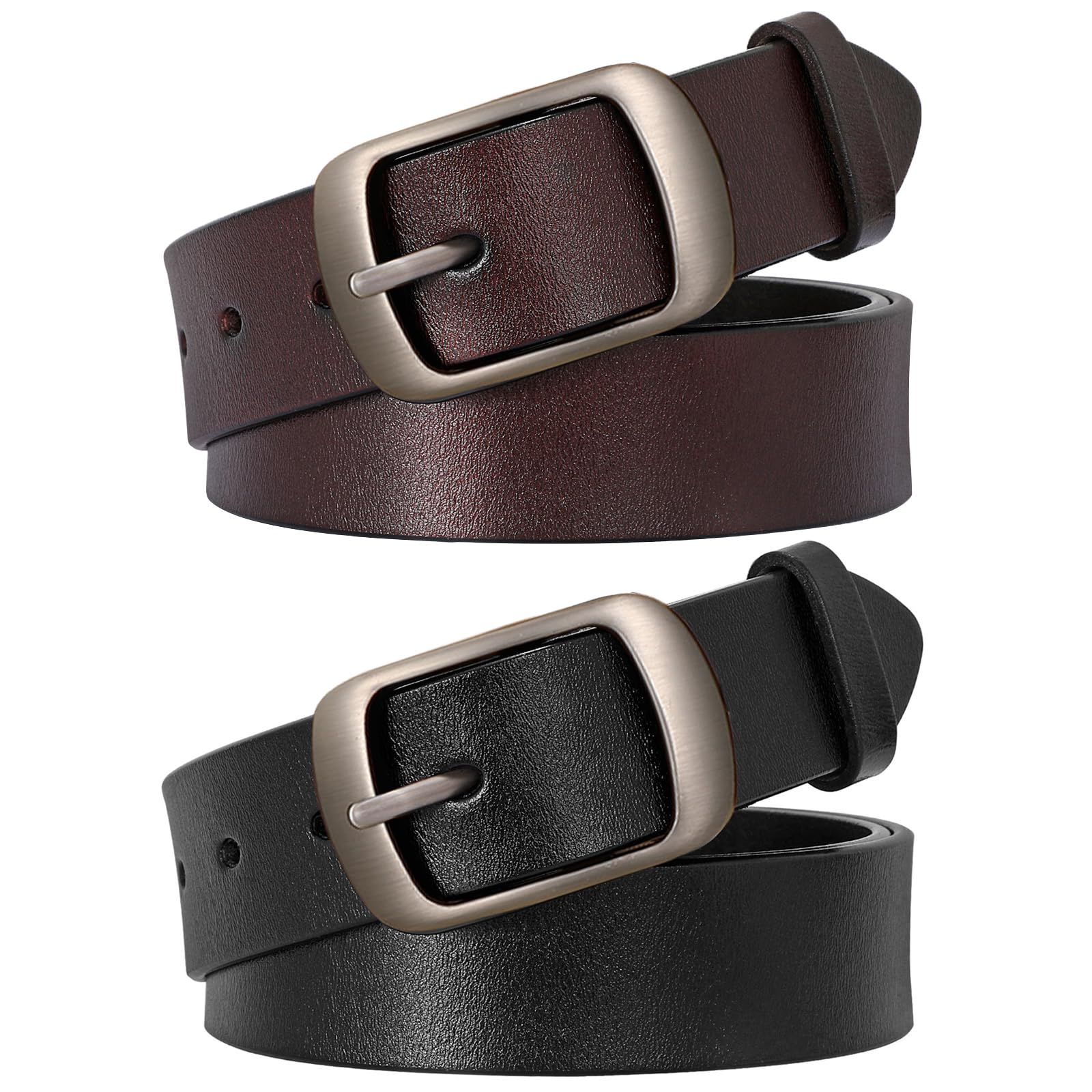
Almost everything in this guide is built on men's sizing, and the SUOSDEY is the exception that matters. It's a 1.3-inch strap sized for women's waists, narrow enough to thread the loops on tailored trousers and dresses, wide enough to look intentional over jeans. The detail we keep coming back to is how flat it lies: the buckle rests against the body instead of propping the strap away from it, which is why it disappears under a fitted top rather than announcing itself.

Sizing is the catch. The chart runs generous at the top of each range and tight at the bottom, so a 30-inch waist can land awkwardly between two sizes. Take the smaller size if you're near the bottom of a range, and use the punch that comes in the box if you need one more hole — the belt also ships with instructions for shortening it, which is more thought than most brands put into packing a belt.

The strap itself is on the thin side rather than a thick hide, which is what lets it lie so flat, and the colors do a lot of the remaining work. The warm browns read as a deliberate choice instead of a default, and they're the reason this belt gets worn all summer rather than saved for jeans weather.

Bottom line: The only belt here cut for women's waists: a slim 1.3-inch strap that lies flat under fitted tops and works with jeans or dresses.

4

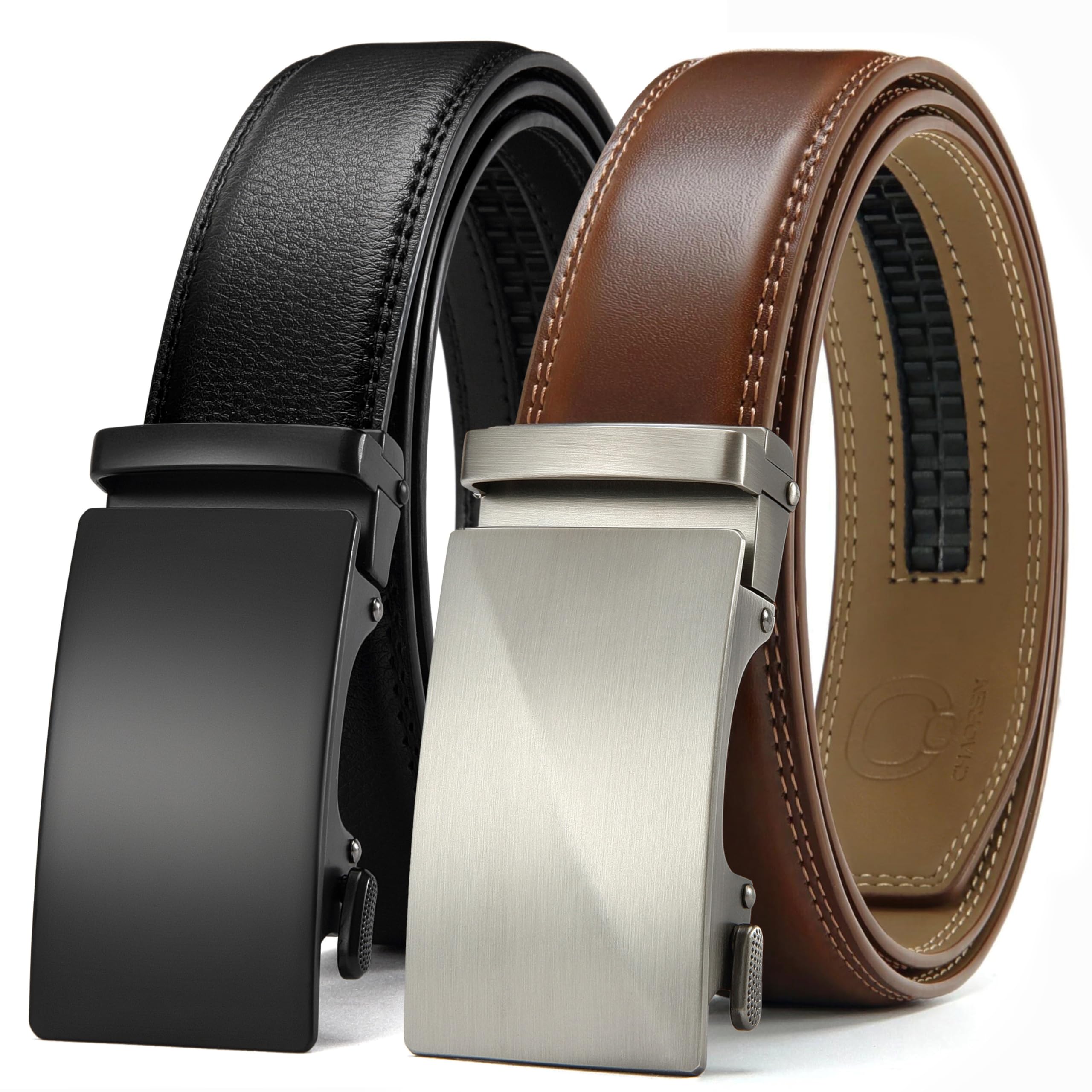
CHAOREN Ratchet Belt 2-Pack

CHAOREN Ratchet Belt 2-Pack

Travel and workdays

Our Score 9.4/10
Check Price

Worth Noting

  • Small, stiff release lever
Pack
2 belts
Width
35mm
Closure
Ratchet
Adjustability
Customizable fit

No holes is the pitch, and it holds up. The CHAOREN uses a track cut into the back of the strap and a spring-loaded buckle that clicks into it, so you tighten in small steps instead of choosing between one hole and the next. Over a day that matters more than it sounds: a belt cinched hard after lunch is a small misery, and clicking it one notch looser without undoing anything fixes it. It stays where you set it, too, with none of the slow slip you get from a strap that's been pulled through a prong one time too many.

Both belts in the pack are trimmable. You open the buckle, cut the tail square, and push it back in, so the belt ends up sized to you rather than to a chart. Cut the correct end: the printed instructions are thin, and cutting the buckle end turns a two-pack into a one-pack. The strap is coated rather than full-grain — firm, convincingly finished, and not the reason to buy this pair.

Where it gives ground is the release. The lever is small and stiff, and it takes a firm thumb to open; loosening this belt one-handed while sitting down isn't realistic, and it's the thing we'd want fixed first. The ratchet track is also the part that eventually fails, which is the argument for buying two at once — a dead buckle isn't the end of the belt-buying week.

Bottom line: Two trimmable ratchet belts for the price of one ordinary belt, with a fit you can nudge a notch at a time — if you can live with a stiff release lever.

5

VATAN Full Grain Jean Belt

VATAN Full Grain Jean Belt

Budget full-grain leather

Our Score 8.8/10
Check Price

Worth Noting

  • Runs short; order a size up
Width
35mm
Material
Full grain leather
Sizing Standard
Men's

Full-grain is the top slice of the hide, the part with the tightest fibers, and it's unusual to see the label on a belt near the bottom of the price range. The VATAN backs it up in the hand: the strap is thick, firm, and cut cleanly at the edges, with a satin finish that doesn't have the plasticky shine of corrected leather. At 35mm it's wide enough for jeans and casual trousers without tipping over into work-belt territory.

What we appreciate is how little it concedes to belts costing two or three times as much. It breaks in properly — the strap softens at the bend and takes the shape of your waist instead of staying a hoop. Getting there takes work. It arrives dry and very stiff, and a couple of weeks of daily wear is what loosens it up; a little conditioner speeds the process, and a lot of conditioner will darken the leather.

The thing to plan around is the smell. It's strong, it's chemical, and it lingers — air the belt somewhere ventilated for a few days before you wear it, and don't open the package in a small room. Past that, this is the most leather for the least money in the guide, and the one that looks most like a belt somebody spent real money on.

Bottom line: Full-grain leather at the bottom of the price range, cut wide enough for jeans — provided you air it out and size up.

6

Dickies Double Prong Belt

Dickies Double Prong Belt

Heavy work pants

Our Score 9.2/10
Check Price

Worth Noting

  • Holes the full length look purely utilitarian
Holes
Punched every inch
Sizes
Regular and big & tall
Closure
Double prong

Two prongs and holes punched every inch, the whole length of the strap. On paper that's an odd belt; on a job site it's the sensible one. You're never between holes, you can cinch a notch tighter after a heavy lunch, and the second prong takes the strain so the first doesn't wallow out its hole over a year of daily use.

The strap doesn't stretch, either, which is the property that actually matters when there's weight hanging off it. It's thick, it's stiff, and it holds a heavy pair of pants up without the belt rolling over at the top. Big-and-tall sizes are part of the range, which is not something every belt in this guide offers, and it's the reason this one keeps coming up for anyone whose waistline moves.

Sizing is where it goes wrong. It runs small, often a full size, so a 38-inch waist wants a 40 — and if you're between sizes, go up again. Because the holes run the length of the strap, an over-long belt is far less of a problem than a short one: you can always cinch past where you'd normally sit, and the second prong keeps the fit honest.

What sells it to us is that double prong. Two points of contact keep the strap from pivoting on a single hole, so the leather around each hole stays round instead of stretching oval — the failure that retires most work belts long before the strap itself gives out. It's a small design decision that buys years.

Bottom line: A double prong and holes every inch make this the work belt for heavy pants and a waistline that moves.

7

MILORDE Dress Belt

MILORDE Dress Belt

Suits and occasions

Our Score 9.0/10
Check Price

Worth Noting

  • Sizing runs long or short by size
Style
Dress
Material
Genuine leather
Sizing Standard
Men's

A dress belt has a different job from everything else in this guide. It needs to be narrow enough for suit loops, plain enough that it doesn't compete with the trousers, and firm enough that the tail doesn't curl up behind your back. The MILORDE gets the look right: a clean strap, a small buckle, straight stitching, and a width that sits between the skinny dress belts and the work straps here. It even arrives in a gift box.

It reads as a belt that cost more than it did, which is most of what you want from something worn a dozen times a year. We wore it with wool trousers and stopped thinking about it, which is the highest compliment a dress belt can earn. The plain buckle is the right call — dress belts shouldn't have a signature — and the leather has a plausible grain rather than a printed one.

The catch is how it ages. The leather starts stiff and stays stiff, and the surface is where belts like this give out: edges crack, the top layer lifts, and a belt that looked sharp in month one looks tired by month six. For a funeral, an interview, and a couple of weddings a year, that's a fair trade. For four days a week, it isn't, and either Dickies here will outlast it comfortably.

Bottom line: The dress belt we keep for occasions: a clean, narrow strap that reads expensive, as long as you're not wearing it four days a week.

How We Sized, Wore, and Stress-Tested 14 Leather Belts

We started by narrowing a long list down to belts with checkable differences: full-grain versus split leather, stitched versus bonded edges, solid versus hollow buckle hardware, and whether the size chart listed a waist measurement or an actual strap length — all weighed against price, since a belt that costs twice as much should show you why. That filtered the field to 14 belts, which we wore for six months across office days, weekend jeans, a wedding, and one very long day on our feet.

Sizing came first. Each strap was measured flat from the fold to the middle hole before its first wear and compared against the listed size, and we noted which hole each tester actually fastened and how much strap was left to adjust in either direction. Two belts ran a full size off their own charts, which is exactly the thing a chart won't tell you.

For buckle functionality, we fastened and released each belt several times a day, listening for rattle, watching for a prong that slipped out of its keeper, and checking whether a ratchet still tracked smoothly after a month of daily use. Durability and craftsmanship were judged by wear: edges checked for splitting, holes for stretching, and the strap at the buckle fold for cracking, with deliberate scuffing against chair arms and car doors to see how the finish aged.

Material and odor got judged twice — straight out of the box, where some smelled like a tannery and others like a chemical air freshener that lingered for days, and again after a week of wear, alongside how the color and surface had settled in.

How to Choose a Leather Belt

Start with the leather, not the label

The word genuine on a belt label means leather, but not necessarily the good part of the hide. Bonded leather is scrap glued and rolled into a sheet; corrected-grain is a split with a stamped, sprayed surface. Both crack and lift at the edges within a year or two of daily wear, which is the failure that looks like peeling paint. Full-grain is the top slice with the fibers intact, and it darkens and softens instead of splitting.

Look at the cut edge near the buckle: one dense cross-section is what you want, and visible layers pressed together are the warning. If you want the cheapest honest example, the VATAN full-grain is the one we point to.

Width has to fit your loops

Belt width is less a style preference than a fit question. Dress trousers usually take a 1.25-inch strap, women's jeans and tailored trousers around 1.3 inches, casual belts 35mm, and work belts 38mm and up. Too wide and the belt bunches the fabric and never sits flat; too narrow and it reads as part of a different outfit.

Measure the loop on the pants you'll wear it with most. A 38mm strap like the Timberland PRO needs roomy denim and simply will not thread a suit loop, however good it looks in the photograph.

Measure a belt, not your waist

Waist size is a starting point, not an answer. The reliable measurement is a belt you already own, laid flat, from the fold at the buckle to the hole you actually use. Order that length, then add a size for stiff work leather that runs short — the Timberland and the Dickies work belt both want it.

A belt worn on the middle hole has room to tighten or loosen through the year. One that only closes on the last hole is finished before you've owned it, and trimmable ratchet belts sidestep the guess entirely because you cut them to length after the buckle comes off.

Buckles fail before straps do

Most belts don't wear out through the leather. They die at the hardware or where the strap bends at the buckle. Ratchet buckles are the most convenient and the most fragile: the spring and the track are what go, and afterward the strap is scrap. A traditional prong buckle is cruder, more repairable, and easy to live with.

A double-prong work buckle spreads the load across two holes so the leather around them stays round rather than stretching oval. Whatever you choose, don't cinch to the last hole, and let a wet belt dry flat and away from heat.

Frequently Asked Questions

Final Verdict

Buy the Dickies work belt. It's the least glamorous recommendation here and the one most people actually need: thick leather, honest hardware, and a shape that survives jeans, khakis, and a long week without asking for anything in return. Every other belt on this list answers a narrower question.

If your belt has to survive a job site, the Timberland PRO's single-piece hide and 38mm strap earn their price. If you're shopping for a women's waist, the SUOSDEY is the only belt here cut for one — check the size chart twice, then take the smaller size.