Fashion

Best Hiking Socks for Women of 2026

The hot spot showed up around mile eight, halfway down a rocky descent I'd walked a dozen times before, and it wasn't the boots. A sock that slips, bunches, or holds onto sweat will undo a good hike faster than any trail feature, and it's the cheapest thing in your pack to fix. What you're actually after is a sock that stays put under the heel, cushions the spots that take a beating, and dries out before your feet go cold and cranky.

My own sock drawer has been merino-heavy for years, and over the past six months my team and I hiked in 16 pairs of women's hiking socks, on weekend day trips, a couple of damp overnights, and plenty of dog walks between. Warmth and softness turned out to be easy to find; what separated the good pairs was fit through the arch, cushioning that didn't flatten by lunchtime, and whether they came out of the wash looking like themselves. Here's the thing first-timers get wrong: thicker isn't automatically better, because a heavily cushioned sock can turn a snug boot into a vise on a long climb. The picks below cover both camps, and the right one comes down to your boots and how far you're going.

1

Darn Tough Hiker Micro Crew

Top Pick
Darn Tough Hiker Micro Crew

Boot-based hiking

Our Score 9.6/10
Check Price

Worth Noting

  • Sold as a single pair
Cuff Height
Micro crew
Weight Class
Midweight
Pairs Per Pack
1 pair

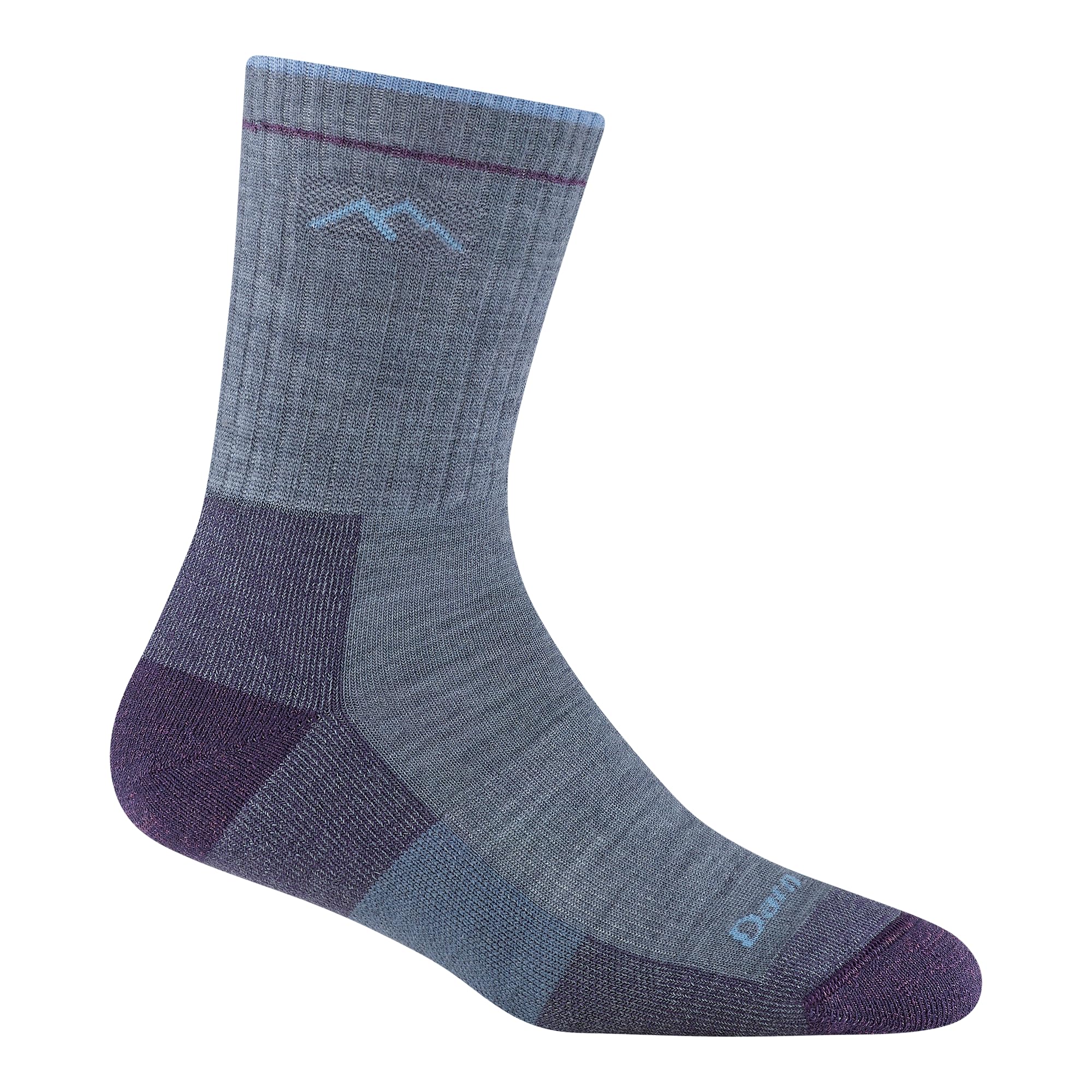
Micro crew is the height that does the most work on a trail. The cuff clears the collar of a standard hiking boot without climbing the calf, so nothing bunches behind the ankle and nothing rubs where the tongue meets the sock. Darn Tough builds this one as a midweight with cushion, which lands in the useful middle: padding under the heel and ball for rocky descents, thin enough at the sides that a broken-in boot still fits the way it did in the store.

What separated this pair from the rest of the field was how little attention it asked for over a long day. The merino moves sweat away and dries quickly, feet stayed comfortable from a cool morning start into warm afternoon sun, and the cuff held its place without leaving a mark. Of everything here, it's the pair we trust most to behave the same on mile ten as on mile one, which is really the whole job.

The trade-off is arithmetic. You get one pair, and it costs several times what a five-pack does, which is the argument the cheaper socks win on paper. What changes the math is the lifetime guarantee Darn Tough backs these with: the failure that makes inexpensive socks expensive, a heel wearing through in a season, is the one this pair is built to answer.

Two details worth knowing before you commit. The patterns and colors run well beyond plain black, which matters if your hiking socks double as cabin socks. And if your trail days happen in low-cut shoes rather than boots, this cuff is more sock than you need — the quarter height below is the better cut for that shoe.

Bottom line: Our default for boot-based hiking: merino that handles sweat, cushioning that doesn't crowd the toe box, and a lifetime guarantee that makes the higher outlay easier to justify.
2

Darn Tough Hiker Quarter

Darn Tough Hiker Quarter

Low-cut trail shoes

Our Score 9.6/10
Check Price

Worth Noting

  • Listed care is hand wash only
Care
Hand wash only
Fabric
59% merino wool, 39% nylon, 2% Lycra spandex
Cuff Height
Quarter
Pairs Per Pack
1 pair

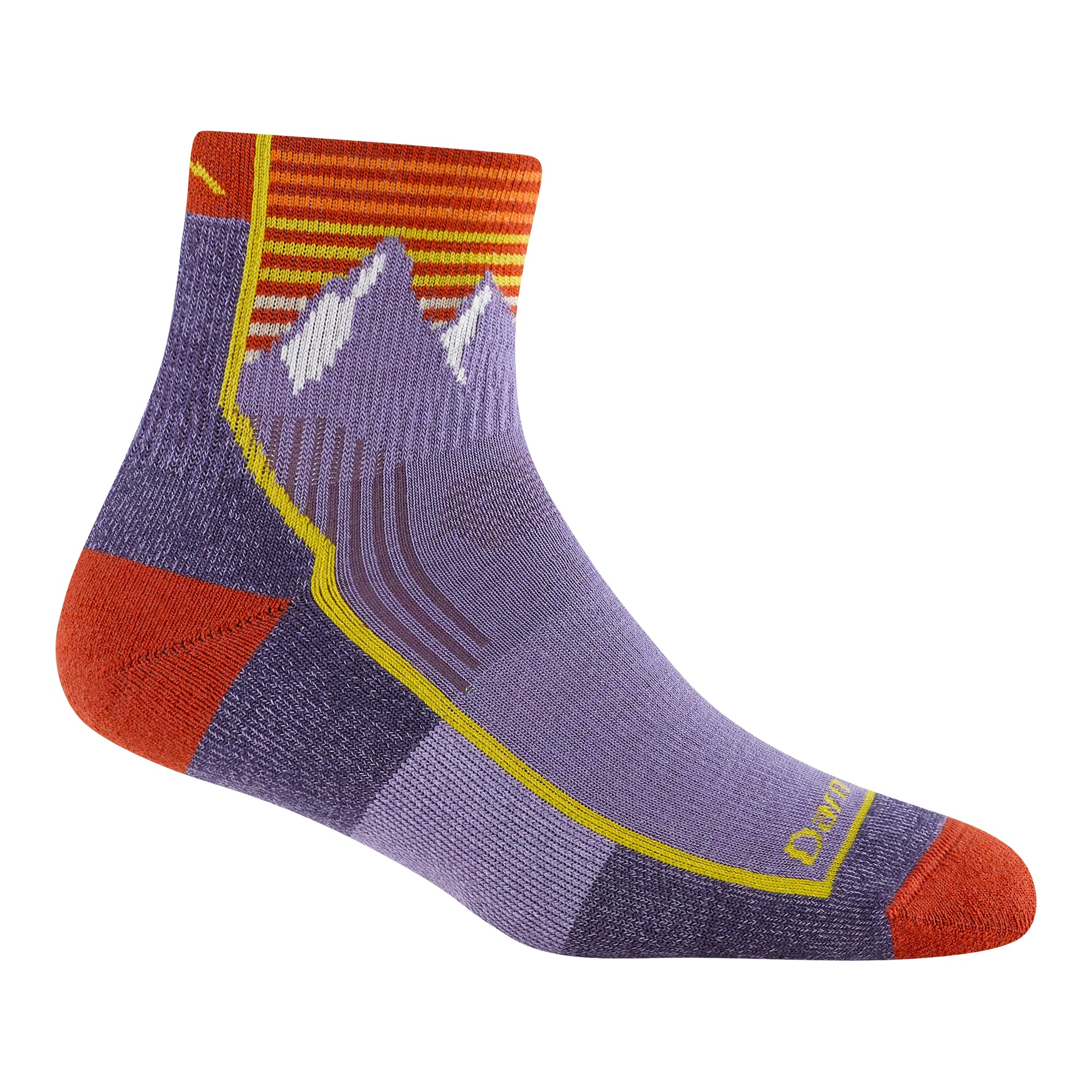
Choose a quarter sock for the shoe, not the outfit. This cuff is cut to sit just above a low hiking shoe or trail runner, which keeps grit out of the shoe without leaving fabric bunched under a tall boot collar. In a mid-height leather boot it's the wrong shape entirely. For trail runners and light hikers, though, it's the cut we recommend first.

The 59% merino, 39% nylon, 2% Lycra blend is what earned this pair a place here. Wool handles sweat and odor, the nylon gives the knit enough structure that the heel stays where you put it, and the spandex lets the band hold without pinching. Across a day of climbing and descending, the fit stayed consistent instead of creeping down into the shoe, which is the failure mode that ruins a cheaper sock.

Warmth is the surprise for a shorter sock: these run warm without turning clammy when the pace picks up, which makes them a three-season pair rather than a summer-only one. The limit is the height — deep snow and tall mountaineering boots want a full crew — and the mountain lupine colorway is pretty enough that ours get worn well off the trail too.

Bottom line: If you hike in low-cut shoes, this is the cut to buy: quarter-height merino cushioning that breathes when you're working and holds its shape on the descent.

3

FEIDEER Hiking Crew 5-Pack

FEIDEER Hiking Crew 5-Pack

Dry-weather day hikes

Our Score 9.6/10
Check Price

Worth Noting

  • Cotton, best kept to dry trails
Fabric
Cotton
Cuff Height
Crew
Pairs Per Pack
5 pairs

Five pairs of crew socks is the pitch, and the arithmetic is hard to argue with when one technical pair costs more than the whole pack. What we didn't expect at this level is a leg band that holds without strangling: the cuff stays where you put it on a climb and comes off without a fight at the end of the day, which is the complaint that sinks most inexpensive crew socks.

The cushioning is the other pleasant surprise. These are thick enough to take the edge off a rocky path without turning a snug boot into a pressure point, and the knit stayed comfortable on warm afternoons rather than cooking our feet on the climb. Fit runs true through the medium, with the usual advice to size up if you're between.

Here's our read: this pack is the sensible first purchase for someone building a hiking drawer from nothing, because five pairs mean one in the pack, one in the car, one drying on the line, and two in reserve. It's a lot of sock for the outlay, and for day hikes in good weather we haven't found an easier way in.

Bottom line: A five-pack that covers a whole season of day hikes — cushioned, well behaved in boots, and inexpensive enough to keep a spare pair in the car.

4

Anlisim Merino Hiking 5-Pack

Anlisim Merino Hiking 5-Pack

Warm-weather trails

Our Score 9.2/10
Check Price

Worth Noting

  • Modest cushioning underfoot
Fabric
Merino wool
Cuff Height
Crew
Pairs Per Pack
5 pairs

The surprise with these is how little sock you feel inside the shoe. They're a thin merino crew — thin enough to disappear inside a snug trail runner, soft enough that the wool never prickles, and warm enough that we reached for them on a cool morning without regret. The colors are loud in the best way, which is either the reason you buy them or the reason you don't.

For hot-weather hiking and travel, this is the five-pack we reach for. Five pairs take less room in a pack than a single fleece, and they dry overnight after a sink wash, which is the real argument for wool on a trip where you're laundering as you go. The sizing runs snug, so go up a size unless you like a compressive fit.

Bottom line: The five-pack for hot trail days and travel: soft merino that keeps feet warm without bulk, provided you go up a size.

5

EnerWear Merino Trail 4-Pack

EnerWear Merino Trail 4-Pack

Cold-weather hikes

Our Score 9.2/10
Check Price

Worth Noting

  • Seams can give out with repeated washing
Fabric
Merino wool
Cuff Height
Crew
Package Weight
10.4 oz
Pairs Per Pack
4 pairs

Cold trailheads are where this four-pack earns its keep. The merino is warm without the loft of a true winter sock, so you get heat on a frosty morning start without your boot feeling tight by the time you've climbed a mile.

The band is the detail we appreciated most: it hugs the ankle without binding, so there's no ring left on your leg at the end of the day, and the sock stays put rather than sliding down into the heel. The colors and patterns lean cheerful, which is a small thing until you're sorting four pairs in a dim cabin.

Thickness varies enough to notice — some pairs feel plusher out of the bag than others — so if you're after a genuinely thick winter sock, this isn't it. Worn as a midweight under a roomy boot, they're comfortable for a full day on the move.

Our take: this is the pack for someone whose hiking season runs into the cold months and who wants warmth without paying premium single-pair prices. Rotate all four through the week and the cost per hike drops to almost nothing, which is the point of buying socks by the pack.

Bottom line: For cold-weather hiking on a budget, this four-pack brings warmth, a comfortable cuff, and enough pairs to rotate through a wet weekend.

6

Sandsuced Merino Boot 5-Pack

Sandsuced Merino Boot 5-Pack

Everyday winter wear

Our Score 9.2/10
Check Price

Worth Noting

  • Pills after a few washes
Fabric
Merino wool
Cuff Height
Crew
Package Weight
6.4 oz
Pairs Per Pack
5 pairs

Five pairs of merino crew socks for less than a single technical pair is the opening argument, and it gets stronger when you see how little space they take — a five-pack flattens to the size of a paperback in a pack. They're snug through the arch, they stay up on the leg, and the knit is thin enough to wear under a boot or a loafer without changing the fit of either.

Our read is that these are the everyday winter pair rather than the long-distance one. They're warm for their weight, the colors hold up, and they handle a workday, a dog walk, and a cold-weather day hike without complaint. If you're between sizes, go up: the fit is deliberately close.

Bottom line: The lowest outlay here for five warm pairs, best for everyday winter wear and short, cold day hikes rather than long mountain days.

7

EBMORE Merino Crew 5-Pack

EBMORE Merino Crew 5-Pack

Cabin and basecamp

Our Score 9.2/10
Check Price

Worth Noting

  • Runs small and short
Fabric
Merino wool
Cuff Height
Crew
Pairs Per Pack
5 pairs

These are the plushest socks in the group. The wool blend is thick, soft, and immediately warm, which is exactly what you want when you've pulled boots off at the end of a cold day, and the knit doesn't itch the way people expect wool to.

The designs are a real part of the appeal — cheerful colors and patterns that are fun to pull on — and they wash well enough if you keep the water cool and the dryer heat low or skip the dryer entirely. Heat is what shrinks a wool blend, so treat these gently and they'll keep their size.

Where these belong is the cabin, the basecamp, and the cold-weather walk: a warm, soft, inexpensive sock for the hours around a hike. For a wet, multi-day traverse, save them for the evening and take one of the merino picks above — there the technical details earn their keep.

Bottom line: A warm, soft, inexpensive five-pack for cabin evenings and cold-weather walks, best kept for the hours around a hike rather than the hike itself.

8

MOGGEI Merino Crew 5-Pack

MOGGEI Merino Crew 5-Pack

Wider calves

Our Score 9.2/10
Check Price

Worth Noting

  • Toe seams can let go early
Fabric
Merino wool
Cuff Height
Crew
Pairs Per Pack
5 pairs

The band is the reason to look at these. If crew socks usually leave a red line around your calf, this pair sits looser up top — it holds position on the leg without pressing in, which is the difference between a sock you forget about and one you're aware of all day.

Warmth and softness are the next thing you notice. It's a thick, cozy knit, warm enough for a cold morning and soft enough to wear around the house, with colors that come out of the wash looking like they went in. They didn't shrink on us under a cool wash and a line dry.

Thickness is well judged for boots: enough cushion to soften a rocky path, thin enough to slide inside a shoe you already own. And because it's a five-pack, a week of cold-weather wear doesn't mean a week of laundry.

Our take: this is the pack for someone who has given up on crew socks staying comfortable, and who wants warmth more than technical performance. Toe seams are the one place to keep an eye on them — if a pair starts to open at the toe, that's the moment to use the guarantee rather than save it for later.

Bottom line: The five-pack for anyone whose crew socks leave a mark: a non-binding band, a warm knit, and softness that works around the house as well as on a short trail.

How We Tested Women's Hiking Socks

We started by pulling together a shortlist of about 40 pairs from retailer listings, brand catalogs, and customer reviews, comparing fiber content, where the cushioning sat, sock height, and whether the women's version was genuinely built on a women's last or just a shrunken men's sock. From there we narrowed to 16 pairs and wore them for six months.

Testing happened on trails, not in a lab. Each pair went out on weekend day hikes with climbs, loose rock, and long descents, plus a few overnight trips where socks got slept in and worn again the next morning. We checked whether the heel stayed seated on steep climbs and whether the arch band left a red mark after a few hours, and we noted if a thick sock made an already snug boot feel tight across the instep. After each hike we squeezed the toe of the sock to see how damp it felt, and we paid attention to whether it felt itchy against bare skin or soft from the first mile.

Durability got its own round of abuse: every pair went through at least 15 wash-and-dry cycles, and we checked the heels and toes for thinning, watched for pilling and holes, and noted whether the cuffs stretched out or the socks shrank. A few pairs came home snagged from brush, which told us plenty about how the knit holds up.

How to Choose Hiking Socks for Women

Match the Cuff to Your Shoe, Not Your Outfit

A crew sock under a low trail runner bunches at the ankle; a quarter sock under a mid-cut boot leaves a strip of bare skin exactly where the collar rubs. Buy for the shoe you wear most: quarter height for trail runners and low hikers, micro crew for a standard hiking boot, full crew for tall boots and deep winter. If you switch shoes between seasons, accept one compromise pair rather than trying to make a single sock cover both.

Cushion Should Fill the Boot, Not Fight It

Padding under the heel and ball softens rocky ground, but a midweight sock inside a precise-fitting boot turns a good fit into a pinch, especially on descents when your foot slides forward. Roomy, broken-in boots make cushion almost free comfort; snug boots punish it. Look at the toe seam too — a flat, low-profile seam is what stops a ridge from pressing on your toes after the tenth mile.

Read the Fiber Content, Not the Front of the Pack

Merino moves moisture off the skin and resists odor, which is why most hiking socks are built around it. Cotton absorbs water and holds it against your foot, so a cotton pair is a dry-weather and everyday choice rather than a wet-weather one. Blends do the structural work: nylon and spandex are what hold a cuff's shape and keep a heel in place. Check the percentage rather than the word merino on the label — our quarter-height pick lists 59% merino, 39% nylon, and 2% Lycra, which is a working blend rather than a token one.

Fit Comes Down to the Band, the Heel, and the Seam

A hiking sock should stay where you put it without gripping: if you can still see the mark on your calf at the end of the day, the band is working harder than it needs to. Bunching under the arch or at the heel is what rubs, so size by foot length rather than shoe size and go up if you're between. Don't expect softness to prevent blisters — moisture and movement cause them, which is why wicking fabric and a stable fit matter more than plushness.

Compare Price Per Pair, Not Price Per Pack

A single technical pair can cost as much as a five-pack, so compare the drawer rather than the package. The split we've landed on is one premium pair for long days and wet weather, where wicking and a lifetime guarantee earn the outlay, plus a multipack for everything else — the short local loop, the commute, the dog walk. If you're on the trail most weekends, the better pair is the better buy; if you hike a handful of times a year, a five-pack is the sensible spend.

Frequently Asked Questions

Final Verdict

If your hiking happens in boots, start with the Darn Tough Hiker Micro Crew Midweight. It handles sweat across a wide range of temperatures, cushions without crowding the toe box, and the lifetime guarantee takes most of the sting out of the price. In low-cut trail shoes, take the quarter height instead — same fiber logic, right shape.

On a tight budget, the FEIDEER five-pack covers a summer of dry day hikes for roughly what one technical pair costs, and the Anlisim pack is the one to pack for hot weather. Buy the premium pair for the days that matter and a pack for everything else, and you'll stop thinking about socks entirely.