Hair Care

Best Hair Straightening Brushes of 2026

The morning I straightened my hair one-handed while the other hand held a coffee is the morning my flat iron started collecting dust. A straightening brush is a heated bristle brush that detangles and smooths in the same pass — no sectioning, no clamping, no mirror rigged behind your head. What it fixes is the ten minutes you spend doing your hair in two stages, which for anyone with hair past their shoulders is the ten minutes that makes them late.

Bristle spacing matters more than top temperature: too wide and strands slip between the teeth without touching heat, too dense and the brush drags. Between my fine, easily-scorched hair and my teammate's thick coils, we covered a decent range of test subjects, and over the past seven months we ran 12 brushes through the same wash-day and second-day routine. The keepers heated fast, held heat across the whole head, and left hair smooth without the scorched smell. Ahead are the ones I'd hand to a friend.

1

TYMO Ring Hair Straightener Brush

Top Pick
TYMO Ring Hair Straightener Brush

Most hair types

Our Score 8.6/10
Check Price

Worth Noting

  • Cord is short for many bathroom outlets
Voltage
Dual voltage
In The Box
Detangling brush, 2 clips, heat glove, bag
Heat-up Time
20 seconds
Heat Settings
5

A detangling brush, two sectioning clips, a heatproof glove, and a bag come in the box with the straightener, and that tells you who TYMO built this for: someone who wants to start styling the minute it arrives. The 20-second warm-up claim is close to what we have seen in use, and it is the fastest brush here. For most people, this is the one we point to first.

The 3D teeth are the real argument. The heated tips sit in a staggered pattern inside a cool outer frame, so you can begin a pass at the hairline instead of an inch below it, which is exactly where most straightening brushes leave a fuzzy halo. Five settings span fine through coarse hair; on medium textures one slow pass per section did most of the work, and thicker sections took two or three. Hair came out smooth and swingy rather than pressed flat.

Small things keep it in rotation. It runs on dual voltage, so it travels, and the auto-off means you can answer the door mid-style without a second thought. Cleaning is the chore nobody mentions: styling product collects between the teeth within a few uses, and a dry toothbrush lifts it better than a cloth. None of that changes our recommendation, because it is a two-minute job at most.

Bottom line: Our default pick: this one heats in about 20 seconds, reaches the roots without scalding, and arrives with a glove, clips, and bag, which makes it the easiest straightening brush to recommend.

2

MiroPure 2-in-1 Ionic Straightening Brush

MiroPure 2-in-1 Ionic Straightening Brush

Budget daily styling

Our Score 8.8/10
Check Price

Worth Noting

  • 60-second warm-up is the slowest here
  • Broad head is a lot of brush for short hair
Safety
Temperature lock, 60-minute auto-off
Weight
12.6 oz
Heat-up Time
60 seconds
Heat Settings
16

Sixteen temperature settings is more control than any other brush here, and that is the interesting thing about this one: the budget price does not take precision away. You also get a double ionic generator, an anti-scald frame, a temperature lock, and a 60-minute auto-off, the features that usually get stripped out of the cheap end of a category. At 12.6 ounces it is light enough to hold through a whole head without your arm complaining.

We recommend it to anyone who is not sure a heated brush will earn a place in their routine. On fine, wavy, and already-relaxed hair it straightens quickly and leaves a decent sheen, and the temperature lock is the underrated part, since it stops a thumb from bumping the dial mid-pass. On type 4 hair, be realistic: it stretches and loosens coils rather than delivering a bone-straight finish, and edges still want a flat iron.

One rule matters more than any feature, and the listing makes it clear: dry hair only. A damp section under a hot plate is how you end up with a rough, dull finish that no serum rescues. Section thin, brush slowly, and let the anti-scald frame do its job near your ears.

Bottom line: If you want to try a heated brush without spending much, the MiroPure gives you 16 heat settings, a temperature lock, and a light body, as long as you expect a few passes on coily hair.

3

Wavytalk Steamline Pro Straightening Brush

Wavytalk Steamline Pro Straightening Brush

Dry, frizz-prone hair

Our Score 8.8/10
Check Price

Worth Noting

  • Top temperature of 410°F is low for coarse hair
  • Most expensive brush in this set
Steam
Hydro-Infusion
Heat-up Time
30 seconds
Heat Settings
4
Temperature Range
325°F-410°F

Steam is either the whole point of this brush or an unnecessary complication, and for hair that frizzes the moment heat touches it, it is the former. The Steamline Pro's Hydro-Infusion system turns water into a warm vapor at the teeth as you pass, and on dry, porous, or color-treated hair that moisture is the difference between smooth and merely straightened. It is the pick here for frizz.

Mechanically it is straightforward: four heat settings, about 30 seconds to temperature, the heating element tucked behind full anti-scald teeth, and a 1.15-pound body that works a long head of hair without a rest. Steam output is the variable we watch, so run it over the sink before your first section to confirm you are getting vapor and not just a hum. If you are, the pass feels lighter than a dry heat brush.

Whether it earns its keep depends on your hair. What you pay for is the moisture: the pass feels gentler and the finish looks calmer than it does after a plain hot brush, especially on second-day hair with product in it. If your hair is already sleek and you just want speed, steam is a complication you do not need, and the TYMO does that job for less.

Bottom line: Steam is the reason to buy this one: it smooths dry, frizz-prone hair that plain heat leaves poofy, and the trade is a lower heat ceiling and the highest price in this set.

4

LANDOT Ionic Ceramic Straightening Brush

LANDOT Ionic Ceramic Straightening Brush

Thick, curly hair

Our Score 8.6/10
Check Price

Worth Noting

  • Buttons sit where your thumb rests
Weight
1.1 lb
Heat-up Time
30 seconds
Heat Settings
12
Temperature Range
250°F-450°F

LANDOT wrote a brief for thick hair and shipped it: dense, heat-resistant bristles, twelve settings from 250°F to 450°F, and an MCH element that is ready in about 30 seconds. The bristle spacing is the part that matters. Close-set teeth grab more hair per pass, which is exactly what thick and coily sections need, and the 450°F ceiling gives coarse hair enough heat to actually respond instead of just warming up.

We keep it for the wash-day crowd. On medium to long curly hair it does in a couple of passes what a wide-pitch brush needs five for, and the 250°F floor means the same tool can handle a finer-haired member of the household at the other end of the dial. At 1.1 pounds it is on the heavier side, but the 360-degree swivel cord keeps the pass from fighting your wrist, and dual voltage makes it a travel option too.

The dense teeth are also why it is not for everyone: on fine hair they can feel like more brush than you need, and the head takes a little getting used to if you normally use something slimmer. What it is best at is the thing that matters on thick hair, reaching through a whole section in one pass rather than three, with the scalp staying comfortable the entire time.

Bottom line: Built for dense hair: 12 settings up to 450°F and close-set bristles get through thick, curly sections in about the time it takes to brush them.

5

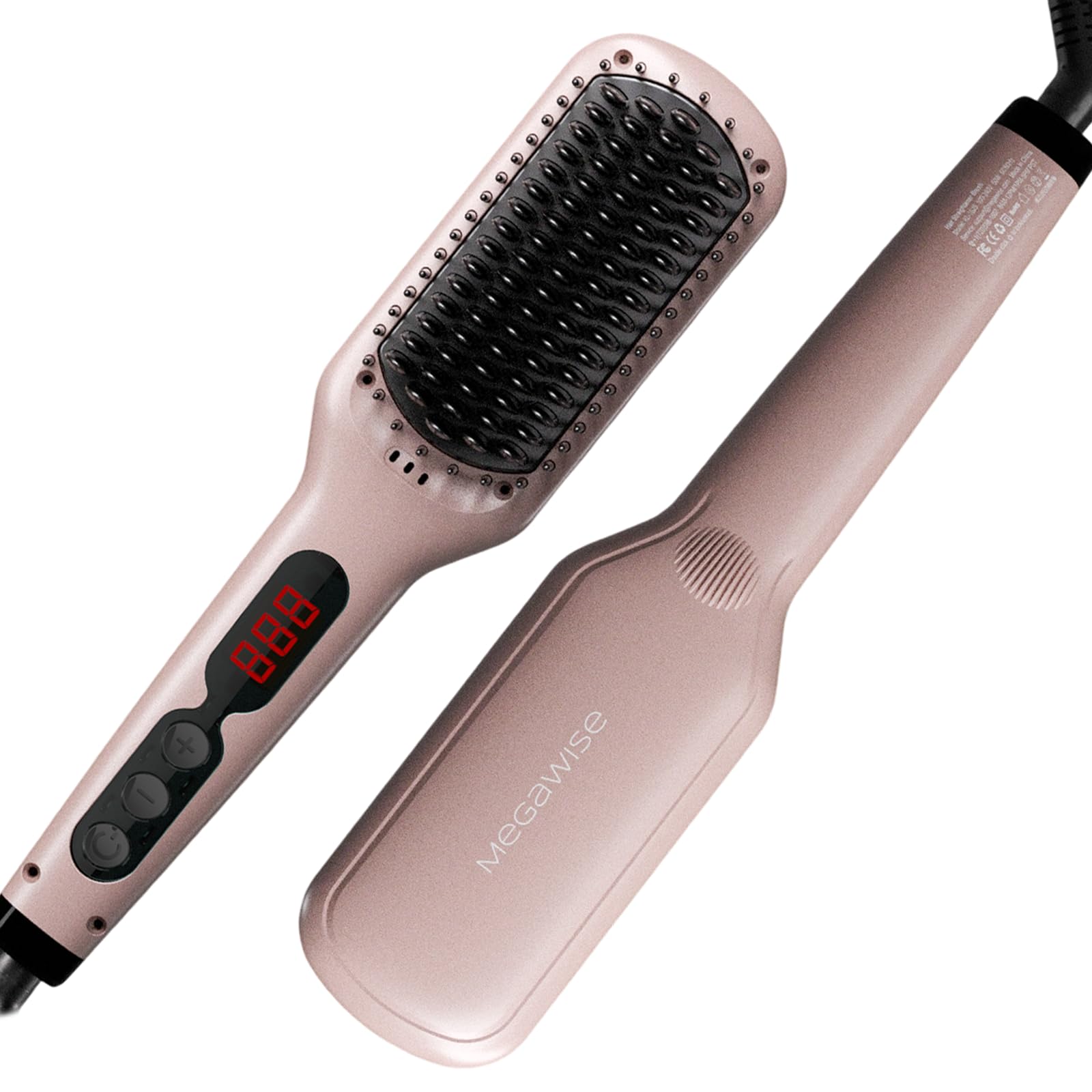
MEGAWISE Ionic Ceramic Heated Brush

MEGAWISE Ionic Ceramic Heated Brush

Versatile budget styling

Our Score 8.6/10
Check Price

Worth Noting

  • Top settings can scorch product buildup if you linger
Weight
10.6 oz
Voltage
Dual voltage
Auto Shut-Off
60 minutes
Temperature Range
230°F-450°F

Most brushes start at 250°F or higher. This one starts at 230°F, which is the least dramatic and most useful thing about it: fine, bleached, or already-relaxed hair can be styled below the temperature where damage accumulates, and the same dial runs all the way to 450°F for coarse hair. That is a wide spread for the least money in this group.

The rest is plain and serviceable: ceramic-coated ionic teeth, an anti-scald outer structure, an LED display, and a 60-minute auto-off, in a 10.58-ounce body that is easy to hold through a whole head. On medium and coarse hair it does the job in a few passes. On very fine hair, start at the bottom and work up rather than assuming the high setting will be faster, because on fine strands it usually is not.

We think of this as the tool for a household with two very different heads of hair, or for coarse hair on a tight budget. It is not the most refined brush here: the body is simple and the controls are basic. What it does, and does without charging extra, is bracket both ends of the temperature scale, which is the one specification that decides whether a brush works on your hair at all.

Bottom line: The cheapest route to 450°F here: a 230°F floor for fine hair, a 450°F ceiling for coarse, and an LED display, provided you respect the top of the dial.

What Seven Months With 12 Straightening Brushes Taught Us

I started with roughly 40 brushes pulled from retailer best-seller pages, other people's roundups, and the models friends kept asking me about, then read through the one- and two-star reviews looking for patterns: plates that quit heating after a month, bristles that bent permanently, cords too short to reach the bathroom mirror. That cut it to 12. I stayed in the middle of the price range on purpose — a straightening brush shouldn't cost more than the flat iron it's replacing, and the cheapest ones tend to give you one temperature and no display.

Each brush lived in a normal bathroom for the better part of a week and got used on wash day, on second-day hair, and on the damp morning after a shower with the mirror still fogged, which is where frizz control shows itself. I timed every one from cold to its highest setting with a stopwatch, then checked whether the indicator light meant the plates had caught up or only that the element had switched on. I straightened one-handed in front of a regular mirror, reaching the back by feel, and counted the passes it took to get a section smooth.

The models with a steam or mist function got watched closely: I looked for spitting water, gurgling, and whether hair came out damp rather than genuinely smoother. For hair health, I compared ends under a bright light after four weeks of use and noted which brushes left that chalky, over-straightened look. Durability meant dropping each one from counter height onto tile, wiping the plates after every use, and rechecking the bristles at the six-month mark. Value came down to whether a brush actually replaced a step in my routine.

How to Choose a Hair Straightening Brush

Start With the Heat Range, Not the Setting Count

Five settings and sixteen settings both get hot, and the number tells you less than the floor and the ceiling do. Fine, bleached, or already-relaxed hair is happiest from about 250°F to 350°F, so a brush that starts at 230°F, like the MEGAWISE, leaves room to work below the temperature where damage accumulates. Coarse, coily hair needs 400°F and up, which is why LANDOT's 450°F ceiling matters more than its twelve steps. The trap is buying the longest feature list: a tool that tops out at 410°F is a fine choice for medium hair and the wrong one for type 4, and no number of settings fixes that.

Teeth, Grip, and Getting Near the Roots

Two designs dominate: close-set heated bristles inside a cool outer frame, and wider-pitch combs. Denser teeth grab more hair per pass and get closer to the scalp, which is what thick hair needs; wider spacing glides through fine hair without dragging. The cool frame matters, but not for the reason the packaging suggests, because it protects your scalp, ears, and fingers rather than your hair. And a brush smooths rather than clamps, so a crisp bend at the ends, a sharp side part, or a stubborn cowlick still calls for a flat iron. Keep both tools.

Warm-Up Time and the Ten-Minute Session

Warm-up runs from about 20 seconds to a full minute across these picks, and section size changes your result more than that spread does. Four sections and one slow pass each beats a fast pass over a thick chunk every time: bigger sections hold heat against the hair longer, thinner ones let it escape. Every brush here is specified for dry hair, and that is not a suggestion, because water plus a 400°F plate cooks the strand instead of smoothing it. Rough-dry first, then brush. Ignore the heat-damage percentages printed on the box; no manufacturer is measuring your hair.

Weight, Cord, and What Decides Whether You Keep Using It

You hold the tool above shoulder height for the whole pass, so weight is a real specification: a 10.6-ounce brush like the MEGAWISE is a different job from a 1.5-pound one. Check the cord against where your mirror and your outlet sit, and prefer a swivel so it does not fight your wrist. Auto-off matters if you tend to walk away mid-style, and dual voltage matters if you travel abroad. Then treat the teeth gently: bristles and combs are the parts that wear out first, so let the tool cool and store it covered rather than loose in a drawer.

Frequently Asked Questions

Final Verdict

The TYMO Ring is what we tell most people to buy. It reaches temperature in about 20 seconds, gets close to the roots without a scorched scalp, and ships with clips, a glove, and a bag. If frizz is the main problem and your hair is fine or medium, the Wavytalk's steam is worth the premium. If your hair is coarse and coily, start with LANDOT's 450°F ceiling and dense teeth.