Skincare

Best Gua Sha Tools of 2026

A gua sha tool is essentially a carefully shaped wedge, and you drag its edge along your jaw, cheeks, and neck to move fluid that's pooled there. Which is why the material matters more than any claims on the box: stainless steel holds a chill and wipes clean in seconds, while jade feels softer against skin but can chip if it slides off a tile counter. Either way, the payoff is the same — a face that looks less puffy at 8 a.m., a jaw that stops aching after a long day at a desk, and five minutes in the evening that feel like a small luxury instead of one more chore.

I kept a jade tool in my bathroom drawer for years and used it roughly once a month, which says a lot about how much grip and shape decide whether you actually stick with one. Over the past four months, my team and I worked 16 gua sha tools into our morning and evening routines, and the difference between a tool you love and one you forget is almost entirely in the edge and the fit in your hand. The picks below are the ones that stayed in rotation long after the novelty wore off.

1

Nuanchu Stainless Steel Gua Sha

Top Pick
Nuanchu Stainless Steel Gua Sha

Daily jaw work

Our Score 9.4/10
Check Price

Worth Noting

  • Fingerprints and water marks show on the polish
Finish
Mirror-polished
Weight
3.2 oz
Included
Velvet travel pouch
Material
Stainless steel

Stone breaks. That is the failure that runs through this category, and it is why a stainless steel board is the one we tell people to buy first. The Nuanchu is a single piece of mirror-polished steel, with no handle, no clamp, and no glued joint, so there is nothing to snap off in a sink or shatter on tile.

At 3.2 ounces it has enough heft to feel deliberate without dragging your hand down, and the balance lands where your fingers wrap around the middle. Steel is cold on its own, so it does not need a fridge to feel like something against a puffy morning face, though we still chill it on the mornings that need it. The surface is non-porous, which makes cleaning a rinse and a wipe rather than a scrubbing job, with no serum soaking in and no residue left behind.

The long curved edge follows a jawline cleanly; the tighter inside corner takes a couple of passes to get used to before it stops feeling fussy. What it does not give you is the weight and hush of real stone in the hand. If the ritual is what keeps you coming back, one of the jade boards below will suit you better, but if you want a tool that lives in the shower caddy and never needs handling with care, this is it.

Bottom line: Our default pick: a steel board that costs no more than the jade ones here and takes the breakage problem off the table entirely.

2

Rena Chris Stainless Steel Gua Sha

Rena Chris Stainless Steel Gua Sha

Learning the strokes

Our Score 9.2/10
Check Price

Worth Noting

  • Small surface means more strokes on jaw and neck
Weight
3.17 oz
Included
Pouch, cloth, guide
Material
Stainless steel
Dimensions
3.35 x 2.17 x 0.16 in

A first gua sha is mostly a technique problem: which edge, which direction, how much pressure before it stops being pleasant. Rena Chris treats that as part of the product. The box includes an instruction booklet and a pointer to a video, plus a storage pouch and a cleaning cloth, which is more hand-holding than any other tool here bothers with.

The board itself is 3.35 inches long, the smallest of the six, and after a few weeks we have decided that is the right call for a beginner. You can see exactly where the edge is against your cheekbone because the tool never disappears past your hand, and the 3.17-ounce weight gives you a little less tool to steer while you are learning where the pressure goes.

Steel is steel, so the finish is the other thing you notice: this one is polished smooth without the mirror shine of the Nuanchu, which hides smudges better in a bag. It is the least precious of the metal tools, in the way a good spatula is the least precious thing in a kitchen, and that suits a tool that gets rinsed twice a day.

Bottom line: The one we hand to first-timers: a printed guide, a video, a pouch, and a cloth in the box, so the first month is about strokes rather than guesswork.

3

Kitsch Stainless Steel Gua Sha

Kitsch Stainless Steel Gua Sha

Mirror-side face work

Our Score 9.2/10
Check Price

Worth Noting

  • Slippery once oil is on your hands
  • Light for neck and shoulder work
Weight
3.14 oz
Material
Stainless steel
Dimensions
3.3 x 2.4 x 0.13 in
Temperature
Cools or warms

Set this next to the Nuanchu and the difference is shape rather than material. The Kitsch is thinner at 0.13 inch, a little wider, and finished like good flatware. We like that for a routine done in front of a mirror: the 3.3-inch body covers more of a cheek in one pass, and the polished steel reads as considered rather than clinical.

Temperature is where it separates itself. Steel takes on whatever you give it, so this one is cold out of the fridge and warm under the tap, and we found the warm version more useful in winter than expected, since a warm edge on a clenched jaw does something a cold one does not. Cleaning is a rinse and a dry.

The slim profile is the catch. With oil on your fingers the board gets slick and there is not much to hold, so we keep a hand towel within reach and grip the wider end. At 3.14 ounces it is light for neck and shoulder passes, where a bit of weight helps. For face work at the sink, none of that gets in the way.

Bottom line: The steel board for a routine you do at the mirror: slim, wide, and happy to be chilled or warmed depending on the morning.

4

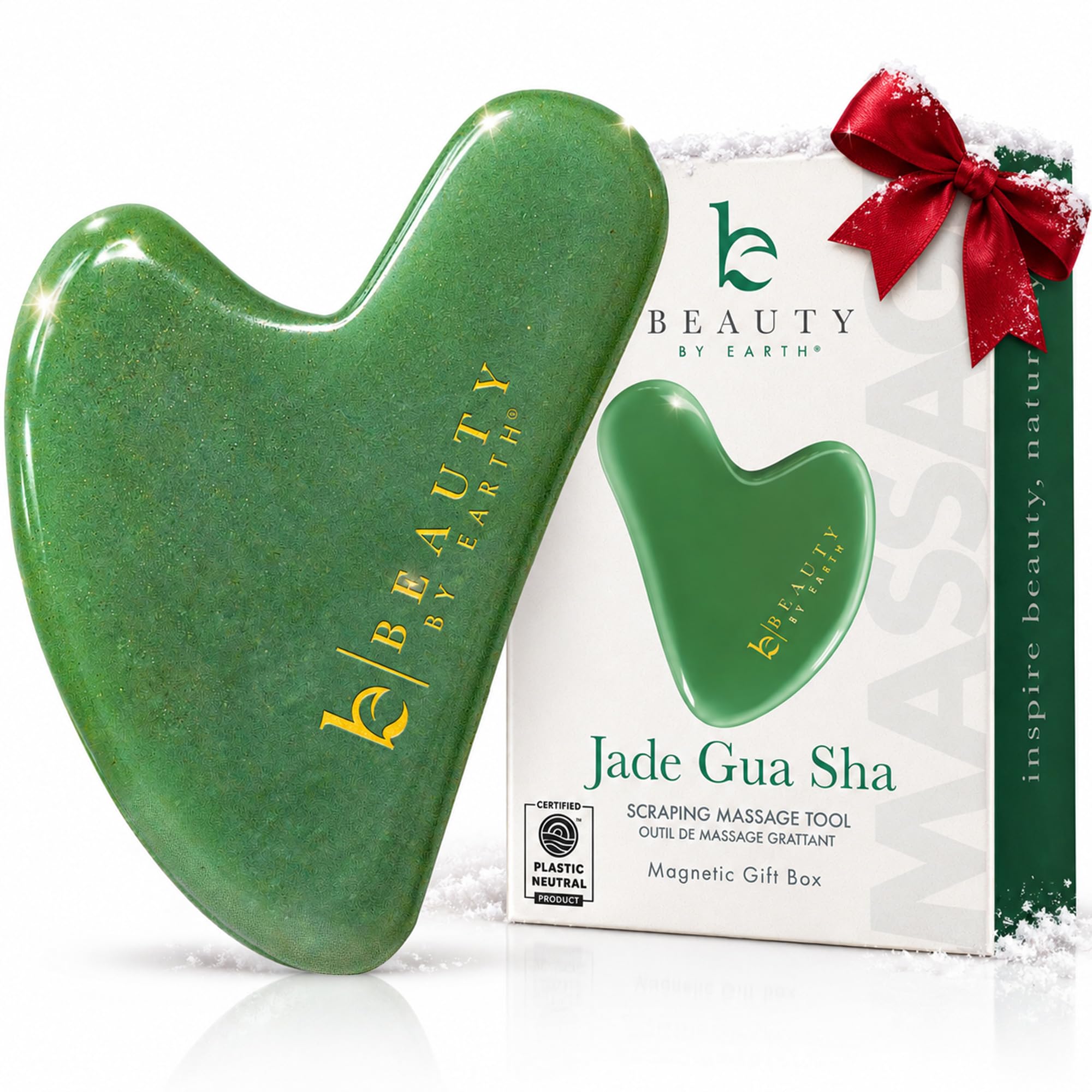
Beauty by Earth Jade Gua Sha

Beauty by Earth Jade Gua Sha

Real stone feel

Our Score 9.4/10
Check Price

Worth Noting

  • Color and veining vary from piece to piece
Weight
1.4 oz
Included
Magnetic gift box
Material
Aventurine jade
Dimensions
3.5 x 2.5 x 0.25 in

Real stone feels different in a way that is hard to fake. The Beauty by Earth board is solid aventurine, 1.4 ounces, cool in a heavy, quiet way that steel does not imitate. We noticed it most around the eyes and brow, where the skin is thin and a metal edge can feel like a lot first thing in the morning.

The shape is where this one earns the stone slot over the cheaper jade boards: a long curve that runs a jawline without catching, a smaller notch that sits into the brow bone, and 0.25 inch of thickness so it does not flex in your hand. It arrives in a magnetic box we have kept for storage, and a lid that closes quietly is the sort of small thing that makes it easy to leave the tool out instead of buried in a drawer.

Stone is a commitment in one specific way: color and veining vary from piece to piece, so what you open will not match the photograph exactly. That variance is also the tell that you are holding stone rather than resin. If you want a board that looks identical every time, buy steel.

Bottom line: The stone tool we point to when you want the real thing: genuine aventurine, contoured where it counts, and boxed well enough to give away.

5

Rena Chris Jade Gua Sha

Rena Chris Jade Gua Sha

First jade board

Our Score 9.2/10
Check Price

Worth Noting

  • Stone quality varies from piece to piece
Weight
1.69 oz
Included
Gift box
Material
Natural jade
Dimensions
3.59 x 2.4 x 0.67 in

This is the least expensive tool in the guide, and the surprise is how little you give up to get there. The Rena Chris is 1.69 ounces of jade with edges polished smooth enough to glide over serum, and it arrives in a box that does not read as the cheap option.

At 3.59 inches it has the largest face of the stone tools here, which suits long cheek and neck strokes and makes it forgiving while you work out where the pressure should sit. Light is the right word for it: 1.69 ounces barely registers in the hand, so this is a tool you guide rather than one that presses for you. The box is sturdy enough to keep using as storage.

What you accept is variance. Jade boards at the low end are a mixed bag, and some pieces feel like stone while others read closer to glass; you will not know which you got until it is in your hand. We treat this as a trial tool: use it daily for a month, and if the habit sticks, the Beauty by Earth board above is the step up.

Bottom line: Our pick for a first jade board: cheap enough to try without agonizing and smooth enough that you will keep picking it up.

6

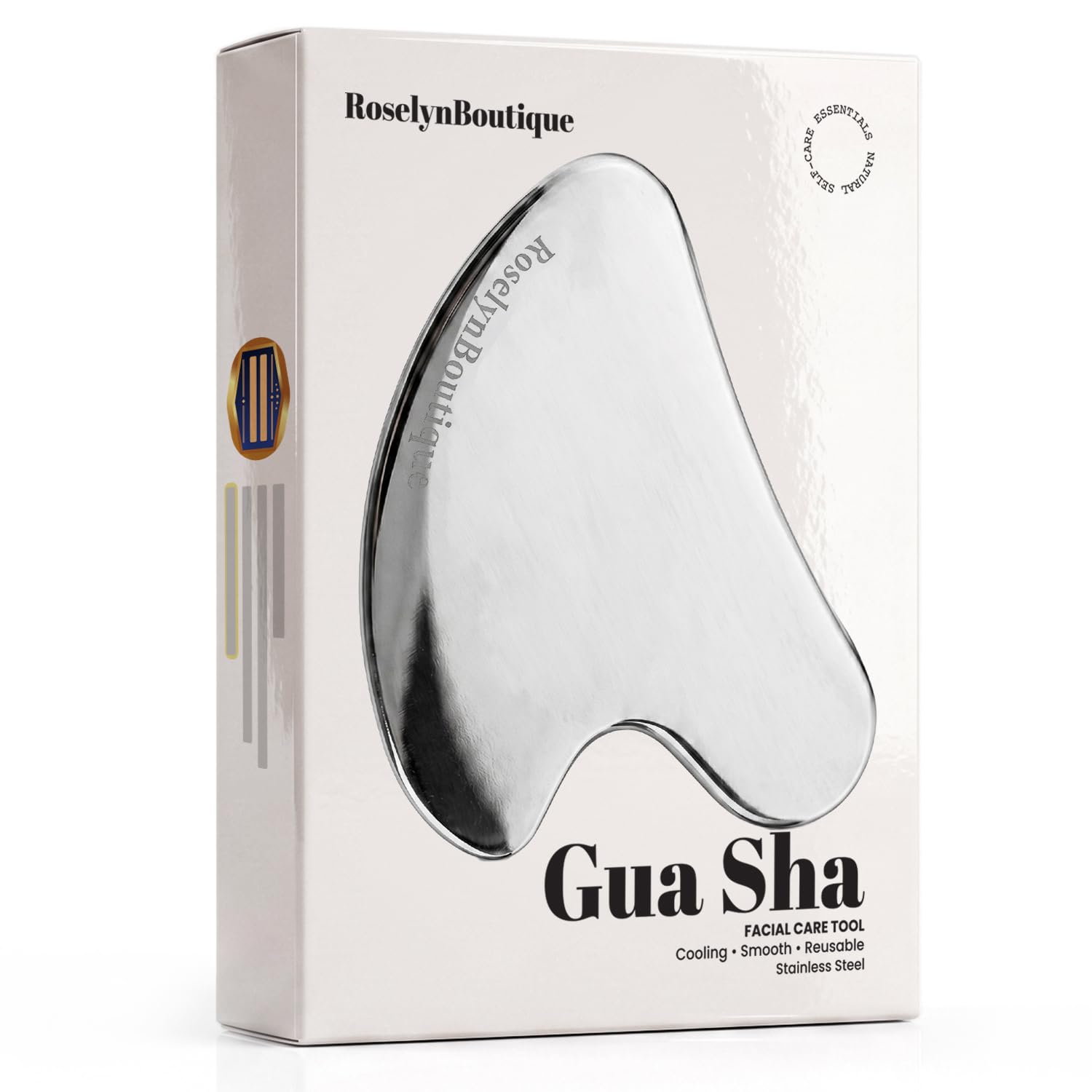
ROSELYNBOUTIQUE Stainless Steel Gua Sha

ROSELYNBOUTIQUE Stainless Steel Gua Sha

Firm pressure work

Our Score 9.2/10
Check Price

Worth Noting

  • Heavy enough to tire your forearm
Edges
Polished, rounded
Weight
5.29 oz
Material
Stainless steel
Dimensions
2.5 x 0.2 x 3.8 in

5.29 ounces. That is the heaviest tool in this guide by a wide margin, well over the steel boards above, and the weight is the entire argument for it. A board this heavy does some of the pressing for you, which on a tight jaw at the end of a day is exactly what you want.

The 3.8-inch length covers a jaw in a single pass and the polished edges move over serum without catching. There is so much steel here that it stays cold without seeing the fridge, and the non-porous surface rinses clean in seconds. It is slim at 0.2 inch, so it slides into a drawer without a case.

Where it stops being the right tool is the morning. At this weight your forearm knows about it after a few minutes, and steering it half-awake around the nose takes more care than a lighter board does. We reach for it in the evening and leave it in the drawer at seven, and that split is the most honest thing we can tell you about it.

Bottom line: The heavyweight of the group: a board that leans into a tight jaw and does the pressing for you, and one that never needs the fridge.

How We Tested 16 Gua Sha Tools Over Four Months

We started by gathering every tool sold as a facial gua sha — jade, stainless steel, comb edges, notched jawline edges, palm-sized blades and pocket-sized ones — and read through customer reviews for the complaints that actually matter: edges that arrive rough, stones that crack, finishes that drag instead of glide. Anything with a visibly uneven edge, a body too small for an adult grip, or a listing that couldn't say what the tool was made of got cut. That left 16 tools, which we used for four months.

Each one went through the same schedule we'd genuinely keep: a two-minute morning pass over the jaw and cheeks with serum before work, a longer evening session along the neck and jawline after screen-heavy days, and a cold pass straight from the fridge on the mornings after a salty dinner. A few traveled in toiletry bags on weekend trips, which is where we learned how much a case and a flat edge actually matter.

We noted whether the edge glided through serum or dragged and skipped, how much pressure a tool needed before skin flushed, and how long that flush lingered — five minutes of light strokes should leave cheeks pink, not irritated. We judged how each one felt in the hand through a full session, whether the chill survived past the first minute, and whether we reached for it again the next night without thinking about it. Durability got its own beating: counter-height drops onto tile, a run through the dishwasher, and weeks of jostling against keys and hairbrushes in a bag.

How to Choose a Gua Sha Tool

Stone or stainless steel?

Steel is the practical answer for most people. It cannot chip, it does not absorb serum, and it is cold on its own, so it works whether or not you remember to chill it. Stone is the one people want to use: jade and aventurine hold a colder, heavier feel that metal does not quite copy, and wanting to pick the thing up is most of what makes a gua sha habit survive past the second week.

Choose steel if the tool lives in a shower caddy, gets dropped, or gets shared; choose stone if you want the object on a shelf and will treat it accordingly. Either way, run a thumb along the edge when it arrives and stop using the tool once it is nicked, because a chipped edge is what scratches skin.

The edges do the work

A long, gently curved edge is for the jaw, cheek, and neck; a tighter notch reaches the brow bone and the side of the nose; a flatter section works the forehead. A single combo-edge board covers all three, which is why the plain shapes here beat anything with a novelty outline.

Polish matters more than thickness. An edge that drags on your thumb will drag on your face, and no amount of serum fixes a rough finish. The Beauty by Earth board is the clearest example of the difference: its notch sits into the brow without digging, which is a shaping decision rather than a material one.

Weight, size, and where it lives

The stone boards here run from about 1.4 to 1.7 ounces and the steel ones from about 3 to 5.3 ounces, and that split tells you what each is for. Heavier tools press harder with less effort but tire your hand; lighter ones steer easily and travel well.

Length is the other half of the decision: a compact board gives more control while you learn, a longer one covers more skin per stroke. If the tool goes in a bag, a pouch is not a detail, because steel arrives scratched without one and stone arrives in pieces.

What a gua sha can and cannot do

Most of what you notice in the first weeks is temporary: a less puffy face in the morning, a looser jaw, five quiet minutes before bed. That is a real benefit and it is also the whole of it, because no board reshapes a jawline or stands in for a retinoid.

So judge the tool on whether you reach for it. Keep sessions short, give it three weeks of daily passes before deciding it is not for you, and buy the shape you will not mind holding for those three weeks.

Frequently Asked Questions

Final Verdict

Start with the Nuanchu. It is the board we keep recommending because it removes the one thing that ends a gua sha habit early: a stone tool that chips or shatters and gets quietly thrown away. At 3.2 ounces it has enough weight to feel purposeful, it is cold without a fridge, and it rinses clean in seconds.

If you want stone, the Beauty by Earth board earns the step up for its contour and its box. And if this is a gift for someone who has never held one, the compact Rena Chris steel set with the printed guide is the kinder introduction.