Makeup

Best Eyelash Glues of 2026

A lash lifting at the inner corner can derail a whole evening, and the wrong glue makes it worse, either grabbing too fast to adjust or staying so slippery that you give up and go out with bare lashes. What you want is enough tack to hold the strip where you place it, a drying time that leaves room to nudge it, and a finish that stays flexible through a long day. I have worn my share of adhesives that turned brittle by dinner, so I know the difference between a strong hold and one that just feels stiff.

Over the past three months, my team and I wore 14 lash glues, including brush-ons, pen-style liners, and cluster formulas, through workdays, dinners, and plenty of humid bathroom-mirror prep. We paid attention to how quickly each one went tacky, whether it kept its grip without flaking, and how cleanly it came off at the end of the night. The ones that made the list were easy to apply, felt worth buying again, and did not leave a sticky residue behind.

1

Kiss Lash Adhesive Clear

Top Pick
Kiss Lash Adhesive Clear

Strips and clusters

Our Score 9.0/10
Check Price

Worth Noting

  • Thick formula can go on unevenly
Finish
Dries clear
Volume
6.12 ml
Formula
Latex-free with aloe
Applicator
Brush tip

Anyone who has fought a squeeze tube knows the problem: the glue arrives in a blob, skins over while you're still trimming the strip, and ends up on your eyelid instead of the band. The brush in the cap of this Kiss bottle fixes most of that on its own. It lays down a thin line you can steer, and the formula stays tacky long enough that a crooked lash can be lifted and reset — which is the single most useful thing we can say about a beginner glue.

Hold isn't the compromise the price implies. Lashes sit through a workday and into the evening, and the clear finish disappears once it sets, so an uneven line doesn't read as dried glue on the lid. It's labeled waterproof, and it shrugs off tears and a drizzly commute; a long swim is a different story.

The formula is latex-free and built around soothing aloe, and there's no solvent smell, which matters when you're working this close to the eye. Removal is the one place to be deliberate: water and micellar alone leave a residue that tugs at the lash line, while an oil-based remover on a soaked cotton pad lets the strip slide off. Keep that in your kit and this stays the easy option.

The bottle holds 6.12 ml, more than most of the tubes here, and a little goes further than that volume suggests. We keep a spare in the drawer rather than rationing the last of it, which is not something we can say about the liner pens in this group.

Bottom line: The default we hand to first-timers: it stays workable while you position the strip, dries invisible, and costs less than anything else here.
2

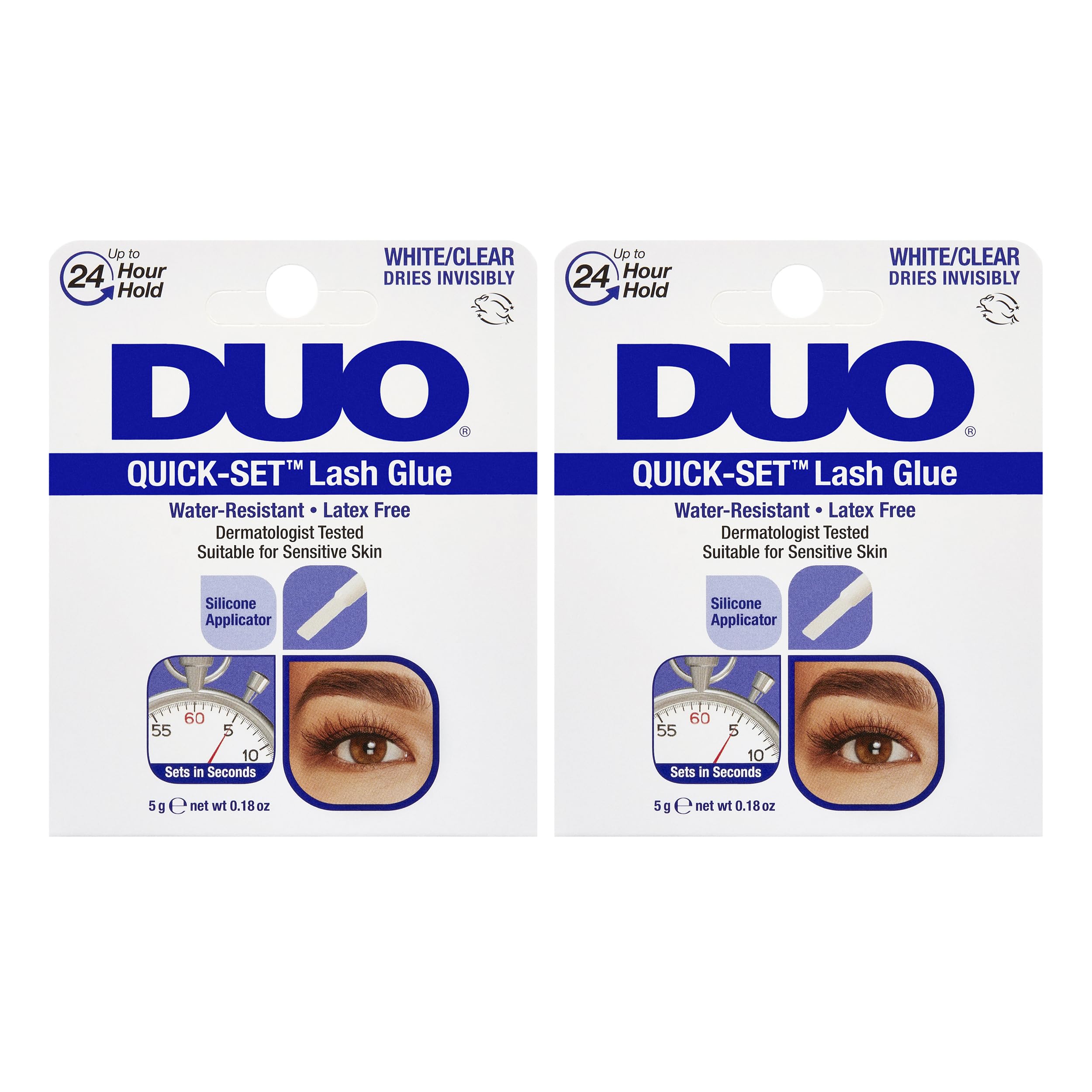
DUO Quick-Set Strong Hold

DUO Quick-Set Strong Hold

Rushed mornings

Our Score 9.0/10
Check Price

Worth Noting

  • Almost no repositioning time
  • Heavy layers are hard to remove
Finish
Dries clear
Formula
Latex-free and formaldehyde-free
Pack Size
2 bottles, 0.18 fl oz each
Applicator
Silicone flat tip

Where our top pick gives you a minute to fiddle, this DUO is built for people who don't have one. The gel turns tacky within seconds of leaving the applicator, so the lash goes on and stays where you put it. Speed is the whole point of the formula, and it's why this is the tube we keep for touch-ups and last-minute plans.

The applicator deserves as much credit as the chemistry. Instead of a brush there's a flat silicone paddle that holds a small bead of gel and wipes it along the band in one pass, so you're not squeezing a tube and hoping. We also appreciate that the box gives you two bottles — one for the vanity, one in a bag — and that the formula skips latex, formaldehyde, parabens and sulfates.

Speed cuts both ways: once the gel grabs, sliding a lash a millimeter to the left isn't happening, so trim and test-fit the strip first. Removal depends on how much you use — a thin layer lifts cleanly with oil-based remover, a heavy one drags. If your eyes water easily, patch test on the inner forearm the day before.

Bottom line: The glue for a five-minute getting-ready window: it turns tacky almost on contact, and the flat silicone tip puts a controlled amount on the band.

3

i•ENVY Super Strong Hold

i•ENVY Super Strong Hold

Long events

Our Score 8.8/10
Check Price

Worth Noting

  • Needs an oil-based soak to remove
Volume
5 ml
Applicator
Brush-on
Stated Hold
Up to 48 hours
Water Resistance
Waterproof and sweatproof

Forty-eight hours is the number on the bottle, and we haven't worn a strip lash for two straight days to prove it. What we can say is that the formula behaves like something built for the long haul: medium-bodied, slow to break down at the corners, and clear enough that regluing a lifted edge doesn't leave a gray smudge behind.

It's waterproof and sweatproof in the everyday sense — a hot kitchen, a cry at a wedding, a windy walk along the river — and the brush applicator gives you a thin coat rather than a puddle. Two bottles come in the pack, which for a glue this tenacious is genuinely useful: the second one lives in a bag for the corner that lifts at six in the evening.

The tack is the part worth learning. It goes sticky fast, and a heavy coat will skin over before the lash lands, so wipe the brush on the rim and work thin — two thin passes hold better than one thick one. Get that right and your corners stay down from morning to night, which is exactly what you're paying for with a long-wear formula.

Bottom line: For weddings, long shifts, and humid afternoons, this is the strip-lash glue we trust to still be there at midnight — its stated hold is the longest of the strip glues here.

4

Kiss Lash Glue Liner

Kiss Lash Glue Liner

Beginners

Our Score 8.8/10
Check Price

Worth Noting

  • Only 0.9 ml per pen
  • Not water resistant
Finish
Matte black
Format
Felt-tip pen
Volume
0.9 ml
Water Resistance
Not water resistant

There isn't much product in this pen — 0.9 ml — and the felt tip is the first thing to clog if the cap lives loose in a makeup bag. We're still recommending it, because for a certain kind of lash wearer it removes the hardest part of the job: you draw a line along your lash line the way you'd draw eyeliner, wait about half a minute for it to go tacky, and set the strip down onto the guide you just made.

The black version doubles as liner, which is why it suits anyone who already wears a wing — the glue line disappears into the makeup instead of sitting on top of it. Application is genuinely fast, both eyes in a couple of minutes once you've done it twice. What it isn't is weatherproof: the listing says not water resistant, and tears, a rainy walk, or a sweaty commute can lift a corner.

Treat it as a format rather than a bottle. Store it tip-down, screw the cap tight, and expect to replace it more often than a 6 ml tube. In exchange you get the least intimidating first lash application in this group, and that's worth a shorter lifespan if lashes have never quite worked for you before.

Bottom line: The friendliest format for beginners: draw the adhesive on like eyeliner, drop the strip onto the line, and skip the bottle entirely.

5

AOA Studio Lash Glue 4-Pack

AOA Studio Lash Glue 4-Pack

Stocking up

Our Score 8.8/10
Check Price

Worth Noting

  • Slower to turn tacky than the label suggests
Finish
Dries clear
Cure Time
30 seconds
Pack Size
4 tubes, 0.17 fl oz each
Applicator
Brush tip

Four tubes at 0.17 fl oz each is a strange amount of lash glue to own, until you've had a bottle go solid three weeks after opening it. Buying in bulk is the cheapest insurance against that, and this is the only set here that treats glue as a consumable rather than a keepsake.

The adhesive itself is better than the price suggests. The brush tip is fine enough to run a thin line along the band, the consistency sits between runny and paste so it doesn't slide toward your eye, and it dries clear without a white cast. On a normal day it holds from morning to evening, which is all most people ask of a strip-lash glue.

Two things to know before you buy. The stated 30-second cure is optimistic in a cool room, so give it longer than you think and test the tack with a knuckle before committing the strip. And while the tube says waterproof, tears and sweat are a different test from a humid afternoon — if you're wearing these to a wedding, this is the set where a spare in your bag costs you almost nothing.

Bottom line: Four full-size tubes for roughly the price of one premium bottle — the sensible pick if glue tends to dry out on you before it runs out.

6

LAUBESS Bond and Seal

LAUBESS Bond and Seal

Cluster lashes

Our Score 8.6/10
Check Price

Worth Noting

  • Adds a step to every application
  • Wear time depends on washing and sleep
Format
Bond and seal duo
Volume
10 ml
Applicators
Mini brush and ball tip
Stated Hold
Up to 72 hours

Bond and seal is two products sharing one tube, and the difference between them is the whole trick. The bond end is a thin, grippy glue you brush under your natural lashes; the seal end is a lighter coating you run over the finished set to lock the bases down. Skip the second step and the bases stay faintly sticky, which is where lint, sleep creases, and lifted corners come from.

The applicators are the reason the routine works. A mini mascara-style brush on the bond end gets under the lash line without painting your eyelid, and the ball tip on the seal end delivers a controlled bead along the base rather than a flood. Ten milliliters split between the two ends is a generous amount for cluster work, which uses far less per application than a strip does.

The sequence matters more than the clock: bond, place the clusters while the bond is still tacky, then seal once the whole set is on. Done in that order the set feels locked rather than glued, and it holds through a shower and a night's sleep in a way a strip adhesive simply doesn't.

What we can't promise is a number of days. With clusters, how long a set lasts depends as much on how you sleep and wash your face as on the adhesive — a set that goes four days with careful washing can lift in two with a hot shower and a rough towel. What the two-step routine buys you is a cleaner base while it lasts, and a removal that wants a proper remover rather than a tug.

Bottom line: The bond-and-seal pair we reach for with cluster lashes: the seal step keeps the bases from staying tacky, and the hold lasts days rather than hours.

7

Kiss Lash Couture Adhesive

Kiss Lash Couture Adhesive

Sensitive lash lines

Our Score 9.0/10
Check Price

Worth Noting

  • Costs more per gram than our top pick
Finish
Clear
Volume
0.17 oz (5 g)
Formula
Biotin and blueberry extract
Applicator
Brush tip

Biotin and blueberry extract are the sort of ingredients that sound like marketing until you've had a lash line react to three adhesives in a row. This one is dermatologist tested, latex-free, formaldehyde-free, and vegan, and the brush tip lays a fine, even line without the formula creeping up the band. For reactive eyes, the label is the argument.

The bottle is 5 g and the finish is clear, so it disappears against a bare lash line and layers under mascara instead of fighting it. It's a strip-lash glue first — the brush runs a controlled line along the band, and the small bottle travels well in a bag.

The honest framing is that this is a formula to choose for comfort. If your eyes have reacted to other adhesives, it's the one to try before you give up on lashes; if you want the most forgiving, most heavily used bottle in this guide, our top pick is the safer bet. Patch test first regardless — a gentle label doesn't rule out a reaction — and pair it with an oil-based remover so removal is as calm as the application.

Bottom line: The one to try when lash glue usually leaves your lids stinging: dermatologist tested, latex-free, and infused with biotin and blueberry extract.

How We Tested 14 Eyelash Glues Through Real Mornings and Long Nights

We started with a shortlist of more than 30 glues sold for strip lashes, clusters, and pen-style application, then narrowed it by formula type, latex-free labeling, applicator, and cost per wear to 14 we could wear regularly. Over three months, every glue went on at a bathroom mirror before work and stayed through a full day at a desk, a commute, and at least one dinner out. We also wore them through a humid bathroom and a rainy walk to see whether the hold turned tacky, crusty, or simply gave way.

We timed the window between application and a clear, tacky finish, and noted whether the glue grabbed the lash on first contact or let us slide it into place. At the 8-, 12-, and 24-hour marks where a formula claimed extended wear, we checked inner and outer corners for lifting, white residue, or a stiff crust. For removal, we followed each maker's directions, held a remover-soaked pad over the lash for 30 seconds, and watched whether the strip released cleanly or left sticky patches on the lid.

We also tracked ease of use, whether a brush, pen, or nozzle dispensed a bead we could control, and counted how many wears we got from each tube before it thickened or ran out. At the end, we noted which tubes we would actually buy again and whether the cap kept the tip from clogging between uses, since value and repurchase matter as much as a strong first stick.

How to Choose an Eyelash Glue

Start With What You're Sticking On

Strip lashes want a glue that stays slightly flexible along a thick band; clusters and individual lashes want something thinner that grabs near the root. That's why bond-and-seal products exist: the bond is tacky enough to hold a cluster at its base, and the seal coats the knot afterward so it doesn't collect lint and pillow fuzz.

If you're new to lashes, a liner-format glue does the aiming for you by drawing the guide line and the adhesive in one pass. Decide the lash type first — the format question mostly answers itself after that.

Treat Tack Time as the Real Specification

Every glue has a window between too wet to stick and too dry to grip, and it usually lands somewhere around 30 to 60 seconds. Fast-setting formulas suit anyone applying in a hurry but punish a crooked strip; slower ones let you slide a lash into place and are the better choice while you're learning the shape of your own eye.

You can test tack without guessing: touch the back of your hand lightly to the glued band. If the glue pulls into strings, give it a few more seconds. If it feels dry and doesn't grip at all, you've waited too long and need a fresh coat.

Clear, Black, or White That Goes Clear

Finish is a style decision with a practical edge. Clear glue disappears against a bare lash line, which forgives an uneven application — but applied too thick, it can dry with a faint white cast before the lash lands. Black glue, and especially liner-format pens, doubles as makeup and hides the seam under a dark lash.

For a wispy, natural style, clear is usually the safer choice. For a winged look, or if your own lashes are dark and you want the band to vanish into them, a black liner glue does more work than a clear bottle will.

Buy for Shelf Life, Not for Volume

Lash glue is a small-volume product that goes off quickly once opened. A 0.17 to 0.25 oz bottle is a normal size, and most of them lose their tack well before they run out, which is the honest argument for multipacks and for small pens you replace without resentment.

Store bottles upright with the cap screwed tight, away from a steamy bathroom shelf, and bring a pen back to life by wiping the tip rather than pumping it. Patch test any new formula on your inner forearm a day before it goes near your eye.

Frequently Asked Questions

Final Verdict

The Kiss Lash Adhesive is the one we point to by default. It also happens to be the least expensive bottle here, but that isn't the reason to buy it: the brush puts glue exactly on the band, the formula forgives a slow first attempt, and it dries clear enough that a slightly crooked lash doesn't announce itself. Keep an oil-based remover in your kit and it will outlast most of the tubes in this guide.

When speed matters more than forgiveness, the DUO Quick-Set earns its place — just trim and test-fit the strip before the glue touches it. And if you're placing clusters rather than strips, skip both and go straight to a bond-and-seal pair.