Skincare

Best Eczema Creams of 2026

The itch shows up at the worst times — 2 a.m., mid-meeting, the second you finally sit down. Scratch and the skin gets angrier; ignore it and you lose the night. A good eczema cream does two jobs: it quiets the itch and the flare quickly, then rebuilds the barrier underneath so the next one is milder. It also has to be something you'll reach for without dread, because a formula that stings cracked knuckles or leaves your hands greasy tends to sink to the back of the shelf.

I've had eczema on my hands and elbows for years, and the gap between a mediocre cream and a good one shows up on day two, not day one. Over the past six months, my team and I worked through 12 eczema creams, watching how fast the itch faded, how each felt on freshly flared skin, how long a tub actually lasted, and what it cost per ounce. One thing I'd tell any first-time buyer: apply within three minutes of a shower, while skin is still damp, or you're fighting uphill. The picks below earned their place even on the bad nights.

1

Eucerin Eczema Relief Cream

Top Pick
Eucerin Eczema Relief Cream

Daily body care

Our Score 9.4/10
Check Price

Worth Noting

  • A cream, not an overnight barrier balm
Size
14 oz
Formula
Fragrance-free, steroid-free
Key Addition
Ceramide-3
Colloidal Oatmeal
1%

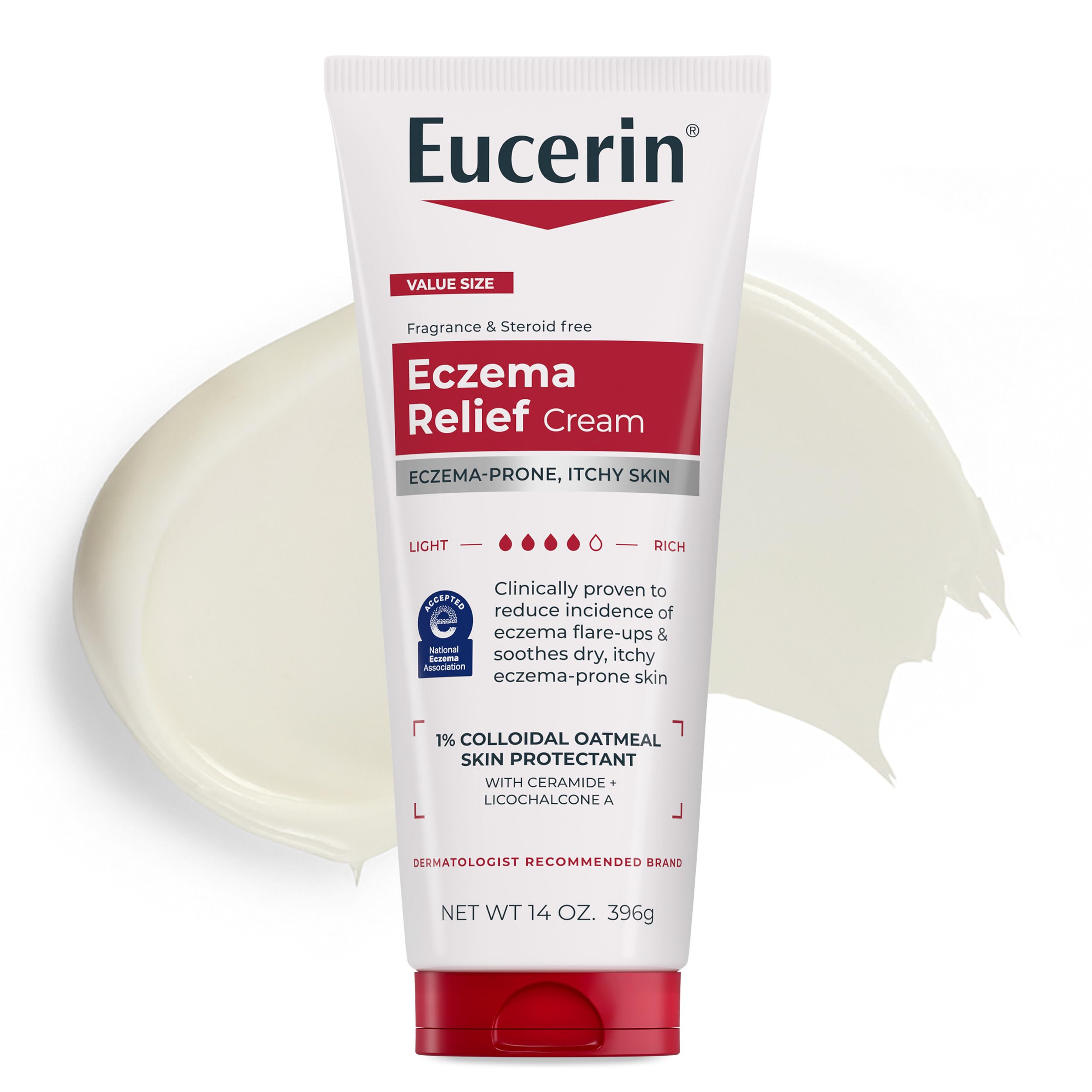
Eczema care is mostly a volume problem. A cream helps only if you use enough of it, often enough, for long enough, and that's the argument for this tube before you read a single ingredient. Fourteen ounces of fragrance-free cream with 1% colloidal oatmeal and ceramide-3 is a size you can put on a whole body twice a day without rationing it — more than can be said for the small tubes elsewhere in this guide.

We think it's the best default here because it gets the unglamorous parts right. The oatmeal is the standard 1% skin protectant dose, the ceramide-3 supports the barrier rather than just sitting on it, and the cream absorbs quickly enough that you can dress straight after. In the brand's clinical study, four out of five children using it daily stayed flare-free for six months — a claim worth less for its precision than for the routine it describes, because six months of daily use is the actual treatment.

Texture is where it gives ground to the balms. This is a cream, not a seal, so cracked, leathery patches that need something sitting on top overnight will do better with a heavier ointment. For daytime, under clothes, on a child who won't stand still, that lightness is exactly why it gets used at all.

Bottom line: This is the eczema cream we recommend first: a big, fragrance-free oatmeal-and-ceramide tube cheap enough to apply lavishly, twice a day, on adults and kids.

2

CeraVe Itch Relief Cream

CeraVe Itch Relief Cream

Itch flare-ups

Our Score 9.4/10
Check Price

Worth Noting

  • Costs more per ounce than plain body creams
Size
12 oz
Relief Claim
2 minutes, up to 8 hours
Barrier Support
3 essential ceramides
Active Ingredient
1% pramoxine hydrochloride

The active ingredient here is a drug: 1% pramoxine hydrochloride, a topical analgesic, carried in the ceramide, niacinamide and hyaluronic acid base CeraVe is known for. The label claims relief within two minutes and up to eight hours, and we treat figures like that as a ceiling rather than a promise — but the pramoxine is exactly why this belongs in a guide full of oatmeal creams.

In the hand it feels like the brand's regular cream: thick, velvety, unscented, and gone within a minute or two of rubbing. That matters more than it sounds. An itch cream gets used at two in the morning, on a child's legs, or on your own hands after every wash, and anything that leaves a film gets skipped the second time.

What it isn't is the cream you spread head to toe every day forever. The 12-ounce tub is for the itch itself; a plain oatmeal cream does the barrier maintenance, and buying both is cheaper than asking one product to do two jobs.

Bottom line: When itch is what's wrecking sleep, our pick is this one — pramoxine to quiet the itch inside a genuinely good ceramide cream.

3

Cortizone-10 Eczema Lotion

Cortizone-10 Eczema Lotion

Short-term flares

Our Score 9.4/10
Check Price

Worth Noting

  • A short-term treatment, not a daily moisturizer
Pack Size
Four 3.5 oz tubes
Also Contains
Seven moisturizers
Active Ingredient
1% hydrocortisone

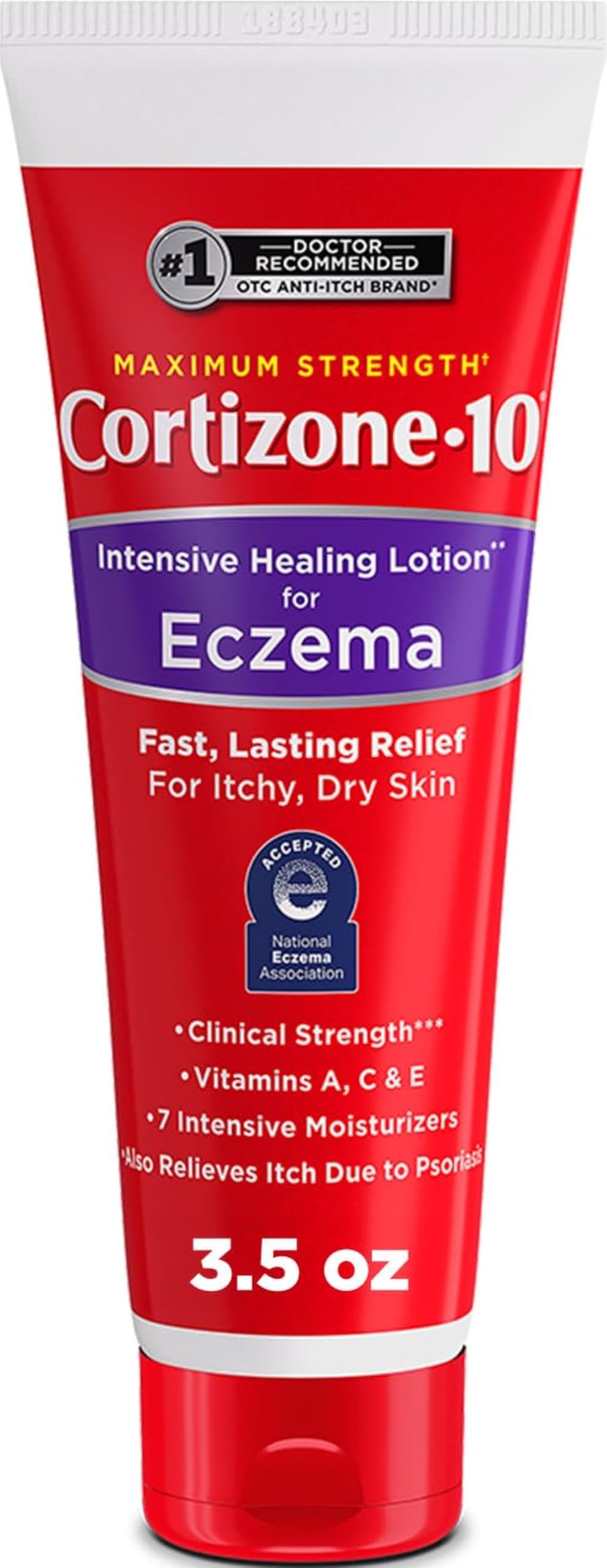
Cortizone-10 isn't a moisturizer with a good story attached. It's 1% hydrocortisone, the strongest strength sold without a prescription, in a lotion built around seven moisturizers plus a vitamin and botanical complex — and that distinction should decide when you reach for it.

The tube earns its keep on the flare that won't settle: the cracked patch on a hand after a winter of washing, the ring on an arm that has shrugged off a month of cream. It goes on like a lotion rather than an ointment and absorbs without grease, and the four-tube pack means one can live in a bathroom, one in a bag, one at work.

What we come back to is the discipline it forces. The label sets the directions and the limits, and following them is the point: this is the tool that gets a flare under control so the daily cream can hold the line afterwards. Bought as a body lotion, the arithmetic goes wrong — you run out of label long before you run out of tube. We keep one in the kitchen drawer for exactly that reason.

Bottom line: We treat this as the flare tool, not the daily cream: 1% hydrocortisone for the patches moisturizer alone isn't settling.

4

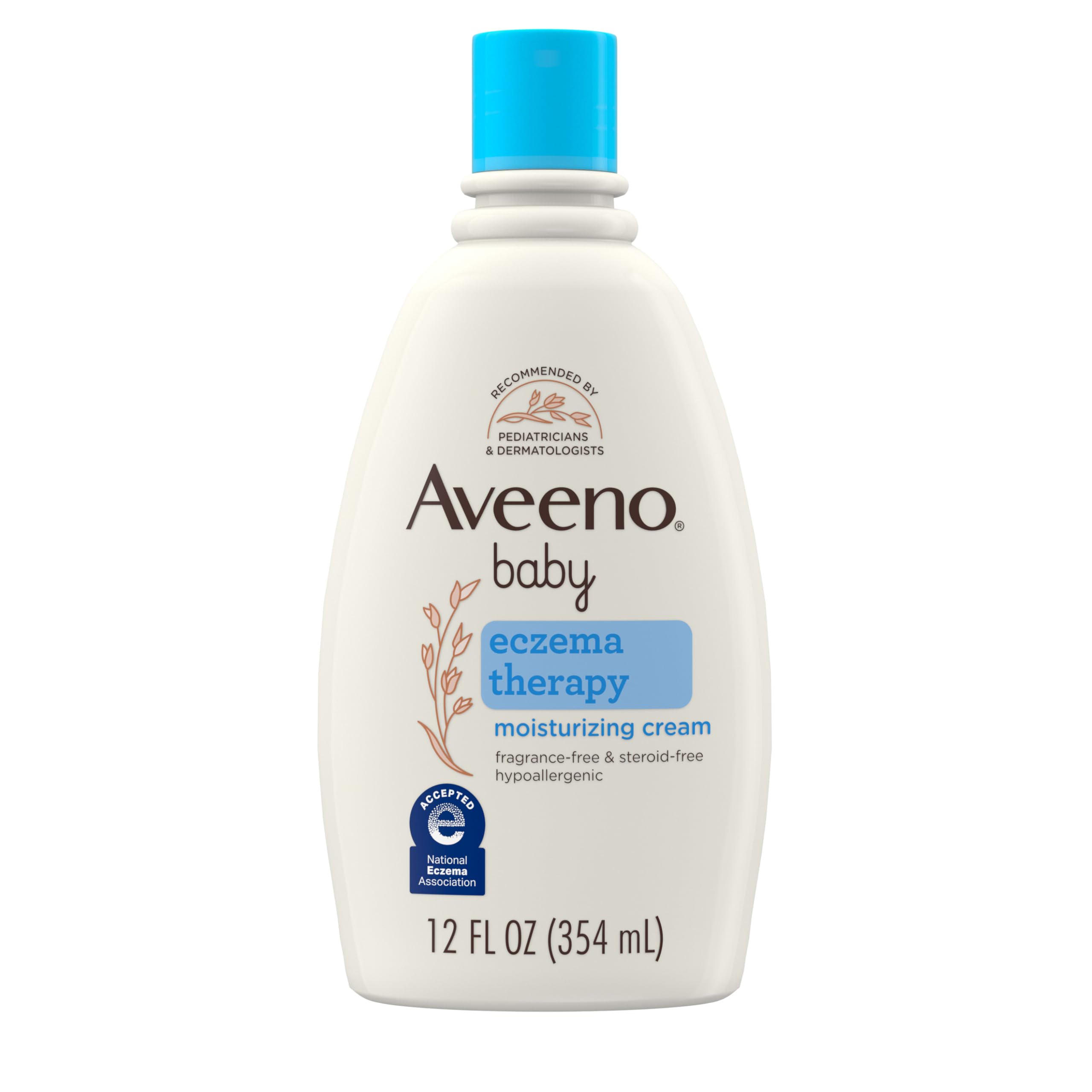
Aveeno Baby Eczema Therapy Cream

Aveeno Baby Eczema Therapy Cream

Babies and toddlers

Our Score 9.6/10
Check Price

Worth Noting

  • Lighter than a balm for very rough patches
Size
12 fl oz
Formula
Fragrance-free, steroid-free
Acceptance
NEA Seal of Acceptance
Key Ingredients
Colloidal oatmeal, vitamin B5

The real test of a baby eczema cream isn't whether it works once. It's whether you can get it on four times a day without a fight. Aveeno's baby cream is the one we hand a parent first: fragrance-free, steroid-free, pH-balanced, with colloidal oatmeal and vitamin B5, and a texture that rubs in and disappears instead of leaving a film a toddler wants to wriggle out of.

It carries the National Eczema Association Seal of Acceptance and is made without fragrances, parabens, or phenoxyethanol, which is the short list most parents are actually scanning for. Twelve fluid ounces is a real size for a baby product — enough to treat a whole small body daily without hoarding it — and it's pleasant enough on adult hands that whoever does the applying tends to keep using it.

What it isn't is the richest thing here. Very rough, thickened patches on an older child or an adult will want one of the ceramide creams. This one is built for frequent, light application on skin that's irritated rather than damaged.

Bottom line: For a baby or toddler with eczema, this is where we start: fragrance-free, steroid-free, and light enough that you'll actually reapply it all day.

5

Cetaphil Restoraderm Eczema Moisturizer

Cetaphil Restoraderm Eczema Moisturizer

Whole-body hydration

Our Score 9.4/10
Check Price

Worth Noting

  • Pump can stop dispensing before the bottle is empty
Size
16 oz
Formula
Fragrance-free, steroid-free, paraben-free
Flare-up Claim
84% noticed fewer flare-ups
Hydration Claim
48 hours

Eczema lotion disappears fastest in the houses that need it most, which is the case for a 16-ounce pump bottle. Cetaphil's Restoraderm is a lotion rather than a cream — thinner, quicker to rub in, dispensed with one hand — and that shape is why it ends up next to the bathroom sink instead of in a drawer.

We rate it highest here for whole-body daily use. The formula is fragrance-free, steroid-free, and paraben-free, and the clinical claims are specific rather than atmospheric: hydration measured at 48 hours, and 84% of users reporting fewer flare-ups over time. A lotion doesn't seal moisture in the way a balm does, but for skin that's dry and itchy rather than cracked, that's a fair trade for something you'll use twice a day without thinking about it.

It doesn't suit every eczema skin. On broken or weeping patches a lotion like this can sting, and the reaction is unpredictable enough that a small test area is worth the two minutes before you cover a whole leg.

Bottom line: Our pick for a household that goes through lotion fast: a big, fragrance-free pump bottle that's easy to use one-handed on a wet, wriggling child.

6

La Roche-Posay Lipikar Eczema Cream

La Roche-Posay Lipikar Eczema Cream

Face and hands

Our Score 9.4/10
Check Price

Worth Noting

  • Labeled from age 3, so not for babies
Labeled For
Ages 3 and up
Key Addition
Shea butter
Colloidal Oatmeal
1%

Face eczema is its own purchase. You're not covering a leg; you're treating patches around the eyes, mouth, and hands, in small amounts, several times a day — and a 16-ounce body pump is the wrong object for that job.

La Roche-Posay's Lipikar Eczema Cream is 1% colloidal oatmeal with shea butter in a thick, unscented cream, accepted by the National Eczema Association and labeled for children 3 and up. It behaves like a spot treatment: a smaller tube that lives in a bag, goes on the backs of hands and along the jaw, and doesn't demand a whole routine around it.

We keep coming back to it for the finish. Shea gives it a softer landing than the oatmeal-only creams here, so it sits under sunscreen and foundation without pilling — the reason it's our pick for face and hands rather than another body tube. The catch is reactivity: on angry skin it can burn going on, so start with one patch at the jaw before you do both cheeks.

Bottom line: This is the one we buy for face and hand eczema: a fragrance-free oatmeal-and-shea cream that layers under makeup and suits small patches.

7

Gold Bond Medicated Eczema Relief

Gold Bond Medicated Eczema Relief

Budget body care

Our Score 9.4/10
Check Price

Worth Noting

  • May need reapplying through the day
Size
8 oz
Testing
Dermatologist-tested, hypoallergenic
Also Contains
Seven moisturizers, three vitamins
Colloidal Oatmeal
2%

Two percent colloidal oatmeal is double what most of the creams here carry, and it's the figure that explains why Gold Bond's eczema lotion is on this list at all. The higher dose of the skin protectant is aimed squarely at itching, scaling, roughness, and redness, and it's paired with seven moisturizers and three vitamins.

It's an 8-ounce tube, dermatologist-tested and hypoallergenic, and it behaves like a medicated lotion rather than a cosmetic cream: soothing on itchy arms and legs, light enough for hands during the workday, and nobody's idea of a luxurious product.

Absorption is where you have to pay attention. Squeeze out a generous blob and it can sit on the surface and roll under your palm; work in a smaller amount properly and it settles down. That's a technique problem rather than a formula problem, and it's the price of a formula this rich at this size.

Our read is that this is the value pick of the set for itch and scale. The oatmeal dose does the heavy lifting, the tube is cheap enough to keep one in the kitchen and one in the car, and the plainness is part of the deal. If your eczema is raw and weeping rather than dry and flaky, start with one of the gentler creams instead.

Bottom line: Twice the colloidal oatmeal of most creams here, in a tube priced for everyday use — our value pick when itch and scaling are the main problem.

8

First Aid Beauty Ultra Repair Cream

First Aid Beauty Ultra Repair Cream

Daytime face wear

Our Score 9.2/10
Check Price

Worth Noting

  • Too light for very dry patches overnight
Formula
Fragrance-free, vegan
Texture
Whipped, fast-absorbing
Key Ingredients
Colloidal oatmeal, ceramides

Whipped is the word that matters. First Aid Beauty's Ultra Repair Cream is lighter and fluffier than anything else in this guide, and that texture is the entire reason it has a place: it goes on the face in the morning and disappears before the sunscreen does.

Underneath the airiness it's a real barrier cream — colloidal oatmeal and ceramides, fragrance-free, vegan and cruelty-free, without parabens, sulfates, or mineral oil. The brand's hydration claim is a 169% boost, which we read as evidence of a serious humectant load rather than a number to plan a routine around.

It's the cream we point to for combination skin that breaks out from rich balms, and for the face rather than the whole body. That's a narrow brief, but a common one: facial eczema is where people are most reluctant to put something heavy, and where a cream that pills or shines under makeup gets abandoned.

It's also the priciest per ounce here, and there's no getting around that — as a full-body routine it's an expensive way to moisturize. Where it earns the money is the face, in the morning, under everything else. For a lot of people with eczema on their face, that's the only application that has to work.

Bottom line: For facial eczema that has to sit under makeup, this is our choice: whipped, fragrance-free, and light enough to forget by mid-morning.

How We Chose and Tested the Best Eczema Creams

We started with the ingredient lists that keep coming up in dermatology offices — colloidal oatmeal, ceramides, glycerin, and in one case 1% hydrocortisone — then narrowed by price, size, and whether the label actually promised fragrance-free. Anything heavily perfumed or built around drying alcohol got cut before it reached a tester. That left 12 creams, which we lived with for six months across a range of skin: my own flaky hands, a colleague's flare-prone arms, and a tester whose toddler gets patches behind the knees.

Testing happened where eczema actually happens. Each cream got a turn in the first three minutes after a shower, on damp skin, and we noted whether it sank in or sat on top; ten minutes later we pressed a black T-shirt against the tester's forearm to see what transferred. The thicker ones went on at bedtime under cotton gloves, and we checked in the morning whether skin still felt cushioned or had dried back out. On cracked knuckles and elbow creases we watched for stinging, and every formula sat on an inner-forearm patch for 24 hours to see how sensitive skin reacted.

For itch, testers rated how long relief lasted rather than how it felt in the first minute — some creams calm a flare for an hour, others carry you through to morning. We tracked how many pumps or scoops a week of daily use ate through, then divided that by the price to get an honest sense of value, since a jumbo tub that needs four reapplications a day is no bargain. The ones that are still on our shelves after six months are the ones that kept skin comfortable without constant topping up.

How to Choose an Eczema Cream

Decide Which Job You're Buying For

Almost every product here does one of three jobs: everyday barrier maintenance, fast itch relief, or short-term flare treatment. Maintenance means a steroid-free oatmeal or ceramide cream applied generously all over, twice a day, whether or not the skin looks bad that morning. Flare treatment means 1% hydrocortisone, used as its label directs for a defined stretch.

The common mistake is buying the flare product and using it as the daily cream, because it works fastest. Keep them separate. A flare tool plus a big tube of maintenance cream costs less between them than one premium cream trying to do both jobs badly.

Learn the Three Actives

Colloidal oatmeal is the skin protectant in most eczema creams, and the percentage is on the label: 1% is the standard dose, 2% is the strongest here. Ceramides, niacinamide, and shea butter are support — barrier lipids and humectants rather than drugs. Pramoxine hydrochloride at 1% is an itch-specific analgesic. Hydrocortisone at 1% is the strongest steroid sold without a prescription.

Match the active to the symptom: oatmeal for skin that's dry, tight, and flaky; pramoxine when scratching is what's wrecking sleep; hydrocortisone when a patch is inflamed and won't settle.

Texture Decides Whether You Actually Use It

A rich balm feels wonderful on a cracked heel and terrible under tights. A fast-absorbing cream is less occlusive but gets applied four times a day, which is worth more than a superior formula sitting unused in a drawer.

Think about when and where. A whipped cream for the morning face, a lotion for hands through the workday, something heavier overnight. If you're buying one cream for a child, choose the one that rubs in fastest — the best formula available is useless if application turns into a wrestling match.

Size and Packaging Beat Price per Tube

Compare cost per ounce, not cost per package. An adult all-over application takes somewhere around 30 to 40 grams, so the 14- and 16-ounce sizes here are the economical ones for daily body use, while a 3- or 4-ounce tube is for a bag, a desk, or one stubborn patch.

A pump is easier one-handed; a tube travels better and gives you more control over the dose. Buy the big one for the bathroom and a small one for everywhere else rather than making a single package do both.

Fragrance, Age Limits, and Patch Testing

Fragrance is the most avoidable irritant in a cream, and every pick here is fragrance-free — what you smell in a fragrance-free product is usually just the base ingredients. Age limits matter too: some formulas are labeled for babies, others from age 3 and up.

Whatever you buy, test it on a small area first, the inside of the forearm for a day or one patch at the jaw for a face cream. Sore, weeping skin reacts to things it tolerates when calm, so a flare is the worst time to try something new over a large area.

Frequently Asked Questions

Final Verdict

Our default is Eucerin's Eczema Relief Cream: a big, fragrance-free oatmeal-and-ceramide tube that makes twice-daily all-over application affordable, which is what most eczema routines actually need. If itch is what's driving you mad, add CeraVe's itch cream with pramoxine; if a patch is inflamed and won't settle, Cortizone-10's 1% hydrocortisone is the short-term tool. For a baby or toddler, start with Aveeno's baby cream.