Bags & Accessories

Best Cycling Gloves for Women of 2026

A cycling glove's entire job happens in a palm-sized patch of material: gel or foam where the bar pushes back, a grippy surface that holds when the road turns rough, and a cuff that stays exactly where you pulled it. Skimp on that patch and you feel it around mile fifteen — hot spots at the heel of the hand, buzzing fingers, a seam bunched under your grip. A good pair makes the bar disappear from your awareness, and that's really the whole point.

I've worn gloves that felt like a second skin for an hour and then turned into a wet rag in July heat, and pairs that were toasty and windproof in October but unbearable by May, so the season you ride matters as much as the padding does. Over six months, my team and I rode in 14 pairs, half-finger and full, and the differences in fit, padding placement, and warmth showed up within a few rides. What follows are the ones that earned a permanent spot in the glove drawer.

1

HTZPLOO Half-Finger Cycling Gloves

Top Pick
HTZPLOO Half-Finger Cycling Gloves

Everyday road riding

Our Score 9.4/10
Check Price

Worth Noting

  • Hand wash only, no machine cycle
Care
Hand wash only
Removal
Finger pull loops
Finger Style
Half-finger
Palm Padding
Silicone gel

The small end of the size range is where women's cycling gloves usually fail, so that's the first thing we checked. On the HTZPLOO, a small is cut small — it closes around the knuckles instead of swimming past them — and the hook-and-loop strap takes up whatever slack is left at the wrist. Put that together with silicone gel under the heel of the palm and you have the glove we point most riders to first.

The padding earns its keep on longer rides. Silicone gel runs across the palm where the bar sits, and it's dense enough to take the buzz out of coarse pavement without bunching when you wrap your fingers around the hoods. The back is a soft Lycra that moves with your knuckles rather than against them, and at just over two ounces the glove disappears once you're moving.

Grip comes from the gel itself rather than a printed pattern, which we prefer — it stays tacky when your palms are damp instead of going slick the way some silicone prints do. Removal is handled by loops between the fingers; catch one with the opposite hand and the glove peels off without turning inside out.

What you give up is convenience at the sink: hand wash only, no machine cycle. It's also the most expensive half-finger glove in this group, and the gap between its padding and the budget Tanluhu's is real but not enormous. What the extra buys is the fit, the strap, and a two-year manufacturer warranty — a fair trade for a glove that sees three seasons a year.

Bottom line: We recommend this pair to most women riders: a small that fits like a small, gel where a bar presses, and loops that end the sweaty-glove struggle.

2

LuxoBike Half-Finger Bike Gloves

LuxoBike Half-Finger Bike Gloves

Indoor and flat-bar

Our Score 9.4/10
Check Price

Worth Noting

  • Too little cushion for long rough-road rides
Removal
Finger pull loops
Finger Style
Half-finger
Palm Padding
Gel cushioning

Not every rider wants a cushion under the palm. If you've felt a thick gel pad rotate under your grip halfway through a ride, you know why: protection on rough tarmac can get in the way everywhere else. The LuxoBike goes the other direction, with a thin gel layer that reads more like a bar-tape upgrade than a shock absorber.

We prefer them for indoor trainer sessions and flat-bar commuting, where the glove's job is to stop your hands sliding on a sweaty grip rather than to soak up hours of vibration. The finger loops work the same way as on the pricier pairs here — they sit between the fingers and pull the glove off cleanly — and the fit is close enough through the knuckles that nothing bunches when you brake.

Sizing runs snug, so if you're at the top of a range, take the next size up; that's the one thing to get right before ordering. They're also the pair in this group sold on the women's side of the cycling shelf, which tells you something about how the sizing was drawn. Long road days on chipped pavement are where the cushioning runs out — that's the trade for the bar feel.

Bottom line: We keep these for riders who want almost no padding under the palm: light gel, a close fit, and loops that come off cleanly.

3

MOREOK Half-Finger Gel Gloves

MOREOK Half-Finger Gel Gloves

Hot-weather rides

Our Score 9.2/10
Check Price

Worth Noting

  • Runs large; order by measured palm size
Removal
Middle-finger pull tabs
Palm Grip
Anti-slip
Finger Style
Half-finger
Palm Padding
5 mm gel

Heat is what kills grip. A sweaty palm slides on a taped bar or a rubber grip, the instinct is to hold tighter, and that's the wrong answer over a long ride. The MOREOK meets the problem head-on with 5 mm of gel across the palm, an anti-slip surface over it, and pull tabs on the middle fingers so a wet glove comes off with one tug.

The back panel is thin and mesh-backed, so air moves through it instead of sitting under the Lycra. That's the difference you notice in July: not that the padding is better than the top pick's, but that your hands run cooler underneath it, and the pull tabs are less fiddly than loops when your fingers are slick.

We rate these the best hot-weather glove in this set for exactly that reason. On long rides the thicker gel holds up better than the thin LuxoBike pad on coarse pavement, and the palm stays planted while you sweat. What they don't have is the close, second-skin fit of the HTZPLOO — these feel like a glove on your hand rather than a layer of it.

Bottom line: We hand these to anyone riding in real heat: 5 mm of gel, a mesh back that lets warmth out, and an anti-slip palm.

4

Tanluhu Half-Finger Cycling Gloves

Tanluhu Half-Finger Cycling Gloves

First pair

Our Score 9.2/10
Check Price

Worth Noting

  • Thin padding, especially at the thumb
Removal
Finger pull loops
Finger Style
Half-finger
Palm Padding
Shock-absorbing cushioning

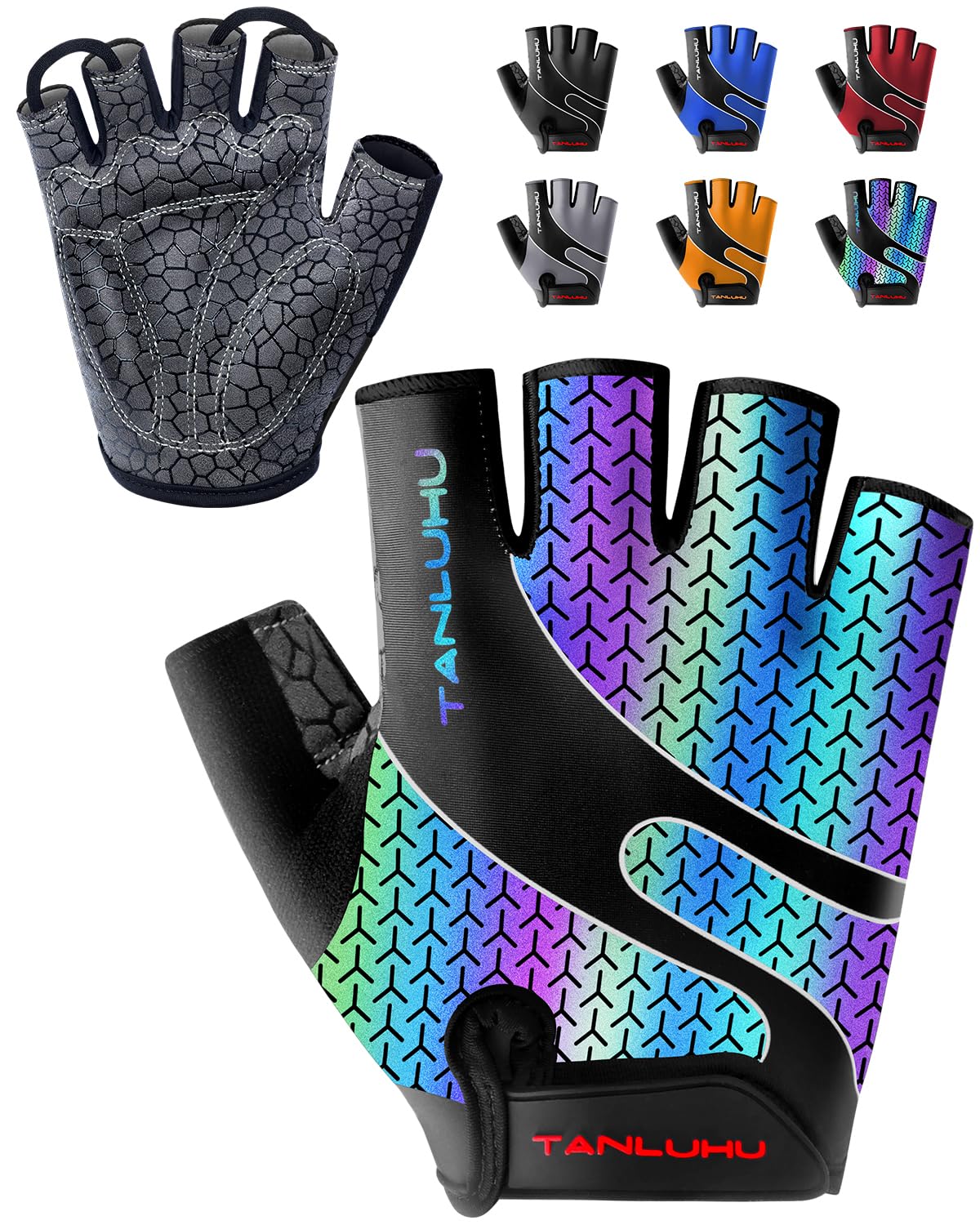
Loops, gel, a wrist strap — the basics of a decent half-finger glove are not expensive to make, and the Tanluhu proves it. It's the least expensive glove in this group and still covers everything the pricier picks do at a basic level, which is why it's the value pick.

The cushioning is softer and thinner than the gel on the top pick or the MOREOK, which gives you more bar feel and less bulk under the hand. That suits flat bars more than drop bars — road buzz through a narrow bar wants a denser pad — and the thumb is the least padded part of the palm.

What we appreciate beyond the price is the shape: the back is smooth and unpadded so it doesn't bunch, the fingers run true to the chart, and the colors are livelier than the usual black. For a first pair, a spare, or a bike that lives locked up outside, that's exactly the calculation you want.

Bottom line: We point budget-minded riders here: real loops, real padding, and the lowest price in this group.

5

Tanluhu Full-Finger Cycling Gloves

Tanluhu Full-Finger Cycling Gloves

Cool morning riding

Our Score 9.0/10
Check Price

Worth Noting

  • Runs small; size up from your usual
  • Touchscreen tips don't always register
Touchscreen
Touchscreen fingertips
Finger Style
Full-finger
Palm Padding
Shock-absorbing padding

There's a stretch in the autumn when a half-finger glove stops being enough and a winter glove is still overkill. These full-finger Tanluhu gloves fill exactly that gap: thin fabric, shock padding across the palm, and the same pull loops as the half-finger pair.

We keep a pair of these for shoulder-season commuting and gravel rides, where the point is covering the back of your hand in case you go down without cooking it the rest of the way. The fabric is thin enough to fold into a jersey pocket when the sun comes out, and the loops make them as easy to strip off as the half-finger picks.

Warmth is the limit. There's no lining and no windproofing, so these are a cool-morning glove and nothing more — once the temperature drops toward freezing your fingers will know about it. If your winters are properly cold, you want a dedicated winter glove with a windproof shell rather than either full-finger pair here.

Bottom line: Our pick when mornings turn cool: full-finger coverage and a thin build you can fold into a pocket.

6

Lamicall Bike and Workout Gloves

Lamicall Bike and Workout Gloves

Gym and commute

Our Score 9.2/10
Check Price

Worth Noting

  • Sizing runs roomy against the chart
Closure
Hook and loop
Palm Grip
Silicone strips
Back Panel
Mesh and Lycra
Palm Padding
5 mm foam

The terry patch on the thumb is the detail that made us look twice. It's there for wiping a brow or a runny nose without stopping, and it's the kind of small thing that separates a glove designed for riding from a glove designed for a spec sheet.

Underneath, the padding is 5 mm of foam rather than gel, backed with silicone strips, and the back is mesh and Lycra. That build is why the maker sells them for lifting and rowing as well as cycling: the palm is grippy and cushioned in a way that works on a knurled bar or a handle, not just a set of hoods.

Construction is the other thing worth noting, since a cheap multi-sport glove usually gives up at the seams. Double stitching and a reinforced palm are the right signs, and the padding isn't so thick that the joins take a beating every time you close your hand.

So where do they fit? As a second pair: affordable enough to live in a gym bag, padded enough for a flat-bar commute, and not so precious that a scuff matters. We rank them below the cycling-specific picks for pure road use, but for a rider splitting time between a bike and a weight bench, they make more sense than a glove that does only one job.

Bottom line: A good second pair for riders who also lift or row, with a terry thumb we appreciate more than we expected to.

7

Hikenture Winter Cycling Gloves

Hikenture Winter Cycling Gloves

Cold commutes

Our Score 8.8/10
Check Price

Worth Noting

  • Warmth runs out near freezing
  • Touchscreen tips work only intermittently
Fit
Stretch fabric
Style
Full-finger thermal
Touchscreen
Touchscreen fingertips

Cold-weather cycling gloves live or die on a narrow band of temperature. This pair leans into the middle of that band: a thermal lining, full fingers, and a zip at the cuff you can open when you're climbing and close again on the descent.

The stretch in the fabric is what makes the fit forgiving across hand sizes, and there's enough room inside for a thin liner if your hands run cold. The cuff zip earns its place on a climb, when the last thing you want is to stop and pull a glove off with your teeth.

We like these for the commute and the school run rather than for a winter century. On a short, cold ride they take the sting out of the wind and the lining is genuinely soft against the hand; on a long one the cold eventually wins. For a three-season rider who wants one glove for the chilly ends of the day, that's a reasonable trade.

Bottom line: We like these for cold commutes rather than deep winter: a thermal lining, full fingers, and a cuff you can open on the climb.

How We Tested 14 Pairs of Cycling Gloves

We started by sorting through what's actually sold as a women's cycling glove rather than a shrunken unisex version, and cut anything with no padding or a single one-size-fits-all option. From there we ordered 14 pairs, spanning thin half-fingers to thermal full-finger gloves, and rode in each one for at least a week across six months.

Most of the riding happened on my daily commute and weekend gravel loops, with a handful of rainy descents and one memorably cold 6 a.m. start thrown in to see how wind resistance and warmth held up. I noted where the gel actually sat — padding under the heel of the hand does something, padding in the middle of the palm does almost nothing — whether it migrated while I gripped the hoods, and how much bar feel survived the padding.

Fit got its own pass: I measured my hand, compared it to each size chart, then rode with the closure cinched as tight as it would go to see if the cuff crept. I timed how fast each pair came on with sweaty hands, since pull tabs and loops matter more than they sound, and tapped out texts and map checks mid-ride to test touchscreen accuracy. After a month, every pair got washed and inspected for loose stitching or bunched gel, and at the end I weighed what the extra dollars actually bought — usually better seam placement, not more padding.

How to Choose Cycling Gloves for Women

Fit First, and Don't Trust the Word Women's

A lot of gloves sold as women's are the same pattern in a smaller size and a different color, so the size chart tells you more than the label does. Measure around the widest part of your dominant hand, just below the knuckles, and match that number to the maker's chart rather than to your street-glove size.

Expect a snug first fit. Fabric gives a little with sweat and use, and the hook-and-loop strap is there to take up the rest at the wrist. If you land between sizes, go with the smaller one provided the fingers still reach the ends and the strap closes: a loose palm lets the padding slide off the pressure point it was made for.

Padding: Placement Beats Thickness

More padding is not automatically more comfort. What matters is whether the gel or foam sits under the parts of your hand that actually rest on the bar: the heel of the palm and the outer edge for drop bars, more of the whole palm for flat bars and mountain bikes.

A glove padded straight across the middle can bunch under your grip and press on the nerve that causes numb fingers, which is the opposite of the point. A well-placed 5 mm pad beats a thicker one placed badly. Before you order, rest your hand on your own grip and notice where the pressure lands.

Half-Finger or Full-Finger

Half-finger gloves are the summer default: cooler, more bar feel, and you can work a phone or open a snack without taking them off. Full-finger gloves cover the whole hand for gravel and mountain terrain where you might go down, and they stretch the season at both ends.

The trap with full-finger gloves is touchscreen accuracy. The conductive tips are usually there, but the contact patch is small and the results are mixed across every pair here, so treat phone compatibility as a bonus rather than the reason to buy. Choose full fingers for coverage and warmth, not for texting.

Getting Them Off With Sweaty Hands

The most underrated feature in this whole category is a pair of pull loops between the fingers. Once your hands are wet, a glove with no loop has to be peeled off finger by finger and usually ends up inside out, with the gel pad creased and the seam strained.

Loops cost nothing to add and save you a small fight twice a day. Check the closure strap too: a short strap on a small glove leaves a loose cuff that rides up your wrist mid-ride, which is the complaint that turns a good glove into one you stop wearing.

Care and How Long They Last

Sweat and sun wear out cycling gloves faster than crashes do. The palm pads are glued or stitched in, and the join between pad and fabric is the first thing to fail, especially if the glove goes through a machine cycle. Several pairs here ask for hand washing; follow that, and dry them flat rather than on a radiator.

If you ride most days, expect to replace a pair every season or two and buy a second so one can dry while the other is on the bike. Salt left in the fabric quietly eats the stitching, which is why a rinsed glove outlasts a neglected one by a wide margin.

Frequently Asked Questions

Final Verdict

Start with the HTZPLOO. It's the pair we put on most women's hands, because the sizing is honest at the small end, the gel sits where a bar actually presses, and the loops mean you aren't wrestling with a sweaty glove at a traffic light.

The rest depends on where you ride. Indoor sessions and a preference for bar feel point to the LuxoBike; real summer heat points to the MOREOK; cool mornings point to the full-finger Tanluhu. If you want a spare to live in a bag, the budget Tanluhu half-finger covers the basics for the least money in this group.