Skincare

Best Chemical Peels of 2026

A chemical peel can leave your skin looking like you just got back from a long weekend — or like you lost a fight with a hot pan. The difference usually isn't the acid itself so much as the concentration, the pH, and how long you leave it on. I found that out the hard way with a glycolic pad I left on too long; my cheeks stayed pink for three days and I avoided acids for a solid year afterward. Done right, an at-home peel does what no scrub can: it lifts the dull, rough dead cells, softens the look of pores, and leaves skin feeling genuinely smooth instead of scrubbed raw.

Over the past eight months, we've put 14 formulas through real routines — leave-on liquids, rinse-off masks, pre-soaked pads, overnight treatments. The ones worth keeping were gentle enough to use weekly without stinging, moisturizing enough that skin didn't feel tight afterward, and light on fragrance. Cost per use mattered too, since a bottle that lasts four months beats a five-pack you burn through in a week. The picks below are the ones that survived all of it.

1

Paula's Choice 2% BHA Liquid Exfoliant

Top Pick
Paula's Choice 2% BHA Liquid Exfoliant

Daily pore care

Our Score 9.0/10
Check Price

Worth Noting

  • Can leave skin tight without moisturizer
  • Costs more than the budget acids here
Use
Daily
Scent
Fragrance-free
Format
Leave-on liquid
Key Acid
2% BHA (salicylic acid)

This is the bottle we hand people first, and the one that tends to stay in the routine longest. Paula's Choice's 2% BHA is a watery, fragrance-free liquid you swipe on with a cotton pad after cleansing — no timer, no rinsing, no burn to brace for, and nothing to remember except to do it again tomorrow.

That lack of ceremony is the recommendation. Salicylic acid is oil-soluble, so it works inside the pore rather than across the surface, which is what you want for blackheads on the nose, congestion along the jaw, and the rough patch that never quite clears. Over several weeks of nightly use, the change was gradual and cumulative: texture smoothed, shine settled, and nothing peeled. Of everything here, it's the one that fits an existing routine instead of replacing it.

There's one caveat worth planning for. If your barrier is already compromised by retinol, cold weather, or too much sun, this is the product here most likely to sting, and that's a signal to pause for a week rather than push through — reactive skin should start with the lactic serum below instead. Everyone else can treat it as the default, and it's the bottle we restock without thinking about.

Bottom line: We recommend it to almost anyone starting an acid routine: a fragrance-free 2% BHA that goes on like water and works on pores without any timing or rinsing.

2

The Ordinary AHA 30% + BHA 2% Peeling Solution

The Ordinary AHA 30% + BHA 2% Peeling Solution

Weekly resurfacing

Our Score 9.2/10
Check Price

Worth Noting

  • Not for sensitive or broken skin
  • Prickle can tip into stinging
Use
Once or twice a week
Format
Rinse-off liquid
Key Acids
30% AHA + 2% BHA
Leave-on Time
10 minutes

The label is refreshingly blunt: 30% AHA, 2% BHA, ten minutes, once or twice a week, not for sensitive or broken skin. That's a resurfacing treatment rather than a nightly maintenance product, and it's the pick we reach for when skin needs a reset rather than a top-up — the closest thing here to the tingle and glow of a professional peel, and the least expensive way to get it.

The liquid is thin and blood-red, which sounds gimmicky until you use it: you can see exactly where it went, and the hairline and the creases beside the nose are where people overdo it. Ten minutes is enough to feel a prickle build. The mistake is leaving it on while you answer an email. We set a timer, rinsed at ten, and got the payoff the next morning — skin smoother to the touch, brighter, and noticeably more receptive to moisturizer.

It is not a beginner's product, and the label says so plainly. If you flush easily, use retinol, or have never put an acid on your face, start with the lactic serum instead and come back to this in a few months. For anyone already comfortable with acids who wants one strong treatment a week, this is the best value in the guide.

Bottom line: The one we reach for after a rough skin week: ten minutes, a real tingle, and a next-morning reset, for people who've used acids before.

3

The Ordinary Lactic Acid 10% + HA

The Ordinary Lactic Acid 10% + HA

First acid routine

Our Score 9.2/10
Check Price

Worth Noting

  • Milder resurfacing than a rinse-off peel
  • One-ounce bottle empties quickly if used nightly
Use
Once daily at night
Format
Leave-on serum
Key Acid
10% lactic acid
Also Contains
Hyaluronic acid, Tasmanian pepperberry

Same brand, opposite temperament. Where the peeling solution above is a ten-minute event with a timer, this is a few drops at night that you follow with moisturizer and forget about.

Lactic acid is a larger molecule than glycolic, which generally means it works closer to the surface and stings less, and at 10% with hyaluronic acid and Tasmanian pepperberry in the formula it's the gentlest leave-on here. The dropper gives you a precise dose, so a small bottle lasts longer than you'd guess from its size.

In nightly use over a few weeks it did the quiet things well: rough patches around the nose softened and foundation sat better across the cheeks. It won't give you the one-morning transformation of the stronger peel — nothing at this strength will — but there was no sting for us to brace for and no peeling, and that's the trade we prefer for skin that complains about everything.

Bottom line: Start here if your skin has never met an acid: nightly lactic that smooths without the sting, the peeling, or the timer.

4

Prequel Multi Acid Milk Peel

Prequel Multi Acid Milk Peel

Face and body

Our Score 9.2/10
Check Price

Worth Noting

  • Label excludes sensitive skin and under-18 users
  • High acid load for a leave-on
Use
Start 1–2 times a week
Size
7.6 oz
Format
Leave-on milk
Key Acids
15% glycolic, phytic, malic, mandelic, and lactic acids

The bottle is the first thing you notice: 7.6 ounces of milky liquid, the largest format here by a wide margin, and it changes how you use the product. This isn't something you ration onto a cotton pad and save for your face at night. It's the one you can afford to sweep down your neck and chest and across the backs of your arms.

The formula is a 15% glycolic blend with phytic, malic, mandelic, and lactic acids, cushioned with squalane and botanicals so it spreads like a light lotion rather than a toner. It dries down in about a minute and needs no rinsing. Drops rather than a pad mean you set the dose — a thin pass when you're starting, more once you know how your skin answers.

The label is the strictest here: patch test first, not for diagnosed skin conditions, not for sensitive skin, not for anyone under 18. That's fair, because 15% glycolic in something this comfortable is exactly the kind of product people over-apply. Once or twice a week is the honest starting point, and it's plenty.

What we appreciate most is the honesty of the format. Nothing about the texture announces that it's working, so the discipline has to come from you — and in exchange you get a peel that covers ground no other bottle here can, at a cost per use that undercuts the pads. If your texture problems run past your jawline, this is the one.

Bottom line: The face-and-body pick — the largest bottle here turns an acid routine into something you can afford to use past your jawline.

5

Dr. Dennis Gross Alpha Beta Daily Peel

Dr. Dennis Gross Alpha Beta Daily Peel

Event-week glow

Our Score 9.0/10
Check Price

Worth Noting

  • Only five treatments per pack
  • Steepest cost per treatment here
Format
Two-step pads
Step 2
12 antioxidants
Key Acids
Five alpha beta acids (step 1)
Treatments
5

Two pads, two minutes apart, and a reason for both. Step one is a blend of five alpha beta acids that loosens dead surface cells; step two is a pad of 12 antioxidants that neutralizes the acids and puts something back. That second step is the whole idea, and it's what makes this the most foolproof thing in the guide — the product stops the reaction for you, so there's no clock to watch and no rinse to get right.

We used it the night before a day that involved a camera, and the difference shows up by morning: skin looks brighter and more even, and makeup sits better over it. There's a light sting on the first pad that fades before the second, and no peeling afterward, which is not something we can say for every acid here.

Five treatments is a taste, not a routine — at the recommended daily pace a pack is gone in under a week, and the per-use cost is the steepest in this guide. Buy it for occasions rather than habit. As occasion skincare it earns its place, and it's the one we'd pack rather than decant a bottle.

Bottom line: For the week before anything with a camera in it: two pads, no clock, and skin that behaves by morning.

6

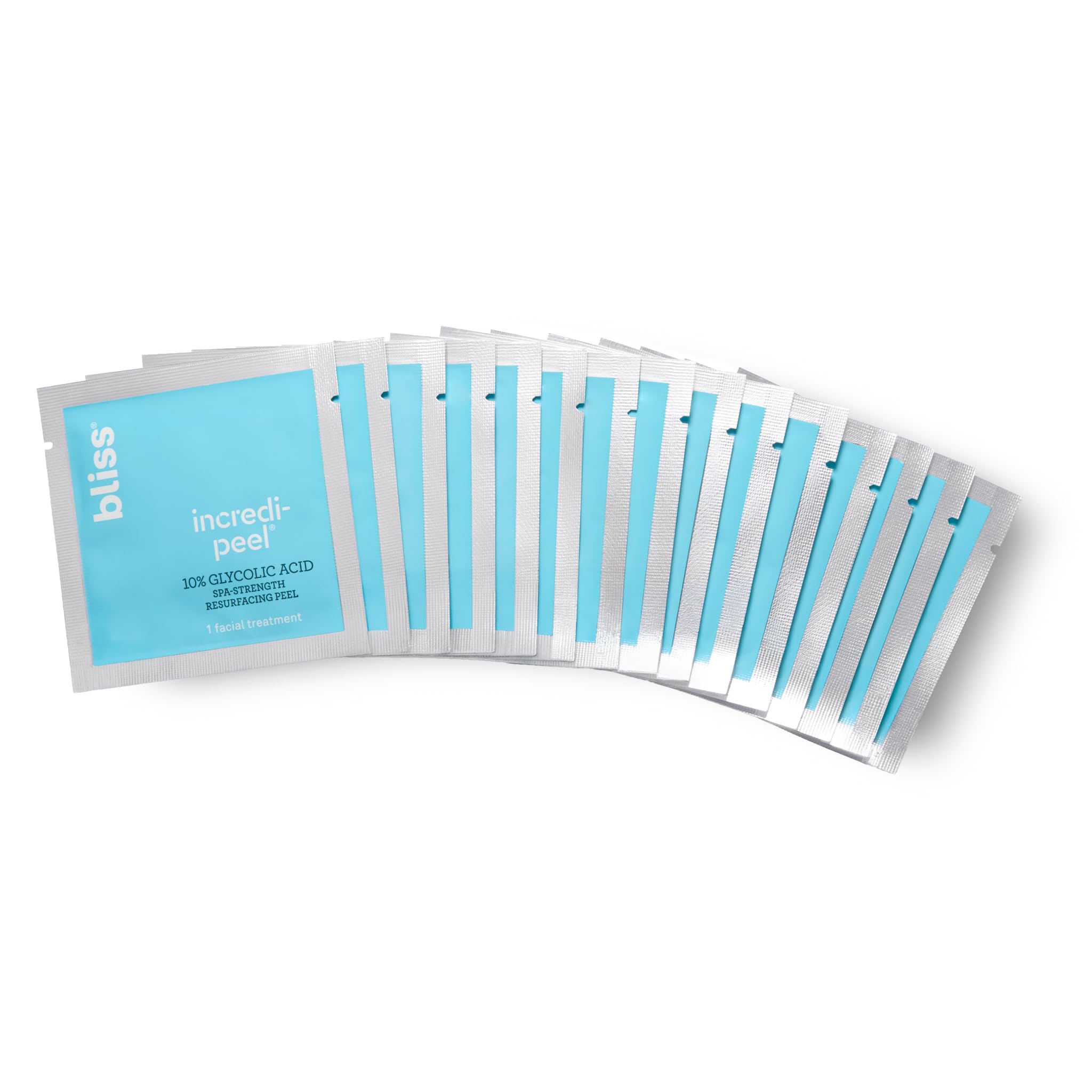
Bliss Incredi-Peel Pads

Bliss Incredi-Peel Pads

Overnight no-rinse

Our Score 9.0/10
Check Price

Worth Noting

  • Only 15 single-use pads per box
  • Results build over weeks, not overnight
Count
15 single-use pads
Scent
Fragrance-free
Format
Leave-on pad, no rinse
Key Acid
Time-released glycolic acid

Most peels ask you to stand at the sink and watch the clock. This one asks you to go to bed. Bliss's pads are soaked with time-released glycolic acid and designed to stay on overnight, with no rinsing step at all — swipe, wait for it to dry, moisturizer, sleep.

Mornings after were the tell: skin felt smoother and looked more even, with none of the tightness we half expected from an acid left on all night. The pads are wet enough that we cut them in half and got two nights out of each, which turns a 15-pad box into something closer to a month of use.

It's fragrance-free and built for two to three nights a week, so it slots into a routine you already have rather than demanding a new one — the reason it stayed in our weeknight rotation after the novelty wore off. For a fast reset before an event, take the two-step pack instead; this is the one for people who want the habit handled.

Bottom line: Swipe it on, go to bed, rinse nothing — time-released glycolic that does the work while you sleep.

7

SilkyShark 10% Glycolic Acid Pads

SilkyShark 10% Glycolic Acid Pads

Budget pad routine

Our Score 9.0/10
Check Price

Worth Noting

  • Milder, slower than a rinse-off peel
Count
60 pads
Extras
Allantoin, green tea, calendula, vitamins C and E
Format
Pre-soaked textured pads
Key Acids
Glycolic (AHA) + salicylic (BHA)

Two sides, one job. The textured face gives you a light physical sweep to go with the glycolic and salicylic acid; the smooth side is for the second pass over cheeks and neck. It's a small thing that makes a jar of 60 pads feel like a tool rather than a wipe.

What surprised us is how calm they are. Glycolic plus salicylic can bite, but these are buffered with allantoin, green tea, and calendula, and we didn't come away pink. Among the pads here, this is the one we point to for skin that reacts to everything.

The catch is pace. Sixty pads at two or three nights a week is months of use, and the changes arrive accordingly — this smooths and brightens over time rather than delivering the ten-minute glow of a rinse-off peel. What you get, for the least money of any pad here, is a routine you can keep up without thinking and a jar that outlasts everything else on the shelf.

Bottom line: Months of gentle, textured pads for less than any other pad here — the easiest acid habit to keep.

8

Good Molecules Overnight Exfoliating Treatment

Good Molecules Overnight Exfoliating Treatment

Cheap nightly upkeep

Our Score 9.2/10
Check Price

Worth Noting

  • Can't be layered with other acids or retinoids
  • Thin texture is easy to over-pour
Use
Up to 3 nights a week
Scent
Fragrance-free
Format
Leave-on overnight liquid
Key Acids
AHA + BHA

If you want to know whether a leave-on acid suits your skin before committing to a bigger bottle, this is the one to find out with. It's the least expensive thing in this guide, and it's a proper AHA and BHA overnight treatment rather than a sample sachet.

The routine is simple: three nights a week at most, on clean dry skin, no rinsing. The label is firm about not layering it with other acids or retinoids, which is worth honoring — we kept everything else plain (cleanser, moisturizer, SPF) and let this do the work.

It's thin and slightly runny, so a few drops covers the face and the bottle goes further than the size suggests. Mornings after were the tell: clearer, smoother skin without the tightness we half expected from something left on overnight.

What it won't do is resurface the way a rinse-off peel does; this is maintenance, not a treatment. What it will do is keep texture and shine in check three nights a week for less than any other leave-on here, which makes it the sensible first bottle for anyone testing the water.

Bottom line: The cheapest way to find out whether a leave-on acid agrees with your skin.

How We Tested At-Home Peels on Real Skin

We started by pulling together roughly 40 formulas from brands we already trusted and ones readers keep asking about, then cut the list by acid type and strength, whether the percentage was actually printed on the label, pH, scent, and cost per ounce. Anything that hid its concentration or leaned hard on alcohol and perfume didn't make it to testing.

Each of the 14 finalists went home with a tester who used it on their own face for at least six weeks. Everyone patch-tested behind the ear and along the jaw for two nights before going full-face, then applied at night — timing leave-on liquids to the minute, rinsing the rinse-off masks exactly when the instructions said, and taking a photo under the same bathroom light every Sunday.

We wrote down what actually happened: a tingle that faded within a minute versus a burn that made us rinse early, how pores looked on day three versus day ten, whether skin felt comfortable or tight an hour later, and whether anyone flaked or flushed the next morning. Gentleness was the gate — a peel that delivered one great night and a raw barrier the following week was out, no matter how good the photos looked.

Because peels are a long game, we also counted how many uses each container really gave us and how cleanly each one came off, whether that meant a rinse, a peel-away film, or a quick swipe before bed. Fragrance got noted too; a couple of formulas smelled strongly enough of vinegar or perfume that we docked them.

How to Choose an At-Home Chemical Peel

Start with the acid, not the strength

Two families do most of the work. AHAs — glycolic, lactic, mandelic — act at the surface, where dullness, uneven tone, and rough texture live. BHAs, meaning salicylic acid, are oil-soluble and get inside the pore, so they're the better tool for blackheads, congestion, and an oily T-zone. Within the AHAs, lactic is the gentler starting point and glycolic the more aggressive at the same percentage.

If pores are the complaint, begin with a 2% BHA like our top pick. If it's texture and glow, a 10% lactic is a kinder first step than any rinse-off peel.

Match the format to your margin for error

Rinse-off peels give you a clock and a hard stop: ten minutes, then wash. Leave-on liquids, serums, and milks keep working until you next wash your face, which suits daily low-dose use and punishes anyone who forgets what they've already applied. Pads fix the dose for you, which is why they travel well and why they're hard to dial back when your skin is struggling.

One trap worth knowing: a soaked pad controls how much liquid you use, not how strong it is. You can't halve the concentration by dabbing lightly.

Percentages don't compare across products

Thirty percent AHA in a rinse-off you wear for ten minutes and 30% in something that stays on all night are different propositions, and the number alone tells you very little. How much acid is actually free to work depends on the formula and its pH, and most listings don't state it. Judge by format, contact time, and the instructions instead.

A product that won't tell you how long to leave it on, or how often to use it, is one to skip.

Buy the aftercare at the same time

Exfoliated skin is more sun-sensitive and every label here says so, which makes a broad-spectrum SPF you'll actually wear part of the purchase rather than an optional extra. Don't stack a new acid with retinol, vitamin C, or another exfoliant in the same routine: introduce one thing, give it a few weeks, then decide.

Moisturizer after every use, especially with the BHA and the stronger rinses. A brief sting that fades is information; one that builds is a reason to rinse.

Frequently Asked Questions

Final Verdict

Our default is Paula's Choice 2% BHA. It's the one we hand to a friend who wants clearer pores and smoother texture with the least chance of a bad night: no timing, no rinsing, and skin that tolerates it nightly.

If you want an actual peel — the tingle, the ten minutes, the next-morning reset — The Ordinary's AHA 30% + BHA 2% is the one to buy, provided you've used acids before. And if your skin flushes at everything, start with the lactic serum and work up from there.