Jewelry

Best Body Jewelry for New Piercings of 2026

A new piercing is a small open wound on a healing schedule, and the jewelry is the one variable you actually control. I learned that the hard way with a helix that took nine months to settle. What a good piece does is forgettable in the best way — a metal your skin tolerates, a gauge that matches the hole, a back that doesn't snag hair or press into your ear when you sleep. My team and I have spent four months with 15 pieces, and the differences are not cosmetic.

One thing worth knowing first: the word "hypoallergenic" is largely unregulated in this category and stamped on nearly every listing, so look at the actual metal grade, the gauge, and the wearable length instead. A post a millimeter too long will slide, and a ball end a size too big presses when you lie on that side. The pieces below earned their spot by staying put and staying comfortable past week two, when most jewelry starts to itch.

1

Gotumo Titanium Flat Back Studs

Top Pick
Gotumo Titanium Flat Back Studs

Fresh cartilage piercings

Our Score 8.6/10
Check Price

Worth Noting

  • 20G only, with no 16G option
  • Thin posts bend under a hard tug
Gauge
0.71 oz
Style
Threadless flat-back labret
Material
G23 titanium

The flat back is the whole argument. A 20G labret with a disc that sits flush against the skin gives a healing piercing nothing to snag on — no ball pressing into the back of an ear when you lie on it, no butterfly back catching a hairbrush. Of everything on this page, this is the set we hand people first for a fresh nostril, helix, conch, or lip, because the design removes the two things that make new piercings angry: friction and movement.

The material backs that up. G23 titanium is what most piercers reach for in a healing piercing, and threadless tops mean the decorative end is held by tension rather than a screw thread, so there's nothing to drag through the tract when the top eventually changes. The posts are thin enough to sit quietly in a nostril and short enough not to poke out the other side, and the flat disc keeps a cartilage piercing calm under a pillow.

The trade is delicacy. Stones can work loose from their settings over months of daily wear, so it's worth pressing the top home after a shower and keeping the spares somewhere you can actually find them. We also treat a set this small as a wear-and-check item rather than something you install once and forget.

Bottom line: We start here for a fresh piercing: titanium, a flat back that nothing catches on, and a push-pin top that swaps without threads.

2

ORANGELOVE Hinged Segment Rings

ORANGELOVE Hinged Segment Rings

Septum and helix

Our Score 8.8/10
Check Price

Worth Noting

  • Stiff hinge is hard to open one-handed
  • 316L steel rather than titanium
Style
Hinged segment ring
Gauges
20G through 8G
Material
316L surgical steel

Twenty gauge through eight gauge in one listing is unusual, and it's the reason this is our ring pick. The same hinged clicker covers a snug septum, a helix, a rook, and a lip, and it comes in a handful of diameters so you can choose between a hoop that hugs the nostril and one that sits looser. It's 316L surgical steel, not titanium, which is worth knowing before you order if your skin has ever reacted to nickel.

The hinge is where we have opinions. Closed properly, the seam all but vanishes — the neatest-looking closure of the rings here — and it stays shut through showers and hair washing. Opening it is the awkward part: the spring is stiff, and doing it one-handed in front of a mirror is exactly as fiddly as it sounds. Dry fingers help; so does letting someone else do it the first time.

For a brand-new piercing, that stiff hinge is also the caution. A hinged clicker has a small step in the metal where the segment meets the ring, and a healing tract notices steps, so we have a piercer fit the first one and then leave it alone until the swelling is gone. Once the piercing has settled, this is a genuinely nice thing to wear for very little money.

Bottom line: The ring we reach for when a piercer clears one: seven gauges in a single listing, a hinge that nearly disappears, and steel rather than titanium.

3

Ruifan 16G Labret Barbell Set

Ruifan 16G Labret Barbell Set

Swelling and downsizing

Our Score 8.8/10
Check Price

Worth Noting

  • Colored coating can wear thin
Gauge
0.56 oz
Material
316L stainless steel
Ball Size
3mm
Bar Lengths
6mm, 8mm, 10mm, 12mm

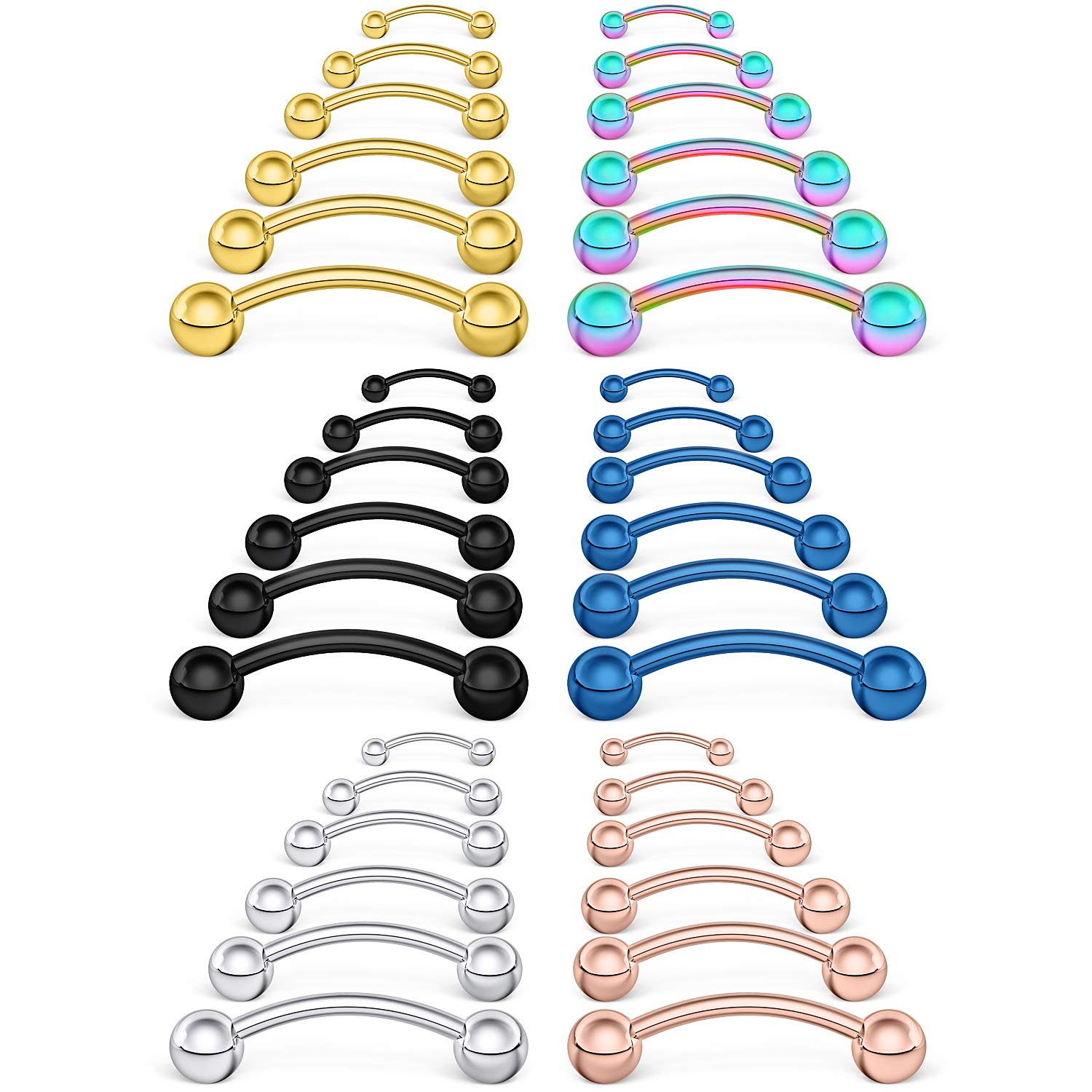
A fresh piercing swells, and the bar it was pierced with has to be long enough to take that without pressing into the skin. This set hands you four lengths — 6, 8, 10, and 12mm — in 16G, with two bars in each, so the adjust-the-length step doesn't turn into a second purchase. For a labret, a Monroe, or a cartilage piercing that puffs up in the first fortnight, that's the most useful thing in the pack.

The 3mm ball ends are small enough to stay out of the way, and 316L stainless steel is the material you'd expect at this end of the market. The flat back is thin, and against the inside of a lip or the back of an ear that thinness is the first thing you notice — it's not uncomfortable, but it doesn't disappear the way a titanium disc does.

The screw-on balls are the fussy part. They arrive tight, and undoing them the first time takes more grip than wet bathroom fingers can give: a square of paper towel or a rubber glove does the job, and after a couple of changes they behave. We like this set for the length options and the spares; the finish on the colored pieces is the bit we'd watch, since coating can wear thin with daily wear.

Bottom line: Four bar lengths is why we keep this one around: you heal with room for swelling, then downsize without ordering again.

4

LOLIAS Threadless Nose Studs

LOLIAS Threadless Nose Studs

Nostril sizing kit

Our Score 8.8/10
Check Price

Worth Noting

  • Long posts can poke a small nostril
  • Smallest stones are fiddly to handle
Sizes
Multiple gem and post options
Style
Threadless flat back
Piercings
Nose and ear

The question we ask of any press-fit stud is whether the top stays seated, and it's the question that follows this set around. The tops hold by tension, so a hard pillow or a towel can work one loose overnight — not a reason to skip the set, but a reason to check the top each morning and keep a spare in your bag. It's the one habit that makes threadless jewelry low-stress.

What the set gets right is choice. Several stone sizes sit on flat-back posts, which means you can find the scale that looks right on your own nose instead of guessing from a photograph, and the flat backs make sleeping on that side far less of a production than a ball end. The posts run long, which suits a nostril with swelling still in it and can poke on a small nose.

Where this earns its place is as a sizing kit rather than a forever piece. Buy it, find the post length and stone size that suit your nose, then spend on one good titanium version of that exact size. The steel is fine for a healed nostril; for a fresh one we still start with the titanium pick above.

Bottom line: The best assortment here for a nostril: threadless tops in several stone sizes, flat backs for sleeping, and enough pieces that losing one isn't a disaster.

5

SCERRING 16G Barbell Assortment

SCERRING 16G Barbell Assortment

Replacement bars

Our Score 8.8/10
Check Price

Worth Noting

  • Externally threaded posts
  • Sizes run small against the photos
Gauge
0.56 oz
Pieces
18 to 36
Lengths
6mm to 16mm
Material
Stainless steel

The first thing we check on a screw-on barbell is whether the balls stay seated, because a bar that sheds its end in a pillow is worse than useless. These hold: the balls screw down and stay down through daily wear, which is the failure that ruins most cheap barbells.

Length is the real value. A healing piercing needs a longer bar than the one you finish with, and having 10mm and 12mm in the box means you aren't hunting for a replacement the week an eyebrow swells. We still put a single titanium piece in the piercing itself and treat this as the set to raid for spares, for a second hole that's already healed, and for the day a ball disappears down the drain.

Two practical notes before you order. The posts are externally threaded, so the thread passes through the piercing channel on the way in — on a healing tract that means going slowly and letting someone with steady hands do it. And the pieces read smaller than the photographs suggest, so measure the length you actually need before you pull one out of the pile.

Bottom line: Buy this for the length range, not the sparkle: 16G bars from 6mm to 16mm that let you swap a swelling eyebrow or helix without a fresh order.

6

FANSING L-Shape Nose Studs

FANSING L-Shape Nose Studs

Spare nose studs

Our Score 8.8/10
Check Price

Worth Noting

  • L-bend rotates out during sleep
  • Labeled gauge can run small
Style
L-shaped nose stud
Gauges
22G, 20G, 18G
Material
316L surgical steel

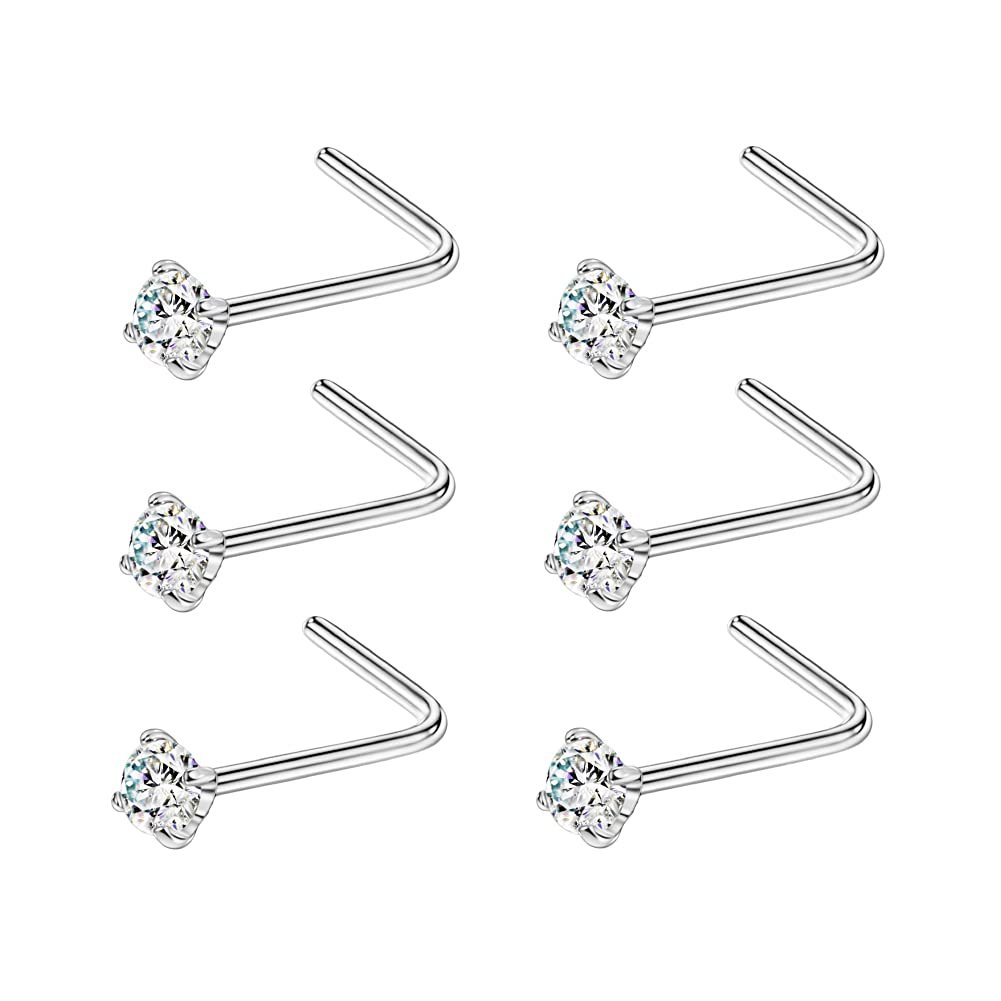
An L-bend is the simplest nose stud there is. The post goes in, the foot turns down inside the nostril, and nothing needs threading, clicking, or a mirror. That makes these quick to insert, easy to swap, and available in 22G, 20G, and 18G — the small gauges a nostril is usually pierced at.

The catch is retention. Nothing locks an L-bend in place, so it can rotate out while you sleep or catch on a towel, and that matters more on a fresh piercing than a healed one, because a hole that's still healing can close quickly. The stones have a nice iridescent sparkle for the money, and the metal is thin enough that a determined tug will bend a post.

So this is the set we keep for spares rather than the one we heal in. Buy it to have the right size on hand when a stud vanishes, and to audition a couple of stone sizes on a nostril that's already settled. For the piercing itself, a flat back behaves better — and the gauge label is worth double-checking against the post you actually receive, since these can run small.

Bottom line: Our spare-parts pick for a nostril: 22G to 18G L-bends that go in without tools, cheap enough to keep a few in the size you were pierced at.

How We Chose and Tested New-Piercing Jewelry

We started with roughly 60 listings and cut them on paper before anything touched an ear. A piece had to name its metal grade, offer the gauge and wearable length we needed, and use a back that wouldn't rotate or catch — flat-back and threadless styles rose to the top, while vague "surgical steel" claims with no length options fell away. We also counted how many pieces in a multipack we'd actually wear; a 36-piece set where 30 sit in a drawer isn't a bargain. Fifteen made the final cut.

Those 15 pieces spent four months in real piercings — a healing helix, a nostril, a second lobe, a tragus — through morning saline sprays, showers, gym sessions, over-ear headphones, scarves, and nights sleeping on one side. We logged every time we had to touch one: a stud that had slid halfway into the hole, a hinged ring that popped open while we dried our face, a threaded back that worked loose by Friday.

Fit came first, since everything else follows from it: we measured gauge and post length against what each listing promised and noted when a "16G" arrived visibly thinner. For security, we gave every top a light tug and wore the hoops through a full week of hair-washing and towel-drying. Comfort was judged at hour twelve rather than hour one — whether a back pressed into the ear against a pillow or a ball end rubbed under headphones. At the end we checked each piece for a dulled finish, pitting, or a hinge gone loose, and noted which sets still had their spares. Ease of use counted too: how long a one-handed swap took in a mirror, and whether a pin bent on the first try. A few are still in rotation; we'll update as they wear.

How to Choose Body Jewelry for a New Piercing

Start with the metal, not the design

A healing piercing is an open tract with metal sitting in it, and the metal is the part you can't fudge. Implant-grade titanium — sold as G23, and on better listings as ASTM F136 — is what most piercers reach for: light, low on nickel, and unreactive for most people. The 316L surgical steel used in the ORANGELOVE rings and the Ruifan labrets is a reasonable step down once a piercing has settled, but it does contain nickel, so it's a poor bet if your skin has reacted to cheap earrings before.

Ignore the word hypoallergenic. It isn't a standard, and every listing here uses it. The material name is the thing you check, and a plated or painted finish is the thing we avoid for a fresh piercing — a coating that chips leaves a rough edge against healing tissue.

Match gauge and length to the hole you have

Gauge is the thickness of the post, and your piercer chose it, not the shopping page. Nostrils and most cartilage are commonly done at 20G or 18G; labrets, eyebrows, and helices often at 16G; some lobes and septums at 14G. Buy that number, because forcing a thicker post into a healing hole is how irritation bumps start.

Length matters just as much. A new piercing swells, so the bar needs a millimeter or two of clearance — the reason the Ruifan set, with two bars in each of four lengths, is worth more than it looks. The trap is scale: a 3mm gem photographed close up reads as a statement, and on a nostril it's a glint. Size up a step if you want visible sparkle in cartilage.

Pick a closure that leaves the healing tract alone

Flat-back labrets and threadless push-pins are the least eventful things to heal in: nothing sits proud at the back, nothing screws through the channel, and there's no seam resting against tissue. That's the whole case for the Gotumo studs as a first piece.

A hinged clicker hides its seam well, but there's still a small step in the metal for a fresh septum or helix to notice, and an L-bend nose stud rotates freely — harmless on a healed nostril, a liability on a new one. Threaded balls work fine, provided you accept that the thread has to pass through the piercing on the way in.

Plan for shrinking, losing, and changing

Expect to buy twice. Swelling drops over the first weeks, and a long bar that felt comfortable at the start begins to catch later; that's when you downsize, and a set with two or three lengths saves a second order. Expect to lose a top or a stud as well — keep one spare in the gauge and length you were pierced with, since a hole that's still healing can close fast.

The cheapest jewelry in this guide is the jewelry you don't have to replace, so a pack of spares in the right size beats a bigger pack in the wrong one. Nothing here needs a tool beyond clean hands and, for stiff screw-on balls, a square of paper towel for grip.

Frequently Asked Questions

Final Verdict

For a new piercing, we point to the Gotumo flat-back studs: 20G titanium, a back that nothing catches on, and a push-pin top that holds through sleep and showers. It's the least eventful thing to heal in, which is exactly what you want for the first few months.

Two situations change the answer. If your piercer puts a ring in a septum or helix, the ORANGELOVE clicker covers more gauges than anything else here. If the piercing is still swelling, the Ruifan labrets give you four lengths to grow out of and downsize from.